• العربية
  • فارسی
Brand
  • Iran Insight
  • Politics
  • Economy
  • Analysis
  • Special Report
  • Opinion
  • Podcast
  • Iran Insight
  • Politics
  • Economy
  • Analysis
  • Special Report
  • Opinion
  • Podcast
  • Theme
  • Language
    • العربية
    • فارسی
  • Iran Insight
  • Politics
  • Economy
  • Analysis
  • Special Report
  • Opinion
  • Podcast
All rights reserved for Volant Media UK Limited
volant media logo

Iran-backed Houthis declare end to Israel, sea attacks as Gaza truce holds

Nov 11, 2025, 20:28 GMT+0Updated: 23:57 GMT+0
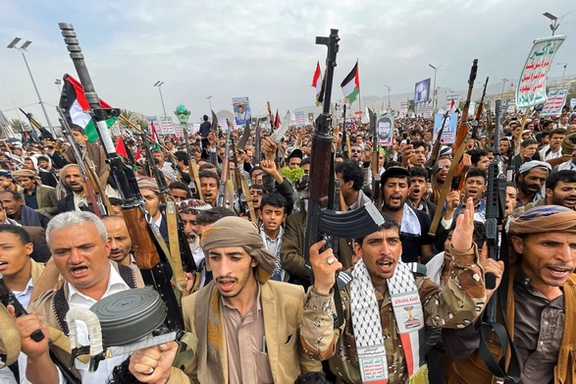
Protesters, largely Houthi supporters, rally to show solidarity with Palestinians in the Gaza Strip, in Sanaa, Yemen, on June 7, 2024. (Reuters)

Yemen’s Iran-backed Houthi movement said they would pause their attacks against Israel and maritime shipping in the Red Sea but warned they will resume combat if the fragile Gaza ceasefire collapses.

After punishing Israeli blows to Iran and its armed affiliates in the region, the Houthis stood out as the most resilient ally of Tehran even as its attacks on Israel and maritime commerce caused relatively little damage.

The message came in a letter from the Houthis’ new military chief, Major General Yusuf Hassan al-Madani, to Hamas’s armed wing, the al-Qassam Brigades.

Al-Madani, who replaced Major General Mohammed Abdul Karim al-Ghamari after he was killed in an Israeli airstrike, used the letter to signal that the group has lifted its naval blockade on Israel.

The Israeli military accused al-Ghamari of having close ties to the Islamic Republic, saying in a statement at the time of his death in August, that he was "trained by Hezbollah and IRGC," referencing Iran's Islamic Revolutionary Guard Corp.

“Your words of loyalty and sincerity are a great source of pride for us… Our unity in confronting the Zionist-American enemy and its criminal projects is rooted in faith and in our shared stance against tyranny and aggression,” wrote al-Madani.

While much of the message focused on shared ideology, its closing section delivered a clear policy signal.

“We are closely monitoring developments,” al-Madani wrote, “and declare that if the enemy resumes its aggression against Gaza, we will return to our military operations deep inside the Zionist entity, and we will reinstate the ban on Israeli navigation in the Red and Arabian Seas.”

That warning comes after two years Houthi attacks on shipping in the Red and Arabian Seas, which they described as an effort to pressure Israel to stop the war in Gaza.

The campaign disrupted one of the world’s busiest trade routes, killed at least nine mariners, and forced global shipping companies to reroute cargo.

The International Monetary Fund estimates Egypt lost about $6 billion in Suez Canal revenue in 2024 as a result.

Frequent Houthi missile and drone attacks on Israel for much of the last two years were mostly fended off by air defense systems.

Notable lapses came in the form of a Houthi drone attack which killed an Israeli man in Tel Aviv last year and a missile attack which struck outside Israel's busiest airport in May.

Since the Gaza ceasefire began on October 10, Houthi attacks have largely stopped. Israeli officials have yet to comment on the new statement, though Defense Minister Israel Katz warned earlier this year that any renewed strikes would draw a “sevenfold” response.

The apparent halt by the Houthis, who have long cast themselves as part of the Islamic Republic’s so-called Axis of Resistance, speaks volumes about Iran’s influence, the shifting calculus of its regional proxies, and the fragility of the current peace truce.

Most Viewed

100 days after carnage: Iran economy reels from war, inflation, unemployment
1
INSIGHT

100 days after carnage: Iran economy reels from war, inflation, unemployment

2
INSIGHT

Ghalibaf defends Iran-US talks amid hardline backlash

3
INSIGHT

A nation in limbo: 100 days after the massacre, has the world moved on?

4
ANALYSIS

From instability to influence: Pakistan’s pivotal role in US-Iran diplomacy

5
ANALYSIS

100 days on: why Iran’s January protests spread across social classes

Banner
Banner

Spotlight

  • War-hit homeowners feel abandoned as Iran’s reconstruction aid fades

    War-hit homeowners feel abandoned as Iran’s reconstruction aid fades

  • 100 days on: the anatomy of Iran’s January crackdown
    INSIGHT

    100 days on: the anatomy of Iran’s January crackdown

  • Ghalibaf defends Iran-US talks amid hardline backlash
    INSIGHT

    Ghalibaf defends Iran-US talks amid hardline backlash

  • 100 days on: why Iran’s January protests spread across social classes
    ANALYSIS

    100 days on: why Iran’s January protests spread across social classes

  • From instability to influence: Pakistan’s pivotal role in US-Iran diplomacy
    ANALYSIS

    From instability to influence: Pakistan’s pivotal role in US-Iran diplomacy

  • A nation in limbo: 100 days after the massacre, has the world moved on?
    INSIGHT

    A nation in limbo: 100 days after the massacre, has the world moved on?

•
•
•

More Stories

Iran hits back at US call to cut Hezbollah funding

Nov 11, 2025, 19:55 GMT+0

The Islamic Republic’s embassy in Lebanon on Tuesday fired back at remarks made by a top US sanctions official who urged Beirut to cut Tehran's funding to its Lebanese ally Hezbollah.

“There’s a moment in Lebanon now. If we could get Hezbollah to disarm, the Lebanese people could get their country back,” said John Hurley, the US Treasury’s undersecretary for terrorism and financial intelligence, in an interview with Reuters.

"The key to that is to drive out the Iranian influence," Hurley said, "and control that starts with all the money that they are pumping into Hezbollah."

Iran, according to Hurley, has delivered about 1 billion dollars to Hezbollah so far this year despite heavy Western sanctions.

His comments came during a regional tour through Turkey, Lebanon and the United Arab Emirates aimed at raising pressure on Tehran.

The Iranian embassy in Beirut dismissed the statements as “baseless and misleading” in a post on X Tuesday. “In recent days, American nonsense about Iran and its presence in Lebanon and the region has increased."

“It would have been better if American officials, instead of wasting time and being preoccupied with empty words, fulfilled the promises they made years ago to the people of Lebanon," it added, "even if only by helping to find a solution to the electricity crisis.”

“Rather than demonizing Iran and making unfounded accusations, the United States should have curbed the evil of the Israeli regime and its savage, ongoing aggression against Lebanon and its oppressed people,” the statement added.

Hurley’s comments mark Washington’s latest bid to choke off Tehran’s regional influence by targeting Hezbollah’s finances.

The strategy has intensified since Israel’s clash with the group escalated late last year with assassinations of senior and mid-ranking officials and an air and ground campaign which killed over 4,000 people.

Citing people familiar with Israeli and Arab intelligence, the Wall Street Journal reported last month that Hezbollah was rebuilding its weapons and ranks in defiance of a a ceasefire deal.

Israel meanwhile continues to maintain a military presence in outposts on Lebanese territory and has repeatedly carried out deadly airstrikes it says target militants.

Iraq votes under watchful gaze of US and Iran

Nov 11, 2025, 19:05 GMT+0
•
Behrouz Turani

Iraq’s parliamentary election on Tuesday unfolded under the shadow of foreign influence from the United States and Iran which have for two decades vied over the future of the war-battered Arab nation.

Less than half of eligible voters reportedly registered, raising doubts that turnout will reach even 50%. Public disillusionment has depressed participation since 2005, with only two exceptions: the first post-Saddam vote that year and the 2015 election, when turnout neared 80%.

Iranian media outlets, especially those aligned with Tehran’s political factions, have been following the buildup intensely.

Conservative papers and those close to state institutions cast the vote as a measure of Iran’s remaining leverage in Baghdad.

But reform-leaning Rouydad24 cautioned that while Tehran and Washington view the election through a geopolitical lens, Iraqi voters are focused on preserving “fragile stability and economic growth,” a subtle critique of both countries’ roles.

‘Weary people’

Truska Sadeghi, a journalist monitoring the election from Paris, described the November 11 vote as “a fateful test for a country caught between crises ranging from the legitimacy of its governments to the influence of foreign powers.”

Iraqis, she said, have grown weary of “repetitive and ineffective political maneuvers,” while shifting coalitions and Iran’s declining sway in the wider “axis of resistance” have made Baghdad Tehran’s most critical arena.

The United States has repeatedly warned Iran in recent months against meddling in Iraq’s political process, urging Baghdad to distance itself from Tehran.

Iran’s foreign ministry on Monday spoke against what it deemed to be "unacceptable” foreign interference. Iraq’s foreign ministry called the statement “provocative” and urged Tehran not to get involved in the country’s internal affairs.

Despite its diminishing regional clout, Iran remains a central player in the Iraq.

Tehran-aligned groups such as Hashd al-Sha’bi and various Kata’ib factions have rebranded themselves as civilian organizations, even as their armed presence in Baghdad remains visible.

‘Stability’

Analysts including Sadeghi and Frankfurt-based Ali Sadrzadeh argue that Iran-linked networks still wield significant political and economic leverage.

Islamic Revolutionary Guard Corps-Quds Force Commander Esmail Qaani and other senior officers continue to shuttle between Iranian and Iraqi cities, meeting aligned factions to ensure “Iraq’s stability.”

A key test for the next government will be whether it can assert authority over pro-Iranian groups like Hashd al-Sha’bi, which has long sought to position itself as a parallel defense institution.

“It’s a battle over whether Iraq achieves genuine political independence or remains tethered to foreign powers,” Sadeghi said.

Whatever the result, she added, Iraq’s next government will face the same core tasks: bringing armed groups under state control, restoring public trust through credible reforms, and recalibrating relations with Iran, the United States and regional partners.

Iranian student dies after self-immolation protesting kiosk demolition

Nov 11, 2025, 16:38 GMT+0

A 20-year-old man in Ahvaz in southwest Iran who set himself on fire as municipal workers moved to demolish his family’s food kiosk last week died on Tuesday, Iranian media reported.

Ahmad Baledi had suffered burns to 70 percent of his body and died in Ahvaz's Taleghani hospital.

The Karun Human Rights Organization which documents rights abuses in the province earlier reported that municipal workers from District 3 arrived at the kiosk in Zeytoon Park without prior notice and sought to demolish.

On Tuesday, Baledi’s father Mojahed told the Tehran-based Ham-Mihan newspaper he had gone to the municipal office that morning to ask for an extension until after his late mother's memorial but was told the shop “must be demolished today.”

He said his son had entered the street stall in front of a kebab restaurant and shut the electric doors behind him when authorities cut power, leaving him inside. Ahmad began dousing himself with fuel, he added, as his mother pleaded to intervene.

“One of the municipal agents mocked him, asking, ‘Should I give you a lighter? Matches?’” he said. “When one of them pulled his mother away, Ahmad lit himself on fire. Firefighters opened the door only after the flames spread.”

Videos shared on social media appeared to show a small crowd of bystanders crowding the area as fire extinguishers were deployed.

Ahvaz prosecutor Amir Khalafian said earlier that the municipality had ignored judicial instructions and acted “unilaterally and at an inappropriate time” during the demolition, adding that both the district mayor and the municipal enforcement chief are suspended from their duties until the investigation concludes.

Iranian lawmaker Mohammad Amiri, who represents Ahvaz, also criticized the city’s management following Baledi’s death. “Hiring practices in Ahvaz Municipality are based on personal connections rather than regulations,” he said. “This has become a serious management problem.”

Pezeshkian orders probe into case

President Masoud Pezeshkian on Tuesday ordered the interior minister to convey his condolences to Baledi's family and to formally investigate the case.

According to the presidential website, Pezeshkian has instructed the interior minister to immediately establish a special committee to probe the incident, ensure swift and firm action against those responsible, prevent similar cases in the future and take steps to console Baledi’s family and help ease their suffering.

Three citizens — identified as Hassan Salamat, Javad Saedi, and Seyed Sadegh Al-Bushoukeh — were arrested for writing about Baledi’s case on social media, according to the US-based Iranian civil society platform Tavaana.

The group said security forces have heavily restricted access to Taleghani Burn Hospital in Ahvaz and prevented people from gathering near the facility.

Earlier Khalafian had said that arrest warrants were also issued for three individuals "who sought to create tension and unrest on social media," adding that they have been released on bail.

Baledi's death had sparked protests in Ahvaz, with demonstrators calling for accountability for his death. The swift official response suggest authorities are seeking to draw a line under the case before it sparks broader unrest.

The incident comes amid deepening economic hardship in Iran, where soaring joblessness and inflation have pushed many households into street vending, peddling, and other informal work to survive.

The self-immolation echoes that of Tunisian street vendor Mohamed Bouazizi, who had been frustrated the confiscation of his wares by police. His case helped ignite the Arab Spring uprisings in 2011.

Street protests erupted in Iran in 2022 after a young woman, Mahsa Amini, died in morality police custody. Authorities quashed the demonstrations with deadly force.

Thousands of Iran energy workers protest low pay, poor conditions

Nov 11, 2025, 13:43 GMT+0

Thousands of contract workers at the South Pars gas complex in southern Iran held a large protest on Tuesday demanding better working conditions, fair pay, and the removal of private labor contractors, Iranian labor outlets reported.

The demonstration, held near the headquarters of the Pars Gas Complex in Assaluyeh, drew more than 3,000 workers from twelve refinery units and nearby facilities, including the Fajr Jam Gas Refinery, according to ILNA. Protesters called for changes to the job classification system, improved benefits, and the introduction of a rotation plan that would allow administrative and support staff two weeks of work followed by two weeks of rest.

They also urged officials to address the status of hired drivers, reinstate travel and housing allowances that were cut, and move toward direct employment under state companies. Many said the contractor system has left them without security, equal pay, or access to benefits given to permanent staff.

South Pars, the country’s main natural gas hub, has long been a flashpoint for labor unrest, with workers frequently demanding overdue pay and more stable contracts. Tuesday’s gathering adds to a wave of protests in Iran’s energy and industrial sectors over recent months.

Earlier in November, oil contract workers rallied outside the presidential office in Tehran, accusing the government of breaking promises to eliminate middlemen and standardize pay across the industry. Similar demonstrations have been held by petrochemical and steel workers in Ilam and Ahvaz, showing persistent frustration among Iran’s industrial labor force despite repeated pledges of reform.

Iran could turn on itself if Supreme Leader harmed, president warns

Nov 11, 2025, 13:30 GMT+0

President Masoud Pezeshkian told parliament on Tuesday that Iran’s cohesion and stability hinge on the Supreme Leader’s security, warning that an attack on him during the June war could have provoked internal clashes posing a greater threat than any external enemy.

Speaking during a parliamentary session reviewing his government’s first year under the Seventh Development Plan, Pezeshkian said the country’s strength rests on Supreme Leader Ali Khamenei’s leadership, which he described as the anchor of national unity.

"The pillar of the country’s tent is the Supreme Leader," he said.

He added the turbulence of the June 12-day war with Israel had never shaken his confidence in Iran’s defense capabilities, but he feared that if anything happened to Khamenei, the country could fall into political infighting – a situation, he cautioned, that would serve Israel’s interests without further action.

"We can disagree with one another, but there is someone who ultimately makes the decisions. During the war I had no fear for myself, but I was worried that, God forbid, if something happened to the leader we would turn on one another – there would be no need for Israel to intervene... We must value him and stand firmly behind him."

Pezeshkian urged rival factions to avoid polarization and to reinforce “discipline, dialogue and cooperation” across institutions. He said the government was focused on economic recovery and stability, calling on lawmakers to help draft a deficit-free budget to curb inflation.

“Inflation rests on our shoulders – the government and parliament,” he said, admitting responsibility for economic hardship and calling for a smaller, more efficient state.

President Masoud Pezeshkian among lawmakers at the parliament on November 11, 2025
100%
President Masoud Pezeshkian among lawmakers at the parliament on November 11, 2025

The president acknowledged widespread public frustration with living conditions, citing surveys showing discontent, and urged officials to “serve people without arrogance” rather than seeking political credit.

"It is our duty – we cannot govern while people go hungry. Set the budget so that livelihoods are the priority. I believe that if we do not resolve the public’s livelihood problems, we will go off course."

He also pointed to steps taken to reduce spending, promote renewable energy, and address water and energy shortages through scientific planning and cooperation with universities and regional authorities.

Pezeshkian said coordination among the government, judiciary and parliament had helped resolve several long-standing issues and expressed optimism that sustained cooperation could ease the country’s economic and social strains.