• العربية
  • فارسی
Brand
  • Iran Insight
  • Politics
  • Economy
  • Analysis
  • Special Report
  • Opinion
  • Podcast
  • Iran Insight
  • Politics
  • Economy
  • Analysis
  • Special Report
  • Opinion
  • Podcast
  • Theme
  • Language
    • العربية
    • فارسی
  • Iran Insight
  • Politics
  • Economy
  • Analysis
  • Special Report
  • Opinion
  • Podcast
All rights reserved for Volant Media UK Limited
volant media logo
ANALYSIS

Double squeeze: Iran faces record capital flight as oil revenues fall

Dalga Khatinoglu
Dalga Khatinoglu

Oil, gas and Iran economic analyst

Nov 8, 2025, 21:41 GMT+0Updated: 23:58 GMT+0
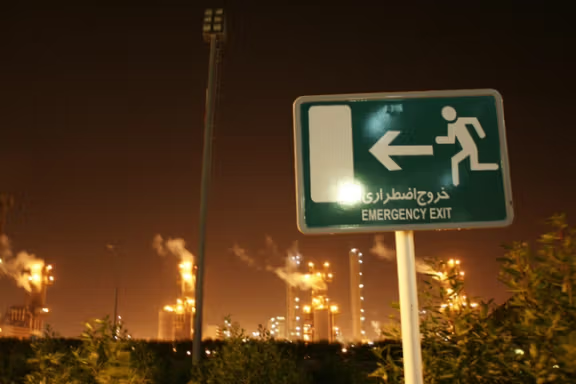
This file photo shows Assaluyeh petrochemical complex in southern Iran

Iran’s Central Bank’s latest quarterly report shows capital flight hit a historic peak in the spring of 2025, underscoring the depth of the country’s financial strain.

The report, published on the Bank’s website, puts the capital account balance in the first quarter of the fiscal year (beginning March 21) at around minus $9 billion, the highest outflow ever recorded.

Last year, capital flight totaled about $20.7 billion, triple the figure in 2020. If this year’s pace continues, outflows could reach $36 billion by March 2026, roughly 10 percent of Iran’s GDP.

It remains unclear how much of the current exodus reflects ordinary citizens moving savings abroad versus businessmen or individuals close to power.

Earlier this year, Hossein Samsami, a member of parliament’s Economic Committee, said that from 2018 to mid-2025, $95 billion in non-oil export revenues never returned to Iran.

Declining foreign trade

Central Bank data show around $80 billion in capital flight between 2018 and 2024, suggesting much of the outflow is tied to foreign trade channels. Yet Iran’s economy minister recently insisted that the private sector accounts for only 15 percent of the country’s foreign trade.

That gap points to individuals with government links or ties to quasi-state institutions, including the Revolutionary Guards, as key drivers of tens of billions of dollars leaving the country.

The report also shows a sharp drop in export revenues. Oil income, including crude, petroleum products, and gas, fell by $3 billion in the spring compared to the same period last year, totaling $15 billion. Non-oil exports slipped by another $1 billion to under $11 billion.

Imports declined by about $800 million to $17.2 billion, while the services trade balance turned negative at minus $2.8 billion.

Overall, Iran exported $6 billion more in goods and services than it imported this spring. Yet $9 billion left the country during the same period through capital flight, erasing the surplus on paper.

Worse to come?

The deficit may rise if oil prices or exports drop—as seems to be the case according to most recent information.

Tanker-tracking data from Kpler show Iranian oil offloading at Chinese ports has fallen in recent months to about 1.2 million barrels per day, down from an average of 1.44 million earlier in the year.

Amid the tightening squeeze, officials continue to warn of severe foreign-currency shortages and the Central Bank’s inability to finance imports or investment.

Meysam Zohoorian, a member of parliament’s Economic Committee, reported this week that the Planning and Budget Organization has told lawmakers it is “stuck with three billion dollars” needed for investment in oil fields.

President Masoud Pezeshkian painted an even darker picture, asserting that his administration can hardly source a third of that amount for development projects.

“We are negotiating over one billion dollars to figure out where to find it,” he said.

Most Viewed

Iran International says it won’t be silenced after London arson attack
1

Iran International says it won’t be silenced after London arson attack

2
VOICES FROM IRAN

Hope and anger in Iran as fragile ceasefire persists

3
INSIGHT

How Tehran bends its own red lines to boost state rallies

4

State media slam Araghchi's Hormuz tweet, say it let Trump claim victory

5

Iran halts petrochemical exports to supply domestic market

Banner
Banner

Spotlight

  • Too early to tell who is winning Iran war, experts say
    PODCAST

    Too early to tell who is winning Iran war, experts say

  • How Tehran bends its own red lines to boost state rallies
    INSIGHT

    How Tehran bends its own red lines to boost state rallies

  • Iran blackout cripples freelancer, small business incomes
    VOICES FROM IRAN

    Iran blackout cripples freelancer, small business incomes

  • Ideology may be fading in Iran, but not in Kashmir's ‘Mini Iran'
    INSIGHT

    Ideology may be fading in Iran, but not in Kashmir's ‘Mini Iran'

  • US blockade enters murky phase as tankers spoof signals and buyers hesitate
    ANALYSIS

    US blockade enters murky phase as tankers spoof signals and buyers hesitate

  • Why the $100 billion Hormuz toll revenue is a myth
    ANALYSIS

    Why the $100 billion Hormuz toll revenue is a myth

•
•
•

More Stories

Tehran eyes Caspian energy boost, risking deeper dependence on Moscow

Nov 8, 2025, 16:40 GMT+0
•
Umud Shokri

The new push for an electricity grid linking Iran, Russia and Azerbaijan grid promises closer energy integration but could leave Tehran more exposed to Moscow’s leverage as rival corridors threaten to dilute its regional role.

In mid-October 2025, Azerbaijan’s deputy prime minister announced the formal launch of an electricity-linkage project among the three countries.

The plan builds on Iran’s 2024 proposal to route Russian electricity through its territory to Persian Gulf Arab states, advancing earlier diplomatic pledges. Full integration is targeted by late 2025, alongside coordination with Armenia.

The initiative fits Russia’s push for southern energy routes under sanctions, but could undercut the strategic weight of the International North-South Transport Corridor (INSTC)—the trade artery linking India, Iran and Russia through Azerbaijan.

Shared leverage

A connected grid could deliver real economic and strategic gains.

By balancing supply and demand across borders, it might ease chronic blackouts—especially in Iran, where sanctions have crippled capacity.

Surplus electricity from Russia and Azerbaijan’s renewables could offset Iranian shortages, while shared infrastructure encourages cross-border power sales and investment.

For Iran, participation promises stability and regional relevance; for Russia, another path around Western-controlled networks; for Azerbaijan, a global profile built on “green power outreach.”

Iran’s balancing act

Integration could offer Tehran both relief and peril.

Years of underinvestment and gas dependency have left its grid aging and inefficient. Sanctions block access to capital and modern equipment, limiting meaningful expansion.

To benefit from the move and reduce vulnerability, Tehran needs to diversify its energy mix, curb waste and reform governance—meaning remove favoritism from energy planning and open the sector to transparent partnerships.

These are tall orders without which the project may only deepen Tehran’s reliance on Moscow.

Caspian crossroads

The grid plan also intersects with rival connectivity schemes.

The International North–South Transport Corridor (INSTC)—a 7,200-kilometer multimodal corridor linking Mumbai to St. Petersburg via Iran and Azerbaijan—has been a lifeline for sanction-hit Tehran, yet it faces chronic delays and funding gaps.

Meanwhile, the EU-backed Black Sea Energy Corridor, launched in 2022, will send 4 GW of Azerbaijani wind and solar power to Europe by 2032. Faster, cleaner and politically safer, it already attracts more Western financing.

If momentum shifts toward the Black Sea route, Iran could lose as much as $10–15 billion in potential transit fees and influence, reinforcing its peripheral role in regional trade.

The choice ahead

Moscow’s dominance—and its expanding 2025 alliance with Tehran—could give it decisive leverage over energy supply, echoing Gazprom’s tactics in Europe.

Western sanctions on both Moscow and Tehran could deter investment and drag Baku into secondary penalties.

Regional flashpoints—from Armenia-Azerbaijan tensions to Iran’s domestic volatility—add fragility. Environmental and technical challenges add further strain, chief among them: fluctuating Caspian water levels and climate stress on Iran’s water-energy nexus.

The Iran-Russia-Azerbaijan grid could make Tehran a regional electricity hub or entrench it as Moscow’s junior partner.

Two visions now compete around the Caspian: one driven by geopolitical necessity, the other by the global green transition. How Iran navigates between them will determine whether this bridge becomes a lifeline—or another bind.

Tehran began water rationing too late, officials admit as crisis deepens

Nov 8, 2025, 11:55 GMT+0

Iran’s water industry officials warned on Saturday that rationing in Tehran began far too late, as the capital’s water situation deteriorates rapidly amid one of its driest periods in nearly fifty years.

The city’s water resources are in exponential decline, Reza Haji-Karim, head of Iran’s Water Industry Federation, told the website Didban Iran.

“Water rationing should have started much earlier. Right now, 62 percent of Tehran’s water comes from underground sources, and the level of these aquifers has dropped sharply.”

The crisis, he said, is the result of years of neglecting scientific warnings about groundwater depletion and climate change.

“The only way to save Tehran is through a chain of measures – from wastewater recycling and consumption reform to cutting agricultural water use,” he added.

Unannounced rationing begins

Residents of Tehran have reported repeated overnight water cuts in several districts in recent days. The Tehran Water and Wastewater Company said the outages are intended to refill storage tanks and prevent the city’s distribution network from collapsing.

Local media outlets reported that nightly rationing has already started in parts of the capital and now continues until early morning hours.

The government may be forced to reduce water pressure to almost zero at night when demand is low, Energy Minister Abbas Aliabadi said Saturday, urging households to install storage tanks.

"Pipeline infrastructure in our country is more than 100 years old; the pipes have become worn out, and some of them were also damaged during the 12-day war" with Israel in June, the minister said.

Presidential warning and vanishing reserves

President Masoud Pezeshkian warned on Thursday that if rainfall does not resume by the end of autumn, Tehran will face water rationing, adding, “If it still doesn’t rain, we will have no water and will have to evacuate the city.”

The Tehran Regional Water Company has said that the capital’s five major dams are now only 11 percent full.

Ali Shariat, secretary-general of the Water Industry Federation, blamed the deepening crisis on “mismanagement and fragmented decisions in agriculture and industry.”

100%

“My honest advice to the public is to take the president’s words very seriously. He has told the truth – bitter but undeniable,” he added.

“Continued inaction may lead to forced migration from Tehran,” Shariat added.

Dams near collapse

A video posted on social media on Thursday showed the dry bed of the Latian Dam near Tehran, whose manager said only half of its remaining 10 percent capacity can be used. Officials in neighboring Alborz province reported that the Karaj Dam is now more than 90 percent empty, with only seven percent of its reservoir remaining.

Tehran, home to nearly nine million people, depends on five dams – all reporting sharp declines.

The Laar and Mamloo reservoirs are at 1% and 7% capacity respectively, while only Taleghan remains above one-third.

This comes as the meteorological organization forecasts no significant rainfall for the rest of November.

Tehran is experiencing one of the driest periods in the past 50 years, according to the energy ministry. If current trends persist, officials warn, the city may run out of drinkable water within weeks.

Tehran faces nightly water cuts as rationing begins without notice

Nov 8, 2025, 08:05 GMT+0

Water rationing has quietly begun in Tehran, with several neighborhoods facing nightly supply cuts without official announcement or public warning, Iranian media reported on Saturday.

Residents say water has been shut off from midnight until around 5 a.m. in recent nights.

“Despite repeated denials by officials, it appears the process of rationing has started” and citizens in parts of the capital “are deprived of water during the night,” Mizan News Agency, affiliated with the judiciary, wrote.

The daily Haft-e Sobh likewise reported sudden five-to-six-hour overnight cuts in drinking water across several districts, all without prior notice.

Reduced pressure across the city, the paper said, and declining surface and groundwater reserves had led to “serious instability” in Tehran’s water network.

The outages have lasted long enough to affect even households with backup storage tanks, according to the report.

Rising frustration

Haft-e Sobh quoted residents as saying the sudden shutdowns disrupted daily life. “When the water is cut off at night, we don’t know when it will return, so we can’t plan our use. Even tanks empty quickly,” one resident said.

President Masoud Pezeshkian warned on November 6 that if rain does not arrive by December, water will have to be rationed across Tehran, adding that prolonged drought could even force evacuation of the city.

The head of Tehran’s provincial water company recently described the capital’s situation as “red and concerning.”

Health and cost concerns

Unannounced rationing, Haft-e Sobh warned, could hinder hygiene and household routines dependent on steady water access. Unreliable supply may increase health risks in residential buildings and impose higher costs on families forced to rely on water tanks or delivery services, it added.

Meteorological data show 20 provinces have gone more than six weeks without measurable rainfall.

100%

No precipitation has fallen in Tehran since the start of autumn, Mohammadreza Kavianpour, head of Iran’s Water Research Institute, said on Thursday warning that forecasts show the drought is likely to persist through the season.

“The risk of water scarcity in the capital must be taken very seriously,” Kavianpour said.

Tehran’s supply depends heavily on the Karaj Dam, whose remaining reserves are sufficient for only two weeks of drinking water.

Environmental experts say years of over-extraction, unscientific dam-building and poor management have pushed the country toward what some describe as “water bankruptcy.”

Broken machine: why Tehran’s food distribution plan won’t move the needle

Nov 8, 2025, 04:00 GMT+0
•
Behrouz Turani

Iran’s latest attempt to curb soaring food prices—delegating the distribution of staple goods in Tehran to the city’s municipality—has again exposed a deeper truth about the country’s economic crisis: quick fixes rarely work when the foundations are broken.

The proposal, reported Thursday by the IRGC-linked daily Javan, would put Mayor Alireza Zakani in charge of supplying essential goods to households in the capital.

Zakani claims the plan, approved by President Masoud Pezeshkian, could reduce prices by up to 40 percent. Residents quoted by Javan said municipal-run markets already sell cheaper goods than elsewhere in the city.

But even at face value, the initiative seems to be yet another reactive measure in a system afflicted by deep structural problems. The question is less whether this plan can work and more why such plans keep reappearing.

Moderate outlet Fararu this week laid out the structural flaws driving Iran’s crisis: contradictory decision-making by overlapping institutions, a budget tied to unstable oil revenues, and an absence of dependable data that leaves officials governing by instinct rather than information.

Economic policy, the outlet said, is shaped by ministries, the Central Bank, the Planning and Budget Organization, and an array of parallel bodies that often work at cross-purposes.

“Most economic decisions in Iran are made overnight,” it wrote, warning that real change requires slow, coordinated reform across government—something the Islamic Republic has resisted for decades.

‘Bipolar economy’

The centrist daily Sazandegi pointed to another symptom of this dysfunction: chaotic decision-making that thrives in the grey zones created by sanctions.

The paper highlighted the clash between hardline MP Amir Hossein Sabeti and Babak Zanjani—the ‘sanctions-fixer’ once sentenced to death but pardoned and now tapped again to recover Iran’s oil revenues.

“Iran’s economy exists in a bipolar state,” Sazandegi wrote, “caught between a revolutionary pursuit of social justice that resists globalization and a rentier capitalism that thrives on sanctions.”

The public spat between two privileged insiders, Sazandegi argued, is evidence of an economy pulled between ideological theatrics and rent-seeking networks—a system that’s neither competitive nor transparent.

Bleak outlook

Despite their scathing critiques, both outlets chose to not mention the elephant in the room—as is almost always the case in Iran: a foreign policy that has produced decades of isolation and tightening sanctions.

With the return of UN sanctions in late September—and Tehran’s continued combative stance—the situation is likely to deteriorate further before any improvement is possible.

Seen through that lens, Zakani’s food-distribution proposal is less a solution than another reflex: an attempt to patch symptoms without addressing the machinery underneath.

Rents hit record high in Iran as housing inflation deepens

Nov 7, 2025, 08:02 GMT+0

Iran’s rental crisis reached its peak in October 2025, slowing the pulse of public welfare as official data showed annual rent inflation climbing to 36.5 percent -- a level economists describe as “severely burdensome” for tenants.

Tehran tenants ended the Iranian month of Mehr (late September to late October) facing a 34 percent year-on-year jump in rental prices, according to data from the Statistical Center of Iran cited by Khabar Online.

The government’s promised measures to regulate the housing market, the report said, have failed to materialize, with renters still squeezed by weak supply and spillover demand from the unaffordable homeownership market.

In major cities such as Tehran, typical monthly rents for standard apartments range from around $400 to $1,800, depending on location and quality.

On a broader national average basis, one-bedroom urban rentals are reported at approximately $250-$300 per month. However, the average monthly net salary is around $200.

While officials have highlighted a minor decline in the overall pace of housing inflation, figures published by the center confirmed rents continue to surge. Monthly housing inflation stood at three percent in late October, year-on-year housing inflation at 34.2 percent, and the annual rate at 36.6 percent -- only slightly below September’s 37.5 percent.

The outlet Tabnak reported that despite the withdrawal of genuine buyers, prices rose another three percent during the period, widening what it called the gap between “the expectation to sell high and the buyer’s zero purchasing power.” A 36.6 percent annual inflation rate, it added, compared with stagnant wages, has pushed first-time buyers out of reach of homeownership.

With both housing and rental prices rising together, accommodation costs now absorb a growing share of household income, fueling urban sprawl and eroding living standards.

The depreciation of the rial -- now trading around 1.08 million per dollar -- has intensified broader economic strains, which analysts link to renewed pressure following the reactivation of UN sanctions under the snapback mechanism.







