• العربية
  • فارسی
Brand
  • Iran Insight
  • Politics
  • Economy
  • Analysis
  • Special Report
  • Opinion
  • Podcast
  • Iran Insight
  • Politics
  • Economy
  • Analysis
  • Special Report
  • Opinion
  • Podcast
  • Theme
  • Language
    • العربية
    • فارسی
  • Iran Insight
  • Politics
  • Economy
  • Analysis
  • Special Report
  • Opinion
  • Podcast
All rights reserved for Volant Media UK Limited
volant media logo
PODCAST

From guns to votes: Iran-backed Iraqi militias may be about to transform

Negar Mojtahedi
Negar Mojtahedi

Iran International

Nov 7, 2025, 21:48 GMT+0Updated: 23:59 GMT+0
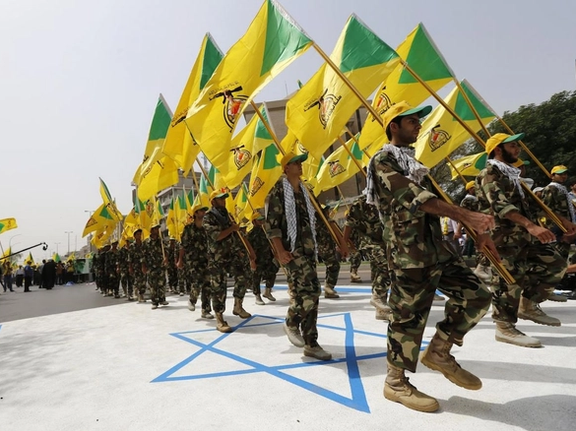
Harakat Hezbollah al Nujaba, an Iraqi militia trained by Iran's Revolutionary Guards

Iran-backed militias in Iraq are looking to consolidate the grip they won by force of arms on the fragile country's politics with gains in parliamentary elections next month, experts told Eye for Iran podcast.

After a series of military and diplomatic setbacks, Tehran may hope their allies next door can preserve its influence via the ballotbox and protect a decades-old Iranian political investment in its neighbor.

Confident that US attacks "obliterated" Iranian nuclear sites in June amidst an Israeli military campaign, US President Donald Trump may be ignoring the potential threat Iran poses in Iraq according to historian Dr Shahram Kholdi.

“Iraq may become, in a very odd way, the Achilles heel of the Trump administration,” he told Eye for Iran.

Kholdi warned Tehran’s reconfigured influence could quietly undermine US gains against Iran in the region, adding that steering its militias into politics risks “recreating the Islamic Republic light version in Iraq, 2.0, that operates through bureaucracy rather than arms.”

The shift comes as Washington issues one of its strongest warnings yet, saying it will not recognize Iraq’s next government if any ministries are handed to armed factions linked to the Islamic Republic, a source in Iraq’s Kurdistan region told Iran International on Friday.

In a recent call with Iraq’s defense minister reported by Saudi daily Al-Sharq al-Awsat, US Secretary of War Pete Hegseth cautioned any interference by armed factions to unspecified future US military operations would provoke a sharp American response.

The minister, according to the report, described it as “a final notice,” reflecting US concern that Iran’s allies could use Iraq’s elections to entrench themselves in state institutions.

For Tehran, encouraging its proxies to enter politics provides a way to adapt without relinquishing its arms.

The Popular Mobilization Forces, an umbrella of Shi'ite militias funded through Iraq’s state budget, command vast patronage networks that already blur the line between governance and coercion. Bringing those networks formally into Iraq’s political system could allow Iran to project stability while maintaining influence behind the scenes.

“Iran has been severely weakened in the wake of the 12-day war,” said Jay Solomon, a journalist and author of The Iran Wars.

“What we see is an effort to maintain their proxies and stay below the radar but rebuild.” The approach, described by Solomon, reflects a shift from confrontation to consolidation, using political channels to preserve influence while avoiding direct conflict with the United States.

That calculation, according to Alex Vatanka, Director of the Iran Program at the Middle East Institute, shows how Iran’s leadership has learned to work within new limits.

“They want to rebuild as much as they can within limits. They probably have a much better sense of their limitations today than they did before this summer. But again, they do not want to have that open fight, certainly not on Iraqi soil.”

Two decades after the US invasion of Iraq, Washington faces a familiar dilemma: whether to tolerate a fragile partner shaped by Tehran’s influence or confront a more sophisticated phase of Iranian power consolidation.

Iran’s recalibration in Iraq, analysts on Eye for Iran said, is less a retreat than a pause for recovery, a reminder that even under pressure its power lies not in confrontation but in adaptation.

You can watch the full episode of Eye for Iran on YouTube or listen on a podcast platform of your choosing.

Most Viewed

Ghalibaf defends Iran-US talks amid hardline backlash
1
INSIGHT

Ghalibaf defends Iran-US talks amid hardline backlash

2
ANALYSIS

From instability to influence: Pakistan’s pivotal role in US-Iran diplomacy

3
ANALYSIS

100 days on: why Iran’s January protests spread across social classes

4

War-hit homeowners feel abandoned as Iran’s reconstruction aid fades

5

Iran says no decision yet on talks as Pakistan prepares to host US team

Banner
Banner

Spotlight

  • The politics of pink: how Iran uses cuteness to rebrand violence
    ANALYSIS

    The politics of pink: how Iran uses cuteness to rebrand violence

  • Bread shortages, soaring prices strain households in Iran, residents say
    VOICES FROM IRAN

    Bread shortages, soaring prices strain households in Iran, residents say

  • War-hit homeowners feel abandoned as Iran’s reconstruction aid fades

    War-hit homeowners feel abandoned as Iran’s reconstruction aid fades

  • 100 days on: the anatomy of Iran’s January crackdown
    INSIGHT

    100 days on: the anatomy of Iran’s January crackdown

  • Ghalibaf defends Iran-US talks amid hardline backlash
    INSIGHT

    Ghalibaf defends Iran-US talks amid hardline backlash

  • From instability to influence: Pakistan’s pivotal role in US-Iran diplomacy
    ANALYSIS

    From instability to influence: Pakistan’s pivotal role in US-Iran diplomacy

•
•
•

More Stories

US raps Tajzadeh’s re-arrest, says Iran prioritizes repression over reform

Nov 7, 2025, 20:35 GMT+0

The US State Department on Friday condemned Iran's arrest of leading political prisoner Mostafa Tajzadeh who was on a furlough to attend his brother's funeral, urging Tehran to focus on improving its people's lives.

Iranian security forces on Tuesday raided Tajzadeh's daughter's home and arrested him without providing any explanation, former fellow inmate Mehdi Mahmoudian said on X.

"The re-arrest of Tajzadeh reflects the Islamic Republic’s blatant disregard for human dignity and justice," the State Department said in a statement on its Persian-language X account.

"It also shows that, for the Islamic Republic, suppressing dissent takes priority over addressing Iran’s deeper crises."

Tajzadeh is a reformist politician who served as deputy interior minister during the presidency of Mohammad Khatami from 1997 to 2005.

He has been imprisoned for 10 of the last 16 years, currently on charges including acting against the state, spreading falsehoods and propaganda.

Before being re-arrested, Tajzadeh attended the funeral of his brother and met several activists including Nobel Peace Prize laureate Narges Mohammadi in a move the State Department hailed as “a symbol of the resistance and courage of the Islamic Republic’s political dissidents.”

Mohammadi said on Tuesday that there was no prospect for reforming the country's Islamic theocracy and its downfall was assured.

“Reform has been dead for years. The time for reforms has long passed. The real main struggle is between the realistic survivalists and those seeking the end of religious despotic regime,” Mohammadi posted on X.

In July, Tajzadeh warned Supreme Leader Ali Khamenei to pivot or resign.

"In this critical situation, Mr. Khamenei has no option but to apologize to the Iranian people and accept fundamental reforms in line with national demands, including by forming a constituent assembly based on completely free and fair elections," he said, "or to resign and step down."

In recent years, the pursuit of reform has shifted toward regime change, as seen in the 2017-18 and 2022 Woman, Life, Freedom uprisings, with many people viewing the system as irreformable.

Former top US officials on Mideast doubt imminent Iran-Israel war

Nov 7, 2025, 19:13 GMT+0

Two former senior US Mideast policy officials said a renewed conflict between Israel and Iran appeared remote after the arch-foes clashed in June, but described Tehran in a roundtable discussion hosted by Iran International TV as a lingering threat.

Iran envoy for President Donald Trump from 2020 to 2021 Elliott Abrams and Ambassador Dennis Ross, a former Middle East adviser to Republican and Democratic administrations, are veterans of decades of US diplomacy with long records in the fraught region.

Both see the Islamic Republic as threat to US national security, the country's military presence in the Middle East and the security of its Arab partners and Israel.

The first direct blows between Israel and Iran last year transformed their fight from one in the shadows and via Iran's armed allies like Hezbollah, they said, into a face-to-face showdown culminating in a June war which dealt Tehran punishing blows.

A ceasefire enforced by Trump after US strikes hit three key Iranian nuclear sites is likely to hold for the foreseeable future, they predicted.

In a panel moderated by Bozorgmehr Sharafedin, Iran International's head of Digital, they said a weakened Tehran is salving its wounds and focusing on its internal grip while Israel relishes calm after a Gaza ceasefire mediated by President Trump.

"Lacking air defenses, (the Iranians) know that a great deal more damage can be done by Israel, and I don't think the Israelis are looking for it right now either," Abrams said. "They've having gotten the hostages back from Gaza. They need to let their military rest, rebuild, rearm."

Israeli strikes likely damaged Iran's air defense infrastructure. Iran's foreign minister Abbas Araghchi said this week Tehran had rebuilt its missile power beyond pre-war levels and that it seeks peace through diplomacy, but Iranians must not fear war.

"I would be quite surprised actually to see war with one exception, Abrams added. "If the regime in Tehran decides we must quickly, as quickly as possible, rebuild the nuclear program, then they're going to get hit again."

Iran denies seeking nuclear weapons but Israel and Western countries doubt its intentions. Trump seeks to resume talks halted by the June conflict but Tehran rejects US demands it negotiate over its missiles or support for armed regional allies.

"The fact is, Iran has no air defense today," Ross said. "If they were to rush for a nuclear weapon right now, that would invite either an Israeli response or an American one, and I'm quite certain that the Iranian leadership knows better than that."

Ross served as director of the policy planning staff of the US State Department under President George H.W. Bush, helping guide diplomacy as perennial US adversary the Soviet Union unraveled and toward Saddam Hussein's Iraq in the 1991 Gulf War.

"Right now where we are with the regime, talk tough, talk bravely, but recognize the reality is," he added. "The last thing you need is another fight with the Israelis, and you need even less of one with the United States."

Obliterated, exaggerated

US attacks on June 22 hit the Fordow, Natanz and Esfahan nuclear sites in raids Trump has repeatedly said "obliterated" Iran's nuclear program.

While he asserted Tehran is now focused on survival and not resuming its activities, Trump has pledged to attack again if it does.

Iranian officials this week vowed to build the program back stronger than before.

The head of UN nuclear watchdog Rafael Grossi said on Friday that Tehran still possesses enriched uranium sufficient, should Iran choose and be able to enrich it further, to make several nuclear weapons.

Both former senior officials said that while the US and Israelis strikes had dealt Iran significant setbacks, Trump was dealing in hyperbole.

"It's premature. It's exaggerated," Abrams said. "Meaning, there is something there. He's just making too much of it."

"It's a real change. And I think Trump is right to draw attention to that," Abrams said. "To go further and say, you know, it's the end of conflict and peace in our time, no that goes too far. The regime is still there. Their military is still powerful. They have a dangerous ballistic missile program."

Abrams, a fellow for Middle Eastern studies at the Council on Foreign Relations (CFR) in Washington, supports robust US engagement in the region and the encouragement of democratic transitions.

A neoconservative, he was a prominent advocate of preemptive military action against Iraq during George W. Bush’s presidency.

Ross said Trump's military intervention marked an important paradigm shift, transmitting to the region that the United States would check Iranian influence.

"What he did is he signaled, 'you don't have impunity any longer.' Now that was really important for the region, because it said, okay, we really don't have to be so afraid of the Iranians anymore."

Ross is fellow at Washington DC thinktank the Washington Institute and served as a presidential aide in unsuccessful bids by Barack Obama to resolve the Israeli-Palestinian conflict.

He has advocated an active and multi-pronged US engagement in the Mideast and the world not limited to ideological or military approaches and co-founded the advocacy group United Against a Nuclear Iran in 2008.

"This is a regime that is focused on survival," Ross asserted. "It always has been, but that's the first priority. It feels it can manage and sustain control, which is another reason why they're not looking for trouble on the outside right now, because that could actually endanger them more on the inside."

In nationalist push, Iran unveils statue of kneeling Roman emperor

Nov 7, 2025, 18:00 GMT+0

Iran on Friday unveiled a statue of Roman Emperor Valerian kneeling in submission before ancient Persian King Shapur after a third century military victory, as Islamic authorities pivot toward nationalism to boost support following a June war.

Videos show the ceremony in Tehran’s Revolution (Enghelab) square, where the statue group was unveiled as part of campaign dubbed by officials “Kneel before Iran."

"The Valerian statue reflects a historical truth that Iran has been a land of resistance throughout history," said Mehdi Mazhabi, head of Tehran's Municipal Beautification Organization. "By implementing this plan in Enghelab Square, we aim to forge a bond between this land's glorious past and its hopeful present."

Following a ceasefire which ended a punishing 12-day war with Israel in June, Iranian officials moved to invoke nationalism and glorifying ancient history of Iran to promote unity. Symbols of the pre-Islamic past had previously been shunned by the theocracy.

Days after the conflict, a mural set up in Vanak square in Tehran depicting Arash the archer firing arrows alongside modern ballistic missiles shot at Israel.

The new statue immortalizes the 260 AD Battle of Edessa, where the second king of the Sassanid Empire Shapur I, 240–270 AD, decisively defeated Roman forces and captured Valerian. The defeat was an unprecedented catastrophe for Rome.

Shapur, son of Ardashir I, expanded Persian territory and clashing repeatedly with the empire that spanned Europe, North Africa and parts of the Middle East. Ancient reliefs at Naqsh-e Rostam show him on horseback, Valerian humbled beneath.

Valerian, 253–260 AD, co-emperor with his son Gallienus, sought to stabilize Rome's eastern frontier.

From murals of Cyrus the Great to patriotic songs at Shi'ite mourning ceremonies, Tehran is now leaning into pre-Islamic imagery it once viewed as anathema.

US extends national emergency declaration on Iran for 46th time

Nov 7, 2025, 16:05 GMT+0

US President Donald Trump has rolled over an annual declaration of a US national emergency on Iran according to a statement published on Friday on the Federal Register.

The national emergency was announced on November 14, 1979 when radical students in Tehran seized the US embassy and took hostage dozens of diplomats, staff and guards. Trump's move marks the 46th time it has been renewed.

The decision by then-president Jimmy Carter was meant “to deal with the unusual and extraordinary threat to the national security, foreign policy and economy of the United States constituted by the situation in Iran.”

In renewing the national emergency Trump said in a statement: "Our relations with Iran have not yet normalized, and the process of implementing the agreements with Iran, dated January 19, 1981, is ongoing."

On that date, Iran and the United States agreed to the Algiers Accords, an understanding brokered by the North African nations for the two enemies to resolve the hostage standoff.

"For this reason, the national emergency declared on November 14, 1979, and the measures adopted on that date to deal with that emergency, must continue in effect beyond November 14, 2025," Trump added. "Therefore... I am continuing for 1 year the national emergency with respect to Iran declared in Executive Order 12170."

In addition to the 1979 declaration, a separate national emergency was declared on March 15, 1995, addressing Iran's actions related to terrorism and weapons proliferation. This emergency has also been renewed annually, with the 30th extension made by the Trump administration on March 7, 2025.

After taking office for his second term in January, Trump reimposed his so-called maximum pressure campaign on Iran. The two sides then held five rounds of nuclear talks before a 12-day war between Iran and Israel in June, which culminated in US airstrikes on three Iranian nuclear sites.

Negotiations have since stalled over uranium enrichment, with Western powers insisting Iran end domestic enrichment and Tehran refusing.

Last month, Iranian Supreme Leader Ali Khamenei described negotiations with the United States as “useless and harmful” and declared any talks with Washington forbidden.

In a speech this week he praised the 1979 hostage taking as a formative moment in the Islamic Revolution and its mission to eject the United States military from the region and defeat its ally Israel.

Iran plotted to kill Israeli envoy to Mexico - Axios

Nov 7, 2025, 15:09 GMT+0

Iran's Islamic Revolutionary Guard Corps sought to kill the Israeli ambassador to Mexico but the plot was thwarted over the summer by Mexican security forces according to US and Israeli officials cited by Axios on Friday.

The plot to assassinate ambassador Einat Kranz-Neiger began at the end of 2024, Axios cited a source with knowledge of the matter as saying, and was led by a member of the IRGC Quds Force's secretive Unit 11000.

The operative, according to the source, spent several years overseeing agents from Iran's embassy in Venezuela.

"The plot was contained and does not pose a current threat," the outlet quoted a US official as saying.

"This is just the latest in a long history of assassination attempts by Iran around the world targeting diplomats, journalists, dissidents, and anyone who disagrees with them — something that should deeply concern every country where there is an Iranian presence," the US official added, according to Axios.

Israel and Iran have been arch-enemies since the 1979 Islamic Revolution made enmity to the Jewish State a key element of state ideology.

Their confrontation had mostly been contained to indirect fighting between Israel and Iran-backed Islamist armed groups in the Middle East including Hezbollah in Lebanon and Hamas in the occupied Palestinian territories.

The October 7, 2023 attacks on Israel led by Hamas helped propel the conflict into a direct showdown which culminated in a 12-day war in June.

Israel launched an air strike on Iran's embassy in Damascus in April 2024 killing several senior IRGC personnel and was widely believed to have carried out the assassination of Hamas senior official Ismail Haniyeh in Tehran in July last year.

A US federal court last week handed out lengthy sentences to two men convicted of seeking to kill US-based Iranian dissident Masih Alinejad in a plot prosecutors said was orchestrated by the IRGC.

Israel, Axios added, thanked Mexico for foiling the plot.

"The Israeli intelligence and security community will continue to work tirelessly, in full cooperation with security and intelligence agencies around the world, to thwart terror threats from Iran and its proxies against Israeli and Jewish targets worldwide," Axios quoted Israeli Foreign Ministry spokesperson Oren Marmorstein as saying.