• العربية
  • فارسی
Brand
  • Iran Insight
  • Politics
  • Economy
  • Analysis
  • Special Report
  • Opinion
  • Podcast
  • Iran Insight
  • Politics
  • Economy
  • Analysis
  • Special Report
  • Opinion
  • Podcast
  • Theme
  • Language
    • العربية
    • فارسی
  • Iran Insight
  • Politics
  • Economy
  • Analysis
  • Special Report
  • Opinion
  • Podcast
All rights reserved for Volant Media UK Limited
volant media logo

US extends national emergency declaration on Iran for 46th time
Nov 7, 2025, 16:05 GMT+0Updated: 23:59 GMT+0
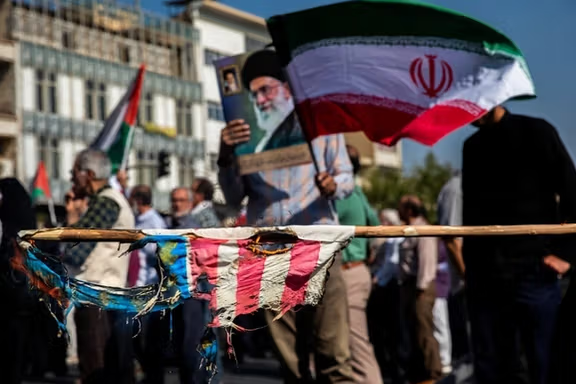
Protesters wave Iran's flag and burn that of the United States, in a rally to support the people of Gaza, Tehran, October 10, 2025

US President Donald Trump has rolled over an annual declaration of a US national emergency on Iran according to a statement published on Friday on the Federal Register.

The national emergency was announced on November 14, 1979 when radical students in Tehran seized the US embassy and took hostage dozens of diplomats, staff and guards. Trump's move marks the 46th time it has been renewed.

The decision by then-president Jimmy Carter was meant “to deal with the unusual and extraordinary threat to the national security, foreign policy and economy of the United States constituted by the situation in Iran.”

In renewing the national emergency Trump said in a statement: "Our relations with Iran have not yet normalized, and the process of implementing the agreements with Iran, dated January 19, 1981, is ongoing."

On that date, Iran and the United States agreed to the Algiers Accords, an understanding brokered by the North African nations for the two enemies to resolve the hostage standoff.

"For this reason, the national emergency declared on November 14, 1979, and the measures adopted on that date to deal with that emergency, must continue in effect beyond November 14, 2025," Trump added. "Therefore... I am continuing for 1 year the national emergency with respect to Iran declared in Executive Order 12170."

In addition to the 1979 declaration, a separate national emergency was declared on March 15, 1995, addressing Iran's actions related to terrorism and weapons proliferation. This emergency has also been renewed annually, with the 30th extension made by the Trump administration on March 7, 2025.

After taking office for his second term in January, Trump reimposed his so-called maximum pressure campaign on Iran. The two sides then held five rounds of nuclear talks before a 12-day war between Iran and Israel in June, which culminated in US airstrikes on three Iranian nuclear sites.

Negotiations have since stalled over uranium enrichment, with Western powers insisting Iran end domestic enrichment and Tehran refusing.

Last month, Iranian Supreme Leader Ali Khamenei described negotiations with the United States as “useless and harmful” and declared any talks with Washington forbidden.

In a speech this week he praised the 1979 hostage taking as a formative moment in the Islamic Revolution and its mission to eject the United States military from the region and defeat its ally Israel.


Most Viewed

State media slam Araghchi's Hormuz tweet, say it let Trump claim victory
1

State media slam Araghchi's Hormuz tweet, say it let Trump claim victory

2
OPINION

The Hormuz get out of jail card turned to a grave

3
INSIGHT

How Tehran bends its own red lines to boost state rallies

4

Iran International says it won’t be silenced after London arson attack

5
VOICES FROM IRAN

Iran blackout cripples freelancer, small business incomes

Banner
Banner

Spotlight

  • Too early to tell who is winning Iran war, experts say
    PODCAST

    Too early to tell who is winning Iran war, experts say

  • How Tehran bends its own red lines to boost state rallies
    INSIGHT

    How Tehran bends its own red lines to boost state rallies

  • Iran blackout cripples freelancer, small business incomes
    VOICES FROM IRAN

    Iran blackout cripples freelancer, small business incomes

  • Ideology may be fading in Iran, but not in Kashmir's ‘Mini Iran'
    INSIGHT

    Ideology may be fading in Iran, but not in Kashmir's ‘Mini Iran'

  • US blockade enters murky phase as tankers spoof signals and buyers hesitate
    ANALYSIS

    US blockade enters murky phase as tankers spoof signals and buyers hesitate

  • Why the $100 billion Hormuz toll revenue is a myth
    ANALYSIS

    Why the $100 billion Hormuz toll revenue is a myth

•
•
•

More Stories

Trump says Iran has asked about lifting US sanctions

Nov 7, 2025, 07:19 GMT+0

Iran has approached Washington to ask whether US sanctions could be lifted, US President Donald Trump told the leaders of the C5+1 Central Asian countries at the White House on Thursday.

“Iran has been asking if the sanctions could be lifted. Iran has got very heavy US sanctions, and it makes it really hard for them to do what they'd like to be able to do. And I'm open to hearing that, and we'll see what happens, but I would be open to it,” Trump said.

Earlier this week, Iran’s Supreme Leader Ali Khamenei said cooperation between the two countries was impossible as long as Washington continued to support Israel, maintain military bases, and interfere in the Middle East.

“As long as America supports the Zionist regime and interferes in the region, cooperation with it is neither rational nor possible,” Khamenei said on Monday.

Trump also said that the United States directed Israel’s first strike on Iran during the June conflict. “Israel attacked first. That attack was very, very powerful. I was very much in charge of that,” Trump told reporters late on Thursday.

“When Israel attacked Iran first, that was a great day for Israel because that attack did more damage than the rest of them put together.”

After taking office for his second term in January, Trump reimposed his maximum pressure campaign on Iran, a policy aimed at preventing Tehran from developing a nuclear weapon. In June, the United States bombed Iranian nuclear sites, further straining ties between the two countries.

The two sides held five rounds of nuclear talks before a 12-day war between Iran and Israel in June. Negotiations have since stalled over uranium enrichment, with Western powers insisting Iran end enrichment on its own soil, a demand Tehran has rejected.

Last month, Khamenei described negotiations with the United States as “useless and harmful” and declared any talks with Washington forbidden. Foreign Minister Abbas Araghchi also said no direct dialogue had taken place, adding that Tehran would discuss only nuclear matters and would never negotiate on regional issues.

Iran reacts to Mamdani win: from Islam triumphant to democracy masterclass

Nov 6, 2025, 20:30 GMT+0
•
Maryam Sinaiee

Zohran Mamdani’s stomping win in New York’s mayoral race drew starkly different reactions in Iran, with views on the first Muslim to run America’s largest city reflecting a bitterly divided political landscape.

For hardline supporters of the Shi'ite theocracy, his faith was a welcome slap to a US establishment seen as implacably hostile. To their critics, Mamdani's win highlights everything the Iranian system resists: youth, pluralism and the power of the vote.

The conservative daily Hamshahri, published by Tehran’s municipality, splashed "America Against America" on its front page, interpreting Mamdani's victory as a proof of the US enemy's internal divides.

Tehran lawmaker Abolghasem Jarareh declared in parliament: “Zohran Mamdani’s victory shows the strength of the slogan ‘Death to Israel!’”

Without elaborating, he then joined fellow lawmakers in chanting the slogan on the floor of parliament, a regular practice among arch-conservatives.

Abdolmotahhar Mohammadi, spokesperson for Tehran’s mayor, wrote on X: “The clear message of Zohran Mamdani’s election … is that the people of New York reject the influence of a genocidal regime in US governance,” adding that Iran “welcomes any strengthening of anti-racist and pro-Palestine discourse anywhere in the world.”

Gaza and Israel

Mamdani's platform emphasized affordable housing, police reform and Palestinian solidarity, earning him strong backing from progressives and Muslim organizations.

Early in his campaign he faced criticism for using the phrase "globalize the intifada" and has since distanced himself from the slogan. Mamdani has repeatedly called Israel's incursion into Gaza a genocide but has spoken out against anti-Semitism.

In an interview, he cited his Shi'ite Muslim faith as an important inspiration.

"To stand up for justice, to stand up for that which is right often means doing something difficult. Imam Hossein's, peace be upon him, conviction in spite of the odds is something that inspires me."

Mamdani has hit out at what he has called Islamophobia in the wake of the 9/11 attacks but has not cited Islam as a basis of his political outlook.

Still, Tehran University academic and idealogue Foad Izadi called Mamdani’s victory “the arrival of the message of 13 Aban in New York.”

He was referring to the Persian calendar commemoration of the 1979 storming of the US embassy by revolutionary students and the hostage-taking of staff there which permanently soured relations.

The date is now celebrated annually in Iran as a focal point of state-sponsored hostility toward Washington.

Free elections vs. clerical vetting

Middle East analyst Mostafa Najafi criticized the hardliners in a social media commentary titled “America’s self-healing system or the message of 13 Aban in New York?”

“Lacking a realistic understanding of the inner workings of power in the United States, some in Iran keep insisting that the country is on the verge of collapse or regime change,” he wrote.

Many critical voices drew sharp comparisons between America’s open elections and Iran’s heavily restricted political system, where supervisory bodies often whittle down lists of eligible candidates.

“Mamdani’s victory shows that despite 46 years of propaganda against America, it is democracy and the rule of law — not the will of the president who is the top official of the system — that prevail there,” prominent commentator Sadegh Zibakalam posted on X.

The veteran analyst was alluding to the limitless authority of Supreme Leader Ali Khamenei, Iran's ultimate decision-maker in all matters, including elections.

Conservative commentator Abdolreza Davari also wrote on X: “Mamdani’s rise in New York … is proof of people’s sovereignty and modern civilization. The roots of America’s global leadership lie in this very expression of the people’s will.”

“In our ‘religious democracy,’ the Guardian Council bars a Zoroastrian from city council because of his faith. But in ‘American liberal democracy,’ a socialist Muslim anti-Zionist can become mayor of New York,” Davari wrote in another post.

He was referring to Sepanta Niknam, a Zoroastrian elected to Yazd’s city council in 2013.

After winning re-election in 2017, a defeated candidate challenged his eligibility because of his religion. Although Zoroastrianism is a recognized religion under Iran’s constitution, Niknam was barred from taking his seat for over a year.

While he was eventually allowed to return, his candidacy for future elections was ultimately disqualified, making the case a symbol of theocratic discrimination.

'Masterclass in democracy'

Prominent jurist Mohsen Borhani called Mamdani’s win “a masterclass in democracy, rule of law and respect for citizens’ choices,” urging Iran’s Guardian Council, which oversees the approval of presidential candidates, to “learn from it.”

The rise of Mamdani, 34, also reignited Iran’s long-standing debate over youth exclusion from politics, even among conservatives.

Khamenei is 86, Guardian Council chairman Ali Jannati is 98 and President Masoud Pezeshkian is 71.

“If this young man from New York ran for office here, would the Guardian Council even approve his qualifications?” conservative activist Vahid Ashtari asked bluntly,

“In Iran, our elections are always between the same figures," he added. "Could any thirtysomething even imagine becoming mayor of the capital?”

US sanctions Hezbollah's Iran-linked 'cash network'

Nov 6, 2025, 16:55 GMT+0

The United States Treasury on Thursday imposed sanctions on a network of alleged Hezbollah financiers it says channelled tens of millions of dollars from Iran into Lebanon this year.

The individuals helped move Iranian funds through both licensed and unlicensed exchange companies, the Treasury said, allowing Hezbollah to rebuild its military infrastructure and sustain its paramilitary units.

“Lebanon has an opportunity to be free, prosperous, and secure, but that can only happen if Hizballah is fully disarmed and cut off from Iran’s funding and control,” said John K. Hurley, the US undersecretary for terrorism and financial intelligence, in a statement.

Efforts to curb Hezbollah’s military power have intensified but borne little fruit since a ceasefire with Israel in June 2024.

The Lebanese group argues that its weapons are needed to defend the country’s from Israel, but rival factions in Lebanon’s fragmented political landscape say the group undermines the state and serves Tehran’s interests.

This message was delivered by Iran's President Joseph Aoun directly to Iran’s security chief, Ali Larijani, during his visit to Lebanon in late September.

Larijani rejected accusations of interference, saying those pushing for disarmament, not Tehran, were meddling in Lebanese affairs.

‘Cash network’

The latest measures target Hezbollah operatives who, according to US officials, oversee the influx of Iranian money generated through covert dealings which contravene US sanctions, including the sale of oil and other goods.

According to the Treasury, the Islamic Revolutionary Guards Corps–Quds Force has transferred more than $1bn to Hezbollah since January 2025.

Among those sanctioned is Ossama Jaber, a Hezbollah member accused of collecting and converting tens of millions of dollars between September 2024 and February 2025.

Washington also moved against figures linked to Hezbollah’s finance team, whose structure has been in flux since the death last year of its long-time chief, Muhammad Qasir, and the collapse of Bashar al-Assad’s regime in Syria — a key financial bridge to Iran for decades.

Qasir’s responsibilities were split among several relatives and associates, including his son Ja’far and nephew Ali, both of whom have already been sanctioned by the US.

Hezbollah has been listed by the US as a foreign terrorist organization since 1997.

Iranian-American poet’s son arrested over Detroit terror plot

Nov 6, 2025, 15:31 GMT+0

US authorities have arrested the 19-year-old son of Iranian-American poet Roger Sedarat over an alleged Islamic State-inspired plot to bomb gay bars in Detroit, the New York Post reported citing police sources.

Milo Sedarat was detained at his father’s home in Montclair, New Jersey, on Wednesday in connection with a foiled attack that investigators said was planned for Halloween.

Roger Sedarat, Milo’s father, is an award-winning Iranian-American poet and professor at Queens College in New York City.

Another 19-year-old from Montclair, Tomas Kaan Guzel, was also arrested according to the report.

The arrests came after five other alleged co-conspirators, including one minor, were charged last week following an investigation by the FBI and the New York Police Department’s Intelligence Bureau.

Authorities said the suspects intended to replicate Islamic State's 2015 Paris attacks.

Police sources told the Post that Guzel moved his travel plans forward after learning of FBI raids on other suspects’ homes in Detroit.

Authorities said the raids uncovered multiple firearms, including three AR-15-style rifles, two shotguns, four pistols, and over 1,600 rounds of ammunition, along with tactical vests, GoPro cameras, and combat gear.

FBI Director Kash Patel said before Halloween weekend that the suspects were planning a “violent attack.”

Sedarat and Guzel are expected to face charges in federal court in New Jersey.

Roger Sedarat has authored four collections of poetry including Dear Regime: Letters to the Islamic Republic and most recently an academic work, Emerson in Iran: the American Appropriation of Persian Poetry.

US probes Iranian oil tycoon over suspected sanctions breaches - BBG

Nov 5, 2025, 21:55 GMT+0

The US Justice Department is investigating whether a son of Iran’s former security chief breached sanctions while using a global network of banks, Bloomberg reported on Wednesday citing people familiar with the matter.

The probe focuses on billions of dollars in money movements between firms overseen by oil tycoon Hossein Shamkhani, the son of a top adviser to Supreme Leader Ali Khamenei, Bloomberg said.

According to the report, the probe has drawn on information from insiders within Shamkhani’s business network and from Wall Street banks that had relationships with entities linked to him.

The main target of the investigation is Shamkhani, rather than the banks, Bloomberg said.

JPMorgan Chase & Co., ABN Amro Bank NV, Marex Group Plc, Standard Chartered PLC, Emirates NBD PJSC and National Bank of Fujairah PJSC are among the institutions under review, the report said citing several people familiar with the probe.

Bloomberg said spokespeople for the Justice Department, JPMorgan, ABN Amro, Marex and Standard Chartered declined to comment. National Bank of Fujairah said it is “not under investigation by the US Department of Justice,” while Emirates NBD said it has not received any communication from US authorities.

Bloomberg said Shamkhani did not respond to a request for comment the news agency sent to his lawyers.

Bloomberg reported last November that the US Treasury Department was examining JPMorgan’s relationship with a hedge fund said to be overseen by Shamkhani.

According to Bloomberg's latest report, the Justice Department’s probe is broader in scope, aiming to map out the tycoon’s global financial network and pursue potential indictments or arrests of his associates, with cooperation expected from authorities in the United Arab Emirates, a key hub for his operations.

Shamkhani, who operates mainly from Dubai, was sanctioned by the United States in July along with dozens of individuals, companies and vessels linked to his network in what the US Treasury described as its largest Iran-related action in seven years. The UK and European Union also imposed sanctions in recent months.

US officials said Shamkhani used his father’s political influence to build a fleet of tankers and container ships that transported Iranian and Russian oil worldwide through shell companies. The Treasury said he used aliases including “H,” “Hector” and “Hugo Hayek” to conceal his dealings.

Following the sanctions, Dominica revoked Shamkhani’s passport issued under the Hayek pseudonym, and Panama de-flagged several vessels tied to his firms.

Bloomberg's report said some of Shamkhani's companies have since shifted operations to Oman.

Another Bloomberg investigation last year found that Shamkhani’s network had become a key channel for Iranian and Russian oil exports and had established a hedge fund with offices in London, Dubai and Geneva to manage proceeds from the trade.





