• العربية
  • فارسی
Brand
  • Iran Insight
  • Politics
  • Economy
  • Analysis
  • Special Report
  • Opinion
  • Podcast
  • Iran Insight
  • Politics
  • Economy
  • Analysis
  • Special Report
  • Opinion
  • Podcast
  • Theme
  • Language
    • العربية
    • فارسی
  • Iran Insight
  • Politics
  • Economy
  • Analysis
  • Special Report
  • Opinion
  • Podcast
All rights reserved for Volant Media UK Limited
volant media logo

Australia passes law to list state sponsors of terrorism

Nov 6, 2025, 08:00 GMT+0Updated: 00:00 GMT+0
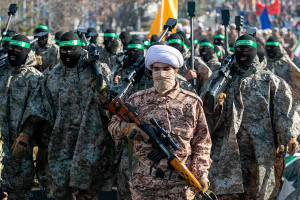
IRGC forces during a parade in Tehran

Australia’s Parliament has passed a law allowing the government to list foreign state entities such as Iran’s Revolutionary Guard Corps (IRGC) as sponsors of terrorism, after intelligence linked the group to antisemitic attacks in Sydney and Melbourne.

Under the Criminal Code Amendment (State Sponsors of Terrorism) Act 2025, the government may now designate a foreign state entity that “has engaged in, or otherwise supported or advocated for, the doing of terrorist acts targeted at Australia.” 

The Criminal Code will also be expanded with new offences aimed at state sponsors of terrorism, their proxies and external supporters.

Attorney-General Michelle Rowland said the legislation reflects Australia’s uncompromising stance on threats to its national security. 

“Our first priority is the safety and protection of all Australians, which is why we have acted decisively in passing this vital legislation through the Parliament,” she said. 

She added that the law “is a warning that foreign states and their supporters who seek to fuel division, create fear, erode social cohesion and perpetrate violence in the Australian community will be held to account.”

The legislation follows a hot-line press conference in August where Prime Minister Anthony Albanese, flanked by Australia’s domestic spy chief, publicly said the IRGC orchestrated two arson attacks on a kosher restaurant in Sydney and a synagogue in Melbourne in 2024.

Australian domestic spy agency Australian Security Intelligence Organization (ASIO) assessed that the IRGC used a “complex web of proxies” to carry out attacks on Australian soil.

Rowland said the new law would create an environment where “it is more difficult, more risky, and more costly for malicious foreign actors to seek to cause Australia and our community harm.” 

She added that law enforcement and intelligence agencies would be given enhanced powers to investigate and disrupt state-sponsored terrorism.

While the IRGC has been designated a terrorist organization by the United States since 2019, Australia’s new law marks the first time Canberra has enabled the listing of a foreign state entity under its federal terrorism framework. 

Parliamentary sources said the government’s intelligence case was bolstered by “credible intelligence” linking the IRGC to extremist actions in Australia.

Foreign Minister Penny Wong described the law as part of broader efforts to protect democratic institutions from overseas interference.

“Foreign state-sponsored extremism does not stop at our border,” she said, adding that the legislation would help safeguard Australia’s “social cohesion and national resilience.”

Tehran dismissed the Sydney and Melbourne attacks allegations as “fabricated aims to undermine Iran.”

Australia’s Parliament passed the bill through the Senate without amendment. Legal analysts said the framework enables Canberra to impose economic and operational restrictions on listed entities and prosecute those who provide material support. The law also allows asset freezes and bans on directors or associates of designated state-sponsor entities.

Most Viewed

State media slam Araghchi's Hormuz tweet, say it let Trump claim victory
1

State media slam Araghchi's Hormuz tweet, say it let Trump claim victory

2

Iran International says it won’t be silenced after London arson attack

3
INSIGHT

How Tehran bends its own red lines to boost state rallies

4
OPINION

The Hormuz get out of jail card turned to a grave

5

Iran halts petrochemical exports to supply domestic market

Banner
Banner

Spotlight

  • Too early to tell who is winning Iran war, experts say
    PODCAST

    Too early to tell who is winning Iran war, experts say

  • How Tehran bends its own red lines to boost state rallies
    INSIGHT

    How Tehran bends its own red lines to boost state rallies

  • Iran blackout cripples freelancer, small business incomes
    VOICES FROM IRAN

    Iran blackout cripples freelancer, small business incomes

  • Ideology may be fading in Iran, but not in Kashmir's ‘Mini Iran'
    INSIGHT

    Ideology may be fading in Iran, but not in Kashmir's ‘Mini Iran'

  • US blockade enters murky phase as tankers spoof signals and buyers hesitate
    ANALYSIS

    US blockade enters murky phase as tankers spoof signals and buyers hesitate

  • Why the $100 billion Hormuz toll revenue is a myth
    ANALYSIS

    Why the $100 billion Hormuz toll revenue is a myth

  • Australia suggests IRGC terror listing need not target innocent conscripts

    Australia suggests IRGC terror listing need not target innocent conscripts

  • Australia moves to label Iran’s Guards a terrorist organization under new bill

    Australia moves to label Iran’s Guards a terrorist organization under new bill

•
•
•

More Stories

US probes Iranian oil tycoon over suspected sanctions breaches - BBG

Nov 5, 2025, 21:55 GMT+0

The US Justice Department is investigating whether a son of Iran’s former security chief breached sanctions while using a global network of banks, Bloomberg reported on Wednesday citing people familiar with the matter.

The probe focuses on billions of dollars in money movements between firms overseen by oil tycoon Hossein Shamkhani, the son of a top adviser to Supreme Leader Ali Khamenei, Bloomberg said.

According to the report, the probe has drawn on information from insiders within Shamkhani’s business network and from Wall Street banks that had relationships with entities linked to him.

The main target of the investigation is Shamkhani, rather than the banks, Bloomberg said.

JPMorgan Chase & Co., ABN Amro Bank NV, Marex Group Plc, Standard Chartered PLC, Emirates NBD PJSC and National Bank of Fujairah PJSC are among the institutions under review, the report said citing several people familiar with the probe.

Bloomberg said spokespeople for the Justice Department, JPMorgan, ABN Amro, Marex and Standard Chartered declined to comment. National Bank of Fujairah said it is “not under investigation by the US Department of Justice,” while Emirates NBD said it has not received any communication from US authorities.

Bloomberg said Shamkhani did not respond to a request for comment the news agency sent to his lawyers.

Bloomberg reported last November that the US Treasury Department was examining JPMorgan’s relationship with a hedge fund said to be overseen by Shamkhani.

According to Bloomberg's latest report, the Justice Department’s probe is broader in scope, aiming to map out the tycoon’s global financial network and pursue potential indictments or arrests of his associates, with cooperation expected from authorities in the United Arab Emirates, a key hub for his operations.

Shamkhani, who operates mainly from Dubai, was sanctioned by the United States in July along with dozens of individuals, companies and vessels linked to his network in what the US Treasury described as its largest Iran-related action in seven years. The UK and European Union also imposed sanctions in recent months.

US officials said Shamkhani used his father’s political influence to build a fleet of tankers and container ships that transported Iranian and Russian oil worldwide through shell companies. The Treasury said he used aliases including “H,” “Hector” and “Hugo Hayek” to conceal his dealings.

Following the sanctions, Dominica revoked Shamkhani’s passport issued under the Hayek pseudonym, and Panama de-flagged several vessels tied to his firms.

Bloomberg's report said some of Shamkhani's companies have since shifted operations to Oman.

Another Bloomberg investigation last year found that Shamkhani’s network had become a key channel for Iranian and Russian oil exports and had established a hedge fund with offices in London, Dubai and Geneva to manage proceeds from the trade.

Iran has built missile power beyond pre-war levels, foreign minister says

Nov 5, 2025, 20:14 GMT+0

Iran's Foreign Minister Abbas Araghchi said on Wednesday that Tehran's current missile power exceeds levels before a 12-day war with Israel in June and that its arch-foe was defeated in the conflict.

"Our missile power today far surpasses that of the 12-day war," Araghchi said in the Western city of Hamedan on Wednesday according to official media. "The enemy in the recent 12-day war failed to achieve all its objectives and was defeated."

The United States held five rounds of negotiations with Tehran over its disputed nuclear program earlier this year, for which President Donald Trump set a 60-day ultimatum.

When no agreement was reached by the 61st day Israel launched a surprise military offensive on June 13, followed by US strikes on June 22 targeting key nuclear facilities in Isfahan, Natanz and Fordow.

"In this war, the skies over the Zionist regime were under Islamic Republic control, and no defensive layer could stop our missiles," Araghchi said.

A ceasefire ended the 12-day conflict, but inspections of damaged sites remain suspended under Iranian law.

Hundreds of military personnel and civilians were killed in the Israeli airstrikes. Tehran responded with over 500 ballistic missiles and 1,100 drones, inflicting heavy casualties and widespread destruction, killing 32 Israeli civilians and one off-duty soldier.

On Sunday, Araghchi accused Israel of misleading Washington with what he called a fabricated nuclear threat and urged President Donald Trump to change course.

He said Israel and the US attacked Iranian nuclear sites under "false pretenses" and cited comments from the UN atomic watchdog and Oman's foreign minister confirming that Iran was not developing nuclear weapons.

Iran's Supreme Leader Ali Khamenei on Monday ruled out any cooperation with the United States, saying every US president had demanded “Iran’s surrender” but failed.

Iran denies seeking nuclear arms and says its program is peaceful.

Russia, Iran sanctions create unprecedented offshore oil build-up - Swiss trader

Nov 5, 2025, 07:29 GMT+0

Western sanctions on Russia and Iran have led to an unprecedented buildup of oil held on tankers at sea, effectively absorbing excess supply and preventing a global glut, the head of commodities trader Gunvor Group said on Wednesday, according to Reuters.

“Through the sanctions that we’ve had around the world, an enormous amount of oil is stuck and dislocated,” Torbjorn Tornqvist, Gunvor’s chief executive, told the ADIPEC energy conference in Abu Dhabi.

“This is unprecedented, the size of that. Therefore, obviously, if all sanctions would disappear, this market would clearly be quite oversupplied,” he added.

The European Union, United Kingdom and the United States have imposed sweeping sanctions on Moscow since its invasion of Ukraine, including new US measures last month targeting Rosneft and Lukoil, Russia’s two biggest oil producers. 

Washington and its allies have also maintained restrictions on Iran’s crude exports over its nuclear program and regional activities.

Traders and analysts say the curbs have redrawn global energy flows, forcing sanctioned crude onto “dark fleet” tankers and into longer, less transparent routes that keep large volumes in transit or storage.

Tornqvist said that while the market remains tight on paper, the hidden inventory floating offshore represents a “buffer” that could quickly weigh on prices if restrictions were eased.

“Effectively, we have a shadow market operating alongside the official one,” he said, noting that the structure of the global oil trade has become more fragmented and less efficient as a result of sanctions.

Oil prices have traded in a narrow range in recent weeks, with Brent crude hovering around $84 per barrel as investors weigh supply risks from the Middle East and the lingering impact of Western sanctions on sanctioned producers.

At the same conference, Marco Dunand, chief executive and co-founder of Mercuria Energy Group, one of the world’s largest independent energy traders, said that while global inventories remain low, the volume of oil held at sea is rising, signaling a gradual build-up of surplus supply. 

He added that Western sanctions continue to act as a “wild card” in determining how much crude reaches the market, estimating that a potential surplus of around two million barrels per day could narrow to about one million. 

“The glut is forming slowly,” Dunand said, “and will probably start to hit the market in the next few months.” 

No regrets: Khamenei ramps up defiance of US with hostage crisis praise

Nov 5, 2025, 07:17 GMT+0
•
Behrouz Turani

Almost half a century after young revolutionaries stormed the US embassy in Tehran, Iran’s Supreme Leader Ali Khamenei once again defended the move, leaning into the original break between the arch-foes and all but ruling out rapprochement.

Speaking Monday on the anniversary of the November 4, 1979 seizure of the embassy, Khamenei described Iran’s enmity toward the United States as “existential rather than tactical,” a confrontation that cannot be resolved.

“The inherently arrogant nature of the US accepts nothing but submission,” he said. “Every US president desired this. Some concealed it, others expressed it openly. The current president has made it explicit, revealing the US’s true nature.”

For Khamenei, the threat lies not in sanctions or military pressure but in ideological erosion. America’s demands—whether over nuclear activities, missiles, or regional policy—are, to him, attempts to take away what defines the system that has become synonymous with his name.

'Victory day’

Khamenei tried to illustrate this point with both history and scripture.

“Our problem with the United States began on August 19, 1953, not November 4, 1979,” he said, invoking the CIA-backed coup against Prime Minister Mohammad Mossadegh seventy-odd years ago.

On the latter date, he echoed his mentor and predecessor Ruhollah Khomeini in calling it “a day of honor and victory,” doubling down on a bet many insiders now publicly regret.

Even senior conservatives like Ali Akbar Nateq Nouri, once chief inspector of the Supreme Leader’s office, have called the storming of the US embassy “a big mistake,” admitting that the ensuing hostage crisis was “the starting point” of many of Iran’s troubles.

But Khamenei is adamant that repentance equals betrayal. History, as he tells it, shows that every concession to the United States only invites more demands—a conviction hardened through experience.

Impossible conditions

When Donald Trump first took office, he declared that all he wanted from Tehran was a pledge not to pursue nuclear weapons, signaling he had no quarrel with Iran’s theocratic order.

But midway through indirect negotiations in the spring of 2025, his stance shifted toward a more conventional hardline: curbs on missiles, abandonment of regional allies, and most recently, recognition of Israel.

Khamenei’s Monday speech contained a direct reply: “If they stop supporting the Zionist regime, remove military bases from the region and cease interfering in regional affairs, these matters could potentially be reviewed,” he said, referring to calls for engagement with the United States.

The conditions were impossible by design—a reminder that what Washington calls diplomacy, he sees as ideological surrender.

‘Unconditional surrender’

Even when hinting at pragmatic concessions such as curbing enrichment, he was dismissive: “This isn’t something foreseeable for now, nor for the near future.”

Trump’s post on Truth Social in mid-October, calling for Iran’s “unconditional surrender” just days into Israel’s war on Iran, may have been the epitome of what Khamenei always asserted: that America seeks capitulation, not coexistence.

His answer was unambiguous: “Expecting the Iranian nation to submit, given its level of capabilities, wealth, intellectual and spiritual background and its vigilant and motivated youth, is meaningless.”

Khamenei shows no sign of repentance or retreat. To him, the struggle with the United States is not about sanctions or missiles but about identity. In his twilight, he seems as convinced as ever that the system must endure as it is, or not at all.
French think tank says Iran purveying influence via Paris embassy

Nov 4, 2025, 20:40 GMT+0

Iran’s embassy in Paris coordinated a decades-long campaign to influence French political, academic and media spheres, according to a new report by French think tank France2050.

The organization's inaugural 120-page report said Iran has maintained a “structured system of infiltration” in France for decades through its diplomats and cultural institutions.

The report compiled by journalists, historians and former intelligence officials, said Tehran had maintained a “structured system of infiltration” in France for decades through diplomats and cultural institutions.

France2050 is led by Gilles Platret, a former mayor and vice president of a center right party. The report's editorial directors, Emmanuel Razavi and Jean-Marie Montali, are authors of books on Iranian influence abroad.

The document was submitted to the Interior Ministry, the Senate and the National Assembly to inform policymakers about foreign influence operations in France, according to its authors.

“In France, the number two of the Iranian embassy, Ali Reza Khalili, was responsible for establishing an influence network: recruiting and directing ‘agents,’ whether they were aware of being manipulated or not,” the report said.

It described Khalili as chief of staff to the Iranian ambassador and president of the Franco-Iranian Center, an association created in 2016 that regularly hosted conferences, cultural events and training sessions.

These activities, the authors wrote, enabled Tehran to “identify and recruit potential interlocutors in academia, civil society and the media.”

Embassy accused of coordinating propaganda

The report called the Iranian embassy in Paris “the European anchor of the Revolutionary Guards’ influence operations.”

Citing European counter-espionage sources, it said the mission served simultaneously as “a cultural center, a propaganda unit and a coordination office for the surveillance of the diaspora and the repression of opponents abroad.”

Several embassy staff members officially registered as diplomats were identified by European services as belonging to Iran’s Ministry of Intelligence (MOIS) or the Quds Force, according to the document.

The embassy allegedly supervised cultural and religious institutions such as the Centre Culturel Islamique d’Iran in Paris, which the report called “a discreet but effective relay for Tehran’s propaganda.”

The France2050 authors also cited links between the embassy and regional Shiite associations in Lyon and Villeurbanne, describing joint events attended by Iranian diplomats “often without public mention of their participation.”

Recruitment in universities and civil society

According to the document, the embassy and the Franco-Iranian Center offered scholarships, internships and trips to Iran to “students or researchers demonstrating open-mindedness toward Iranian culture,” which it characterised as a form of recruitment for influence operations.

Targets included “young intellectuals, journalists in training, or NGO activists susceptible to anti-Western or anti-imperialist rhetoric,” the report said.

The embassy also allegedly directed a digital influence campaign using social-media accounts tied to Iranian state outlets such as Press TV, Al-Alam and Hispan TV.

Cyber-monitoring referenced in the report found recurring links between these French-language networks and the embassy’s communications unit, with some account administrators participating in events run by Ali Reza Khalili’s center.

The campaigns, the report added, aimed to “create ideological confusion, erode trust in democratic institutions and normalize the Iranian regime’s positions in the French political and media landscape.”

It warned that the absence of an EU terrorist designation for the Revolutionary Guards allowed operatives “to travel, fundraise and coordinate freely across Schengen countries.”