• العربية
  • فارسی
Brand
  • Iran Insight
  • Politics
  • Economy
  • Analysis
  • Special Report
  • Opinion
  • Podcast
  • Iran Insight
  • Politics
  • Economy
  • Analysis
  • Special Report
  • Opinion
  • Podcast
  • Theme
  • Language
    • العربية
    • فارسی
  • Iran Insight
  • Politics
  • Economy
  • Analysis
  • Special Report
  • Opinion
  • Podcast
All rights reserved for Volant Media UK Limited
volant media logo

Venezuela turns to Iran, Russia, China for military aid amid US buildup - WP

Nov 1, 2025, 20:26 GMT+0Updated: 00:03 GMT+0
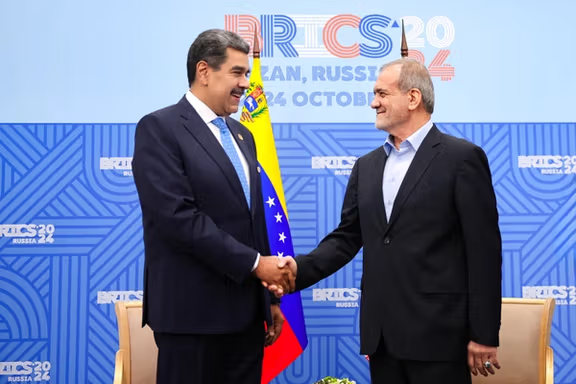
Venezuelan President Nicolas Maduro meets Iran's President Masoud Pezeshkian in Russia in October 2024

Venezuela is seeking military help from Russia, China and Iran — from drone technology to missile support — as it faces a rising US military buildup in the Caribbean, according to internal US documents reported by The Washington Post.

Venezuelan Transport Minister Ramón Celestino Velásquez recently coordinated a shipment of military equipment and drones from Iran while planning a visit to that country, the Washington Post reported citing the documents.

The Venezuelan minister told an Iranian official that his country was in need of “passive detection equipment,” “GPS scramblers” and “almost certainly drones with 1,000 km [600 mile] range,” the report added citing the documents.

The report does not clarify how Russia, China or Iran have responded to the outreach, nor whether any of the requested items are already en route.

However, Venezuelan officials have maintained close ties with all three countries in recent years, relying on them for economic, energy and security support as sanctions have deepened the country’s isolation from the West.

The overtures come as the United States has significantly increased its naval presence in the Caribbean, deploying ships and aircraft in what US officials say is part of counter-narcotics and security operations.

President Nicolas Maduro’s government has portrayed the buildup as a direct threat, accusing Washington of preparing for intervention and using the regional military posture to justify its push for foreign defense assistance.

The Trump administration has secretly authorized the CIA to conduct covert action in Venezuela, The New York Times reported last month citing US officials.

Most Viewed

100 days after carnage: Iran economy reels from war, inflation, unemployment
1
INSIGHT

100 days after carnage: Iran economy reels from war, inflation, unemployment

2
INSIGHT

Ghalibaf defends Iran-US talks amid hardline backlash

3
EXCLUSIVE

Iranian assaulted in London amid concern over threats to regime critics

4

IRGC fires at Indian vessel in Hormuz

5
INSIGHT

A nation in limbo: 100 days after the massacre, has the world moved on?

Banner
Banner

Spotlight

  • War-hit homeowners feel abandoned as Iran’s reconstruction aid fades

    War-hit homeowners feel abandoned as Iran’s reconstruction aid fades

  • 100 days on: the anatomy of Iran’s January crackdown
    INSIGHT

    100 days on: the anatomy of Iran’s January crackdown

  • Ghalibaf defends Iran-US talks amid hardline backlash
    INSIGHT

    Ghalibaf defends Iran-US talks amid hardline backlash

  • 100 days on: why Iran’s January protests spread across social classes
    ANALYSIS

    100 days on: why Iran’s January protests spread across social classes

  • From instability to influence: Pakistan’s pivotal role in US-Iran diplomacy
    ANALYSIS

    From instability to influence: Pakistan’s pivotal role in US-Iran diplomacy

  • A nation in limbo: 100 days after the massacre, has the world moved on?
    INSIGHT

    A nation in limbo: 100 days after the massacre, has the world moved on?

•
•
•

More Stories

Gunmen kill two Revolutionary Guard forces in Iran's restive southeast

Nov 1, 2025, 17:49 GMT+0

Two members of the Revolutionary Guard’s Basij paramilitary forces were killed in an armed attack on the Khash–Zahedan road, local authorities announced on Saturday, in the latest of a series of clashes with Sunni militants in Iran’s restive southeast.

The vehicle of Mohammad-Reza Shahouzehi, a tribal elder of the Shahouzehi clan, came under fire by armed militants while he was inspecting the area under his jurisdiction near Eskalabad, close to Dehpabid in Sistan and Baluchestan province, the Quds base of the IRGC Ground Forces said.

Two of his companions, identified as Esmail Shavarzi and Mokhtar Shahouzehi, were seriously wounded in the attack and later died from their injuries, the IRGC said in its statement, calling it an act of terrorism.

The killing follows several similar incidents in recent months, mostly claimed by the Sunni militant group Jaish ul-Adl, designated as a terrorist organization by both Iran and the United States.

In September, Reza Azarkish, a local Basij militia member, was shot dead in Iranshahr. Earlier in the month, Iraj Shams Askani, a member of the Revolutionary Guards, was gunned down by Jaish ul-Adl in the border town of Rask.

Last month, Parviz Kadkhodaei, a local Basij commander in Nikshahr, was killed in a separate assault. Prominent tribal leader Mullah Kamal Salahi-zehi was also killed in October when unidentified gunmen opened fire on his vehicle in Iranshahr.

The province, bordering Pakistan and Afghanistan, has long been the scene of attacks by Sunni insurgent groups that Tehran says are backed by foreign intelligence services.

Iran military court clears three IRGC officers accused of killing civilians

Nov 1, 2025, 03:59 GMT+0

A military court in Iran's Hamedan has upheld a ruling that drops all charges against three Revolutionary Guard officers accused of killing two young men during a checkpoint incident in July, according to a document obtained by Iran International.

The officers fatally shot two young men, Mohammad-Mehdi Abaei and Alireza Karbasi, on July 1. The shootings took place amid heightened domestic surveillance and arrests following the end of war between Iran and Israel.

A document from Branch One of the Hamedan Military Court obtained by Iran International shows that the court confirmed a previously issued decision to halt legal proceedings against the officers identified as Colonel Behrouz Amid, Colonel Mehdi Ghiyasvand and Major Ali-Asghar Yaghoubi.

The ruling says: “This court, while rejecting the objections, fully confirms the issued non-prosecution order.”

The victims were shot outside Hamedan during what state authorities called a security operation. The IRGC-affiliated Fars News Agency reported that forces opened fire on their vehicle near the Tareek-Darreh area after suspecting it of drone-related activity.

Two of them, Abaei and Karbasi, were killed and a third was injured.

At the time, it was claimed that two Basij members had fired the shots, but the document received by Iran International shows the accused are IRGC officers.

A source close to the victims’ families told Iran International that state media are trying to silence the families and mislead public opinion by framing the victims as “Israeli spies.”

According to this source, security agencies have banned the families from speaking to the media, while state-run outlets attempt to label the two young men as “agents of Israel.”

Lawyers protest ruling

Lawyers for the victims and the injured survivor objected to the ruling, arguing that there had been no traffic restrictions in the area and that the officers violated the law on the use of firearms.

They said the officers fired “a burst of bullets at the vehicle and its passengers without any necessity,” stressing that the act was “inherently lethal”.

They also said that the shooting occurred ten days after the end of the war with Israel, making the claim of wartime conditions invalid.

The prosecutor, however, argued the suspects had acted “voluntarily due to a sense of responsibility to confront Mossad agents and protect public security,” and could have refused the mission.

The court wrote that “due to lack of evidence, firm denial by the accused, and based on the presumption of innocence, the decision not to prosecute is issued.”

During the funeral procession for Abaei and Karbasi on July 3, mourners chanted “Death to the oppressor” and demanded accountability for the killings.

In 2024, at least 484 civilians were shot by security forces in Iran — 163 killed and 321 wounded — according to US-based human rights group HRANA. A five-year review shows a worrying rise in the number of victims of such shootings, with the figure more than doubling compared to the previous five-year period, the rights group said.

Iran-backed Hezbollah rearms, defying cease-fire - WSJ

Oct 31, 2025, 08:50 GMT+0

Iran-backed Hezbollah is rebuilding its weapons and ranks, defying a cease-fire deal and risking renewed conflict with Israel, the Wall Street Journal reported on Friday, citing people familiar with Israeli and Arab intelligence.

The intelligence shows Hezbollah is restocking rockets, antitank missiles and artillery through seaports and smuggling routes that still operate in parts of Syria, the people said. Some of the new weapons are made in Lebanon by Hezbollah itself, one of the people said.

The rearmament defies the terms of the cease-fire agreement that required Lebanon to begin disarming Hezbollah south of the Litani River. Instead, Hezbollah has resisted, saying its weapons are essential to defend Lebanon’s sovereignty.

Israel, which has provided intelligence to help Lebanese forces disarm Hezbollah and carried out more than 1,000 strikes against the group since last November, is growing impatient, the people said. One person familiar with the matter said the Israeli government was angered to learn the issue had shifted from disarmament to rearmament only months after the truce began.

US Ambassador to Turkey Tom Barrack said in October that Israel could act unilaterally if Beirut delays further, warning of grave consequences. Lebanese leaders have appealed for patience through American and Arab intermediaries and signaled willingness to expand coordination with Israel despite the two states remaining technically at war.

  • Iran helped Hezbollah rebuild command structure in Lebanon - Le Figaro

    Iran helped Hezbollah rebuild command structure in Lebanon - Le Figaro

  • Hezbollah warns disarmament push can lead to war, thanks Iran for support

    Hezbollah warns disarmament push can lead to war, thanks Iran for support

Hezbollah leader Naim Qassem said in a recent television interview that attempts to disarm the group should be resisted but that it seeks to avoid another war. He said Hezbollah has not retaliated to Israeli strikes since the truce began.

The cease-fire followed a two-month Israeli campaign last year, triggered when Hezbollah fired rockets into Israel after Hamas’s 2023 attack. Thousands of airstrikes crippled the group’s infrastructure and killed many of its commanders.

Hezbollah deepens ties in Latin America as Iran faces strain

While Hezbollah rebuilds its military power at home, the group is also reinforcing its global funding base.

US experts told senators last week that Hezbollah is expanding its financial and criminal networks in Latin America, particularly in Venezuela, as Iran struggles under economic pressure. Matthew Levitt, a terrorism analyst, said Hezbollah has long relied on diaspora and illicit trade networks to raise money when funding from Tehran slows.

Lawmakers warned that Venezuela has become a hub for Hezbollah’s drug and finance operations. Senator Sheldon Whitehouse said the group is “one of Iran’s tools to destabilize and terrorize,” urging stronger action to cut its financial lifelines. Others called on Latin American governments to follow Argentina, Colombia, and Paraguay in designating Hezbollah as a terrorist group.

Jewish think tank disputes war report citation by Iran security boss

Oct 30, 2025, 08:22 GMT+0

Iran’s Supreme National Security Council Secretary was challenged over his interpretation of a study by the Jewish Institute for National Security of America on the June 2025 Israel-Iran conflict, after he cited the report in remarks posted on X last week.

The Iranian security chief Ali Larijani “cites my 12-Day War report but skips the part where Iran lost: Iran’s missile and drone attacks were overwhelmingly defeated by US and Israeli defenses and Israel’s crushing strikes against Iran,” Ari Cicurel, Associate Director of Foreign Policy at JINSA and author of the report “Shielded by Fire,” wrote on X.

The Iranian official had written that “Iran's armed forces demonstrated power in the war against the Zionists,” invoking the JINSA study to back his argument. But the report, released in August 2025, found that Iran’s missile and drone attacks were mostly neutralized through integrated US-Israel air and missile defenses.

US defenses decisive

The 29-page study said Iran launched 574 ballistic missiles and more than 1,000 drones between June 13 and 24, yet only 49 missiles impacted populated areas or infrastructure. It attributed Israel’s limited damage to the combined interception network, which it said achieved an 85 percent success rate.

“The vast majority of the over 500 ballistic missiles fired by Iran did no damage to Israel, that success due in large part to ad hoc US-led air defense cooperation,” the report said.

The analysis credited Washington’s role as decisive, noting that the United States deployed two THAAD missile defense batteries and several Aegis-equipped destroyers to support Israel and provided over 230 interceptors -- around a quarter of its total stockpile.

Contrasting narratives

Israel’s counterstrikes destroyed hundreds of Iranian launchers and reduced its missile stockpile from 2,500 to roughly 1,000 - 1,500, forcing Tehran to scale back its offensives, according to the report.

While Iran’s security chief portrayed the conflict as a demonstration of military strength, the JINSA study described it as a costly confrontation that exposed Iran’s vulnerabilities.

The report concluded that Israel and the United States must expand interceptor production and formalize their missile defense coordination to prevent Iran from regaining its offensive capacity.

Iran welcomes Saudi–Pakistan security pact, calls for Muslim unity

Oct 28, 2025, 20:54 GMT+0

Iran’s security chief Ali Larijani on Tuesday endorsed a defense pact between Saudi Arabia and Pakistan, calling for unity among Muslim countries in the face of what he described as common regional threats.

"The signing of a strategic agreement between Pakistan and the Kingdom of Saudi Arabia is a matter that pleases us," Ali Larijani, Secretary of Iran’s Supreme National Security Council, wrote on X.

"The Islamic world is in need of this brotherhood. And we no longer need speeches to resolve the region's issues, but rather action and cooperation," he added following a meeting with Pakistan’s Interior Minister Mohsen Naqvi in Tehran.

Larijani also praised Pakistan’s stance during a 12-day war in June between Iran and Israel, saying it “reflects a shared understanding of the region’s strategic realities.”

Saudi Arabia and Pakistan signed a strategic defense agreement in September, pledging mutual protection in the event of external aggression.

Nuclear armed-Pakistan has one of the world's largest armies but lacks fellow Sunni state Muslim state Saudi Arabia's vast energy wealth.

Both countries have long been suspicious of the Shi'ite Muslim theocracy in Tehran, which they view as a competitor for regional influence.

Iran’s endorsement of the agreement signals a rare moment of apparent convergence amid deepening geopolitical faults in the Middle East.

Pakistan shares a 560-mile border with Iran, where both countries face persistent threats from armed groups operating in the frontier region, including cross-border militancy.

In January 2024, Iran and Pakistan exchanged missile and drone strikes targeting militant groups in one of the most serious military escalations between them in decades.

Despite the exchange, both sides moved quickly to de-escalate, activating diplomatic channels and emphasizing that the attacks aimed at non-state actors not each other’s governments.