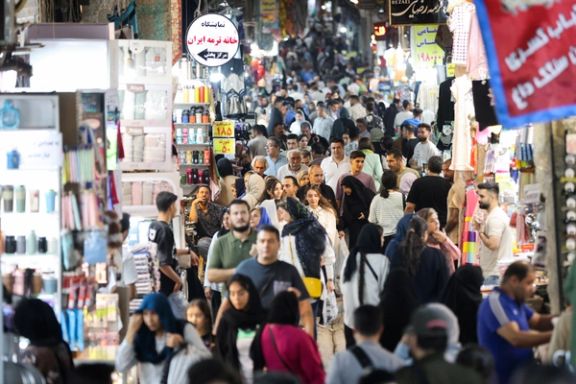
Iranian people walk at the Tehran Bazaar in Tehran, Iran, October 5, 2025.
The race for Tehran’s City Council elections is heating up among state-aligned factions almost entirely detached from an electorate which has largely quit the ballot box.
Preoccupied with the daily struggle to make ends meet—and having lost hope in meaningful change through elections—many in Iran’s capital view the spectacle of rival elites competing for power as little more than political theatre.
Turnout in Tehran’s last council election barely reached 25 percent. Mehdi Chamran, the conservative who now chairs the council, was elected with votes from roughly five percent of eligible citizens.
Sociologist Masoumeh Entezam recently described this decline as part of a deeper “crisis of participation” marked by “silent votes” and the erosion of political representation.
Writing in the government’s official daily Iran, she said many Iranians now see elections as contests for “specific factions rather than society at large,” but added that the new “proportional” system—to be introduced in next year’s Tehran council elections—could “open a small window toward reviving the institution of elections.”
Power launchpad
Despite outside doubts, within Iran’s insular political class the race is seen as highly consequential.
The Tehran City Council not only selects the capital’s mayor but has long served as a launchpad for national ambitions.
In 1997, the municipality’s reformist-aligned daily Hamshahri helped propel Mohammad Khatami’s late campaign to victory. Eight years later, then-mayor Mahmoud Ahmadinejad, appointed by the ultraconservative Abadgaran faction that controlled the council, rode the same route to the presidency.
With the next election due in May 2026, nearly every major political camp is maneuvering to secure a foothold.
Reformists and centrist parties—often sidelined in recent years—have vowed to present a unified list, a first for Iran’s local elections, according to prominent centrist figure Hossein Marashi.
Hardliners, despite controlling the current council that installed Alireza Zakani as mayor, remain divided. Some members have resigned early to prepare their own bids.
Hardliners divided
Among the key contenders are the ultraconservative Paydari Party and Sharian, a newer faction led by Mehrdad Bazrpash, a former protégé of hardline presidents Mahmoud Ahmadinejad and Ebrahim Raisi.
Reports in Tehran media suggest Bazrpash now leads a well-funded campaign to secure the mayorship.
Outlets such as Khorassan and Khabar Online describe the council race as a “preliminary stage” for the next presidential contest, warning that hardliners risk repeating the infighting and disillusion that have already alienated many urban voters.
Despite the fevered jockeying among Iran’s political elite, few believe the outcome will meaningfully alter the city’s direction—or the country’s.
As in other elections under the Islamic Republic, the final result is widely expected to align with Supreme Leader Ali Khamenei’s preferences, not the will of an increasingly detached public.
A former commander of Iran’s Islamic Revolutionary Guard Corps (IRGC) has called for the execution of women who reject the country’s mandatory hijab.
“The sentence for someone who does not accept the hijab is execution,” Hassan Hassannia said. “If the martyrs were here, they would flay the skin off those who, with the slogan ‘woman, life, freedom,’ stripped themselves naked,” he added, referring to the slogan chanted during Iran’s nationwide 2022 protests sparked by the death in custody of 22-year-old Mahsa Jina Amini.
He said women who refuse to wear the hijab “will not be corrected by dialogue,” urging that they be dealt with using “the harshest punishment.”
Hassannia also criticized Iranian officials who question the Islamic Republic’s hijab mandate, saying, “You became president, minister and governor and swore on the Quran to uphold the constitution; you are wrong when you say you do not accept the hijab.”
His comments come as Iran’s hardline daily Kayhan, run by Supreme Leader Ali Khamenei’s representative, blamed government bodies for lax enforcement of hijab rules and called for stronger promotion of compulsory veiling in a commentary published last week.
Earlier in the week government spokesperson Fatemeh Mohajerani, had said that “hijab cannot be restored to society by force” and that social values should be strengthened through cultural engagement rather than coercion.
Defiance of Iran’s mandatory hijab laws has endured since the 2022 protests, as unveiled women continue to appear in public across major cities despite recent recurring crackdowns on businesses accused of serving women without headscarves.
A female worker rests outside a factory in northeastern city of Mashhad, Iran, October 25, 2025
An outlet linked to Iran’s Revolutionary Guards on Thursday conceded that life is getting harder for Iranian families, in a sign that economic malaise has become too severe to ignore even by the ruling establishment.
Javan newspaper, which rarely acknowledges public hardship, wrote at length about the near-daily rise in grocery prices.
“Life has become more difficult and more expensive for Iranian families,” the daily wrote, citing examples of dairy, fruit, and bread skyrocketing.
According to the Statistical Center, food and beverage prices rose more than any other category during the month of Mehr (September 23–October 23). Bread prices increased by 98%, fruit by 94% and vegetables by 77%.
Not surprisingly, the paper laid the blame entirely on President Masoud Pezeshkian and his administration, whose mandate falls well short of tackling the domestic and foreign policy failures that have undermined Iran’s economy in recent years.
“He says at least three times a week that he never intended to become Iran’s president,” Javan wrote, accusing Pezeshkian of shirking responsibility.
The relative moderate is opposed by the hardline conservative Islamic Revolutionary Guard Corps.
Soaring inflation
The paper also criticized his supporters, including former President Mohammad Khatami, for focusing on abstract debates such as “the tension between religion and freedom” or “celebrity scandals” instead of economic realities.
The Statistical Center reported that point-to-point inflation from late September to late October reached 48.6%, with the Consumer Price Index climbing to 403.8 relative to 2021—meaning prices have quadrupled since.
Iran’s economy has been battered by sweeping international sanctions targeting its oil revenues, banking, and shipping sectors.
Years of corruption, opaque budgeting, and mismanagement of resources already strained by those sanctions have deepened the crisis and fueled public anger, as evidenced by the collapse of a major retail bank this week.
Despite mounting pressure on households, the government recently approved steep price hikes for vehicles produced by state-owned companies, ignoring the ripple effects on other goods and services.
Growing concern
Javan also attacked moderates for not speaking up against the administration they favor, singling out journalist-turned-politician Mohammad Ghoochani.
Ghoochani once warned of a “meat’s rebellion” when the dollar stood at 500,000 rials and meat cost 1.5 million rials per kilogram ($3), Javan jibed. “Now, with the dollar at one million rials and meat priced at 10 million rials per kilogram ($10), he remains silent.”
Junior hardliners in parliament received a brief rebuke too, scolded by the IRGC outlet for “challenging senior politicians” merely to boost their social media profiles.
The latest wave of price increases has forced many families to cut consumption, with some essential items disappearing entirely from household shopping baskets.
Even Iran’s tightly controlled media, including outlets owned by the government and armed forces, are now reporting on the growing hardship.
Iran’s ban on Halloween celebrations has turned plastic pumpkins into symbols of defiance, exposing deeper tensions over culture, joy and control in a nation long haunted by the politics of morality.
Enthusiasm for Western-style festivities has quietly grown in Iran over the past decade.
Despite frequent crackdowns, cafés and restaurants in Tehran and other cities have increasingly hosted Christmas and Valentine’s events, with shopfronts displaying seasonal decorations once unseen in the Islamic Republic.
Halloween observance has gathered pace along with its popularity with children and teenagers.
"This year, all the cafes and restaurants in Mehrshahr have decorated for Halloween in such a way that it feels like I should just wait for the kids to show up at our door soon and say 'Trick or treat!'" one user posted on X, referring to a district in norther Iran.
In 2023, the government-run Borna News outlet reported that some private elementary schools in affluent north Tehran had held discreet Halloween gatherings.
Parents told the outlet that teachers had requested pumpkins and other items to hold Halloween parties on school grounds. The report added that much of the paraphernalia was imported, but some was produced in “underground workshops.”
So when Iran’s Chamber of Guilds announced an official ban on “any and all Halloween festivities” this week, it sounded almost comical to many.
The directive warned that “ceremonies, gatherings, advertising or the sale” of items related to Halloween were prohibited in all public and business venues.
The move, it said, aimed to protect “cultural, religious, and social values.”
Reports on social media suggest that many cafés and restaurants quickly cancelled their planned Halloween events after the warning.
In the southern city of Ahvaz, Mohammad Lari described taking his child to an amusement park that had organized a Halloween-themed play event.
“I took the kid to one of those play venues. A bunch of wild people showed up, upsetting the kids and families because of the Halloween theme,” he wrote on X, in apparent reference to morality police. “People got so upset it would’ve turned into a fight if there weren't a few sane people around.”
The Chamber’s notice came only days after cafés and small shops in Tehran’s traditional bazaars had filled their windows with ghost masks and orange décor.
Many had already launched Halloween-themed menus and cakes before the ban took effect, hoping to take advantage of consumer demand for a fresh new holiday as sanctions and mismanagement have driven up costs of living and hit sales.
Backlash and online ridicule
The announcement triggered an immediate outcry online, reviving debates over the state’s priorities as hardships mount.
Mihan Media, a dissident Instagram account, mocked the order, describing it as "a move that perfectly captures the Islamic Republic’s fear of plastic pumpkins and fake spiderwebs."
"The regime, ever vigilant against witches, ghouls and Western consumerism, seems to have concluded that a few teenagers in costume pose a greater threat to Iran’s moral order than corruption, inflation or repression."
“While the world laughs at imaginary monsters," it added," the Islamic Republic is busy chasing imaginary cultural ones — proving that nothing frightens it more than joy itself.”
On X, many used irony to highlight the country’s economic hardship.
“They say holding Halloween celebrations is forbidden and will be dealt with," user Alireza Yahyaei wrote.
"In a country where buying a home is impossible (for many), even if one saves for it for a century, and food inflation is at 100%, is there even a need for Halloween? The nightmare the world celebrates in one night, we live every day!”
Others pointed to Iran’s cultural contradictions. Sadegh Maktabi, a teacher, wrote: “Iranian society is the strangest collage in the world; one day it celebrates the birth of Hazrat Zaynab (graddaughter of the Prophet Muhammad), the next morning it honors Cyrus (the Great), and at night it celebrates Halloween."
"Islamism, nationalism and Westernism, all together,” he added.
Iranian cleric Mehdi Karroubi during a meeting with the family of Mir-Hossein Mousavi in Tehran on October 30, 2025
Iranian reformist cleric Mehdi Karroubi accused Supreme Leader Ali Khamenei of endorsing alleged rigging in the disputed 2009 presidential election and backing the deadly crackdown on the Green Movement protests which followed.
Karroubi made the remarks during a meeting with the family of Mir-Hossein Mousavi, the Green Movement leader who has been under house arrest since 2011. Both men were presidential candidates in the disputed 2009 election, which they contended was marred by fraud and irregularities.
“In the 2009 election, Mr. Khamenei not only did not tolerate the people’s vote, but he supported fraud and violent suppression and accused us of sedition, lack of insight and indecency,” Karroubi said.
The 2009 election, in which authorities swiftly declared Mahmoud Ahmadinejad the winner, triggered one of the biggest street unrests since the 1979 revolution, with mass demonstrations and a crackdown by security forces. Khamenei at the time urged Iranians to accept the result and later warned protesters to end rallies.
"Khamenei claimed insight, but destroyed the economy, culture, security and ethics, and what you see today is the product of that wrong approach,” Karroubi was quoted as saying by Iranian media.
Mir-Hossein Mousavi and his wife Zahra Rahnavard
Karroubi, who is no longer under house arrest, said both he and Mousavi “saw deviation” in 2009 and intervened out of concern for the country, arguing that the growing role of the Revolutionary Guards, Basij militia and security agencies in politics and the economy had “ruined” governance and eroded oversight.
“Oversight bodies lost their effectiveness and unbridled corruption spread throughout the country.”
Karroubi, a former parliament speaker who ran in 2009, also called for the release of Mousavi and his wife, Zahra Rahnavard. “I hope that childish grudges and stubbornness will end, and that we will soon witness the freedom of Mr. Mousavi and his respected wife,” he said.
Mousavi, a former prime minister who also contested the 2009 vote, has remained under house arrest with Rahnavard since 2011, while Karroubi’s detention eased earlier this year.
Karroubi linked political decisions to Iran’s economic deterioration, citing the currency’s collapse since their detention. “The day we went into house arrest, one dollar was 900 tomans and today it is 108,000 tomans, and if this path is not corrected God knows how much it will be in the near future,” he said.
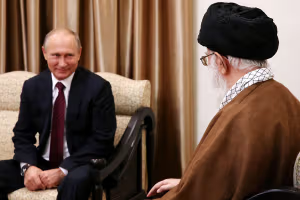
He also criticized what he called excessive alignment with Moscow by some officials and lawmakers. “The deviation from the revolution and the martyrs’ ideals is such that some military men in parliament tear their shirts for [Vladimir] Putin,” he said.
Mousavi, who in July called for a referendum to convene a constitutional assembly, has said Iran’s political structure “does not represent all Iranians.”
Iranian authorities say the 2009 election was fair and that security measures then and since have been necessary to preserve order.
The collapse of Iran’s Ayandeh Bank resembles a national-scale Ponzi scheme, exposing how reckless lending, political patronage, and failed mega-projects drained public wealth.
Ayandeh survived on illusion—paying old investors with new deposits while building an empire of glass and marble called Iran Mall.
Founded in 2010 by businessman Ali Ansari, Ayandeh emerged from the merger of his Bank Tat with several smaller institutions.
Within a few years, it shook up Iran’s banking sector by offering interest rates roughly four percentage points higher than those allowed by the Money and Credit Council.
The strategy drew millions of depositors and rapidly expanded its market share; by 2017, Ayandeh held 7.6 percent of all deposits in Iran’s banking system. Beneath that success lay a web of risky loans and inflated promises.
By 2020, the bank’s fortunes had reversed, and calls for its liquidation began. When it was finally folded into Bank Melli, the savings of seven million depositors were trapped in bad loans and speculative ventures.
Much like a Ponzi scheme, Ayandeh relied on a steady inflow of new deposits to pay earlier investors while channeling enormous sums into illiquid assets—mostly real estate.
Iran Mall in the west of Tehran
Biggest Gamble: Iran Mall
Experts trace Ayandeh’s downfall to its massive exposure to real estate, especially the Iran Mall—a colossal shopping and leisure complex west of Tehran (1.95 million square meters) developed and owned by Ansari himself.
Investigations showed that roughly 70 percent of Ayandeh’s lending went to the Iran Mall Development Company, a subsidiary fully owned by the bank.
The loans exceeded the legal limit for a single borrower by more than a thousandfold—blatant self-dealing that violated banking laws capping ownership of any single shareholder at 10 percent, or 30 percent with Central Bank approval.
Ayandeh’s executives effectively lent billions to themselves, betting that post-nuclear-deal optimism and foreign investment would transform Iran Mall into a profit engine.
But after the US withdrew from the JCPOA in 2018, Iran’s economy contracted, purchasing power plunged, and foreign brands stayed away. What was meant as a monument to modern commerce became a mausoleum of financial hubris and cronyism.
Shielded by Power
Ansari, now 63, began building his empire in his twenties, founding Bank Tat in 2009 with a capital base of 2 trillion rials (about $200 million at the time) before merging it with other institutions to form Ayandeh.
Beyond Iran Mall, he owned several luxury properties, including a Tehran tower sold to convicted tycoon Babak Zanjani, who paid only one-fifth of the price.
After Ayandeh’s dissolution, Ansari claimed his “conscience is clear,” though he has faced no legal proceedings.
Rumors persist of political protection, including alleged ties to Mojtaba Khamenei, the Supreme Leader’s son, and Gholam-Ali Haddad-Adel, Mojtaba’s father-in-law.
These remain unverified but reinforce perceptions that Ayandeh’s rise and fal were inseparable from Iran’s political elite.
‘People pay the price’
By the time the Central Bank dissolved Ayandeh, the bank was 550 quadrillion rials (roughly $5.1 billion) in debt.
If its real-estate assets—including Iran Mall—cannot be sold to cover liabilities, the Central Bank will have to print money to repay depositors, injecting vast sums into the economy—a “pure inflationary disaster,” as the financial outlet Bourse Press warned.
Officials have pledged that major shareholders will be held accountable and small depositors repaid first, but skepticism abounds.
Economist Ali Sarzaeem argued that the Central Bank long knew the scale of Ayandeh’s abuses but lacked the will to act.
“If the bank’s assets are overvalued or unsellable,” he wrote, “the gap between debt and equity will again be filled from the pockets of ordinary Iranians.”
The moderate-conservative Jomhuri Eslami painted an even bleaker picture: “Even more tragic is that this infection has been passed on to Bank Melli—and that bank too will sooner or later meet the same fate.”