Iran, Russia, China question IAEA’s mandate after end of UN resolution
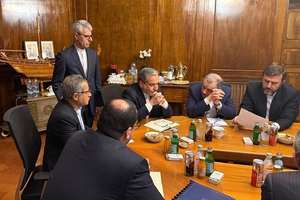
Russian Deputy Foreign Minister Sergei Ryabkov, Chinese Foreign Minister Wang Yi and Iranian Deputy Foreign Minister Kazem Gharibabadi pose for a photo as they meet on March 14, 2025 in Beijing, China.
Iran, Russia and China have told the International Atomic Energy Agency that its monitoring and reporting linked to the 2015 nuclear deal should end following the expiry of the UN resolution that endorsed it, Iranian media said on Friday.
Kazem Gharibabadi, Iran’s deputy foreign minister, said the three countries sent a joint letter to IAEA Director General Rafael Grossi arguing that Resolution 2231, which endorsed the 2015 Joint Comprehensive Plan of Action (JCPOA), formally expired on Oct. 18.
He said the letter followed a previous joint message the countries had sent to the UN secretary-general and the president of the Security Council, declaring the resolution terminated. “All provisions of Resolution 2231 have now lapsed, and attempts by European countries to reactivate sanctions through the so-called snapback mechanism are illegal and without effect,” Gharibabadi said, according to state media.
In their letter, the ambassadors of Iran, Russia and China wrote: “With this termination, the reporting mandate of the Director General of the IAEA concerning verification and monitoring under Security Council Resolution 2231 has come to an end.” The letter added that the IAEA Board of Governors’ decision of Dec. 15, 2015, which authorized verification and monitoring for up to 10 years or until the agency issued a broader conclusion on Iran’s nuclear program, whichever came first, “remains valid and constitutes the sole guidance which the IAEA Secretariat is obliged to follow.”
According to the three governments, “as of 18 October 2025, this matter will be automatically removed from the Board of Governors’ agenda, and no further action will be required in this context.”
Iran, Russia and China have maintained that the resolution’s expiry removes Iran’s nuclear file from the Security Council’s agenda and ends the IAEA’s mandate tied to it.
Grossi urges diplomacy, notes Iran stays in NPT
IAEA chief Rafael Grossi said earlier this week that diplomacy must prevail to avoid renewed conflict and noted that Iran had not withdrawn from the Nuclear Non-Proliferation Treaty despite tensions. He said continued cooperation between Iran and the agency was vital to prevent escalation.
Grossi told Le Temps newspaper on Wednesday that Iran holds enough uranium to build ten nuclear weapons if it enriched further, though there is no evidence it seeks to do so. He said Israeli and US airstrikes in June had caused “severe” damage to Iran’s nuclear facilities in Isfahan, Natanz and Fordow, but that the country’s technical know-how “has not vanished.”
Tehran and the IAEA have yet to agree on a framework to resume full inspections at the bombed sites. Grossi said Tehran was allowing inspectors access “in dribs and drabs” for security reasons, adding that efforts were continuing to rebuild trust and restore routine monitoring.