• العربية
  • فارسی
Brand
  • Iran Insight
  • Politics
  • Economy
  • Analysis
  • Special Report
  • Opinion
  • Podcast
  • Iran Insight
  • Politics
  • Economy
  • Analysis
  • Special Report
  • Opinion
  • Podcast
  • Theme
  • Language
    • العربية
    • فارسی
  • Iran Insight
  • Politics
  • Economy
  • Analysis
  • Special Report
  • Opinion
  • Podcast
All rights reserved for Volant Media UK Limited
volant media logo

Iran lawmaker says nuclear work continues despite site damage

Oct 25, 2025, 10:59 GMT+1
An Iranian missile system is displayed next to a banner with a picture of Iran's Supreme Leader Ali Khamenei during the Iranian Defence Week, in a street in Tehran, Iran, September 25, 2025.

Iran continues to advance its nuclear program despite damage to several atomic facilities, Fadahossein Maleki, a member of parliament’s national security and foreign policy committee, said on Saturday.

Maleki said that airstrikes had harmed parts of Iran’s nuclear infrastructure but that “work is ongoing” and would not be halted. “Nuclear science has become part of the daily life of our people,” he said.

His comments followed remarks by IAEA Director General Rafael Grossi, who said earlier this week that Iran’s technical expertise had survived the 12-day war in June, when US and Israeli airstrikes caused severe damage to key nuclear sites in Isfahan, Natanz and Fordow. Grossi told Le Temps newspaper that Iran now holds enough enriched uranium for ten nuclear weapons if it chose to enrich further, but added there was no evidence Tehran seeks to build one.

He also said Iran had not withdrawn from the Nuclear Non-Proliferation Treaty and that diplomacy should prevail to prevent renewed confrontation.

Maleki said Iran would continue its program “regardless of outside rhetoric” and that there was “no reason to abandon it.”

Renewed friction over IAEA oversight

The lawmaker’s remarks came amid rising tension between Tehran and the International Atomic Energy Agency after Iran, Russia and China urged an end to the agency’s monitoring and reporting tied to the 2015 nuclear deal, following the expiry of the UN resolution that endorsed it.

In a joint letter sent on Friday, the three countries told Grossi that Resolution 2231, which endorsed the 2015 Joint Comprehensive Plan of Action (JCPOA), formally expired on October 18. They asserted that with its termination, the IAEA’s reporting mandate under the resolution “has come to an end.”

Western governments reject that position, insisting that the agency’s verification work remains vital as long as Iran stays bound by the NPT and its safeguards obligations.

Grossi has said the IAEA continues to monitor developments and that cooperation between Iran and the agency is essential to avoid escalation.

Most Viewed

Ghalibaf defends Iran-US talks amid hardline backlash
1
INSIGHT

Ghalibaf defends Iran-US talks amid hardline backlash

2
INSIGHT

100 days after carnage: Iran economy reels from war, inflation, unemployment

3
INSIGHT

A nation in limbo: 100 days after the massacre, has the world moved on?

4
ANALYSIS

From instability to influence: Pakistan’s pivotal role in US-Iran diplomacy

5
ANALYSIS

100 days on: why Iran’s January protests spread across social classes

Banner
Banner

Spotlight

  • War-hit homeowners feel abandoned as Iran’s reconstruction aid fades

    War-hit homeowners feel abandoned as Iran’s reconstruction aid fades

  • 100 days on: the anatomy of Iran’s January crackdown
    INSIGHT

    100 days on: the anatomy of Iran’s January crackdown

  • Ghalibaf defends Iran-US talks amid hardline backlash
    INSIGHT

    Ghalibaf defends Iran-US talks amid hardline backlash

  • 100 days on: why Iran’s January protests spread across social classes
    ANALYSIS

    100 days on: why Iran’s January protests spread across social classes

  • From instability to influence: Pakistan’s pivotal role in US-Iran diplomacy
    ANALYSIS

    From instability to influence: Pakistan’s pivotal role in US-Iran diplomacy

  • A nation in limbo: 100 days after the massacre, has the world moved on?
    INSIGHT

    A nation in limbo: 100 days after the massacre, has the world moved on?

  • Iran, Russia, China question IAEA’s mandate after end of UN resolution

    Iran, Russia, China question IAEA’s mandate after end of UN resolution

  • Trump says Iran no longer respected after US attacks

    Trump says Iran no longer respected after US attacks

•
•
•

More Stories

Khamenei's daily faults officials over 'lax' hijab enforcement

Oct 25, 2025, 09:26 GMT+1

Iran’s hardline daily Kayhan, run by Supreme Leader Ali Khamenei’s representative, blamed government bodies for lax enforcement of hijab rules and called for stronger promotion of compulsory veiling in a commentary published on Saturday.

The call came after remarks earlier this week by government spokesperson Fatemeh Mohajerani, who said “hijab cannot be restored to society by force” and that social values should be strengthened through cultural engagement rather than coercion.

“The enemy pretending to care about our women only dreams of removing their headscarves and seeing them naked, with no concern for their real needs,” Kayhan wrote.

The hardline paper argued that the establishment of the Islamic Revolution had “dispelled the illusion that unveiling represents progress or that hijab hinders development and talent.”

  • Iran says hijab laws remain in force amid debate over enforcement

    Iran says hijab laws remain in force amid debate over enforcement

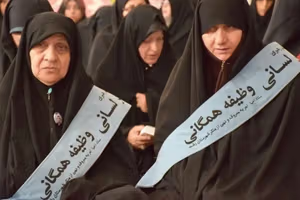
  • Iran to mobilize 80,000 volunteers for hijab campaign, official says

    Iran to mobilize 80,000 volunteers for hijab campaign, official says

The paper portrayed unveiled women as targets of foreign plots and accused senior officials of “passivity and lack of cultural planning.” It said government institutions had failed to act decisively against the promotion of indecency by celebrities and online platforms.

“Purposeful norm-breaking now requires deterrent measures against those leading and promoting it,” the commentary said. “If Iranian women were properly informed, many would consciously choose the Islamic-Iranian lifestyle over Western models.”

It urged cultural bodies to include pro-hijab themes in school curricula, films, and television dramas.

Cultural pressure meets official restraint

Kayhan’s remarks came as Tehran’s Promotion of Virtue and Prevention of Vice headquarters announced plans to deploy 80,000 volunteers to monitor hijab compliance across the capital.

Since the 2022 death of Mahsa Amini in the custody of morality police, widespread defiance of hijab laws has persisted, turning daily appearances of unveiled women in major cities into a visible act of civil disobedience despite recurring enforcement campaigns.

Exiled prince calls for ‘Cyrus Accords’ in post-Islamic Republic Iran

Oct 25, 2025, 08:11 GMT+1

Exiled Iranian prince Reza Pahlavi said on Friday that Iran’s resources should be directed toward peace rather than conflict once the Islamic Republic ends, calling for a new framework he described as the “Cyrus Accords” to follow the 2020 Abraham Accords.

Pahlavi made the remarks during a ceremony in Toronto marking Cyrus the Great Day, an annual commemoration of the founder of the Achaemenid Empire. The event, attended by Iranian-Canadian artists and members of the diaspora, featured musical performances and speeches highlighting Iran’s pre-Islamic heritage.

He said that under a new government, Iran could “turn its resources from supporting violence to advancing peace” and contribute to regional stability. “Iran will elevate the Abraham Accords to the Cyrus Accords,” he said.

The Abraham Accords, brokered by the United States under President Donald Trump in 2020, normalized diplomatic relations between Israel and several Arab states, including the United Arab Emirates and Bahrain. Later joined by Morocco and Sudan, the accords opened direct air links and expanded trade and defense cooperation. They represented the first major diplomatic rapprochement between Israel and Arab nations in decades.

Pahlavi invoked Cyrus the Great as a historical figure symbolizing tolerance and national identity. He said the principles attributed to Cyrus, “Iranian identity, humanity, freedom, and tolerance,” were essential to rebuilding Iran’s political and social order.

The son of Iran’s last Shah said national sovereignty must be returned to the people. He described the Islamic Republic as “corrupt and malevolent” and said its end would allow Iran to rejoin the international community “as a force for peace.”

“Iran is under the occupation of Islamists,” he said, adding that the country’s “window for rescue is limited.” He said Iranians must be prepared to “take responsibility for their destiny” and rebuild a government based on freedom and respect for human rights.

Iran, Russia, China question IAEA’s mandate after end of UN resolution

Oct 25, 2025, 07:51 GMT+1

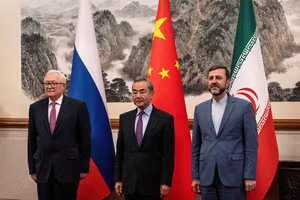
Iran, Russia and China have told the International Atomic Energy Agency that its monitoring and reporting linked to the 2015 nuclear deal should end following the expiry of the UN resolution that endorsed it, Iranian media said on Friday.

Kazem Gharibabadi, Iran’s deputy foreign minister, said the three countries sent a joint letter to IAEA Director General Rafael Grossi arguing that Resolution 2231, which endorsed the 2015 Joint Comprehensive Plan of Action (JCPOA), formally expired on Oct. 18.

He said the letter followed a previous joint message the countries had sent to the UN secretary-general and the president of the Security Council, declaring the resolution terminated. “All provisions of Resolution 2231 have now lapsed, and attempts by European countries to reactivate sanctions through the so-called snapback mechanism are illegal and without effect,” Gharibabadi said, according to state media.

In their letter, the ambassadors of Iran, Russia and China wrote: “With this termination, the reporting mandate of the Director General of the IAEA concerning verification and monitoring under Security Council Resolution 2231 has come to an end.” The letter added that the IAEA Board of Governors’ decision of Dec. 15, 2015, which authorized verification and monitoring for up to 10 years or until the agency issued a broader conclusion on Iran’s nuclear program, whichever came first, “remains valid and constitutes the sole guidance which the IAEA Secretariat is obliged to follow.”

  • Iran no longer bound by 2015 nuclear deal restrictions, Araghchi tells UN

    Iran no longer bound by 2015 nuclear deal restrictions, Araghchi tells UN

  • Iran says UN Resolution 2231 has formally ended

    Iran says UN Resolution 2231 has formally ended

According to the three governments, “as of 18 October 2025, this matter will be automatically removed from the Board of Governors’ agenda, and no further action will be required in this context.”

Iran, Russia and China have maintained that the resolution’s expiry removes Iran’s nuclear file from the Security Council’s agenda and ends the IAEA’s mandate tied to it.

Grossi urges diplomacy, notes Iran stays in NPT

IAEA chief Rafael Grossi said earlier this week that diplomacy must prevail to avoid renewed conflict and noted that Iran had not withdrawn from the Nuclear Non-Proliferation Treaty despite tensions. He said continued cooperation between Iran and the agency was vital to prevent escalation.

Grossi told Le Temps newspaper on Wednesday that Iran holds enough uranium to build ten nuclear weapons if it enriched further, though there is no evidence it seeks to do so. He said Israeli and US airstrikes in June had caused “severe” damage to Iran’s nuclear facilities in Isfahan, Natanz and Fordow, but that the country’s technical know-how “has not vanished.”

Tehran and the IAEA have yet to agree on a framework to resume full inspections at the bombed sites. Grossi said Tehran was allowing inspectors access “in dribs and drabs” for security reasons, adding that efforts were continuing to rebuild trust and restore routine monitoring.

‘Nothing to lose': unbowed Iran may opt for war, ex-Israeli envoy says

Oct 25, 2025, 01:25 GMT+1
•
Negar Mojtahedi

Iran is isolated and under pressure but its robust counterattacks in a 12-day war with Israel may embolden it to fight another more deadly conflict, author and former Israeli ambassador to Washington Michael Oren told Eye for Iran.

“The Middle East is at an inflection point,” Oren said. “Iran feels cornered, and that’s when nations become most dangerous.”

Oren said Tehran does not believe it was defeated in the last conflict and may now see little to lose by reigniting hostilities.

“Toward the end of the war, the percentage of interceptions went down,” he recalled. “The Shahab rockets didn’t take down a room; they took down a neighborhood. I don’t know how many nights we could have gone on.”

He said Iran’s ability to adapt under fire—learning Israel’s missile defense systems in real time—was one reason Israel accepted a ceasefire sooner than expected.

“They were learning how to get through our umbrella,” Oren said. “They were causing us some very severe damage.”

Redefining the Middle East

The former envoy said the aftermath of the conflict has already begun reshaping the region. The Six-Day War of 1967 saw Israel capture vast territory and redraw the Middle East map. Oren, who has written extensively about that war, said the current transformation could be even more consequential.

“The Middle East has been transformed in ways more far-reaching than even the changes after the Six-Day War,” he said.

Oren pointed to Iran’s growing isolation and new alignments forming around Israel. He said some governments that publicly criticized Israel during the fighting are now quietly engaging with it, drawn by shared concerns about Tehran’s role in the region.

“Peace in the Middle East is made through strength,” he said. “Soft power alone has never worked.”

Iran's nuclear file and new fault lines

Oren’s comments come amid renewed tension over Iran’s nuclear program. Tehran, backed by Moscow and Beijing, has informed the International Atomic Energy Agency (IAEA) that European efforts to reimpose sanctions are illegitimate, arguing that UN Resolution 2231 has expired.

In Jerusalem earlier this week, US Vice President JD Vance said Washington will continue to pursue diplomacy to ensure Iran does not obtain a nuclear weapon.

“President Trump actually wants Iran to be prosperous,” Vance said, “but they cannot have a nuclear weapon.”

According to the IAEA, Iran holds about 400 kilograms of uranium enriched to 60 percent—enough for roughly ten bombs if refined further—but there is no evidence Tehran intends to build one. Agency chief Rafael Grossi has warned, however, that if diplomacy fails, “a renewed resort to force cannot be ruled out.”

Inside Iran, Friday sermons reflected a defiant tone. Senior clerics denounced Washington and praised what they called the country’s resilience. Ahmad Khatami vowed to “break the horn of this wild bull,” while Mohammad Saeedi in Qom thanked Supreme Leader Ali Khamenei for “crushing the arrogance of the US president.”

Despite speculation that Israel’s prime minister might pursue another strike, Oren said Israel understands the risks. He noted that the previous conflict could have been far more costly and that few in Israel want to test those limits again.

“Iran is isolated,” he said. “And it may feel that it has nothing to lose by triggering a second round.”

Still, Oren said he remains cautiously optimistic that the region could ultimately move toward a new equilibrium.

“If cards are played right,” he said, “the Middle East could look unrecognizable in two years.”

You can watch the full episode of Eye for Iran on YouTube or listen on any podcast platform of your choosing.

Iranian court sentences man to write out religious book for wearing shorts

Oct 24, 2025, 20:20 GMT+1

A court in the Iranian holy city of Qom sentenced a 26-year-old man to rewrite a religious book by hand as punishment for wearing shorts while skateboarding.

His father, a practicing attorney, said that officers had handcuffed his son and transferred him to the local police station, where he was held overnight, legal advocacy website Dadban reported on Thursday without providing their names.

The young man was released on bail during a preliminary investigation but a judge on Friday sentenced him to write out the whole text of the religious book “Thirty Minutes in the Afterlife” as part of his sentence.

The book is reportedly used to illustrate Islamic concepts of the afterlife, divine judgment and personal accountability, often drawing from Shi'ite religious teachings and narratives about the Day of Judgment.

“Wearing shorts is not a crime and cannot be considered as provoking public sentiment,” the father said. “I have filed a complaint against the police station and the prosecutor for their unlawful behavior.”

“Iranian law contains no provision criminalizing the wearing of shorts by men. The act also does not fall under articles of the Islamic Penal Code, which addresses public acts of immorality, and therefore cannot be legally classified as a crime,” Dadban reported.

Iran enforces Islamic dress codes primarily through mandatory hijab regulations for women and girls, while men are also expected to observe modesty standards, such as avoiding shorts and keeping their shoulders and knees covered — although there is no written law prescribing specific clothing rules for men.