• العربية
  • فارسی
Brand
  • Iran Insight
  • Politics
  • Economy
  • Analysis
  • Special Report
  • Opinion
  • Podcast
  • Iran Insight
  • Politics
  • Economy
  • Analysis
  • Special Report
  • Opinion
  • Podcast
  • Theme
  • Language
    • العربية
    • فارسی
  • Iran Insight
  • Politics
  • Economy
  • Analysis
  • Special Report
  • Opinion
  • Podcast
All rights reserved for Volant Media UK Limited
volant media logo

Iran talks down war fears but US deployments stir anxiety

Maryam Sinaiee
Maryam Sinaiee

Iran International

Oct 2, 2025, 17:20 GMT+1Updated: 00:32 GMT+0
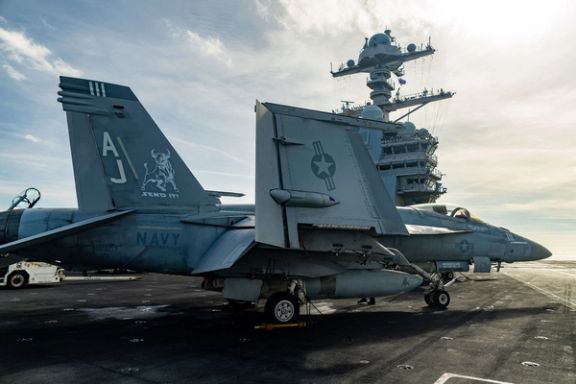
A US navy F-18/A Super Hornet is parked on the deck of the USS Gerald R. Ford as it conducts NATO exercises off European waters, Sept. 24, 2025.

Iranian officials are downplaying talk of another war with Israel and the United States but US carrier and tanker movements have sparked anxiety as weary citizens weigh readiness for a possible re-run of a punishing summer war.

Mohammad-Jafar Ghaempanah, the President’s executive deputy, told reporters after a cabinet meeting on Wednesday that Iran is “fully prepared” for any new war, though he judged it unlikely Iran's foes would “repeat the mistake”.

Ali Saeedi, head of the Supreme Leader’s Ideological-Political Office, told state media he “could not give a clear answer” on whether war will come.

“The armed forces must be fully prepared, but people should continue their lives and should not be inflamed. At present, we do not observe signs of an enemy attack.”

Flight tracking data over the weekend showed a rapid deployment of aerial refueling craft to the Al Udeid airbase in Qatar, the largest American military installation in the region.

The last large-scale movement of such assets coincided with surprise US and Israeli attacks on Iran in a brief June war. That conflict sent tens of thousands of Iranian civilians heeding Israeli warnings to flee major urban areas. Hundreds were killed.

Open-source satellite imagery and flight tracking date shows the USS Nimitz aircraft carrier and its attendant aircraft operating in the Persian Gulf and docked at Dubai's Jebel Ali port as of last month. Such port calls are largely routine.

Behnam Saeedi, secretary of parliament’s National Security Committee, rejected a link between snapback of UN sanctions and war: “Whether a war restarts or not, in the current circumstances, it has nothing to do with the snapback.”

Still, he described the situation as “not a ceasefire but a suspension of combat operations.”

Military posture: beefing up deterrence

Nour News, a news outlet close to Iran's mercurial ex-security boss Ali Shamkhani, on Tuesday framed new US deployments as a “political message” of support to regional allies and a warning to Iran that the military option is still on the table.

Chief of the General Staff Major-General Amir Mousavi declared the Army and the Revolutionary Guards maintain “extraordinary readiness for a possible future clash.”

Brigadier General Mohammad-Jafar Asadi of the Khatam al-Anbiya headquarters promised Iran would “increase the range of its missiles as far as necessary,” while maintaining that Tehran “will not initiate a war but will give a decisive response to any aggression.”

Competing calculations: low or high risk?

Journalist Hossein Yazdi assessed the probability of renewed large-scale strikes as low. He argued Iran’s nuclear sites, already hit, have not been rebuilt; Israel has extracted its revenge; and the US would likely block further escalation.

“The military phase is over,” he wrote on X, suggesting Israel is now using psychological pressure to sap Iran’s economy.

But others warn that the prospect of strikes are high.

“If you think that the deployment of this volume of armaments, refueling aircraft, fighter jets, and so on by America is random, accidental, or merely for the sake of creating fear and intimidation, congratulations," writer Mohammad-Reza Mohajer posted on X. "You are extremely optimistic, and no other event can destroy this optimism in you."

Political analyst Ali Nasri called endless speculation corrosive: “Keeping society continually struggling to ‘predict’ or ‘await’ a military attack is itself a tool of psychological warfare and collective torture of the Iranian people."

"It aims to further damage the economy and disrupt life. If there is a war, we will respond proportionately," he added on X. "For now, our challenge as citizens is to continue ordinary life.”

Street-level voices: fear, anger, fatigue

Signals of potential conflict are already being priced in Iran's moribund markets.

The rial and gold have reacted, with the dollar rate again breaking records against the prone rial and gold hitting new highs. On social media, frustration dominates.

One user lamented: “Instead of enjoying the weekend, everyone I meet talks about war and the dollar and the misery the clerics have given us!”

Another wrote: “Dollar, sanctions and the possibility of war — I really have no strength left to continue.”

Most Viewed

Iran diplomacy wobbles as factions compete to avoid looking soft on US
1
INSIGHT

Iran diplomacy wobbles as factions compete to avoid looking soft on US

2
ANALYSIS

The politics of pink: how Iran uses cuteness to rebrand violence

3

Scam messages seek crypto for ships’ safe passage through Hormuz, firm warns

4
EXCLUSIVE

Family told missing teen was alive, then received his body 60 days later

5
INSIGHT

Is Iran entering its Gorbachev moment?

Banner
Banner

Spotlight

  • Diplomacy tolls at Hormuz as conflict returns to its doorstep
    OPINION

    Diplomacy tolls at Hormuz as conflict returns to its doorstep

  • Opposition to US talks grows in Tehran as ceasefire deadline nears
    INSIGHT

    Opposition to US talks grows in Tehran as ceasefire deadline nears

  • Tehran moderates see ‘no deal–no war’ limbo as worst outcome
    INSIGHT

    Tehran moderates see ‘no deal–no war’ limbo as worst outcome

  • The future has been switched off here
    TEHRAN INSIDER

    The future has been switched off here

  • Lights out, then gunfire: Witnesses recount Mashhad protest crackdown
    VOICES FROM IRAN

    Lights out, then gunfire: Witnesses recount Mashhad protest crackdown

  • Is Iran entering its Gorbachev moment?
    INSIGHT

    Is Iran entering its Gorbachev moment?

•
•
•

More Stories

Denial dominates Iran’s parliament, but sanctions toll hard to ignore

Oct 2, 2025, 08:19 GMT+1
•
Behrouz Turani

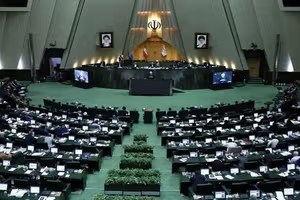
While Iran’s hardline-led parliament resounds with defiant statements dismissing the impact of new UN sanctions, a few lawmakers are beginning to admit the likely economic toll.

Independent MP Hamid Reza Goudarzi broke ranks on Wednesday, saying the so-called snapback of measures halted under the 2015 nuclear deal has “damaged Iran’s economy.”

His remarks drew sharp criticism from colleagues but resonated with many outside parliament who are struggling with higher prices and a collapsing currency.

The rial, which hovered around one million to the US dollar before the sanctions’ return, surged past 1,160,000 by midday Wednesday, a new low. Food and basic staples are increasingly out of reach.

Another moderate MP, Salman Eshaghi, lamented the strain on his constituents in eastern Iran: “People can no longer afford meat, chicken, rice and other staples,” he said, urging the judiciary to summon local and national officials over the price hikes.

But the dominant voices in the Majles remain combative.

‘They want riots’

Vahid Ahmadi, a member of the National Security and Foreign Relations Committee, dismissed the currency crash as a “psychological” effect.

“Nothing has happened as a result of the snapback,” he insisted. “The rise in exchange rates has no economic reason.”

Ahmadi argued that sanctions were simply a continuation of war by other means: “The 12-day war against Iran was intended to trigger regime change and national disintegration. Now that our enemies have failed and begged for a ceasefire, they aim to confront the Islamic Republic through snapback sanctions.”

Another senior MP Ahmad Rastineh echoed this line: “the snapback is designed to incite riots in Iran,” he asserted. “We seek the destruction of Israel, and we will continue to pursue that goal.”

Cracks in hardline narrative?

Hossein Ali Haji Deligani, notorious for his incendiary remarks, took it a step further.

“The European troika is a slave and servant of the United States,” he said. “It is not in Iran’s interest to remain in the 2015 nuclear deal or the Non-Proliferation Treaty.”

Many interpreted this as an open call to review Iran’s nuclear doctrine, edging toward weaponization.

Such hardline voices dominate Iran’s parliament, but cracks are widening as economic pressure intensifies.

Hossein Samsami, an MP for Tehran, tied rising prices directly to the collapsing exchange rate, contradicting colleagues who blamed foreign plots or “psychology.”

The fact that even conservative outlets like the Students News Network are publishing such remarks shows how far the looming crisis has pushed officials: denial still dominates, but moments of candor are breaking through.

Decades of defiance: why Khamenei still believes time is on his side

Oct 1, 2025, 21:10 GMT+1
•
Lawdan Bazargan

Iran’s Supreme Leader Ali Khamenei blocked any potential signal of compromise before President Masoud Pezeshkian even landed in New York—a move some saw as a reckless gamble but in fact a calculated strategy rooted in decades of survival.

By calling negotiations with the United States “pointless” and “harmful,” the 86-year-old theocrat closed the door in advance, after which Pezeshkian delivered one of the harshest speeches of his career on the UN rostrum.

The choreography left no doubt: foreign policy remains Khamenei’s domain, and presidents, however reform-minded are confined to carrying out his script.

Since taking power in 1989, Khamenei has built a structure designed to withstand shocks. He has consolidated control over the military, judiciary and intelligence services, silenced dissent before it could spread, and constructed a security state that has absorbed everything from economic collapse to mass protest.

Khamenei’s doctrine is simple: so long as no foreign power places “boots on the ground” in Tehran, the Islamic Republic can survive.

Regimes in neighboring Iraq and Afghanistan collapsed only when foreign armies physically invaded. Iran’s ruler wagers that Israel lacks the capacity — and Washington the will — to do the same in Iran.

Weapon of time

Airstrikes, sabotage and cyberattacks may wound the system, but the Islamic Republic has bunkers intelligence tools designed to outlast them. This is the logic of endurance: time, not compromise, is Tehran’s strongest weapon.

Yet the June war with Israel revealed how fragile that calculation may be. Precision strikes and AI-driven targeting allowed Israel to decapitate Iranian command structures in hours.

For the first time, senior officers rather than foot soldiers became the primary casualties, along with hundreds of civilians. In such a war, no bunker guarantees safety.

Khamenei’s confidence is shaped not only by military assumptions but also by diplomacy.

One formative lesson came in 1997, when a German court found Iran responsible for the assassinations of three dissidents in a Berlin restaurant. European states briefly withdrew their ambassadors in protest, only to quietly return them months later.

For Khamenei, this was proof that Europe’s resolve is fleeting, its economic and political interests overriding its outrage. He has leaned on that lesson ever since.

Sanctions, what sanctions?

Even now, as the snapback mechanism is reactivated, he assumes enforcement will fray. He expects Europe’s divisions and Washington’s caution to leave loopholes that allow Iran to keep exporting oil, especially to China and India, at discounted rates.

Sanctions, in the octogenarian’s view, are never airtight. They are survivable obstacles, not existential threats.

Khamenei’s rhetoric serves multiple aims: it projects deterrence abroad by drawing red lines; reassures loyalists at home by projecting strength; frames any Western retreat as weakness; and, above all, buys time.

The longer Iran resists, the thinking goes, the more likely international resolve will weaken—as it has before.

But the strategy is not without risk.

Internal unrest can erupt faster and wider this time. Sanctions may dig deeper into the economy, hollowing out the state’s support base. Warfare itself has changed in ways that undercut the assumption that endurance alone ensures survival.

Khamenei continues to rely on the playbook that has carried him through three decades: repression at home, resilience abroad and a conviction that the West will ultimately step back.

The gamble is that history will repeat itself. The danger is that this time, it may not.

Iran watchdog clears tougher espionage law targeting Israel, US cooperation

Oct 1, 2025, 13:27 GMT+1

Iran’s Guardian Council on Wednesday approved a bill imposing harsher penalties for espionage and collaboration with Israel, the United States and other “hostile states,” clearing the way for the law to be enacted once signed by President Masoud Pezeshkian.

The legislation, formally titled the “Intensification of Punishment for Espionage and Cooperation with the Zionist Regime and Hostile States Against National Security and Interests,” was passed by parliament in late June following the 12-day war between Iran and Israel.

The Guardian Council, a powerful 12-member body of clerics and jurists that vets legislation and elections in Iran, initially sent the bill back in July citing ambiguities, but said after revisions it no longer conflicted with Islamic law or the constitution.

  • New Iran espionage law halted for review, slowing post-war crackdown

    New Iran espionage law halted for review, slowing post-war crackdown

  • Iran's parliament approves death penalty for cooperation with Israel, US

    Iran's parliament approves death penalty for cooperation with Israel, US

The measure classifies espionage or intelligence cooperation with Israel and the US as “corruption on earth,” a charge under Iran’s penal code that can carry the death penalty.

It also criminalizes providing information, media content or assistance to groups deemed hostile, with prison sentences ranging from two to 15 years depending on the offense.

  • Iran executes man accused of spying for Israel

    Iran executes man accused of spying for Israel

  • Iran hangs nuclear scientist over alleged espionage for Israel’s Mossad

    Iran hangs nuclear scientist over alleged espionage for Israel’s Mossad

Supporters say the law is needed to counter infiltration and disinformation. “Any cooperation in media or propaganda activity, including sending videos or images to hostile channels that weaken public morale or create division, undermines national security and will face severe judicial response,” said Ebrahim Azizi, a former Revolutionary Guards commander and head of parliament’s national security committee.

  • Iran arrests over 700 accused of spying for Israel amid espionage crackdown

    Iran arrests over 700 accused of spying for Israel amid espionage crackdown

  • Iran to execute over 100 inmates over Israel spying charges - Sunday Times

    Iran to execute over 100 inmates over Israel spying charges - Sunday Times

The bill follows the June conflict in which Israeli airstrikes targeted Iranian nuclear and missile sites, prompting Tehran to retaliate with hundreds of missile and drone launches.

Iranian authorities later announced the arrest of hundreds of people accused of spying for Israel and the US.

Rights advocates have expressed concern that the law’s broad definitions, including provisions applying retroactively, could restrict free expression and be used against journalists and activists.

Boeing to get $123mln to replace bombs used in Iran strikes - Bloomberg

Oct 1, 2025, 09:22 GMT+1

Boeing is set to receive a contract worth up to $123 million to replace the 14 massive bunker-buster bombs expended during June’s US strikes on Iran’s nuclear facilities, Bloomberg reported on Tuesday,citing a Pentagon budget document and three people familiar with the matter.

The weapon, known as the GBU-57 Massive Ordnance Penetrator (MOP), weighs 30,000 pounds (13,600 kg), measures six meters (20 feet) in length, and is considered the world’s largest precision-guided conventional bomb. It can penetrate up to 200 feet underground before detonating, according to the US Air Force.

The Pentagon disclosed in an August budget document that it had reallocated $123 million from operations and maintenance accounts to Air Force munitions procurement, saying the funds were needed to replace munitions used in “Operation Midnight Hammer,” the code name for the strikes.

The document described the operation as being conducted “in support of Israel.”

During the June raid, US B-2 bombers deployed 12 of the MOPs against the Fordow nuclear enrichment facility, with President Donald Trump telling a gathering of military leaders outside Washington that the weapons achieved “total obliteration,” and that “every single one of them hit its target.”

On June 22, Trump ordered airstrikes on nuclear sites at Isfahan, Natanz, and Fordow two days before brokering a ceasefire to a 12-day war in June between Iran and Israel.

The bombs are manufactured with components from several facilities. The bomb bodies are forged at the McAlester Army Ammunition Plant in Oklahoma, where the Army has been expanding production capacity to triple monthly output.

Personnel there fill casings with explosives and assemble the warhead and fuse. Boeing supplies the tail kit, which provides navigation and guidance systems, and has integrated the bomb for use with the B-2 stealth bomber.

The Air Force has disclosed few details about the program but acknowledged in 2015 that it had contracted 20 units with Boeing.

The new replacement contract is separate from an agreement the service awarded in late August to Applied Research Associates Inc. and Boeing to design and prototype the next generation of the weapon.

After June war, is the Islamic Republic due for a 'paradigm shift'?

Sep 30, 2025, 20:23 GMT+1
•
Behrouz Turani

Once relegated to the world of academic social science, the term "paradigm shift" has gained traction in Iran's political discourse after a punishing 12-day war with Israel and the United States exposed the country's weakness.

With new international sanctions set to deepen economic suffering and no diplomatic or domestic opening yet visible, the severity of Iran's predicament is clear.

The term "paradigm shift" has become a euphemism for fundamental change to Iran’s political system, specifically, curbing Supreme Leader Ali Khamenei’s nearly four decades of autocratic rule.

As Iran's primary and often sole decision-maker, Khamenei has shaped not only strategic affairs but also the daily operations of government, media and public life.

But a remarkable exchange between two natural political opponents aired by an independent media outlet appears to show that both sides of the political spectrum grasp the need for a profound shift, albeit couched in politically inoffensive terms.

On September 29, the Iranian website Entekhab posted a YouTube video featuring a debate between two prominent figures: Mohammad Reza Bahonar, a conservative heavyweight and member of the Expediency Council and Abolfazl Shakouri Rad, former leader of the reformist Unity of the Nation Party.

In the 90-minute video, Bahonar emphasized that a paradigm shift does not mean regime change.

“It’s not about abandoning principles,” he said. “It’s about adapting them to new realities. The revolution’s core, Islamic governance and independence, remains intact. But the world has changed. We can’t ignore the demands of the youth or the country’s economic challenges.”

Shakouri Rad agreed, framing the shift in terms of Thomas Kuhn’s theory of scientific revolutions: “This is Kuhn’s paradigm shift applied to politics, old models collapse under pressure. Iran is facing this due to sanctions, demographics and technological globalization.”

Kuhn (1922–1996) was an American historian and philosopher of science who popularized the concept of paradigm shifts.

'Mini-shifts'

Bahonar noted that Iran has experienced “mini-shifts” before, under President Akbar Hashemi Rafsanjani (1989–1997), who pursued economic liberalization, and President Mohammad Khatami (1997–2005) who pushed for reforms despite resistance from Khamenei.

These shifts, Bahonar argued, were pragmatic rather than ideological.

Shakouri Rad added historical context: “Paradigm shifts often occur during crises like the 1979 revolution or the 1988 ceasefire with Iraq. Today, we’re in a post-heroic phase. War veterans no longer dominate politics. Over 60% of the population is under 30. They demand transparency and reject the resistance narrative.”

Bahonar called for economic reform as the cornerstone of any shift: “The Resistance Economy is a good idea, but it will fail without global engagement. Sanctions have crippled us. A real shift requires pragmatic diplomacy. Domestically, we must decentralize power and empower local councils.”

Shakouri Rad focused on ideological reform, touching on the foundational theocratic doctrine of the country.

“Velayat-e Faqih (Guardianship of the Jurist) needs reinterpretation, not abolition. We must transition from exporting revolution to practicing defensive realism," he said.

Despite their differences, both politicians agreed on the need for generational transition. Shakouri Rad elaborated: “We need a hybrid model of Islamic values with modern efficiency, like Turkey’s early Erdogan era. The solution is bottom-up change through elections, not top-down fatwas. Data shows 70% of Iranians want better ties with the West.”

Bahonar warned of the risks of delay: “If the shift is too slow, economic collapse could trigger unrest.” Shakouri Rad echoed the concern: “Without change, brain drain will accelerate.”

Responding to viewers’ questions at the end of the segment, Bahonar reiterated: “Shift means dialogue, not submission. Change is an Islamic duty. The ‘evolve or perish’ idea isn’t Western—it’s Quranic adaptation.”