• العربية
  • فارسی
Brand
  • Iran Insight
  • Politics
  • Economy
  • Analysis
  • Special Report
  • Opinion
  • Podcast
  • Iran Insight
  • Politics
  • Economy
  • Analysis
  • Special Report
  • Opinion
  • Podcast
  • Theme
  • Language
    • العربية
    • فارسی
  • Iran Insight
  • Politics
  • Economy
  • Analysis
  • Special Report
  • Opinion
  • Podcast
All rights reserved for Volant Media UK Limited
volant media logo
EXCLUSIVE

Khamenei’s reversal on secret US talks hamstrings president at UN

Mehdi Parpanchi
Mehdi Parpanchi

Iran International executive editor

Sep 29, 2025, 19:35 GMT+1Updated: 00:33 GMT+0
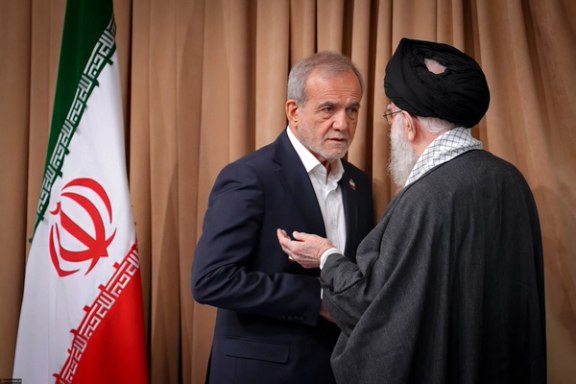
Iran's Supreme Leader Ali Khamenei (right) speaks to President Masoud Pezeshkian on September 7, 2025

Iranian President Masoud Pezeshkian departed Tehran for the United Nations in New York last week buoyed by Supreme Leader Ali Khamenei's quiet blessing to start secret talks with Washington to ward off looming sanctions.

According to two members of Pezeshkian's delegation, the 86-year-old hardline theocrat had privately told the relatively moderate president he could start a secret dialogue if it headed off the return of United Nations sanctions due for the week's end.

But as their plane crossed the Atlantic, Khamenei delivered a fiery speech on state television categorically ruling out any talks with Washington in a reversal that stunned Pezeshkian and Iran's top envoy, according to the two sources.

Iran’s foreign minister Abbas Araghchi later confided before a closed-door meeting of Iranian experts and academics that renewed US talks were the only avenue to halt the return of the European-triggered sanctions, three participants told Iran International.

The episode shows the Supreme Leader and his top civilian officials are deeply at odds about how to chart Tehran's way out of the lingering impasse over its nuclear program which threatens further conflict after a punishing Israeli-US war in June.

Araghchi and US President Donald Trump's special envoy Steve Witkoff had held indirect talks for two months before a surprise Israeli military campaign on Iran on June 13.

The attacks were capped off by US strikes on three key Iranian nuclear sites which appeared to bury much of Iran's highly-enriched uranium stockpiles but left the ultimate resolution of the West's standoff with Iran on its nuclear ambitions unresolved.

Khamenei in his speech and Pezeshkian in an address before the United Nations again said Tehran does not seek a bomb and hit out at sanctions as unfair and illegal.

Closed-door meeting in Manhattan

On Friday, Sept. 26, shortly after the UN Security Council rejected Russian and Chinese proposals to suspend the snapback of UN sanctions on Iran, Pezeshkian and Araghchi met with a small group of invited Iranian experts and academics at The Luxury Collection Hotel in Manhattan.

The session was scheduled to last an hour, but before it began, Foreign Minister Abbas Araghchi lingered in the lobby with a few of the invitees, speaking more candidly than usual about Tehran's predicament.

“The only way to stop the snapback was direct talks,” Araghchi told them. “And only direct talks can prevent further escalation. But we are not allowed to engage.”

He even suggested the participants urge Pezeshkian to try to persuade the Supreme Leader, but none of them did that.

Khamenei's U-turn on secret US talks

Three participants in the private meeting later recounted to Iran International, on condition of anonymity, that Araghchi elaborated further before the session began.

He explained that before leaving Tehran, Pezeshkian had raised the idea of direct engagement with the Supreme Leader. The Americans, he said, had laid out three firm conditions for such talks with envoy Steve Witkoff:

1. Public, on-the-record meetings with the press present before and after.

2. Disclosure of the location of 400 kilograms of highly enriched uranium.

3. Full access for inspectors from the International Atomic Energy Agency.

Araghchi said Ayatollah Khamenei had rejected public negotiations but explicitly agreed that secret direct talks would be acceptable if they could stop the snapback.

Yet by the time the delegation landed in New York, the Supreme Leader had gone on state television to rule out any talks at all — directly contradicting his private position and leaving the delegation blindsided.

Inside Tehran’s New York huddle

The private hourlong session with Pezeshkian brought together a group of academics and experts including Houshang Amirahmadi, an academic and longtime advocate of US–Iran engagement; Vali Nasr, a scholar and former State Department adviser; and Trita Parsi, the executive vice president of the Quincy Institute for Responsible Statecraft.

The other participants included Hadi Kahalzadeh, a fellow at the Quincy Institute for Responsible Statecraft; Djavad Salehi Esfahani, a professor of economics at Virginia Tech; Masoud Delbari, a senior energy expert and analyst; Ali-Akbar Mousavi Khoeini, a former Iranian parliamentarian and reformist activist; Mohammad Manzarpour, a freelance journalist; and Yousef Azizi, a PhD candidate at Virginia Tech.

Amirahmadi spoke first, and for nearly half the meeting. For about 25 minutes he laid out a stark binary: surrender or go nuclear. He argued that the United States’ main problem with Iran was not its nuclear program but its strength in the region. Washington, he said, does not want a “powerful Iran.” He strongly advised Pezeshkian that Iran must invest more heavily in its missile and military capabilities, declaring that the time had come to pursue a nuclear deterrent. His remarks went on so long that Iran’s UN envoy, Amir Saeed Iravani, eventually asked him to conclude.

Pezeshkian, throughout, took careful notes. When he returned to Tehran, he told journalists at the airport that in his meeting with Iranians, “one of the respected figures” had said the United States’ real problem with Iran was its strength. He did not name Amirahmadi but directly echoed his point.

Because of the length of Amirahmadi’s remarks, only a few others had time to weigh in. Parsi said the major sanctions were American sanctions, with UN measures adding complications but not being the primary concern. He added that despite the UN sanctions, he expected China to continue buying Iranian oil, saying Beijing would likely ignore the restrictions. Both Araghchi and Pezeshkian nodded in agreement. Parsi also insisted that direct dialogue with Washington remained the only way to avoid escalation and prevent Israel from exploiting Iran’s isolation.

Nasr offered a bleaker assessment, saying Tehran had missed its chance under President Biden and that little could now be recovered. He spoke briefly and did not engage further.

A system in crisis

The contradictions at the heart of Tehran’s decision-making were unmistakable. Privately, Khamenei had given conditional approval for secret talks, and Araghchi confided this to a few attendees, making clear that Iran’s leadership understood direct dialogue was the only path left.

Publicly, however, the Supreme Leader reversed himself overnight, denouncing all negotiations and leaving his own president and foreign minister uncertain of their mandate.

The episode revealed a system in crisis: with the president, the foreign minister, and many political figures pressing for de-escalation as the only way to avoid another war, while Khamenei alone stood in the way, shifting positions in a manner that even his closest envoys struggled to navigate.

The president’s trip to New York, meant to showcase pragmatism, instead underscored paralysis.

Editor’s Note:
Our initial report, based on sources, said that Farnaz Fassihi attended the meeting. The New York Times has since issued a statement saying that she was not present. Accordingly, her name has been removed from the report.

Most Viewed

Ghalibaf defends Iran-US talks amid hardline backlash
1
INSIGHT

Ghalibaf defends Iran-US talks amid hardline backlash

2
ANALYSIS

From instability to influence: Pakistan’s pivotal role in US-Iran diplomacy

3
ANALYSIS

100 days on: why Iran’s January protests spread across social classes

4

War-hit homeowners feel abandoned as Iran’s reconstruction aid fades

5

Iran says no decision yet on talks as Pakistan prepares to host US team

Banner
Banner

Spotlight

  • Iran diplomacy wobbles as factions compete to avoid looking soft on US
    INSIGHT

    Iran diplomacy wobbles as factions compete to avoid looking soft on US

  • The politics of pink: how Iran uses cuteness to rebrand violence
    ANALYSIS

    The politics of pink: how Iran uses cuteness to rebrand violence

  • Bread shortages, soaring prices strain households in Iran, residents say
    VOICES FROM IRAN

    Bread shortages, soaring prices strain households in Iran, residents say

  • 100 days on: the anatomy of Iran’s January crackdown
    INSIGHT

    100 days on: the anatomy of Iran’s January crackdown

  • Ghalibaf defends Iran-US talks amid hardline backlash
    INSIGHT

    Ghalibaf defends Iran-US talks amid hardline backlash

  • From instability to influence: Pakistan’s pivotal role in US-Iran diplomacy
    ANALYSIS

    From instability to influence: Pakistan’s pivotal role in US-Iran diplomacy

•
•
•

More Stories

Concessions or distractions? Iran's pop culture challenges theocratic rule

Sep 29, 2025, 18:12 GMT+1
•
Maryam Sinaiee

Pop concerts and late summer parties are spreading across Iran as music, as dance and fashion become battlegrounds testing the limits of state control.

Videos on social media show unveiled women dancing and singing freely at these events, some of them open to the public. In Tehran’s Grand Bazaar, models recently walked a red-carpet fashion show with no hijab in sight.

Just a few years ago, such scenes brought swift arrests. Most seem to meet no retaliation, and the fashion show earned only a limp judicial summons.

Some view these as proof of state retreat under social pressure. Others say it’s not real change but fleeting gestures to distract from economic hardship and the anniversary of the 2022–23 Woman, Life, Freedom protests in which hundreds were killed.

Hardliners fight on

Hardliners denounce hijab-free events as a betrayal of revolutionary values, warning that such openings erode ideological control and deepen rifts inside the establishment.

“It’s as if all the cultural officials of the country have perished together,” one conservative commentator posted online.

“Why did we have a revolution, sacrifice our loved ones to the enemy’s blade, and create a cemetery of martyrs? Only to become so like Westerners and allow a civilization … detached from Sharia to dominate us?”

At the Shah’s palace

The clash was visible at a September concert by pop star Sirvan Khosravi on the grounds of the Shah’s former palace, now run by Tehran Municipality. Clips of unveiled women singing and dancing went viral.

Only a year earlier, women were detained at another Khosravi concert for Islamic dress code violations. This time, police stood back. Some described the atmosphere as euphoric.

“Sirvan Khosravi’s concert was more than just a performance; it was walls breaking down,” said Nazanin, a 21-year-old student. “The compulsory hijab has nearly collapsed, and women are reclaiming cultural freedoms one by one.”

On X, a user named Mostafa used the hashtag #retreat: “Did anyone notice? The attendees sang ‘I love my life’ with no interference from enforcers … or police? The Mayor and City Council paid the costs, and police chief (Ahmadreza) Radan was busy protecting the dancers!”

Both officials had long promoted and enforced Islamic dress codes.

Opening or survival instinct?

Some among Tehran’s opposition accuse both artists and fans of playing into the establishment’s hands, saying that such events coincide with families mourning the third anniversary of Mahsa Amini’s killing.

“When certain groups in the government stage free street concerts during the protests’ anniversary, a wise person shouldn’t play on its turf,” one user posted on X. “Whatever the mullahs say and do, the opposite is right.”

Some see this tolerance as a survival tactic rather than real liberalization. Others believe it signals cracks in the Islamic Republic’s cultural order.

Music journalist Bahman Babazadeh argued: “The system has learned its lesson. It has moved beyond the stupidity of canceling concerts. It’s no big deal if a few reactionary zealots get angry by these images. For survival, the system has adapted.”

Filmmaker and academic Ali Azhari suggested the state tolerates “safe” cultural expressions while clamping down on those with social impact.

“The regime has concluded, more or less, that cultural mediocrity is harmless,” he wrote.

“Pop beats, commercial comedies with a few sexual jokes … don’t really pose a threat to the system. But when culture drives real social mobilization, there is no compromise.”

Iran warns of harsh penalties for illegal poppy cultivation

Sep 29, 2025, 13:26 GMT+1

Iran’s anti-narcotics authority warned on Monday that poppy cultivation would face severe punishment, including fines, prison and land confiscation for repeat offenders.

Tarahomi, head of legal affairs at the Anti-Narcotics Headquarters, told state media that speculation about legalizing poppy cultivation was misplaced. “What is under consideration is licensing controlled cultivation of certain poppy species such as Papaver bracteatum -- also known as the Iranian poppy -- for medical use, not opium poppy,” he said.

He explained that Iran had voluntarily halted poppy farming after the 1979 revolution, meeting pharmaceutical needs through seizures and imports. But declining production in Afghanistan has forced Tehran to consider limited licensed cultivation for morphine and related medicines under international conventions.

Tarahomi said licensed crops would be grown only on enclosed land with state purchase and factory processing, leaving no possibility of diversion. By contrast, he warned, illegal growers would face escalating penalties: “The first time a fine, the second time a fine and prison, and from the third time onward, fine, prison and confiscation of agricultural land.”

Officials have previously reported a sharp fall in opium seizures and rising concerns over illegal cultivation in some provinces, with authorities destroying thousands of hectares of illicit fields.

Iran judiciary warns of legal action against those stoking fear over sanctions

Sep 29, 2025, 11:00 GMT+1

Iran’s judiciary chief warned on Monday that those undermining public morale amid renewed international sanctions would face legal action, accusing them of aiding hostile powers.

“For nearly half a century, the front of arrogance has employed every kind of conspiracy and enmity against the Iranian nation and the Islamic Republic,” Gholamhossein Mohseni-Ejei told the Supreme Judicial Council, using a phrase Iranian authorities employ to refer to Western powers.

He said economic siege was “nothing new” for Iranians, adding: “At this time, when enemies are focusing all efforts to bring down the Iranian nation and system, we must be vigilant that their agents do not infiltrate and damage national unity.”

“Those who through psychological operations weaken people’s spirit and spread fear will face legal measures,” he said, warning that profiteers or individuals disrupting essential goods markets “whether out of greed, negligence, or acting as enemy agents, will be dealt with decisively under the law.”

Earlier this month, Iran’s prosecutor general’s office warned that media and online outlets would also face legal action if their coverage of the reimposed UN sanctions undermines public morale.

Judiciary’s news outlet Mizan said some websites and channels had posted “sensitive content” about rising prices, adding that such reporting threatened the “psychological security of society.”

The judiciary has previously pursued cases against journalists and citizens over commentary on political and economic issues.

Pezeshkian under fire as UN sanctions return sparks rival camps’ backlash

Sep 28, 2025, 19:00 GMT+1
•
Maryam Sinaiee

The reimposition of UN sanctions on Iran, atop the US sanctions President Masoud Pezeshkian had pledged to lift during his election campaign, has disillusioned many of his moderate supporters and prompted hardliners to call for his resignation.

Pezeshkian, who left New York on Saturday empty-handed after failing to secure a deal with European powers, said the United States demanded Iran surrender its stock of highly enriched uranium in exchange for only 90 days of relief from UN sanctions.

“If we are to choose between the unreasonable demands of the Americans and the snapback, our choice is the snapback,” Pezeshkian said, hours before the return of UN sanctions.

Kamran Matin, professor of international relations at the University of Sussex, told Iran International that Iran’s leaders knew negotiations would not succeed because halting enrichment and surrendering the highly enriched uranium stockpiles would have meant “total surrender”—something that would have endangered the Islamic Republic’ cohesion.

US-based commentator Ali Afshari argued that the responsibility went beyond Pezeshkian, stressing that presidents do not determine Iran’s strategic policies.

“Those who peddled illusions in the 2024 presidential ‘quasi-election’ cannot hold only Masoud Pezeshkian responsible for the return of UN sanctions and the war,” he wrote on X, adding that reformists had misled voters by urging participation.

Hardliners claim vindication

The snapback of UN sanctions has emboldened Pezeshkian’s conservative rivals who staunchly opposed the 2015 nuclear deal.

After the UN vote, his hardline election rival Saeed Jalili wrote on X: “In 2015 they said JCPOA would completely lift sanctions but almost nothing (happened). Ten years of a nation’s life was wasted because of this political behavior.”

Ultra-hardline lawmaker Amirhossein Sabeti, a close ally of Jalili, echoed his remarks: the JCPOA “was a colonial and one-sided agreement that wasted ten years of the nation’s life, restricted Iran’s nuclear infrastructure, and ultimately, by proving the wisdom of the revolutionary camp that opposed it from the beginning, exposed the illusions of the pro-West faction.”

On social media, ultra-hardline users demanded prosecutions. One wrote: “The end of the disgraceful JCPOA—the greatest shame in the history of Iran’s politics—congratulations to patriotic compatriots and those who care for Iran, and condolences to reformists, centrists, moderates, and all traitors to the homeland. It is time that those responsible for this disgraceful agreement be put on trial for this unforgivable betrayal.”

Some voices in the reformist camp lamented the collapse. Azar Mansouri, head of the Reform Front, accused conservatives of political score-settling.

“They fought it for years and now celebrate its death. But returning to the pre-JCPOA era means sanctions, isolation, and more pressure on the people. What is there to celebrate?”

Disillusionment with Pezeshkian

Frustration has increasingly turned toward the president. One user recalled his campaign pledge: “Pezeshkian had promised that if he failed to achieve his goals, including lifting sanctions, he would resign. Why didn’t he rely on popular mobilization to achieve his aims? Why doesn’t he resign now?”

Others mocked his unkept promises. “From the beginning, pinning hopes on Pezeshkian to lift sanctions was wishful thinking,” one activist wrote. “Someone who couldn’t deliver on his promise of lifting internet filtering after a year cannot be expected to deliver on lifting sanctions… He had also promised to resign if his pledges were not fulfilled.”

Journalist Mohammad Aghazadeh faulted reformists for urging turnout: “They frightened us by saying if Jalili won, the JCPOA would collapse, and war would break out. Pezeshkian was elected, but sanctions returned, and war came too—and will come again.”

Activist Hossein Razzagh, who boycotted the election, wrote: “The only thing Pezeshkian is not committed to is the votes of those he lured to the ballot box with promises of lifting the shadow of war. The only thing he is committed to is the Leader!”

Journalist Ahmad Zeidabadi urged Pezeshkian to level with voters: “Most of the decisive factors lie beyond his control. But he must frankly explain to the people what his plan is… In fact, he entered the second round of the presidential election with the aim of saving us from Saeed Jalili’s program. Now he is compelled to play Mr. Jalili’s role himself!”

Political activist Motahereh Gounei summed up the wider sense of betrayal: “You celebrated that Jalili didn’t come and Pezeshkian did! The country was ruined, its resources and infrastructure destroyed, we got both war and negotiations!"

"Sanctions returned, the dollar reached 110,000 tomans, and now I, a young Iranian, am awaiting a prison sentence simply for writing about Khamenei’s incompetence in governance and policymaking," the activist said.

Iran’s intelligence mocked by allies and foes over 'secret' Israel files

Sep 27, 2025, 17:55 GMT+1
•
Maryam Sinaiee

A documentary released by Iran’s Intelligence Ministry claiming infiltration into Israel has drawn ridicule from both opposition groups and hardline loyalists of the Islamic Republic who criticized it for relying on public images and exaggerating its claims.

The documentary, The Spider’s Hideout, aired on state television on September 24, presenting alleged intelligence on Israeli nuclear sites, including Dimona.

Intelligence Minister Esmaeil Khatib described it as "a major infiltration yielding a treasure of top-secret intelligence," seemingly in response to criticism of his ministry’s failures during Israel’s June campaign.

Independent reviews, however, revealed that most images were publicly available online. Critics noted some visuals depicted Israel’s nuclear research collaboration rather than weapons programs, and the individuals named were publicly known Israeli Atomic Energy officials.

The incident has raised concerns about the inefficiency of Iran's intelligence apparatus and its propaganda methods.

Mehdi Kharratian, head of an Iranian think tank close to power circles, wrote: "Superiority must be shown not in the media but in the field—by raising levels of deterrence and increasing the costs to any enemy that acts against the country's security."

He also urged the establishment of a fact-finding committee to address inefficiencies and security gaps within the intelligence apparatus.

Guards-linked outlets admit use of online photos

Fars News Agency, affiliated with the Revolutionary Guards (IRGC), acknowledged using archival images, describing the choice as “poor judgment” that allowed critics to call the documentary “fabricated.”

It confirmed that all images, including archived ones, were labeled as “exclusive photos.”

Mashregh News, also linked to the IRGC, claimed the documents came from human sources inside Israel and were used in targeting sites during the 12-day war.

While admitting some images were available online, it alleged Israel had waged a Persian-language social media campaign to discredit the documentary.

Social media reactions

Iranian media largely avoided direct criticism of the intelligence ministry probably due to fear of prosecution, but X users from opposition and Islamic Republic loyalists were scathing:

“The Islamic Republic’s problem is that it thinks it is ruling over people aged 5 to 10… This is how the clerics have driven a great country into ruin," one user said on X.

"Calling (the documentary) a media stunt would be generous — it was more like a media toy; like a rattle handed to a child to distract them," reads another post.

Ghasem Mohammadi, a supporter of the Green Movement leader Mir-Hossein Mousavi, lamented wasted resources, writing: “Once again the people’s money has been squandered.”

“It is truly upsetting to see the state of the country’s intelligence apparatus like this! Some things are a matter of dignity.”

“Believe me, if the enemy wanted to ruin an institution’s reputation with a media operation, they couldn’t have done better.”

Why are ultra-hardliners criticizing the ministry?

Some ultra-hardliners’ criticism may reflect a structural conflict between Iran’s Intelligence Ministry and the IRGC’s parallel intelligence network, which aligns more with hardline factions.

Although appointed with the Supreme Leader's approval, the Intelligence Minister formally reports to the president and is intended to serve as the country’s main civilian intelligence body, while the IRGC’s intelligence organization reports directly to the Supreme Leader and the Guards’ command.

This dual structure creates overlapping responsibilities and frequent rivalries, with the IRGC often acting independently of—or even in opposition to—the ministry’s priorities.

The ministry has supported President Masoud Pezeshkian’s push for social and cultural relaxation, including resisting the enforcement of the new Hijab law. These changes, now increasingly irreversible, are seen as undermining hardline influence.