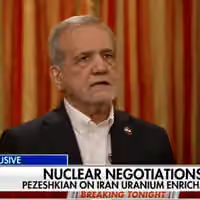
Speaking in a televised interview, Larijani, head of Iran’s Supreme National Security Council, said Washington has demanded Iran halt all uranium enrichment and curb its missile program.
“The Americans insist we must negotiate, specifically about Iran’s missiles,” Larijani said. “They came and said you shouldn’t have any enrichment at all … They said no missiles, sometimes below 300 kilometers (185 miles), now below 500 kilometers (310 miles)—meaning they want to strip us of key defensive and offensive capabilities.”
For years, Iran has voluntarily capped its missile range at 2,000 kilometers, which it says is sufficient to reach its main regional adversary, Israel.
France, Britain and Germany triggered the resumption of UN sanctions against Iran last month through the “snapback” mechanism of a 2015 nuclear deal, accusing Tehran of not conforming to nuclear obligations outlined in the agreement.
The measures are scheduled to take effect September 28. Larijani dismissed their impact, arguing that US sanctions remain far harsher.
“Some politicians in Iran ask why we don’t resolve this sooner. We’re trying to resolve it; we don’t want unnecessary pressure on the country. But is there any politician in Iran who would agree to cut our missile range below 500 kilometers?” he asked.
Supreme Leader Ali Khamenei on Tuesday rejected talks with Washington, calling US President Donald Trump’s demand that Iran end domestic uranium enrichment an “insult” that had earned him a “slap in the face” from the Iranian people.
President Masoud Pezeshkian, addressing the UN General Assembly in New York on Wednesday, denounced Israeli raids on Iran’s nuclear facilities in June as illegal and condemned European powers for reimposing UN sanctions.
Bad terms
Larijani said that Iran is open to dialogue but unwilling to accept terms he called “illogical.”
“The issue is they want us to negotiate. Negotiate, fine—has anyone said don’t negotiate? But if the endgame is already decided, no sensible person will accept it. We’ve tried all paths, but if they insist on these illogical demands, we must stand firm.”
Israel launched a surprise military campaign on June 13, striking military and nuclear sites in Iran. Air raids killed nuclear scientists along with hundreds of military personnel and civilians. Tehran retaliated with drone and missile attacks that killed 31 Israeli civilians and one off-duty soldier.
The United States entered the conflict on June 22, bombing major nuclear facilities including Fordow, Natanz, and Isfahan, before brokering a ceasefire on June 24.
Washington said the strikes set back Iran’s nuclear program by years, though the International Atomic Energy Agency has yet to verify the damage due to lack of access.