• العربية
  • فارسی
Brand
  • Iran Insight
  • Politics
  • Economy
  • Analysis
  • Special Report
  • Opinion
  • Podcast
  • Iran Insight
  • Politics
  • Economy
  • Analysis
  • Special Report
  • Opinion
  • Podcast
  • Theme
  • Language
    • العربية
    • فارسی
  • Iran Insight
  • Politics
  • Economy
  • Analysis
  • Special Report
  • Opinion
  • Podcast
All rights reserved for Volant Media UK Limited
volant media logo

Belgian MPs summon Iranian ambassador over missing Swedish prisoner

Sep 19, 2025, 11:24 GMT+1Updated: 00:38 GMT+0
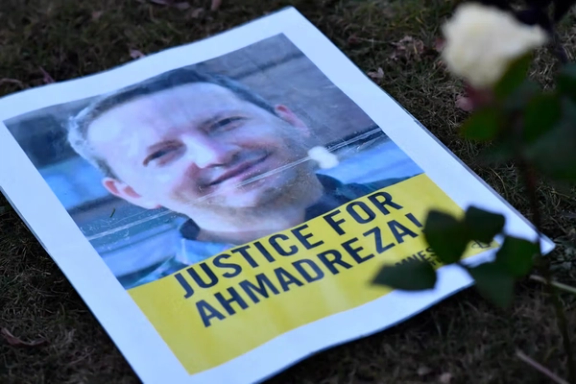
A poster from a protest in support of Ahmadreza Djalali

The Foreign Policy Committee of the Flemish Parliament in Belgium has called on Iran’s ambassador to clarify the fate of Ahmadreza Djalali, the jailed Iranian-Swedish academic whose whereabouts have been unknown since June.

“After three months without any news, concern about the condition of Prof. Ahmadreza Djalali is greater than ever. The MPs therefore want to obtain more information from the Iranian ambassador,” parliament chair Freya Van den Bossche and committee chair Bogdan Vanden Berghe said in a joint statement on Thursday.

Djalali, a disaster medicine specialist affiliated with the Free University of Brussels, was detained in April 2016 during a professional visit to Iran. In 2017 he was sentenced to death on charges of espionage and complicity in the killing of two Iranian nuclear scientists, accusations he and his family have consistently denied.

Earlier this year, he suffered a heart attack while held in Tehran’s Evin prison. After the Israeli bombing of that facility, he was transferred with other detainees to the Greater Tehran Penitentiary. From there, according to accounts shared by his family, he was taken away separately. Since June 23, there has been no trace of him.

Pressure builds in Belgium

Last week, the committee and parliament speaker Van den Bossche met Djalali’s wife, Vida Mehrannia, to discuss his situation. Following that meeting, MPs unanimously agreed to summon the Iranian envoy.

Djalali’s case has drawn international concern, with European institutions and human rights organizations urging Tehran to halt his death sentence and release him on humanitarian grounds.

For Belgian lawmakers, his disappearance has heightened alarm not only about his health but also about the Iranian authorities’ treatment of dual nationals, many of whom remain imprisoned under contested charges.

Most Viewed

Ghalibaf defends Iran-US talks amid hardline backlash
1
INSIGHT

Ghalibaf defends Iran-US talks amid hardline backlash

2
VOICES FROM IRAN

Bread shortages, soaring prices strain households in Iran, residents say

3
INSIGHT

Iran diplomacy wobbles as factions compete to avoid looking soft on US

4
ANALYSIS

The politics of pink: how Iran uses cuteness to rebrand violence

5
ANALYSIS

From instability to influence: Pakistan’s pivotal role in US-Iran diplomacy

Banner
Banner

Spotlight

  • Is Iran entering its Gorbachev moment?
    INSIGHT

    Is Iran entering its Gorbachev moment?

  • Iran crackdown reaches cemeteries as graves of slain protesters defaced
    EXCLUSIVE

    Iran crackdown reaches cemeteries as graves of slain protesters defaced

  • Iran diplomacy wobbles as factions compete to avoid looking soft on US
    INSIGHT

    Iran diplomacy wobbles as factions compete to avoid looking soft on US

  • The politics of pink: how Iran uses cuteness to rebrand violence
    ANALYSIS

    The politics of pink: how Iran uses cuteness to rebrand violence

  • Bread shortages, soaring prices strain households in Iran, residents say
    VOICES FROM IRAN

    Bread shortages, soaring prices strain households in Iran, residents say

  • Ghalibaf defends Iran-US talks amid hardline backlash
    INSIGHT

    Ghalibaf defends Iran-US talks amid hardline backlash

•
•
•

More Stories

Nearly a third of Iranian general practitioners inactive

Sep 19, 2025, 09:52 GMT+1

Almost 29 percent of registered general practitioners in Iran are not practicing medicine, according to figures cited by local media, which said the trend highlights waste in training costs and ongoing shortages of medical specialists.

More than 104,000 general practitioners are officially registered, but at least 30,000 are not active in the field, Nour News, an Iranian outlet affiliated with Supreme National Security Council, reported Thursday.

“The number alone demonstrates the loss of educational, financial and human capacity in a country that constantly faces shortages of specialists and unequal access to health services,” the outlet wrote.

It criticized authorities for repeatedly expanding medical school admissions as a response to shortages, arguing this has produced “a surplus of manpower without efficiency.”

Concerns about the lack of specialists have grown in recent years.

Interest in six key specialty fields has declined to the point that “the absence of applicants in these core disciplines will confront Iran’s healthcare system with serious challenges,” Abbasali Reis-Karami, head of Tehran University of Medical Sciences warned in July.

Training each general practitioner, according to Nour News, costs the government “tens of thousands of dollars,” yet many leave medicine altogether or turn to unrelated jobs.

No effective strategy has addressed the shortage of specialists, the outlet added, citing the most recent residency exam where only 10 percent of emergency medicine slots were filled, alongside 32 percent in anesthesiology, 22 percent in pediatrics, and 15 percent in infectious diseases.

An increasing number of Iranian doctors and nurses are leaving the profession or emigrating, mainly due to very low wages, raising concerns about a serious shortage of healthcare workers.

Iranian medical and government officials have repeatedly warned in the past few years about the inevitable deterioration of the healthcare system and its possible collapse if the same trends continue.

Iran withdraws resolution on nuclear site attacks at IAEA

Sep 19, 2025, 08:10 GMT+1

Iran pulled a resolution at the UN nuclear watchdog’s annual conference that sought to prohibit attacks on nuclear facilities.

The draft resolution—co-sponsored by China, Russia, and a group of nations including Cuba and Venezuela—condemned the June 2025 Israeli and US strikes on Iranian nuclear facilities.

“Guided by the spirit of goodwill and constructive engagement, and at the request of several member states,” Tehran had deferred action until next year, Iran’s Ambassador to the UN Reza Najafi told the General Conference on Thursday.

Iran and the other sponsors of the resolution do not wish to place member states in a position of endorsing an unrealistic decision, he said.

The issue will be raised again at the next session of the IAEA General Conference, according to the Permanent Mission of the of Iran.

The withdrawal also comes as France, Germany and the UK have invoked the snapback mechanism to reimpose UN sanctions on Iran under resolution 2231. That process is expected to conclude by September 28 unless the Security Council adopts a resolution to preserve sanctions relief.

This comes against a backdrop of escalating tensions, triggered by Israeli strikes on Iranian nuclear and military sites in June, followed by US attacks on three additional facilities.

However, Tehran says its nuclear program is peaceful.

French President Emmanuel Macron said on Thursday that the sanctions process was “a done deal,” adding that “The latest news we had from the Iranians is not serious.”

Security Council set to vote on Iran sanctions snapback

Sep 19, 2025, 07:40 GMT+1

The UN Security Council will vote Friday morning on a draft resolution concerning the snapback of sanctions on Iran, a process initiated after European governments declared the country in significant non-performance of the 2015 nuclear deal.

South Korea, as Council president this month, placed the text in blue earlier in September. It contains a single operative paragraph affirming that past sanctions remain terminated, meaning adoption would preserve relief measures under resolution 2231.

European ministers said in an August 28 letter that Iran’s actions left no credible alternative to triggering the mechanism. They pointed to more than 8,400 kilograms of enriched uranium—forty times the agreed limit—including several hundred kilograms enriched to 60 percent. “Iran has yet to take the reasonable and precise actions necessary to reach an extension of resolution 2231,” the German Foreign Office said Wednesday.

US Secretary of State Marco Rubio welcomed the E3 move while stressing continued room for diplomacy in late August. The United States remains available for direct engagement with Iran in “furtherance of a peaceful, enduring resolution to the Iran nuclear issue,” Rubio said.

Council divisions

China, Russia, and Pakistan are expected to support the draft resolution. Denmark, France, Greece, Panama, Slovenia, the Republic of Korea, the UK, and the US are unlikely to back it, leaving the text short of the nine votes needed for passage. Even if it reached that threshold, the US is expected to veto.

If no resolution is adopted, sanctions suspended since 2015 will automatically return at the end of the 30-day window on September 28. That would reinstate restrictions on uranium enrichment, arms, finance, and shipping linked to Iran’s nuclear and missile programs.

Negotiations may continue during the UN General Assembly’s high-level week, where China and Russia have circulated an alternative draft extending the deal until April 2026.

Israel raids on Iran arms in Syria had Putin’s blessing, ex-Mossad chief says

Sep 18, 2025, 23:17 GMT+1

Russian President Vladimir Putin personally gave the green light for Israeli airstrikes in Syria against Iranian arms transfers to Lebanon's Hezbollah during Bashar al-Assad’s rule, former Mossad chief Yossi Cohen reveals in his new memoir Sword of Freedom.

Israel carried out hundreds of air raids in Syria during the civil war from 2011 onward, aiming to disrupt shipments of advanced weaponry from Iran’s Revolutionary Guard Corps (IRGC) to Hezbollah in Lebanon and other allied groups.

At the time, observers in Iran questioned why their Russian allies, which controlled much of Syrian airspace, did not intervene to shield Tehran’s forces and proxies.

Now, Yossi Cohen reveals in his new book that he secured Putin’s green light after traveling to Moscow to personally make the case for the strikes.

“I visited the Kremlin to explain, in detail, how and why we had to hit that route because of the weapons finding their way to Iran’s Revolutionary Guards, within Syria, and to Hezbollah in Lebanon,” he wrote.

According to Cohen, Putin accepted the logic of Israel’s position and suggested setting up a direct channel between the militaries to avoid misunderstandings.

“Putin followed my logic, proposed that our respective deputy chiefs of staff open up a red line every time we intended to attack, and gave his blessing,” he revealed.

The former spy chief underscored that Moscow’s acquiescence was not merely symbolic, but essential to Israel’s freedom of action in Syria.

“That permission, to strike at the interests of his partners in Iraq as well as Syria, was essential, since the Russians operate S300 and S400 air defense systems that can strike at aircraft flying at up to thirty kilometers, or 98,000 feet, high,” Cohen explained.

“We cannot risk the beautiful F-35s the Americans give us, so we cannot be shy about our best interests.”

Russia entered the Syrian conflict in 2015 to support President al-Assad, aligning itself with Iran, Lebanon’s Hezbollah, and other Shi’ite militias that were backing Damascus in its fight against Islamic State and various Sunni rebel factions.

The Israeli strikes intensified under al-Assad’s embattled government, which relied heavily on Tehran and its allied militias for survival. At the time, Russia had deployed advanced S-300 and S-400 air defense systems and exercised significant control over Syrian airspace, making Moscow’s consent critical for Israeli operations.

Post-Assad Syria

After al-Assad was overthrown by the forces of Abu Mohammad al-Jolani in December 2024, Iran and Russia confronted steep losses of influence in Syria. Tehran’s deep investments in militias and infrastructure largely unraveled, while Moscow saw its grip on Damascus loosen.

Russia’s prized naval foothold at Tartus came under pressure after Syrian authorities moved to terminate the lease, forcing Moscow to scale back operations and withdraw several warships. At the same time, equipment was relocated from the Khmeimim air base, where access is now subject to restrictions imposed by rebel factions controlling the surrounding area.

The turmoil has only deepened in the months since. Clashes between Syria’s new Islamist rulers and the Israeli-backed Druze minority in the southern province of Sweida—compounded by Israeli strikes on Syrian government forces—have pushed Damascus into an uneasy recalibration of its ties with Moscow.

Earlier in the year, the Syrian authorities were actively seeking to sideline Russia, but the threat posed by Israel has since compelled them to consider expanding Russian military involvement as a counterbalance.
Rare missile tests streak through Tehran twilight

Sep 18, 2025, 20:35 GMT+1

Iran carried out missile tests around the capital Tehran on Thursday evening local time, a local official confirmed. A Revolutionary Guards-linked outlet and eyewitnesses reported images and video of the test on social media.

The missile launches were visible from Tehran and the nearby northeastern cities of Gorgan, Sari and Semnan. Unverified videos shared online appeared to show trails of smoke from the launches arcing upward in the sky.

Mehdi Barari, deputy governor of Semnan for political, security and social affairs was quoted by state broadcaster IRIB as confirming the tests.

"The luminous objects observed in the sky over several provinces, including Semnan, this evening were related to missile system tests in another part of the country," IRIB cited him as saying, adding that he indicated there was no cause for public concern.

Sepah Pasdaran News, an official telegram channel of Iran's Islamic Revolutionary Guard Corps, shared imagery of the nighttime trails in the sky without explicitly claiming responsibility. Missile tests are relatively rare in Iran.

Israel said it degraded and destroyed much of Iran's arsenal it is surprise 12-day campaign against the Islamic Republic in June. Tehran counters that its capabilities weathered Israeli attacks and missile attacks deterred its foe.

Iran's missile program has long been a key point of contention with Western powers and its arch-enemy Israel, who say the weapons pose a threat.

Tehran on Wednesday ruled out any talks with the United States on its missiles, accusing Washington of blocking prospects for nuclear negotiations by insisting on military curbs Iran deems a non-starter.

"The United States is in no position to make decisions about Iran’s national defence capabilities," foreign ministry spokesman Esmaeil Baqaei said.

"The Islamic Republic of Iran is determined to preserve its independence at any cost, stand on its own feet, and firmly resist the excessive demands, aggression, and acts of hostility by foreign powers -- including the United States and the Zionist regime."