• العربية
  • فارسی
Brand
  • Iran Insight
  • Politics
  • Economy
  • Analysis
  • Special Report
  • Opinion
  • Podcast
  • Iran Insight
  • Politics
  • Economy
  • Analysis
  • Special Report
  • Opinion
  • Podcast
  • Theme
  • Language
    • العربية
    • فارسی
  • Iran Insight
  • Politics
  • Economy
  • Analysis
  • Special Report
  • Opinion
  • Podcast
All rights reserved for Volant Media UK Limited
volant media logo

Israel raids on Iran arms in Syria had Putin’s blessing, ex-Mossad chief says

Sep 18, 2025, 23:17 GMT+1Updated: 00:38 GMT+0
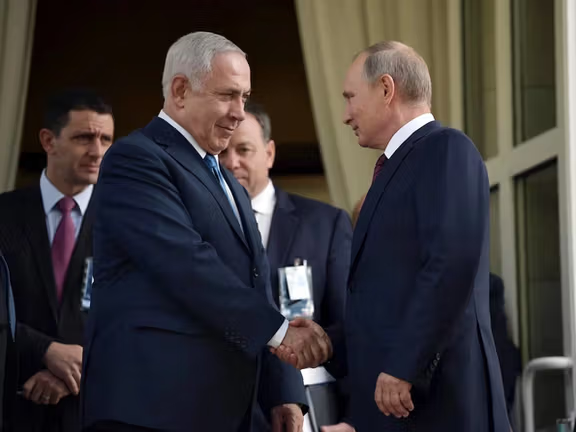
Russian President Vladimir Putin (R) shakes hands with Israeli Prime Minister Benjamin Netanyahu during a meeting in Sochi, Russia August 23, 2017.

Russian President Vladimir Putin personally gave the green light for Israeli airstrikes in Syria against Iranian arms transfers to Lebanon's Hezbollah during Bashar al-Assad’s rule, former Mossad chief Yossi Cohen reveals in his new memoir Sword of Freedom.

Israel carried out hundreds of air raids in Syria during the civil war from 2011 onward, aiming to disrupt shipments of advanced weaponry from Iran’s Revolutionary Guard Corps (IRGC) to Hezbollah in Lebanon and other allied groups.

At the time, observers in Iran questioned why their Russian allies, which controlled much of Syrian airspace, did not intervene to shield Tehran’s forces and proxies.

Now, Yossi Cohen reveals in his new book that he secured Putin’s green light after traveling to Moscow to personally make the case for the strikes.

“I visited the Kremlin to explain, in detail, how and why we had to hit that route because of the weapons finding their way to Iran’s Revolutionary Guards, within Syria, and to Hezbollah in Lebanon,” he wrote.

According to Cohen, Putin accepted the logic of Israel’s position and suggested setting up a direct channel between the militaries to avoid misunderstandings.

“Putin followed my logic, proposed that our respective deputy chiefs of staff open up a red line every time we intended to attack, and gave his blessing,” he revealed.

The former spy chief underscored that Moscow’s acquiescence was not merely symbolic, but essential to Israel’s freedom of action in Syria.

“That permission, to strike at the interests of his partners in Iraq as well as Syria, was essential, since the Russians operate S300 and S400 air defense systems that can strike at aircraft flying at up to thirty kilometers, or 98,000 feet, high,” Cohen explained.

“We cannot risk the beautiful F-35s the Americans give us, so we cannot be shy about our best interests.”

Russia entered the Syrian conflict in 2015 to support President al-Assad, aligning itself with Iran, Lebanon’s Hezbollah, and other Shi’ite militias that were backing Damascus in its fight against Islamic State and various Sunni rebel factions.

The Israeli strikes intensified under al-Assad’s embattled government, which relied heavily on Tehran and its allied militias for survival. At the time, Russia had deployed advanced S-300 and S-400 air defense systems and exercised significant control over Syrian airspace, making Moscow’s consent critical for Israeli operations.

Post-Assad Syria

After al-Assad was overthrown by the forces of Abu Mohammad al-Jolani in December 2024, Iran and Russia confronted steep losses of influence in Syria. Tehran’s deep investments in militias and infrastructure largely unraveled, while Moscow saw its grip on Damascus loosen.

Russia’s prized naval foothold at Tartus came under pressure after Syrian authorities moved to terminate the lease, forcing Moscow to scale back operations and withdraw several warships. At the same time, equipment was relocated from the Khmeimim air base, where access is now subject to restrictions imposed by rebel factions controlling the surrounding area.

The turmoil has only deepened in the months since. Clashes between Syria’s new Islamist rulers and the Israeli-backed Druze minority in the southern province of Sweida—compounded by Israeli strikes on Syrian government forces—have pushed Damascus into an uneasy recalibration of its ties with Moscow.

Earlier in the year, the Syrian authorities were actively seeking to sideline Russia, but the threat posed by Israel has since compelled them to consider expanding Russian military involvement as a counterbalance.

Most Viewed

Ghalibaf defends Iran-US talks amid hardline backlash
1
INSIGHT

Ghalibaf defends Iran-US talks amid hardline backlash

2
VOICES FROM IRAN

Bread shortages, soaring prices strain households in Iran, residents say

3
INSIGHT

Iran diplomacy wobbles as factions compete to avoid looking soft on US

4
ANALYSIS

The politics of pink: how Iran uses cuteness to rebrand violence

5
ANALYSIS

From instability to influence: Pakistan’s pivotal role in US-Iran diplomacy

Banner
Banner

Spotlight

  • Is Iran entering its Gorbachev moment?
    INSIGHT

    Is Iran entering its Gorbachev moment?

  • Iran crackdown reaches cemeteries as graves of slain protesters defaced
    EXCLUSIVE

    Iran crackdown reaches cemeteries as graves of slain protesters defaced

  • Iran diplomacy wobbles as factions compete to avoid looking soft on US
    INSIGHT

    Iran diplomacy wobbles as factions compete to avoid looking soft on US

  • The politics of pink: how Iran uses cuteness to rebrand violence
    ANALYSIS

    The politics of pink: how Iran uses cuteness to rebrand violence

  • Bread shortages, soaring prices strain households in Iran, residents say
    VOICES FROM IRAN

    Bread shortages, soaring prices strain households in Iran, residents say

  • Ghalibaf defends Iran-US talks amid hardline backlash
    INSIGHT

    Ghalibaf defends Iran-US talks amid hardline backlash

Tweet unavailable

•
•
•

More Stories

Rare missile tests streak through Tehran twilight

Sep 18, 2025, 20:35 GMT+1

Iran carried out missile tests around the capital Tehran on Thursday evening local time, a local official confirmed. A Revolutionary Guards-linked outlet and eyewitnesses reported images and video of the test on social media.

The missile launches were visible from Tehran and the nearby northeastern cities of Gorgan, Sari and Semnan. Unverified videos shared online appeared to show trails of smoke from the launches arcing upward in the sky.

Mehdi Barari, deputy governor of Semnan for political, security and social affairs was quoted by state broadcaster IRIB as confirming the tests.

"The luminous objects observed in the sky over several provinces, including Semnan, this evening were related to missile system tests in another part of the country," IRIB cited him as saying, adding that he indicated there was no cause for public concern.

Sepah Pasdaran News, an official telegram channel of Iran's Islamic Revolutionary Guard Corps, shared imagery of the nighttime trails in the sky without explicitly claiming responsibility. Missile tests are relatively rare in Iran.

Israel said it degraded and destroyed much of Iran's arsenal it is surprise 12-day campaign against the Islamic Republic in June. Tehran counters that its capabilities weathered Israeli attacks and missile attacks deterred its foe.

Iran's missile program has long been a key point of contention with Western powers and its arch-enemy Israel, who say the weapons pose a threat.

Tehran on Wednesday ruled out any talks with the United States on its missiles, accusing Washington of blocking prospects for nuclear negotiations by insisting on military curbs Iran deems a non-starter.

"The United States is in no position to make decisions about Iran’s national defence capabilities," foreign ministry spokesman Esmaeil Baqaei said.

"The Islamic Republic of Iran is determined to preserve its independence at any cost, stand on its own feet, and firmly resist the excessive demands, aggression, and acts of hostility by foreign powers -- including the United States and the Zionist regime."

Two Tehran cafes shuttered over alleged alcohol, nudity and dancing

Sep 18, 2025, 18:08 GMT+1

Authorities in Tehran have shut down two cafe-restaurants over alleged violations including “serving alcohol, nudity, and mixed-gender dancing,” Revolutionary Guards-affiliated Fars news agency reported on Thursday.

Fars said the Suite Lounge café-restaurant in northern Tehran was shut down on those grounds and released a video of a police raid that did not show nudity, though women without the compulsory hijab were visible.

The Banichu café-restaurant in western Tehran, which had previously received a closure warning, was also shut down earlier this week after authorities said "six liters of homemade and foreign alcohol were discovered," and mixed-gender parties were held.

The main suspect linked to Banichu remains at large, and a judicial case is under review at the Tehran prosecutor’s office, the report added.

Possession and consumption of alcohol are illegal in Iran, carrying punishments ranging from fines and lashings to prison sentences. Despite the ban, underground networks and discreet venues continue to supply alcohol, often at high cost and under strict secrecy, according to both state and independent reports.

Separately, on Thursday, police in the western Iranian city of Doroud shut down 12 cafés and traditional teahouses for “failing to comply with trade regulations,” state broadcaster IRIB reported, adding that another nine businesses received written warnings.

In recent weeks, authorities have shuttered several cafes and restaurants across Iran, citing reasons ranging from live music and mixed-gender gatherings to customers failing to conform to Islamic dress codes.

Over the past two months, at least 20 cafes, garden restaurants, and wedding halls have been closed in Tehran, Dezful, Hamedan, Kashan and Maragh in Isfahan province over alleged hijab violations, according to a report by reformist daily Ham Mihan.

Last year, at least 536 businesses across Iran were shut down, mostly for non-commercial reasons such as enforcing mandatory hijab, operating during Ramadan, or holding events during religious mourning periods, according to US-based rights group Human Rights Activists in Iran (HRANA).

The group said the closures highlight growing intervention by judicial and security bodies in business activity, with significant impacts on individual and social freedoms.

Snapback sanctions will be imposed on Iran by month’s end, Macron says

Sep 18, 2025, 17:00 GMT+1

Snapback sanctions on Iran will be triggered at the end of this month, French President Emmanuel Macron said in an interview with Israel’s Channel 12 on Thursday.

Asked if the return of UN sanctions on Iran was a "done deal," Macron answered: “Yes, I think so. Because the latest news we have from the Iranians are not serious."

Iran’s Foreign Minister Abbas Araghchi, he added, “tried to make a reasonable offer” to reach a deal with European powers, but did not receive backing from other members of the Iranian ruling system.

Iran made a new proposal to the E3 nations Britain, Germany and France on Wednesday to avoid the return of UN sanctions, Wall Street Journal journalist Laurence Norman reported on X earlier on Thursday.

The E3 views the proposal as insufficient because it seeks major concessions without any concrete Iranian action, Norman added, citing an unnamed source.

Seperately, Axios journalist Barak Ravid wrote on X that a draft resolution to extend the suspension of UN sanctions on Iran will be circulated at the Security Council on Thursday, with a vote scheduled for Friday.

Barak said the resolution is not expected to pass, which would trigger the “snapback” mechanism, leading to the reimposition of sanctions on Iran at 8 p.m. ET on September 27.

The three European powers triggered the snapback process on August 28 under Resolution 2231, demanding Iran return to talks, grant wider access to inspectors, and account for its missing uranium stockpiles.

On Wednesday, European foreign ministers urged Iran to resume nuclear talks, allow inspections of sensitive sites and curb its stockpile of highly enriched uranium.

Last week, Iran's foreign minister Abbas Araghchi said that if the E3 move to activate the snapback mechanism to reimpose UN sanctions, "they will be excluded from nuclear negotiations with the Islamic Republic."

Europe unmoved by Iranian proposal to avoid sanctions - WSJ reporter

Sep 18, 2025, 15:56 GMT+1

European states at the center of a sanctions drama with Tehran due for a finale next month deemed an Iranian proposal to gain a reprieve insufficient and overly demanding, a Wall Street Journal reporter said on Thursday.

The E3 - France, Germany and the United Kingdom - last month triggered a mechanism in a 2015 international nuclear deal with Iran to "snapback" international sanctions within 30 days if Tehran does not convince them of its compliance.

“Iran made a new offer to E3 yesterday to avoid snapback, I understand. One which frankly is barely a bit credible. I am not alone in thinking that,” Norman posted on X, going on to cite a source familiar with the matter.

"The E3 regard Iran's latest proposal as insufficient in substance as it demands far-reaching actions like extension of the SnapBack or even complete termination (of 2231) in exchange for Iranian declarations of intent, but without any concrete actions on the Iranian side," he quoted the source as saying.

Norman was referring to the United Nations Security Council resolution number promulgating the nuclear deal which, in the Western view, authorizes the snapback move.

Iran denies seeking a bomb, criticized the US withdrawal from the agreement during President Donald Trump's first term in 2018 and say the European powers lack authority to trigger snapback sanctions because they violated their own commitments to the deal.

Any agreement to extend or avert the restored sanctions must be reached before a October 18 deadline.

The E3 "remain dedicated to diplomacy and ready to engage with Iran at any time, including" at the UN General Assembly meeting in New York next week, Norman quoted the source as saying.

The 80th session of the UN General Assembly opened on September 9, with world leaders beginning to arrive in New York on September 22.

Norman, a veteran watcher of international nuclear diplomacy, paraphrased Iran’s position as “Give us everything we want, and we might give you some of what you want.”

The Joint Comprehensive Plan of Action (JCPOA), signed in 2015 by Iran and the P5+1, the United States, Britain , France, Germany, Russia and China plus the European Union, aimed to curb Iran’s nuclear program in return for sanctions relief.

Iran says facing 'hybrid war' despite end of 12-day conflict

Sep 18, 2025, 14:02 GMT+1

A senior commander in Iran’s Islamic Revolutionary Guard Corps said on Thursday the country remained under attack in a “hybrid war” waged by the United States and Israel, even after the end of their 12-day military confrontation in June.

Yadollah Javani, the Guards’ deputy political chief, said the conflict was “years old” and had only taken on a military dimension earlier this summer. He told a gathering in Kerman that while fighting had ceased, the campaign continued across media, cyber and political domains.

Javani said Iran’s response would be a “hybrid jihad,” mobilizing military, cultural and public resources to counter what he described as the enemy’s focus on narrative battles and online influence.