• العربية
  • فارسی
Brand
  • Iran Insight
  • Politics
  • Economy
  • Analysis
  • Special Report
  • Opinion
  • Podcast
  • Iran Insight
  • Politics
  • Economy
  • Analysis
  • Special Report
  • Opinion
  • Podcast
  • Theme
  • Language
    • العربية
    • فارسی
  • Iran Insight
  • Politics
  • Economy
  • Analysis
  • Special Report
  • Opinion
  • Podcast
All rights reserved for Volant Media UK Limited
volant media logo

Iran-linked networks amplify false claims after Charlie Kirk killing, researchers say

Sep 18, 2025, 10:25 GMT+1Updated: 00:39 GMT+0
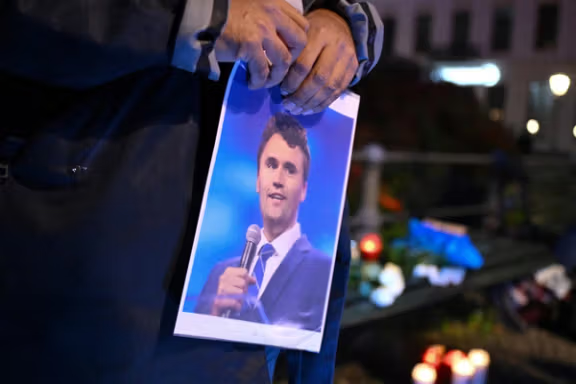
A man holds a picture of Charlie Kirk beneath a banner during a vigil outside the US Embassy in Berlin, September 11, 2025.

Iran-aligned media and online networks joined Russia- and China-linked actors in pushing false or inflammatory narratives after US conservative activist Charlie Kirk was shot dead earlier this month according to US officials and outside researchers.

Monitoring firm NewsGuard said on Wednesday that official outlets in China, Russia and Iran mentioned Kirk more than 6,000 times from September 10–17, frequently framing the shooting as a conspiracy and recycling unsubstantiated claims.

“The more confusion and mistrust they can inject right after a breaking news event, the harder it becomes for people to know what’s true,” McKenzie Sadeghi, NewsGuard’s editor for AI and foreign influence, said.

Utah Governor Spencer Cox said earlier this week that authorities were tracking “a tremendous amount of disinformation” and bot activity urging violence; he did not cite specific accounts.

Police have charged a 22-year-old suspect and said he acted alone. Authorities have not linked the killing to any foreign government.

Analysts and media reports say the narratives diverged: pro-Kremlin channels sought Ukraine links; Beijing-aligned accounts highlighted US polarization and gun violence; and Iran-linked outlets and influencers promoted anti-Israel conspiracy theories.

Pro-Iranian groups say Israel was behind Kirk’s death and that the suspect was set up to take the fall, according to New York Times.

“They’re picking up domestic actors and amplifying them,” said Joseph Bodnar of the Institute for Strategic Dialogue.

Cox urged Americans to ignore viral claims that appear designed to provoke fear.

The activity fits a longer pattern US officials have attributed to Tehran. Microsoft’s Threat Analysis Center reported in August 2024 that Iranian operators stood up US-facing pseudo-news sites such as “Savannah Time” and “Nio Thinker,” sometimes using generative AI, and in June 2024 attempted to compromise accounts tied to US presidential campaigns.

The Foundation for Defense of Democracies said in September 2024 it had identified at least 19 pro-Iran sites targeting minority and veteran voters. Google Cloud’s Mandiant and Meta have separately flagged Iran-linked efforts aimed at US audiences.

Washington has sanctioned Iranian and Russian entities over alleged interference. In December 2024, the US Treasury blacklisted an Islamic Revolutionary Guard Corps subsidiary known as the Cognitive Design Production Center and Russia’s Center for Geopolitical Expertise, accusing both of seeding disinformation and, in Moscow’s case, using AI-generated deepfakes.

Russia, China and Iran have all denied targeting Americans with disinformation.

Kirk, founder of Turning Point USA, had mixed public views on Iran over the years. In 2020 he warned against a broader war after the US killed Iranian commander Qassem Soleimani. In June 2025, after US strikes on Iranian nuclear sites, he publicly backed the action while praising Iranian-Americans in earlier campus remarks widely shared online.

US officials say foreign exploitation of domestic crises predates the 2024 election cycle. A 2021 declassified assessment found Iran sought to undercut Donald Trump’s prospects in 2020 while eroding trust in US institutions; security agencies warned again in 2022 and 2024 that Tehran aims primarily to inflame social divisions.

The Center for Countering Digital Hate said posts calling for retaliatory violence after Kirk’s killing were viewed 43 million times on X, though the share from foreign sources is unclear.

Most Viewed

Ghalibaf defends Iran-US talks amid hardline backlash
1
INSIGHT

Ghalibaf defends Iran-US talks amid hardline backlash

2
INSIGHT

A nation in limbo: 100 days after the massacre, has the world moved on?

3
ANALYSIS

From instability to influence: Pakistan’s pivotal role in US-Iran diplomacy

4
ANALYSIS

100 days on: why Iran’s January protests spread across social classes

5

War-hit homeowners feel abandoned as Iran’s reconstruction aid fades

Banner
Banner

Spotlight

  • War-hit homeowners feel abandoned as Iran’s reconstruction aid fades

    War-hit homeowners feel abandoned as Iran’s reconstruction aid fades

  • 100 days on: the anatomy of Iran’s January crackdown
    INSIGHT

    100 days on: the anatomy of Iran’s January crackdown

  • Ghalibaf defends Iran-US talks amid hardline backlash
    INSIGHT

    Ghalibaf defends Iran-US talks amid hardline backlash

  • 100 days on: why Iran’s January protests spread across social classes
    ANALYSIS

    100 days on: why Iran’s January protests spread across social classes

  • From instability to influence: Pakistan’s pivotal role in US-Iran diplomacy
    ANALYSIS

    From instability to influence: Pakistan’s pivotal role in US-Iran diplomacy

  • A nation in limbo: 100 days after the massacre, has the world moved on?
    INSIGHT

    A nation in limbo: 100 days after the massacre, has the world moved on?

  • Slain activist Charlie Kirk praised Iranians, backed nuclear sites attack

    Slain activist Charlie Kirk praised Iranians, backed nuclear sites attack

  • Charlie Kirk urged Trump in Oval Office to avoid war with Iran, Carlson says

    Charlie Kirk urged Trump in Oval Office to avoid war with Iran, Carlson says

•
•
•

More Stories

Iran cites wartime-like conditions, ties IAEA inspections to new safeguards

Sep 18, 2025, 07:24 GMT+1

The country faces conditions similar to wartime following Israeli and US airstrikes on its nuclear facilities, Iran’s nuclear chief said on Wednesday, warning that inspections by the International Atomic Energy Agency would not fully resume without new safeguards.

“This is the first time in history that safeguarded nuclear facilities have come under military attack,” Mohammad Eslami, head of the Atomic Energy Organization of Iran, said in an interview by Japan’s Kyodo News.

“Special precautions must be taken before inspections can return to normal.”

Israeli strikes on June 13 killed senior Iranian military commanders and dozens of nuclear scientists, and US air raids days later targeted three major sites at Fordow, Natanz and Isfahan. The attacks led parliament to approve a law to suspend cooperation with the UN nuclear watchdog, forcing most inspectors to leave.

Iran and the agency reached a September 9 accord to establish new procedures under what Tehran calls “postwar conditions,” but implementation has been slow. Inspectors returned briefly to oversee a fuel swap at the Bushehr power plant before departing again without access to Fordow or Natanz.

Eslami accused the IAEA of failing to defend the integrity of confidential information and said its silence over the attacks was “an unforgivable mistake that will go down in history.”

While insisting Iran’s nuclear program is for peaceful purposes under the Nuclear Non-Proliferation Treaty, Eslami said inspection obligations must be balanced with national security.

“The threats from our enemies persist, and no country places any issue above its sovereignty and national security,” he said.

The standoff comes as Western governments push the IAEA to continue strict monitoring of enriched uranium stockpiles despite the heavy damage to Iranian sites.

Focus on Society and Justice, by Narges Mohammadi

Sep 17, 2025, 21:00 GMT+1

Below is the full text of an editorial penned by Iranian Nobel Laureate Narges Mohammedi for Iran International on the occasion of the third anniversary of Mahsa "Jina" Amini's death in morality police custody:

From the very start of the killings, imprisonments, torture, murders and executions in the early days of the Islamic Republic, the pursuit of justice began in Iranian society.

In every era, under every condition and in every place, justice-seeking in Iran has taken on a form shaped by its social circumstances — but it has never been extinguished.

The images of the mothers and fathers of those killed and executed, the handwritten notes, the histories, the testimonies and memoirs of prisoners and torture survivors, and the protest actions carried out through public and private letters, petitions to judicial and security authorities, and appeals to international human rights bodies — all these have been part of the ongoing struggle over the past 46 years.

These acts — through their representation in poetry composed by renowned poets; in songs and ballads performed by celebrated singers from Marjan and Marzieh to the rap verses of young artists; in films created underground or in exile; in clandestine theater staged under fear; and in powerful stories penned by gifted and conscientious writers — have formed another part of our society’s effort to keep the pursuit of justice alive.

In truth, justice-seeking as a collective process has spread through every layer of society, accompanied by actions, reactions, creative and influential events and both individual and collective protests.

In recent years, civil activists have worked alongside prisoners, torture survivors, the wounded and the families of those killed and executed, bringing wider segments of society into this process and strengthening the justice-seeking movement.

Families and survivors of the executed, the killed, the imprisoned, the tortured, the abused, the oppressed and the wronged have all played a vital role in advancing this movement in Iran.

In the 1980s, when the solidarity of society, political and social forces and the broader public was not as widespread as in recent years, families endured indescribable suffering under government — and at times social — pressure, in order to plant the seeds of justice-seeking in society.

They made the historical tradition of justice-seeking in Iran richer and more meaningful.

With the continuation and intensification of the Islamic Republic’s oppression, every decade, every year and every day the number of justice-seekers has grown, as has the depth of their demand for justice.

Survivors of the 1980s executions and massacres, the chain murders, the 1999 student protests, the Green Movement, the protests of 2017 and 2019, and the “Woman, Life, Freedom” uprising have all been interconnected threads sustaining the pursuit of justice.

Together with civil, professional, social, political, and cultural circles, they have forged a powerful chain within society.

From the image of the Khavaran mother standing tall over an unmarked grave, to the embrace of Mahsa Jina Amini’s parents in a hospital corridor as they endured her final moments in pain and tears, countless scenes have been created that will remain eternal in the history of our nation’s quest for justice.

From the images of anti-execution activists outside prison walls who kept vigil with families through the night of darkness until the dawn of execution, to the journalists who paid the price of reporting and speaking with families through imprisonment, torture, solitary confinement and the silent suffering of exile — all attest to the hidden strength of the justice-seeking movement.

Justice-seeking is a path toward liberation through the realization of justice itself — justice trampled by a tyrannical government and stripped of the tools to achieve it. In the wasteland of injustice and oppression, justice-seeking is a lamp to light the way, a hope in the darkness of despair and an effort to resist defeat and passivity.

Our society, in its pursuit of justice and its struggle to expose oppression and discrimination so that history cannot erase them, stands among the greatest in the world.

Long live the justice-seeking movement.
Three years after Mahsa Amini’s death, Iranian frustration festers

Sep 17, 2025, 17:49 GMT+1

Three years after the death of Mahsa Amini in morality police custody and subsequent protests which were quashed with deadly force, the mood among Iranians has only darkened, with many pointing to hardships that increasingly shape daily life.

In response to Iran International query asking viewers what had changed since her death and the igniting of the Woman, Life, Freedom protest movement, most said life had become ever harder.

“Every day people fall deeper into ruin: more penniless, more unemployed, more hungry. There’s no water, power, or gas in places. Killings and violence have increased,” another message said.

Many Iranians are grappling with shortages of water and electricity and cited the mounting toll of high inflation and broader economic strain.

Sanctions, corruption and mismanagement have plagued Iran's economy for decades.

The wave of civil disobedience especially among women and girls continues subtly across Iran and has even spread to many traditionally religious cities.

“We’re in Mashhad. Even though it’s a religious city, many women come out with freer dress. I used to wear the chador, but since Mahsa I no longer wear hijab. Men have also changed. They’re united with the women,” one respondent said.

Other messages confirm that civil disobedience over dress codes and open defiance of Islamic regulations is widespread across the country.

“Women this year gained a little more freedom in dress. Men wear shorts and tank tops in public now. The government is failing on the hijab issue, but a woman still cannot claim her rights even in a court. Child laborers and people sleeping in cardboard boxes remain — poverty is rampant,” a caller said.

Patchy enforcement

A harsh new sanctions and chastity bill passed by the hardliner-dominated parliament was frozen by Iran's top security body this year in an apparent bid by the theocracy to forestall further unrest.

Some messages suggested that in affluent areas, obedience to the Islamic dress code has collapsed almost entirely, but that the trend was far from universal.

“The Mahsa movement caused the costly system of forced hijab to crumble. But in practice nothing changed, it got worse," in person said.

"A few women walking unveiled in the streets only benefits the wealthy; it does nothing for the millions who are starving. In fact, those who were killed and injured suffered the most. There’s no benefit for the poor.”

Beyond shortages of water and electricity, callers pointed to critical deficits in health and food supplies.

There are reports of shortages of essential medicines including treatments for rare diseases, cancer and chronic illnesses, as well as a scarcity of powdered milk and infant formula.

Rising food inflation has placed basic staples out of reach for many families. Still, messages of hope and a desire for change are widespread.

“Life has become much harder financially, socially and psychologically," one respondent said, "but we feel that a small spark, one small spark could become the final ax to tear down this tree of oppression."

US Republicans push E3 to enforce return of UN sanctions on Iran

Sep 17, 2025, 14:16 GMT+1

Fifty Senate Republicans wrote to the foreign ministers of the UK, France and Germany, urging them to press ahead with the reinstatement of United Nations sanctions on Iran, Jewish Insider reported on Wednesday.

“While we back diplomatic efforts to restore Iran’s compliance with its International Atomic Energy Agency (IAEA) commitments, the international community should not allow hollow gestures and cynical threats from Tehran to stop the snapback process,” the lawmakers wrote.

“Sanctions relief should only be negotiated after snapback is fully implemented.”

The letter, led by Senate Foreign Relations Committee Chairman Jim Risch, said that dismantling Iran’s nuclear program, restoring full IAEA inspections and halting Tehran’s support for proxy groups and ballistic missiles should be the “minimum” bar for any relief.

The senators called for the closure of Iranian banks in Europe and tougher action against oil sales to China, arguing that “closing off the regime’s financial pathways will curb the regime’s aggression.” They thanked the E3 for their “leadership” in triggering the mechanism.

The appeal comes after EU foreign policy chief Kaja Kallas warned Wednesday that “the window for finding a diplomatic solution” was closing fast. Germany also said Tehran has yet to take the “reasonable and precise actions necessary” to extend the UN resolution underpinning the 2015 nuclear deal.

Under the process, UN sanctions on Iran will automatically return by late September unless the Security Council votes otherwise.

US designates four Iran-backed militias as terrorist groups

Sep 17, 2025, 13:45 GMT+1

The United States on Wednesday designated four Iran-aligned militias as foreign terrorist organizations, a statement by Secretary of State Marco Rubio said.

The groups are Harakat al-Nujaba, Kataib Sayyid al-Shuhada, Harakat Ansar Allah al-Awfiya, and Kataib al-Imam Ali.

“These militias have conducted attacks on the US Embassy in Baghdad and on bases hosting US and coalition forces, typically using front names or proxy groups to obfuscate their involvement,” Rubio said in a statement. He said the designations support President Donald Trump’s directive to impose maximum pressure on Iran and cut off revenue to its regional proxies.

Sanctions target oil and crypto networks

The move followed fresh Treasury sanctions on Tuesday against four Iranian nationals and more than a dozen companies and individuals in Hong Kong and the United Arab Emirates, accused of moving funds for Iran’s military through oil sales and cryptocurrency.

“Iranian entities rely on shadow banking networks to evade sanctions and move millions through the international financial system,” Under Secretary for Terrorism and Financial Intelligence John Hurley said. “Under President Trump’s leadership, we will continue to disrupt these key financial streams that fund Iran’s weapons programs and malign activities in the Middle East and beyond.”

Treasury said the networks laundered hundreds of millions of dollars through front companies and digital assets to finance Iran’s ballistic missile and drone programs and to support allied groups including Hezbollah.

Separately, the State Department said it revoked a sanctions waiver for Afghanistan-related projects at Iran’s Chabahar Port, effective September 29. The exemption, in place since 2018, was meant to facilitate trade and reconstruction projects for Afghanistan but will now end, exposing operators and investors to penalties under the Iran Freedom and Counter-Proliferation Act.

Regional security deal with Iraq

The measures come as Iran has sought to expand its regional influence through new security understandings. Last month, Ali Larijani, Secretary of Iran’s Supreme National Security Council, said a new memorandum with Iraq was meant to “preserve stability” and prevent foreign powers from destabilizing the region.

The agreement commits both sides to prevent individuals or third countries from using one another’s territory to threaten security, Larijani said, linking it to lessons from the June war with Israel. Iraq later described the arrangement as a border protocol rather than a broader pact, while Washington warned it risked undermining Iraqi sovereignty.

Iran-backed groups have also been in the spotlight after the release of Israeli-Russian academic Elizabeth Tsurkov in Baghdad earlier this month.

Tasnim, an outlet linked to Iran’s Revolutionary Guards, reported her freedom came in a prisoner exchange for two members of the “resistance,” a term used in Tehran to refer to allied armed groups.

Tsurkov, a Princeton University student abducted in 2023, was believed to have been held by Kataib Hezbollah, one of the groups long accused of attacks on US and Israeli targets in Iraq. US President Donald Trump confirmed her release on Tuesday, saying she had been tortured during her captivity.