• العربية
  • فارسی
Brand
  • Iran Insight
  • Politics
  • Economy
  • Analysis
  • Special Report
  • Opinion
  • Podcast
  • Iran Insight
  • Politics
  • Economy
  • Analysis
  • Special Report
  • Opinion
  • Podcast
  • Theme
  • Language
    • العربية
    • فارسی
  • Iran Insight
  • Politics
  • Economy
  • Analysis
  • Special Report
  • Opinion
  • Podcast
All rights reserved for Volant Media UK Limited
volant media logo
VOICES FROM IRAN

Three years after Mahsa Amini’s death, Iranian frustration festers

Sep 17, 2025, 17:49 GMT+1Updated: 00:39 GMT+0
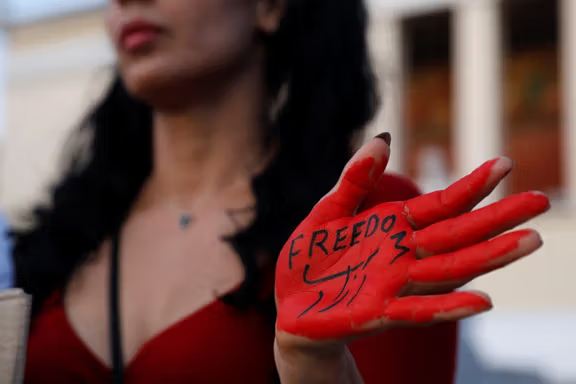
A woman with her hand-painted with the word "Freedom" takes part in a protest following the death of Mahsa Amini, in Athens, Greece, October 1, 2022

Three years after the death of Mahsa Amini in morality police custody and subsequent protests which were quashed with deadly force, the mood among Iranians has only darkened, with many pointing to hardships that increasingly shape daily life.

In response to Iran International query asking viewers what had changed since her death and the igniting of the Woman, Life, Freedom protest movement, most said life had become ever harder.

“Every day people fall deeper into ruin: more penniless, more unemployed, more hungry. There’s no water, power, or gas in places. Killings and violence have increased,” another message said.

Many Iranians are grappling with shortages of water and electricity and cited the mounting toll of high inflation and broader economic strain.

Sanctions, corruption and mismanagement have plagued Iran's economy for decades.

The wave of civil disobedience especially among women and girls continues subtly across Iran and has even spread to many traditionally religious cities.

“We’re in Mashhad. Even though it’s a religious city, many women come out with freer dress. I used to wear the chador, but since Mahsa I no longer wear hijab. Men have also changed. They’re united with the women,” one respondent said.

Other messages confirm that civil disobedience over dress codes and open defiance of Islamic regulations is widespread across the country.

“Women this year gained a little more freedom in dress. Men wear shorts and tank tops in public now. The government is failing on the hijab issue, but a woman still cannot claim her rights even in a court. Child laborers and people sleeping in cardboard boxes remain — poverty is rampant,” a caller said.

Patchy enforcement

A harsh new sanctions and chastity bill passed by the hardliner-dominated parliament was frozen by Iran's top security body this year in an apparent bid by the theocracy to forestall further unrest.

Some messages suggested that in affluent areas, obedience to the Islamic dress code has collapsed almost entirely, but that the trend was far from universal.

“The Mahsa movement caused the costly system of forced hijab to crumble. But in practice nothing changed, it got worse," in person said.

"A few women walking unveiled in the streets only benefits the wealthy; it does nothing for the millions who are starving. In fact, those who were killed and injured suffered the most. There’s no benefit for the poor.”

Beyond shortages of water and electricity, callers pointed to critical deficits in health and food supplies.

There are reports of shortages of essential medicines including treatments for rare diseases, cancer and chronic illnesses, as well as a scarcity of powdered milk and infant formula.

Rising food inflation has placed basic staples out of reach for many families. Still, messages of hope and a desire for change are widespread.

“Life has become much harder financially, socially and psychologically," one respondent said, "but we feel that a small spark, one small spark could become the final ax to tear down this tree of oppression."

Most Viewed

Ghalibaf defends Iran-US talks amid hardline backlash
1
INSIGHT

Ghalibaf defends Iran-US talks amid hardline backlash

2
INSIGHT

A nation in limbo: 100 days after the massacre, has the world moved on?

3
ANALYSIS

From instability to influence: Pakistan’s pivotal role in US-Iran diplomacy

4
ANALYSIS

100 days on: why Iran’s January protests spread across social classes

5

War-hit homeowners feel abandoned as Iran’s reconstruction aid fades

Banner
Banner

Spotlight

  • War-hit homeowners feel abandoned as Iran’s reconstruction aid fades

    War-hit homeowners feel abandoned as Iran’s reconstruction aid fades

  • 100 days on: the anatomy of Iran’s January crackdown
    INSIGHT

    100 days on: the anatomy of Iran’s January crackdown

  • Ghalibaf defends Iran-US talks amid hardline backlash
    INSIGHT

    Ghalibaf defends Iran-US talks amid hardline backlash

  • 100 days on: why Iran’s January protests spread across social classes
    ANALYSIS

    100 days on: why Iran’s January protests spread across social classes

  • From instability to influence: Pakistan’s pivotal role in US-Iran diplomacy
    ANALYSIS

    From instability to influence: Pakistan’s pivotal role in US-Iran diplomacy

  • A nation in limbo: 100 days after the massacre, has the world moved on?
    INSIGHT

    A nation in limbo: 100 days after the massacre, has the world moved on?

•
•
•

More Stories

Erasing memory: Tehran squeezes Woman, Life, Freedom families

Sep 17, 2025, 16:58 GMT+1
•
Maryam Sinaiee

Iranian authorities have led a systematic campaign to silence the families of those killed and executed amid the Woman, Life, Freedom protest movement—denying public mourning, arresting relatives and subjecting mourners to threats and intimidation.

From the earliest days after the death of Mahsa Amini in morality police custody three years ago, family memorials and funerals became focal points for renewed protest.

Victims' kin insist that remembrance itself is a form of resistance, and safeguarding the right to mourn is central to winning truth and justice.

In Iran, funerals and anniversaries have long been potent political tools. They gather people across social and geographic divides, create moments of public memory and sustain narratives of grievance and solidarity.

The 2022–23 protests frequently reignited during burials and 40-day mourning periods. Since then, authorities have continued to dismantle these anniversary rituals through arrests, intimidation, legal harassment and tight security controls at cemeteries where the victims are buried.

Families who refuse to forget

Despite these pressures, families persist. They gather at cemeteries, share photos and videos on social media, and hold private ceremonies to honor their loved ones. Many celebrate birthdays and New Year holidays at graves, bringing cakes, flowers, and posting images online as quiet acts of resistance.

Like previous years, Mahsa Amini’s father, Amjad Amini, published a defiant message on September 14 in remembrance of his daughter on Instagram.

“The memory and demand for justice for Mahsa and the other slain protesters will never be forgotten,” he wrote.

Menaced for mourning

The case of Mashallah Karami demonstrates the lengths to which the state will go to scotch remembrances. His son, Mohammad-Mehdi Karami, along with co-defendant Mohammad Hosseini, was executed in January 2023 for alleged involvement in the death of a Basij militia member in Karaj in central Iran. They denied the charges.

Karami’s father, a street vendor who campaigned relentlessly for his son and Hosseini, was arrested in August 2023 during a security raid. Authorities froze the family’s bank accounts and repeatedly destroyed plaques commemorating the men.

He now serves an eight-year and ten months sentence in prison on fabricated charges of money laundering and obtaining property through illegitimate means, on top of fines and asset confiscations. His appeals for a retrial were rejected by the Supreme Court this month.

Similarly, Mohammad Javad Zahedi, 20, from Sari in northern Iran, was shot dead in September 2022 while on his way to a pharmacy, his body showing close to a hundred pellet wounds.

His mother, Mahsa Yazdani, launched a social media campaign demanding justice but was arrested ahead of the first anniversary of his death.

She was sentenced to 13 years in prison, including a mandatory five-year term, on charges of insulting sacred values and inciting people to disrupt national security, insulting the Supreme Leader and propaganda against the system.

Her sentence was later commuted to home detention with an electronic ankle bracelet, and she was finally released in March after serving two years.

Lawyers in the dock

Legal defenders of these families have also faced persecution.

Saleh Nikbakht, winner of the European Parliament’s Sakharov Prize in 2023, who represented Mahsa Amini’s family, was sentenced to one year in prison for interviews with Persian-language media outside Iran and cooperation with hostile states.

Another lawyer, Khosrow Alikordi, was likewise sentenced to one year in prison for propaganda in favor of opposition groups. He represented the prosecuted members of Abolfazl Adinehzadeh’s family.

Adinehzadeh, a seventeen-year-old student, was shot with over 70 pellets in Mashhad during the protests.

Several of his family members, including his father and sister were charged with propaganda against the system. They had been detained at his gravesite on the first anniversary of his death.
US Republicans push E3 to enforce return of UN sanctions on Iran

Sep 17, 2025, 14:16 GMT+1

Fifty Senate Republicans wrote to the foreign ministers of the UK, France and Germany, urging them to press ahead with the reinstatement of United Nations sanctions on Iran, Jewish Insider reported on Wednesday.

“While we back diplomatic efforts to restore Iran’s compliance with its International Atomic Energy Agency (IAEA) commitments, the international community should not allow hollow gestures and cynical threats from Tehran to stop the snapback process,” the lawmakers wrote.

“Sanctions relief should only be negotiated after snapback is fully implemented.”

The letter, led by Senate Foreign Relations Committee Chairman Jim Risch, said that dismantling Iran’s nuclear program, restoring full IAEA inspections and halting Tehran’s support for proxy groups and ballistic missiles should be the “minimum” bar for any relief.

The senators called for the closure of Iranian banks in Europe and tougher action against oil sales to China, arguing that “closing off the regime’s financial pathways will curb the regime’s aggression.” They thanked the E3 for their “leadership” in triggering the mechanism.

The appeal comes after EU foreign policy chief Kaja Kallas warned Wednesday that “the window for finding a diplomatic solution” was closing fast. Germany also said Tehran has yet to take the “reasonable and precise actions necessary” to extend the UN resolution underpinning the 2015 nuclear deal.

Under the process, UN sanctions on Iran will automatically return by late September unless the Security Council votes otherwise.

US designates four Iran-backed militias as terrorist groups

Sep 17, 2025, 13:45 GMT+1

The United States on Wednesday designated four Iran-aligned militias as foreign terrorist organizations, a statement by Secretary of State Marco Rubio said.

The groups are Harakat al-Nujaba, Kataib Sayyid al-Shuhada, Harakat Ansar Allah al-Awfiya, and Kataib al-Imam Ali.

“These militias have conducted attacks on the US Embassy in Baghdad and on bases hosting US and coalition forces, typically using front names or proxy groups to obfuscate their involvement,” Rubio said in a statement. He said the designations support President Donald Trump’s directive to impose maximum pressure on Iran and cut off revenue to its regional proxies.

Sanctions target oil and crypto networks

The move followed fresh Treasury sanctions on Tuesday against four Iranian nationals and more than a dozen companies and individuals in Hong Kong and the United Arab Emirates, accused of moving funds for Iran’s military through oil sales and cryptocurrency.

“Iranian entities rely on shadow banking networks to evade sanctions and move millions through the international financial system,” Under Secretary for Terrorism and Financial Intelligence John Hurley said. “Under President Trump’s leadership, we will continue to disrupt these key financial streams that fund Iran’s weapons programs and malign activities in the Middle East and beyond.”

Treasury said the networks laundered hundreds of millions of dollars through front companies and digital assets to finance Iran’s ballistic missile and drone programs and to support allied groups including Hezbollah.

Separately, the State Department said it revoked a sanctions waiver for Afghanistan-related projects at Iran’s Chabahar Port, effective September 29. The exemption, in place since 2018, was meant to facilitate trade and reconstruction projects for Afghanistan but will now end, exposing operators and investors to penalties under the Iran Freedom and Counter-Proliferation Act.

Regional security deal with Iraq

The measures come as Iran has sought to expand its regional influence through new security understandings. Last month, Ali Larijani, Secretary of Iran’s Supreme National Security Council, said a new memorandum with Iraq was meant to “preserve stability” and prevent foreign powers from destabilizing the region.

The agreement commits both sides to prevent individuals or third countries from using one another’s territory to threaten security, Larijani said, linking it to lessons from the June war with Israel. Iraq later described the arrangement as a border protocol rather than a broader pact, while Washington warned it risked undermining Iraqi sovereignty.

Iran-backed groups have also been in the spotlight after the release of Israeli-Russian academic Elizabeth Tsurkov in Baghdad earlier this month.

Tasnim, an outlet linked to Iran’s Revolutionary Guards, reported her freedom came in a prisoner exchange for two members of the “resistance,” a term used in Tehran to refer to allied armed groups.

Tsurkov, a Princeton University student abducted in 2023, was believed to have been held by Kataib Hezbollah, one of the groups long accused of attacks on US and Israeli targets in Iraq. US President Donald Trump confirmed her release on Tuesday, saying she had been tortured during her captivity.

Europe presses Iran to act on nuclear deal as snapback sanctions loom

Sep 17, 2025, 13:14 GMT+1

European foreign ministers on Wednesday urged Iran to resume nuclear talks, allow inspections of sensitive sites and curb its stockpile of highly enriched uranium, warning that sanctions suspended under the 2015 deal would be reimposed if Tehran fails to act in the coming days.

“Iran has yet to take the reasonable and precise actions necessary to reach an extension of resolution 2231,” the German Foreign Office said on social media after a call between the E3 – Britain, France and Germany – the EU’s foreign policy chief and Iran’s foreign minister.

Iranian foreign ministry spokesman Esmaeil Baghaei confirmed that the call was scheduled for Wednesday afternoon but warned that Tehran could take reciprocal measures if pressured.

“If other parties fail to fulfill their commitments or seek to pressure Iran through coercive means, naturally no one can claim that Iran must remain committed to the agreement,” he told reporters in Tehran.

  • Iran rules out US talks on missile program

    Iran rules out US talks on missile program

Baghaei also rejected US criticism of Iran’s missile program, saying Washington had no authority to dictate the country’s defense policy. “The Islamic Republic of Iran is determined to preserve its independence at any cost and firmly resist the excessive demands of foreign powers -- including the United States and Israel,” he said.

US Secretary of State Marco Rubio, speaking in Jerusalem earlier this week alongside Israeli Prime Minister Benjamin Netanyahu, said Iran’s missile ambitions already threaten Persian Gulf states and Europe.

“A nuclear Iran governed by a radical Shia cleric that possesses not just nuclear weapons potentially, but the missiles that could deliver those weapons far away is an unacceptable risk,” Rubio said, vowing continued “maximum economic pressure” until Tehran changes course.

Iran ex-hijab enforcer gets lashes in sex scandal, escapes execution on legal twist

Sep 17, 2025, 11:18 GMT+1

An Iranian court has sentenced Reza Seghati, the former head of the Ministry of Culture and Islamic Guidance in Gilan province, to 100 lashes and exile in connection with a widely publicized same-sex scandal that cost him his post.

According to Iranian outlets including Ensaf News, the court found Seghati (also Seqati) guilty of “lavat tafkhizi,” a same-sex act defined under Iran’s Islamic penal code as non-penetrative sexual contact between men.

Both Seghati and the other man seen in a leaked video were handed 100 lashes and prison exile terms of one and two years respectively, reports said.

Iran’s penal code prescribes severe punishments for same-sex relations, including flogging and, in cases of penetrative intercourse or repeat offenses, the death penalty. Rights groups have long criticized these provisions, but Iranian authorities say they are enforcing Islamic law.

  • Hijab Official In Iran Fired Over Same-Sex Video

    Hijab Official In Iran Fired Over Same-Sex Video

  • Iranian MP Calls For Death Of Hijab Official Over Same-Sex Video

    Iranian MP Calls For Death Of Hijab Official Over Same-Sex Video

  • Sex Scandals Continue To Discredit Iran’s Clerical Regime

    Sex Scandals Continue To Discredit Iran’s Clerical Regime

  • Iran Tries To Quell Scandal Over Official’s Same-Sex Video

    Iran Tries To Quell Scandal Over Official’s Same-Sex Video

The scandal began in July 2023 when a video surfaced online allegedly showing Seghati engaged in sexual activity with another man. The leak led to his dismissal from office and triggered a political storm due to his past role as a vocal enforcer of Iran’s mandatory hijab rules.

Ensaf News, citing an image of the judgment, also reported that the son of a former senior Gilan official was sentenced to 10 years in prison and exile for orchestrating what authorities described as a criminal network that used secretly recorded videos to discredit rivals. Other defendants are said to remain under investigation.