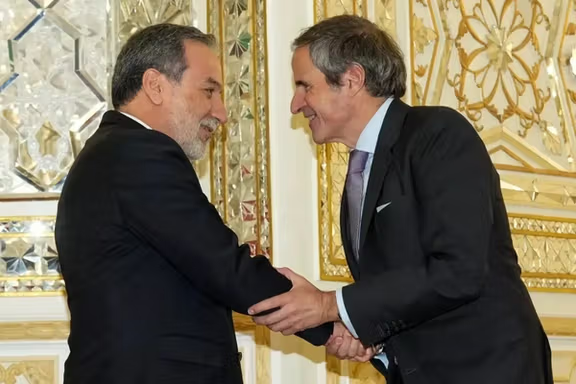
Iran's Foreign Minister Abbas Araghchi and IAEA chief Rafael Grossi
Ultra-hardliners in Tehran blasted a new nuclear deal struck in Cairo with the UN atomic watchdog, accusing negotiators of bypassing parliament and putting national security at risk.
Hardline lawmakers and media outlets say chief negotiator Abbas Araghchi and International Atomic Energy Agency (IAEA) Director General Rafael Grossi have given contradictory accounts of the scope of inspector access to Iranian facilities.
Araghchi insisted the agreement limits inspector access for now to the Bushehr power plant, while calling it a “step in the right direction.” Grossi, by contrast, said it establishes “practical modalities” for inspections covering “all facilities and installations” in Iran.
The ultra-hardline daily Kayhan, funded by the office of Iran’s Supreme Leader, accused negotiators of bypassing parliament’s authority.
“The bitter experience of the JCPOA and the deceitful games of ‘fact sheets’ is being repeated once again—this time with a counterpart that has a record of espionage, servitude to Israel,” a Thursday editorial read.
The paper also claimed the E3 of France, Germany and the United Kingdom delayed activating the snapback mechanism and extended the deadline for reinstating UN sanctions only to prolong psychological pressure on Iran.
No trust for the IAEA
Hamid Rasaei, an ultra-hardline lawmaker, complained that he has not even been able to see the contents of the Cairo agreement.
“What Araghchi says about inspections would only be meaningful if either the text of the agreement was published or the IAEA had formally confirmed it,” he posted on X.
Rasaei also accused Grossi of passing information to Tehran’s foes and warned against granting the Agency access to bombed sites.
“What value does a commitment from an organization that has never condemned US and Israeli military strikes really have?” he asked.
Rasaei and other hardline MPs who recently tabled a “triple-urgency” bill to pull Iran out of the nuclear Non-Proliferation Treaty (NPT) now argue the Cairo agreement tramples on a June bill requiring suspension of cooperation with the IAEA.
Who benefits?
Amirhossein Sabeti, another ultra-hardline lawmaker and adviser to former nuclear negotiator Saeed Jalili, described the Cairo deal bluntly as a “disaster.”
“Araghchi’s deal with Grossi undermines national interests, paves the way for renewed attacks on Iran, and violates Parliament’s legislation,” he wrote on his Telegram channel.
“The return of IAEA spies and inspections of Iran’s nuclear sites serves the Agency’s interests but provides no benefit whatsoever to Iran,” he added, calling the agreement “passive and born of weakness.”
“It is not enough for Iran to make promises for tomorrow, we need to see evidence from Iran today,” the E3—which triggered the snapback mechanism last month—said in an open letter, noting that key sites remain closed and the timeline for full access is unclear.
The United States on Wednesday urged Iran to take “immediate and concrete action” to meet its nuclear safeguards obligations, warning the IAEA board may need to act if Tehran fails to cooperate.
Iranian flags and drapes with religious quotes cover a building destroyed by Israeli strikes, Tehran, Iran, September 6, 2025
Iran’s Foreign Minister Abbas Araghchi on Wednesday cast doubt on a potential opening in the nuclear standoff, appearing to undermine the deal he had signed just a day earlier with IAEA Chief Rafael Grossi in Cairo.
Grossi had announced Tuesday that Tehran would grant inspectors access to nuclear sites. But Araghchi quickly walked it back, saying it was only “a one-time access to the Bushehr Power Plant that had been granted earlier.”
He added that any future agreement depended on halting “hostile actions against Iran, including activation of the trigger mechanism.”
The mixed signals captured Iran’s familiar pattern: apparent concessions abroad, followed by dismissive clarifications at home.
Araghchi himself has a record of burnishing his toughness after negotiations.
In 2014, he claimed he had shouted at US negotiators and thrown his pen at Wendy Sherman; the tale was later debunked, with witnesses recalling a calm exchange and even small talk about grandchildren.
Reasons for optimism
Despite Araghchi’s backtracking, many in Tehran saw Grossi’s visit as a sign Iran may be edging toward engagement.
With the snapback of international sanctions due in less than ten days, moderates urged the government to seize the moment.
Khabar Online called the Cairo deal “a first step to stop the snapback and pave the way for constructive negotiations with the United States.”
Reformist Rouydad24 and conservative Farhikhtegan alike said “Iran appears to be taking a new approach.”
That chorus grew louder on Sunday.
Prominent reformist Behzad Nabavi told Etemad that “a change in paradigms” is needed, insisting “wisdom calls for negotiations with the United States.” Former lawmaker Ali Motahari went further, urging President Masoud Pezeshkian to meet Donald Trump at the UN General Assembly in New York.
Missed Openings
The precedent is shaky.
In 2000, President Mohammad Khatami was moments from a handshake with Bill Clinton before hardliners stopped him; he reportedly ducked into a bathroom to avoid the encounter.
In 2013, Hassan Rouhani’s brief phone call with Barack Obama drew a public rebuke from Supreme Leader Ali Khamenei.
Both moments revealed how even modest steps toward dialogue can be reversed in Tehran.
Araghchi’s Cairo reversal echoed past retreats and left many questioning whether Tehran can commit to real engagement. Skeptics argue that optimism will always be checked by the system’s instinct for resistance.
News of the Grossi agreement briefly pushed the dollar below one million rials on Tuesday, only for it to rebound above one million and ten thousand by Wednesday. Traders complained of volatility, while regional insecurity after Israel’s strike in Doha added to the pressure.
Even the markets seem unsure which way Iran is heading.
A crowd sets fire to Israeli and American flags, Tehran, Iran, March 5, 2024
Israel’s strike in Doha targeting senior Hamas leaders has given Tehran a chance to present itself as the true defender of Arab sovereignty and Palestinian resistance.
The rare attack on Qatari soil—a US ally and mediator in the Israel-Hamas conflict—took place Tuesday during a Hamas leadership meeting to consider a US-backed ceasefire proposal. Qatar’s Prime Minister denounced the assault as “state terrorism,” saying it sabotaged peace efforts.
Iranian officials moved quickly to condemn the strike. President Masoud Pezeshkian phoned Qatar’s Emir Sheikh Tamim bin Hamad Al Thani within hours, calling the attack an “illegal, inhumane and anti-peace action.”
Foreign Ministry spokesman Esmaeil Baghaei described it as a violation of international law and Qatar’s national sovereignty, warning: “Global inaction in the face of Zionist regime’s crimes in Palestine and West Asia threatens all.”
“The message of the Zionist entity’s recent crime in Qatar: O countries of the region! Prepare yourselves for my upcoming dominance!” he posted on X.
Qatar-Iran relationship
Tehran’s framing draws on recent memory. Ismail Haniyeh, Hamas’s political bureau chief, was assassinated in Tehran in July 2024 while attending Pezeshkian’s inauguration—a killing Iran cast as part of a broader campaign to decapitate the Hamas leadership.
Iran has also sought to distinguish its conduct from Israel’s.
When it struck the US Al Udeid air base in June, Tehran notified Qatar in advance and emphasized that Doha was not the target. Qatar condemned the strike but acknowledged Iran’s outreach and later expressed hope for continued good ties.
On September 4, Pezeshkian sent a message through top diplomat Abbas Araghchi requesting Sheikh Tamim’s help in facilitating dialogue with the US and the E3 to resume nuclear negotiations.
‘Lesson for US allies’
Many in Tehran framed Israel’s strike as a gift to the Islamic Republic’s regional narrative.
Mohammad Mokhber, a former vice president and close advisor to Khamenei, said the incident shows the futility of relying on the Abraham Accords.
Hardline activist Hatef Salehi called it a “lesson” for US allies in the region.
“It demonstrated, in the clearest way, that no matter how much Arab states serve US interests … Washington’s absolute priority is always the protection of the Israeli regime,” he posted on X.
Even moderate voices highlighted potential benefits for Tehran.
Journalist Reza Ghobeishavi argued the incident may push Gulf states closer to Iran.
“Previously, there was an idea that Israel would defend the Gulf countries against Iran, but that notion has now been weakened,” he wrote on X. “Israel’s attack on Qatar benefits Iran’s camp and Israel’s opponents, while harming the camp that supports normalizing relations with Israel.”
Ahmad Bakhshayesh, member of The National Security and Foreign Policy Commission of the Iranian Parliament
An Iranian lawmaker said on Wednesday the country should pursue building a nuclear weapon since it already paid a heavy price for its nuclear activities in a 12-day conflict with Israel and the United States in June.
“I’ve always believed we should have built it long ago. I’ve always supported building a nuclear bomb because we’ve already paid the costs for it,” national security committee member Ahmad Bakhshayesh told state media on Tuesday.
Bakhshayesh argued that nuclear-armed China is a member of the nuclear Non-Proliferation Treaty and that Iran should have taken the same path long ago.
“We should have built it without leaving the NPT,” he added. “We’ve been entangled in this nuclear issue in our country for 25 years now.”
Beijing acceded to the NPT in 1992 but conducted its first nuclear weapons test in 1964. China is one of the five recognized nuclear-weapon states under the agreement, alongside the US, Russia, the UK, and France.
NPT debate in Tehran
Iran maintains that its nuclear program is peaceful.
France, Germany, and the United Kingdom last month triggered the so-called "snapback" mechanism within a 2015 international nuclear deal to which they are party along with Iran, giving Tehran 30 days to comply with the agreement or face restored international sanctions.
Calls have grown inside Iran to withdraw from the NPT in response.
A bill to exit the agreement is under review in the Iranian parliament. Some lawmakers argue the legislature can pass the measure on its own, while former nuclear chief Ali Akbar Salehi said the ultimate decision rests with Supreme Leader Ali Khamenei.
'No inspection yet'
UN nuclear chief Raphael Grossi on Wednesday inked a deal to pave a way forward on resuming cooperation with Iran alongside its foreign minister Abbas Araghchi at a ceremony in Cairo.
Araghchi later told state TV that the Cairo agreement “recognizes Iran’s legitimate security concerns" and does not by itself reopen facilities to inspectors.
The three European powers said on Wednesday they were alarmed by the lack of clarity on Iran's stockpile of near-bomb-grade uranium and that Tehran must show not claim if it wanted to avoid more sanctions.
Supreme leader Ali Khamenei speaks to president Masoud Pezeshkian after a meeting with the cabinet, Tehran, Iran, September 7, 2025
Pressure on President Masoud Pezeshkian’s government continues to mount despite explicit support from Supreme Leader Ali Khamenei, who this week praised the president and his cabinet during a meeting in Tehran.
The latest move against Pezeshkian involves his labor minister Ahmad Maydari, whom hardline lawmakers seek to impeach despite the apparent reservations of the parliament’s presidium.
“The Majles will take no decisions without coordination with the pillars of the political system,” Abbas Goudarzi, a presidium spokesperson, told Tasnim News on Tuesday following a closed-door parliament session attended by Pezeshkian and his ministers.
The pillar of the system is widely understood to be a reference to Khamenei’s office.
That remark may reflect Khamenei’s own position, who has voiced frustration with repeated public attacks on the government, arguing that constant criticism only weakens the state.
At a Sunday meeting with the cabinet, he coupled that warning with unusually warm praise for Pezeshkian and Vice President Mohammad Reza Aref, even though he stopped short of citing tangible achievements.
'Solving no problem'
Maydari, however, remains a prime target. Hardliners have pressed for his removal for more than a year, citing the Labor Ministry’s failure to address strikes and protests by workers and pensioners.
Pezeshkian has resisted dismissals, arguing that “replacing individuals will solve no problem.” Still, Maydari has become emblematic of government shortcomings as economic grievances mount.
Goudarzi also revealed that impeachment motions are underway against two other ministers.
While he did not name them, outlets including Eghtesad Online have reported that Roads Minister Fereshteh Sadeq faces allegations of abusing her position for personal gain, while Energy Minister Abbas Aliabadi is under fire for blackouts and water shortages.
While MPs cite valid technical grounds, the impeachment drive reflects a deeper struggle inside Iran’s political system.
Much ado about power
Since the 1990s, hardliners have used parliamentary oversight to chip away at governments they view as unreliable. Pezeshkian’s weak political base and difficulty recruiting top technocrats have left him particularly exposed.
Despite Khamenei’s backing, the campaign against the government appears to be widening.
For now, Khamenei’s intervention has shielded the government from collapse. But the impeachment moves reveal how hardliners are pressing their advantage, testing whether even the Supreme Leader’s explicit support can restrain them.
Russian President Vladimir Putin and Chinese President Xi Jinping attend an official welcoming ceremony in Beijing, China May 16, 2024
The so-called “Look East” strategy has become the latest point of contention in Tehran's fractious politics, with conservatives presenting it as a shield against Western isolation and reformists warning it risks overreliance on unreliable partners.
The debate sharpened last week when President Masoud Pezeshkian took part in the Shanghai Cooperation Organization (SCO) summit in Tianjin, China.
While his usual detractors in the hardline camp hailed the trip as proof of Iran’s integration into a multipolar world order, some moderate backers warned the bloc’s loose structure and rival interests limits its usefulness in times of need.
Proponents of the Look East approach portray SCO membership as a political win.
“Strengthening Iran’s presence in the SCO and BRICS disrupts the US and West’s project of isolating Iran,” hardline daily Kayhan wrote in a Sunday editorial. “The clear message is that the more pressure increases, the deeper Iran’s ties with major non-Western powers will become.”
Nour News, linked to Iran’s security establishment, stressed that the trip coincided with Europe’s activation of the snapback sanctions mechanism and argued that membership helps Tehran build a “political consensus” against Western pressure.
The summit’s final communiqué denounced sanctions on Iran as unjust and condemned Israel’s military strike on Iranian soil.
But reformist voices highlight the bloc’s limitations. Sazandegi noted the SCO is neither NATO nor the EU, offers no security guarantees and has in the past refused Iran’s entry over UN sanctions
“The example of Russia, which after Western sanctions received little practical support from the SCO, reinforces this view,” the editorial argued.
Economic expectations
Economically, Look East advocates frame the policy as an antidote to sanctions and a gateway to new markets.
Pezeshkian used the summit to call for greater use of national currencies, shared digital financial systems, and a multilateral settlement fund.
Javan, the Revolutionary Guards-linked daily, argued that such mechanisms could reduce reliance on the Western financial system.
“The SCO provides a platform to reduce dependency on the Western financial system,” the paper wrote on Sunday.
The multilateral currency fund… can accelerate Iran’s digital economy growth, while linking Chabahar port to the North–South corridor will turn Iran into a trade crossroads between China, Russia and India.”
Critics counter that these ambitions face hard limits. Key SCO members including India and Central Asian states maintain close economic ties with the West and may hesitate to risk secondary sanctions.
Security expectations
While the SCO is not a military alliance, conservatives view its security framework and symbolism as central to Look East.
Javan said Pezeshkian’s presence alongside Chinese, Russian, and Indian leaders sent a deterrent message.
“The response (to any US-Israeli attack) will not only come from Tehran but also, by other means, from the Eastern bloc,” the daily asserted.
The same outlet pointed to prospects for cyber cooperation, artificial intelligence and advanced telecoms, arguing that Russian and Chinese technologies could help Iran close its sanctions-induced tech gap and support “the smart modernization of defense and the economy.”
The government's Iran newspaper acknowledged that expectations for Eastern alliances had been overblown in some circles.
"Some inside Iran had expected the (SCO) bloc to act as a genuine security shield for its members, not merely issue a formal statement of condemnation.
"Yet such expectations rest less on institutional realities than on romanticized notions and political myth-making," it added. "Over the past two decades, labels such as the 'Eastern NATO,' an 'anti-Western hegemonic alliance,' or even a 'new Warsaw Pact' have fueled these inflated perceptions within Iran’s political discourse."