• العربية
  • فارسی
Brand
  • Iran Insight
  • Politics
  • Economy
  • Analysis
  • Special Report
  • Opinion
  • Podcast
  • Iran Insight
  • Politics
  • Economy
  • Analysis
  • Special Report
  • Opinion
  • Podcast
  • Theme
  • Language
    • العربية
    • فارسی
  • Iran Insight
  • Politics
  • Economy
  • Analysis
  • Special Report
  • Opinion
  • Podcast
All rights reserved for Volant Media UK Limited
volant media logo

The politics of prayer: who controls Iran’s mosques and Friday sermons

Maryam Sinaiee
Maryam Sinaiee

Iran International

Oct 18, 2025, 16:17 GMT+1Updated: 00:10 GMT+0
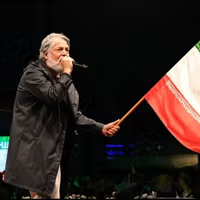
Recent Friday prayers in Tehran

Despite millions of dollars in state funding and tight clerical oversight, most of Iran’s mosques sit half-empty, and Friday prayers have dwindled as a platform for religious and political messaging.

The Center for the Supervision of Mosque Affairs, a branch of the Organization for Islamic Propagation, oversees and coordinates mosque activities.

Prayer leaders in major mosques are appointed or vetted by provincial representatives of the Supreme Leader, while smaller neighborhood mosques may select imams locally—though clerical approval is still required.

Mosques also serve as mobilization hubs, with Basij units of the Revolutionary Guards frequently operating from them. This dual religious–military role shapes both administration and staffing.

No fewer than 24 institutions—from the Leader’s provincial offices and Basij units to the Endowment and Charity Affairs Organization (ECAO) and municipal authorities—play a direct or indirect role in mosque management.

Yet despite extensive resources, many remain underutilized.

Reza Moamami-Moghaddam of the ECAO has acknowledged that of Iran’s 85,000 mosques, only about 2,750 are highly active, around 20,000 host regular religious or cultural activities, and more than 16,000 are almost or completely inactive.

Low turnout in daily and weekly prayers reflects broader cultural shifts.

Senior cleric Mohammad Ali Ayazi complained in 2016 that in one city only 0.2 percent of the population attended Friday prayers, a decline that has eroded mosques’ role as community and mobilization centers.

Through the Friday Prayer Headquarters, the Leader’s office appoints and supervises Friday Imams, vets sermon content, and sets policy guidelines on political, social, and religious themes.

Sermons routinely stress resistance to foreign adversaries, support for domestic policies, and the ideals of the Islamic Revolution.

Friday Imams in provincial capitals wield particular influence, often outranking local governors as the Leader’s representatives. Their messaging is closely monitored to ensure complete alignment with state priorities, making Friday prayers a central instrument of official propaganda.

Funding comes from state budgets, imam salaries, provincial grants, mosque endowments (waqf) such as rental property and commercial assets, and local donations. Transparency is limited, with detailed expenditure reports rarely published.

Recent budgets earmarked trillions of rials for mosque and Friday prayer programs.

The Center for the Supervision of Mosque Affairs received 3.7 trillion rial ($3.7 million), the Headquarters for the Promotion of Prayer $2 million, the Friday Prayer Leaders Policy-Making Council $3.1 million, and the Friday Prayer Headquarters nearly $3 million.

These funds cover salaries, cultural programs, and construction projects, yet little is disclosed about how they are actually spent.

Most Viewed

Ghalibaf defends Iran-US talks amid hardline backlash
1
INSIGHT

Ghalibaf defends Iran-US talks amid hardline backlash

2
INSIGHT

Iran diplomacy wobbles as factions compete to avoid looking soft on US

3
VOICES FROM IRAN

Bread shortages, soaring prices strain households in Iran, residents say

4
ANALYSIS

The politics of pink: how Iran uses cuteness to rebrand violence

5

Scam messages seek crypto for ships’ safe passage through Hormuz, firm warns

Banner
Banner

Spotlight

  • Diplomacy tolls at Hormuz as conflict returns to its doorstep
    OPINION

    Diplomacy tolls at Hormuz as conflict returns to its doorstep

  • Opposition to US talks grows in Tehran as ceasefire deadline nears
    INSIGHT

    Opposition to US talks grows in Tehran as ceasefire deadline nears

  • Tehran moderates see ‘no deal–no war’ limbo as worst outcome
    INSIGHT

    Tehran moderates see ‘no deal–no war’ limbo as worst outcome

  • The future has been switched off here
    TEHRAN INSIDER

    The future has been switched off here

  • Lights out, then gunfire: Witnesses recount Mashhad protest crackdown
    VOICES FROM IRAN

    Lights out, then gunfire: Witnesses recount Mashhad protest crackdown

  • Is Iran entering its Gorbachev moment?
    INSIGHT

    Is Iran entering its Gorbachev moment?

•
•
•

More Stories

Ex and current Iranian MPs sentenced to jail, media bans over public remarks

Oct 18, 2025, 11:29 GMT+1

Two Iranian lawmakers — one sitting and one former — have been handed suspended jail sentences and bans on media activity over separate cases involving public remarks deemed damaging to national security and public order, the judiciary’s official news outlet reported on Saturday.

The former lawmaker, Mostafa Kavakebian, was convicted after repeating allegations in two televised interviews accusing a French-born journalist of having intimate relations with senior Iranian officials.

“Following the remarks, the former member of parliament was summoned by the judiciary to present evidence and documentation, but after failing to provide any credible proof to support his statements, an indictment was issued by the prosecutor’s office and the case was referred to court for trial,” wrote Mizan News Agency.

The court sentenced him to 14 months in prison, suspended for four years, and imposed a two-year ban on all media activity, including interviews and publication of commentary across outlets or online platforms.

The editor-in-chief of the outlet that broadcast his comments was also fined under the court’s ruling, Mizan News Agency added. The verdicts are subject to appeal.

Kavakebian’s remarks concerned Catherine Perez-Shakdam, a French journalist of Jewish background who had previously visited Iran and written favorably about its leadership. In a July state TV interview, he said that she was an Israeli spy who had slept with 120 senior officials. Speaking to Iran International, Shakdam dismissed the charge as “not true, not possible, and completely absurd.”

Shakdam now works as a political analyst and spokesperson for an Israeli advocacy group We Believe In Israel.

Separate sentence for Tehran MP

In a separate ruling, a current member of parliament representing Tehran was convicted of “disturbing public opinion” after describing the government of President Masoud Pezeshkian as plotting to “end the Islamic Revolution” and “terminate Khamenei’s rule” during an online interview in June.

Abolfazl Zohrevand, who formerly served as Iran’s ambassador to Afghanistan, received a sentence of three months and one day in prison, suspended for three years, along with a two-year prohibition on media engagement. The editor responsible for publishing his comments was likewise ordered to pay a fine.

The court said it had first consulted the parliament’s oversight board, which confirmed the remarks fell outside Zohrevand’s duties as a lawmaker.

Each of the lawmakers remains free but under suspended sentences that would take effect if similar offenses are repeated within the designated period.

Iran debate over Russia reliance flares anew amid Putin's mediation offer

Oct 18, 2025, 07:01 GMT+1
•
Behrouz Turani

A fresh debate has erupted in Tehran over Russia’s role in Iran’s foreign policy amid diplomatic moves that may suggest an intermediary role for President Vladimir Putin between the Islamic Republic and its arch-foes Israel and the United States.

Russia said on Friday it was ready to help resolve the impasse over Iran’s nuclear program—a day after former foreign minister Mohammad Javad Zarif accused Moscow of standing in the way of Tehran’s potential path to normalcy with the West.

Zarif reignited long-running suspicions about Moscow’s intentions as Iran’s security chief Ali Larijani visited the Russian capital to deliver a message from Supreme Leader Ali Khamenei.

The former head of parliament’s National Security Committee Heshmatollah Falahatpisheh echoed the charge on Friday, asserting that Russia had previously obstructed a potential agreement with the United States in 2021.

“Over-reliance on the Kremlin puts Iran on a dangerous path,” he warned in the economic daily Donya-ye Eghtesad. “Russia is not a trustworthy partner around the world, and ignoring this could be costly.”

Another moderate outlet, Rouydad24, argued in a Friday editorial that “historical experience shows Moscow’s interests do not always align with Tehran’s.”

Lifeline or liability?

Iran’s dependence on Russia—even amid Putin’s hints at goodwill mediation—has long been questioned by moderates who favor a tilt toward the West.

Those calls have intensified since the June war with Israel, when Moscow offered little help—either unwilling, as some in Tehran suggested, or unable due to its own entanglement in Ukraine.

Hardliners, and most crucially the Supreme Leader, appear to think otherwise.

Ali Khamenei has rarely been seen since Israel demonstrated its ability to strike top commanders in June, but the message from those considered closest to him remains unmistakably combative.

Khamenei’s top foreign-policy adviser Kamal Kharrazi said in an interview with the leader’s website that Iran’s missile program and support for armed allies in the region remain non-negotiable.

While emphasizing Iran’s openness to diplomacy, Kharrazi also laid bare Tehran’s limited room for compromise with Washington.

Anti-West line rules

That same day, cleric Alireza Panahian, close to Khamenei’s office, promoted a state-sponsored book advocating Israel’s annihilation—underscoring how deeply confrontation remains embedded in the system’s worldview.

Covering Larijani’s trip to Moscow, hardline outlets invariably hailed him as a “trusted figure,” implying that others, including President Masoud Pezeshkian, were not considered reliable enough to represent Khamenei.

It didn’t help the relatively moderate president that he was filmed cycling through Isfahan as part of a campaign promoting healthy living just as the veteran conservative Larijani delivered Khamenei’s message to Putin.

The image was mocked by social media users who saw it emblematic of a fragmented government in which real authority rests beyond the president's station.

Iran's real crisis: environmental decay wrought by official neglect

Oct 17, 2025, 15:25 GMT+1
•
Roozbeh Eskandari

As the world races to meet the UN’s 2030 Sustainable Development Goals, Iran faces a bleak environmental outlook given the scale of its problems and authorities' record of short-term policymaking.

From vanishing water reserves and dried wetlands to fragile cities, failing infrastructure and a fossil-fuel-dependent economy, decades of reactive decisions have set the country on an unmistakably unsustainable path.

Iran now stands on the brink of “water bankruptcy,” a term describing when consumption far exceeds natural replenishment.

Over-extraction from aquifers, unchecked dam-building, inter-basin transfers, and ill-planned agricultural projects have left more than 500 plains suffering groundwater collapse and land subsidence—what experts call a “silent earthquake.” In some areas, land sinks by more than 20 centimeters a year.

Hundreds of villages across central and eastern Iran now lack safe drinking water, triggering waves of climate-driven migration.

The crisis no longer threatens only agriculture and food security but the country’s social stability and national security.

No climate plan

Iran is among the world’s most climate-vulnerable nations.

Rising temperatures, shrinking snowfall, extended droughts and intensifying dust storms reveal the scale of change, yet the country still lacks a national adaptation plan.

Limited engagement with international scientific bodies, poor climate data and a reactive policy mindset have weakened its ability to respond.

While many countries invest in innovations like smart farming and early-warning systems for floods and droughts, Tehran’s measures remain short-term and unsustainable.

Cities Strained

In five decades, Iran has urbanized at one of the fastest rates globally—without the infrastructure or governance to match.

Tehran, Mashhad, Isfahan and Ahvaz now face toxic air, crumbling public services, decaying neighborhoods, and growing informal settlements.

Municipal priorities lean toward costly showcase projects instead of building resilient, livable cities.

As a result, Iran’s urban quality-of-life indicators remain far below global averages, and its cities are increasingly vulnerable to earthquakes and floods.

Self destruction

Iran’s economy remains tethered to the overuse of natural resources and fossil fuels, eroding efficiency and environmental security.

Agriculture, despite contributing little to GDP, consumes more than 90% of the nation’s water—often to grow water-intensive crops like rice and pistachios in arid zones.

Inefficient subsidies for energy and water encourage overconsumption, soil degradation and aquifer depletion. Heavy reliance on oil and gas fuels pollution and delays a shift toward a green economy.

Unlike many of its neighbors, Iran still lacks a binding strategy for renewable energy—a gap that risks locking the country into technological stagnation and environmental decline.

Governance at the core

At its core, Iran’s crisis stems less from a lack of natural resources than from weak governance and fragmented decision-making.

Years of unscientific, short-term policymaking and exclusion of civil and expert institutions from decision processes have eroded the capacity for sustainable development.

Centralized, project-based management continues to dominate where transparency, public participation and local knowledge could drive meaningful solutions.

Sustainable development is no longer optional. It is vital to Iran’s survival.

Continuing the current course—from vanishing wetlands and land subsidence to air pollution and climate migration—will erode the country’s ecological and human foundations.

Reversing course will demand a new development model—one built on sustainable water management, restored aquifers, reformed crop patterns, national climate adaptation, urban renewal and investment in clean energy.

Yet these are tall orders—and they appear far down the list of priorities for rulers consumed by political rather than ecological survival.

Iran to mobilize 80,000 volunteers for hijab campaign, official says

Oct 17, 2025, 09:53 GMT+1

Iran plans to activate about 80,000 trained volunteers in Tehran province to support social and religious outreach programs, including new coordination on hijab and public behavior, a senior official said on Thursday.

“The country’s greatest asset is its faithful and revolutionary people,” Rouhollah Momen-Nasab, head of Tehran’s headquarters for the Promotion of Virtue and Prevention of Vice, told reporters. “By activating 80,000 trained personnel, we can bring about major transformation in the province even before relying on large state budgets,” he said.

He announced the formation of a “chastity and hijab situation room” involving cultural and executive bodies, inviting citizens to join a network of local observers to help promote what he described as social discipline and religious values.

Momen-Nasab described the group’s response to what he called a “cognitive and cultural war” as data-driven and multi-layered, with monitoring and policy recommendations sent to relevant authorities. The organization, he said, will also push institutions through legal and audit channels to fulfill their “statutory duties.”

Momen-Nasab said the headquarters was coordinating with the prosecutor’s office and cyber police to monitor online and streaming platforms, warning that “virtual spaces and VODs must not be safe havens for lawbreakers.”

The renewed push comes as most Iranians continue to oppose mandatory hijab rules. A 2022 survey by Netherlands-based GAMAAN found more than 70 percent of Iranian men and women opposed compulsory veiling.

For Iran’s leadership, however, enforcement of hijab laws remains a pillar of political legitimacy. Since Mahsa Amini’s death in 2022, women appearing unveiled in public have turned defiance into a sustained act of civil protest.

In recent weeks, authorities have sealed cafés and restaurants across cities for noncompliance after outcry by hardliners. Police warned that all businesses “must observe current laws.”

Tehran’s ‘Saint Mary’ station: symbol of tolerance or political prop?

Oct 16, 2025, 20:58 GMT+1
•
Maryam Sinaiee

The upcoming opening of Tehran’s new Saint Mary Metro station has sparked both celebration and controversy: hailed by some as a gesture of interfaith harmony and dismissed by others as a hollow publicity stunt to polish Iran’s image abroad.

Located near Saint Sarkis Armenian Church in downtown Tehran, the Saint Mary (Maryam-e Moghaddas) station features large reliefs of Jesus and Mary.

“The station was built to honor Saint Mary and to demonstrate the coexistence of divine religions in Tehran,” Mayor Alireza Zakani posted on X earlier this week.

Conservative media welcomed the move as proof of Iran’s tolerance.

“Respect in Iran for religious and cultural diversity is unparalleled, yet these matters receive no coverage in Western media!” wrote hardline commentator Ehsan Movahedian on X.

The Revolutionary Guards-linked Fars News Agency claimed that “foreign social media users, recalling grim portrayals of Iran and the lives of its minorities in mainstream media, have described such narratives as part of a Western agenda with anti-Iranian motives.”

Others were less impressed.

Journalist Azadeh Mokhtari mocked municipality-run daily Hamshahri, which splashed ‘Global Reactions to Saint Mary Metro’ on its Wednesday front page.

“Global reaction?” Mokhtary quipped on X, “their jaws must have dropped for sure that you built one metro line. And your even bigger act of genius is that you named it Holy Mary?”

Opposition voices were sharper still.

“Why the ‘Mary Metro’? Because the Islamic Republic is desperate,” wrote a user posting as Cyrus the Great. “It’s trying to polish its global image and manipulate Western audiences, especially conservatives and religious figures like Donald Trump.”

“Don’t be fooled,” the user added. “By falling for this propaganda, you’re helping the same dictatorship that has oppressed the people of Iran for decades.”

Christians in Iran: Rights and Restrictions

Iran’s constitution recognizes Zoroastrians, Jews, Armenians, and Assyrian-Chaldeans as religious minorities, granting them limited rights to worship, manage schools, and hold parliamentary seats.

But these protections exclude Muslim-born converts to Christianity.

Existing churches may admit only members of their own communities, and no new churches can be established.

While Christian holidays are officially observed, all activities remain under state supervision.

Apostasy and the Threat of Persecution

Muslim-born converts often worship secretly in “house churches,” risking arrest on charges such as “acting against national security” or “propaganda against the system.”

Missionary activity is banned.

Armenian-born pastor Joseph Shahbazian, accused of leading a house church, was sentenced in 2022 to ten years in Evin Prison.

Courts have also intervened in family cases—including a 2020 ruling in Bushehr ordering a Christian convert couple to surrender their adopted child.

Though executions for apostasy have ceased since 1990, converts such as Yousef Nadarkhani, Mehdi Dibaj, and Hamid Soodmand have faced death sentences in the past.

Apostasy remains prosecutable under Sharia or clerical fatwas, even without explicit codification in Iran’s penal law.

The contrast between Tehran’s public tributes and its private punishments has become a familiar script—one no metro station can disguise.