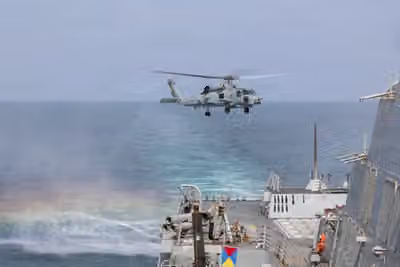
A screengrab from Iranian state TV footage purportedly shows the moment an Iranian missile is launched at Israel while an Israeli drone attack hits another launchpad in the same location.
Time is running out to avert a nuclear crisis, Nicole Grajewski of the Carnegie Endowment said, describing Iran's nuclear program as a complex file where diplomacy is limited, military strikes are insufficient, and Europe’s snapback of UN sanctions risks sparking fresh conflict.
Grajewski told Iran International's Eye for Iran that only Washington can break the deadlock by re-engaging directly with Tehran and backing a short extension that ties International Atomic Energy Agency (IAEA) inspections to credible security guarantees.
Tehran responded by restricting IAEA access. Soon after, Britain, France, and Germany — the E3 — formally invoked snapback under UN Security Council Resolution 2231. The mechanism automatically restores pre-2015 UN sanctions in 30 days unless the Council unanimously endorses continued relief.
Foreign Minister Abbas Araghchi accused Europe of “acquiescing” to Washington and Israel and warned any reinstated sanctions would be “null and void.” Iranian lawmakers have threatened to quit the Nuclear Non-Proliferation Treaty (NPT)—the cornerstone pact that obliges Iran to cooperate with the IAEA — if UN sanctions return.
Grajewski warned that such a step could be a trigger for war.
“Iran could withdraw from the NPT. And this is where you might see another conflict between Iran and Israel, more Israeli strikes on Iran’s program,” she said. “They’ll use the excuse that now we can’t see Iran’s nuclear program. We no longer have inspectors.”
She also cautioned against overreliance on force. “It’s unclear what we could have achieved with diplomacy. And it’s also clear that military action alone can’t solve the Iranian nuclear issue,” she said. President Donald Trump, for his part, has defended the June strikes as necessary.
What can Washington do now?
Grajewski urged the United States to resume direct or indirect talks, press for restored IAEA access, and offer a narrow, conditional assurance: no new strikes on nuclear facilities during a brief extension, so long as Iran meets inspection and transparency benchmarks. That package, she argued, could unlock a six-month snapback extension and lower the odds of escalation.
Moscow has floated a counter-resolution at the UN and, as Grajewski noted, is adept at using UN procedures to delay investigations and enforcement.
Grajewski tied today’s impasse back to the collapse of the 2015 nuclear deal, the Joint Comprehensive Plan of Action.
“Had the JCPOA remained in force, we probably wouldn’t have seen the 12-day war,” she said. But she added that Tehran overplayed its hand: “Iran has made so many terrible decisions… showing off their capabilities” exposed weaknesses and hardened adversaries’ resolve.
For now, the file sits on a knife-edge. “A crisis is not inevitable,” Grajewski concluded. “It’s possible and it’s somewhat likely — either a diplomatic crisis with NPT withdrawal or potentially something kinetic. But it’s not a foregone conclusion.”