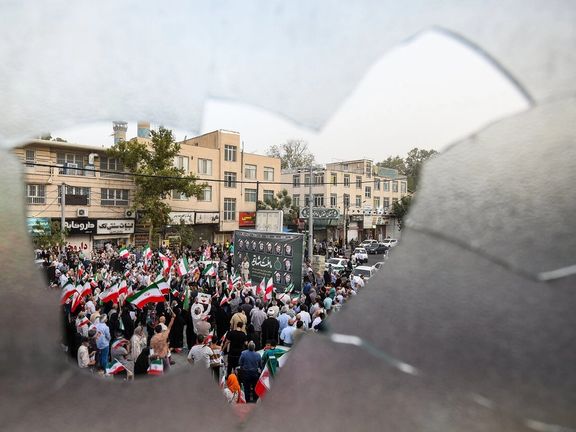
A rally in support of Iran's military operations against Israel seen through a broken window, Karaj, Iran, June 24, 2025
The legacy of a 12-day war with Israel which ended last month will likely be yet more economic hardship, deteriorating living standards and intensifying public distrust.
While the government portrays the conflict as a strategic victory, mounting evidence suggests a society battered, exhausted and increasingly disillusioned.
Daily life has grown more difficult, strained by chronic water and electricity shortages. Yet, despite the hardship, protests remain rare.
While state media continue to glorify the armed forces and the Supreme Leader, many recall a different reality: missile strikes without bomb shelters, ineffective air defenses and a war waged without public support.
The Supreme Leader’s three-week stay in an underground shelter became a symbol of elite insulation. On the ground, thousands of homes were damaged or destroyed, with casualties still likely unreported.
The government’s support for reconstruction has been slow and unclear, evoking comparisons to Khorramshahr, a focus of combat in the Iran-Iraq war which remains mostly ruined decades after the Iran–Iraq War.
The official refrain that “Israeli homes were also destroyed” has brought little comfort.
A huge plume of smoke rises over Tehran with the iconic Milad Tower in the background, Iran, June 2025
Economic disruption, official deflection
At the end of the 12-day war, Iran’s Chamber of Commerce acknowledged the war’s serious impact: disrupted trade, blocked currency repatriation and shaken investor confidence.
“Government-led economics cannot improve the situation,” said Isa Mansouri, head of the Chamber’s Research Center.
The warning echoed the view from Tehran’s bazaar and stock exchange: that even limited geopolitical shocks can derail imports and daily commerce.
Pension delays are another flashpoint.
A July 23 report by state news agency ILNA revealed some retirees were still waiting for April payments. Infrastructure damage in Tehran is extensive—over 3,000 housing units were hit in District 4 alone, with no clear timeline for repairs.
To contain the crisis, authorities quietly declared unofficial “holidays” in Tehran, reducing strain on water and power utilities while avoiding transparency.
President Pezeshkian’s claim on Al Jazeera that Israel bombed water resources to deprive Iranians of access was widely ridiculed and seen as deflecting from decades of internal mismanagement.
War’s reach into private life
A study by academic Momeneh Baseri, "The Iran-Israel War and the Change in Iranians' Lifestyle", published June 21 by Azad University, highlights the war’s broad social effects—even among those far from the front lines.
Drawing on field research and crisis sociology, Baseri identified several trends:
A decline in travel despite official campaigns promoting domestic tourism.
Widespread stockpiling of food, fuel, and medicine, worsening shortages.
Spiking media use, especially of social platforms and foreign-based outlets
Fading optimism, with marriage, investment, and emigration all clouded by uncertainty.
Cinemas and concert halls remain empty. In their place: home-based religious rituals, streaming platforms, and a growing culture of isolation.
Three men sitting in the shade of a tree near Tehran's Azadi square, Iran, July 19, 2025
The illusion of normalcy
Even efforts to portray resilience have backfired.
A video recorded and published by moderate daily Ham-Mihan shortly after ceasefire showed quiet Tehran streets and shuttered shops.
Another report by moderate online publication Asr Iran featured returning residents—some relieved, many bracing for more strikes. “It felt good to return,” said one man on camera, “even to an unsafe home.”
Foreign observers confirm the unease.
Deutsche Welle’s Dan Hirschfeld described Tehran as “in a constant state of alert,” with many seeking to leave and economic stress visibly deepening.
Calls for fundamental change
Criticism of the government narrative is mounting.
Sociologist Taqi Azad Armaki, writing in Fararu, called for a transition “from ideological warfare to national reconstruction.”
A urged empowering the sidelined middle class and warned that the war had left Iran helpless and unable to meet basic needs.
Though cautiously framed, it marks the clearest sign yet of openness to structural change.
Despite claims of stability, the Islamic Republic may be at its most fragile point since the 1981 bombing that killed over 70 top officials claimed by the People's Mojahedin Organization of Iran or MEK.
Then, the system had a charismatic leader in Ruhollah Khomeini and revolutionary zeal. Now, it is led by a solitary, increasingly isolated Supreme Leader with no clear path forward.
Israel conducted powerful airstrikes on July 16, 2025, targeting key government sites in Damascus, including the Defence Ministry, military headquarters, and locations near the presidential palace, reportedly killing at least one and injuring many more.
Israel’s attack on Damascus may unintentionally clear a path for its arch-foe Iran to regain influence in war-torn Syria, warns Thomas Juneau, a professor at the University of Ottawa's Graduate School of Public and International Relations.
“The best way to prevent Iran from rebuilding its influence in the new Syria is to have a strong Syria... weakening the new Syria goes exactly against that,” Juneau told Eye for Iran. “That’s why I struggle to see how Israel, in the longer term, is acting in favor of its own interests.”
Israel launched airstrikes on Syria's defense ministry and an area adjoining the presidential palace on July 16 following days of sectarian killings between Bedouin tribes and members of the Druze minority in southern Syria.
Israel cited a need to protect the Druze, an ethnoreligious community which also lives in Israel and the Israeli-occupied Golan Heights.
The UK-based Syrian Observatory for Human Rights reported on Sunday that the past week’s violence killed 1,120 people, including 427 Druze fighters, 298 Druze civilians, 354 government security forces and 21 Sunni Bedouin.
But the Israeli strikes may risk destabilizing the already fragile central government of former jihadist-turned-president Ahmed al-Sharaa, Juneau said.
“To actively work against the creation of a new Syria, where there is a once-in-a-lifetime opportunity now... this could easily fall back against Israel itself,” said Juneau, an associate fellow with the Chatham House's Middle East and North Africa Program.
“The more unstable the new Syria is, the more it creates openings for Iran to rebuild its influence.”
Israel appears to be adamantly opposed to the new rulers of Damascus.
Diaspora Affairs Minister Amichai Chikli called for Syrian President Ahmed al-Sharaa to be assassinated in a statement posted in both English and Hebrew on his X account on July 15.
“Anyone who thinks Ahmad al-Sharaa is a legitimate leader is gravely mistaken — he is a terrorist, a barbaric murderer who should be eliminated without delay,” Chikli wrote.
The next day, Israeli jets pounded heart of Damascus, in an attack that was caught live on a news broadcast as the anchor ducked for cover.
A large flag flying outside the stricken defense ministry which replaced that of the ousted Assad dynasty dictatorship was left shredded.
US Special Envoy to Syria Tom Barrack has taken aim at Israel’s intervention, describing the strikes to the Associated Press as “poorly timed” and a setback to ongoing efforts to stabilize the region.
Tehran eyes comeback amid Syrian chaos
Iran is likely exploiting Syria’s current instability to reactivate dormant networks tied to the former Assad regime, said Juneau, who previously served as the Canadian Department of National Defense's strategic policy analyst focused on the Middle East.
“There is no doubt in my mind that the Islamic Republic will try—probably already is trying—to rebuild its influence networks in Syria, especially with dissatisfied elements and former regime elements,” he told Eye for Iran.
Under Bashar al-Assad, Syria had become Iran’s closest state ally, acting as a conduit for arms to Hezbollah, a strategic launchpad for attacks against Israel, and a hub for Islamic Revolutionary Guard Corps (IRGC) commanders and loyalist militias.
Al-Sharaa, Syria's de facto president, has taken steps to block Iranian re-entry into Syria, including cutting arms transfer routes to Hezbollah that would be used against Israel and working to prevent the return of Iranian influence.
Iran has long justified its refusal to negotiate or normalize ties with Israel on ideological and strategic grounds. But Juneau warned that Israel’s current actions could validate Tehran’s narrative that diplomacy is futile.
“What message does it send when Israel not only hits Iranian and former Iranian assets in Syria, but actively hits the new Syrian government?” he asked. “I think it sends a very negative message... to the Sharaa administration itself, which has clearly said it has no hostile intentions towards its neighbors, including Israel.”
Missiles launched from Iran are seen from Jerusalem, June 13, 2025.
A senior commander in Iran’s Islamic Revolutionary Guard Corps (IRGC) and aide to the IRGC’s chief said the 12-day war with Israel ended with an absolute win for Tehran, adding Iran could have carried on the fight for years if necessary.
“We achieved a 100% victory in this war. Do not doubt it. Our victory was very significant, and we definitely came out as the winner,” Ahmad Vahidi told Fars News in an interview published Thursday.
When asked how he defined victory, Vahidi pointed to public opinion and the circumstances surrounding the ceasefire.
“In all the surveys, the judgment of our people is that we were victorious. The opinion of the people and global public sentiment is the same,” he said, without citing specific evidence.
“If we hadn’t won, and if the enemy hadn’t been crushed, then why did they ask for a ceasefire? It’s those who are defeated who request a ceasefire. For us, those 12 days were not a problem — we could have continued for 12 years.”
Israeli airstrikes and drone attacks during the June war killed hundreds of Iranians, including civilians, military personnel, and nuclear scientists. Missile strikes launched by Iran killed 27 Israeli civilians.
On June 22, the United States entered the conflict by striking Iran’s nuclear facilities in Isfahan, Natanz, and Fordow using long-range bombers and submarine-launched missiles.
A US-brokered ceasefire was announced on June 24 after Iran launched retaliatory airstrikes on a US airbase in Qatar.
Asked about the level of Israeli infiltration in Iran, Vahidi acknowledged limited human espionage but attributed most of Israel’s intelligence advantage to technological superiority.
“We don’t deny they have spies. But that they had someone at that level, in that position? I do not confirm that,” he said. “Much of their intelligence comes from advanced technology and satellite surveillance.”
During the war, Israel reportedly killed several high-ranking IRGC officials, including Armed Forces Chief of Staff Mohammad Bagheri, IRGC Commander Hossein Salami, IRGC Aerospace Force Commander Amir Ali Hajizadeh, and IRGC Deputy for Operations Mehdi Rabbani.
Iranians driving their cars into a shallow river to beat the summer heat near the Caspian city of Sari, July 23, 2025
Officials in Tehran blame drought and public overuse for Iran’s worst water shortage in living memory, but the crisis stems from decades of mismanagement, short-sighted policy and institutional denial.
Iran consumes about 100 billion cubic meters of water each year—more than twice Turkey’s usage, despite similar populations. Around 90% goes to agriculture, 6% to households and the rest to industry.
Per capita household water use is similar to Turkey’s, but Iran recycles only about 20% of wastewater, compared to 85% in Turkey, 95% in the United Arab Emirates and 98% in Germany.
Despite a UN “red warning” 25 years ago, Iran expanded hydropower rather than wastewater treatment.
The Islamic Revolutionary Guard Corps (IRGC) has built over 60 dams in recent decades. More than half are now empty, with hydropower generation operating at just one-third of its nominal capacity.
Hydropower’s share in Iran’s electricity mix has fallen below 5%. Meanwhile, 80% of untreated wastewater is dumped into rivers, deserts and underground wells, contaminating the very sources Iran increasingly depends on.
Agriculture: high consumption, low output
The agricultural sector accounts for nearly all of Iran’s water use but contributes just 11% to GDP. Most farming still relies on flood irrigation.
In contrast, Turkey has reduced agriculture’s share of national water use from 75% to under 64%, while doubling the value of its agricultural output, which now stands at $60 billion, 13 times higher than Iran’s.
Perhaps more staggering, Turkey has achieved that using only a third of what Iran uses annually for farming.
Young men pumping water from a pond near the southern town of Karkheh, Iran, July 23, 2025
Overextraction is reducing Iran’s groundwater reserves by 5 billion cubic meters annually. In Turkey, by contrast, aquifer recharge rates exceed extraction by a factor of three.
Drought is real, so is bad policy
Past policies pushing grain self-sufficiency worsened the problem.
In 2014, a deputy agriculture minister dismissed claims that farming consumed over 90% of the country’s water—insisting on continuing the strategy despite mounting environmental costs.
Iran, like many countries in the region, faces rising water stress.
Last year’s rainfall totaled around 400 billion cubic meters, but 70% of it evaporated, compared to a 50% loss in Turkey, which saw 537 billion cubic meters of precipitation.
Official figures show Iran’s dam reserves are just 46% full nationwide, and only 13% in the capital region. Turkey’s dam levels are at 57%, down from 70% a decade ago.
Both countries experience erratic rainfall but Turkey’s investments in water recycling, storage and irrigation have helped stabilize its system. Iran’s have not.
Iran’s water crisis isn’t simply the result of climate stress. It’s the consequence of institutional neglect, poorly prioritized infrastructure, and refusal to heed decades of expert warnings.
While others adapted, Iran doubled down on wasteful practices and political denial. The result: a deepening crisis, no longer possible to blame on nature alone.
Current Trump aide Sebastian Gorka speaks annual at the annual Conservative Political Action Conference (CPAC) in 2018.
A senior White House official said the Trump administration has no plans to topple the Islamic Republic by force but said Washington hoped what he described as the people of Persia would ultimately "liberate themselves".
“We are not in the business of deploying the 82nd Airborne to do regime changes anywhere,” Sebastian Gorka, deputy assistant to the president and senior director for counterterrorism at the White House, told an event at Washington DC thinktank the Foundation for Defense of Democracies.
“We would like the people of Persia, including all the minorities in Persia, to eventually liberate themselves.”
A ceasefire late last month ended a 12-day conflict between Israel and Iran that was capped off by US strikes on Iranian nuclear sites.
Israeli Prime Minister Benjamin Netanyahu and US President Donald Trump both mooted killing Iran's Supreme Leader Ali Khamenei at the height of the conflict and Trump hinted at favoring Iranian regime change.
"It’s not politically correct to use the term, 'Regime Change,' but if the current Iranian Regime is unable to MAKE IRAN GREAT AGAIN, why wouldn’t there be a Regime change??? MIGA!!!" Trump said in a post on Truth Social in late June.
Israel’s prime minister also said on Tuesday that Iran’s clerical leadership will fall from within not through any foreign military intervention.
“Everybody talks about regime change and they envision the American army and Israeli forces invading Iran — boots on the ground and all that stuff people spew. No,” Netanyahu said in an interview with the Full Send Podcast.
Israel's surprise campaign of airstrikes and drone attacks killed hundreds of Iranians including civilians, military personnel and nuclear scientists. Iran's retaliatory missile strikes killed 27 Israeli civilians.
Diplomats from Iran, Russia, and China met in New York to coordinate their positions on the recent Israeli and US military campaigns and UN Security Council Resolution 2231 -- the basis that can bring back sanctions lifted under the 2015 nuclear deal, Iranian media reported.
UN Security Council Resolution 2231, adopted on July 20, 2015, endorses the Joint Comprehensive Plan of Action (JCPOA), the nuclear agreement between Iran and the P5+1 countries. The US unilaterally withdrew the accord in 2018.
The resolution includes provisions for monitoring Iran's compliance and sets a timeline for the eventual end of UN sanctions, provided Iran upholds its commitments.
“We held a joint meeting with the ambassadors and permanent representatives of China and Russia to review developments and adopt shared positions,” said Kazem Gharibabadi, Iran’s deputy foreign minister for legal and international affairs.
“We always coordinate our positions on key international issues, especially those concerning Iran.”
The meeting took place at Iran’s permanent mission to the United Nations on the sidelines of Gharibabadi’s trip to attend Security Council sessions.
A high-level meeting with Russian and Chinese officials was also held in Tehran on Tuesday, as reported by IRNA state news agency. This was part of a diplomatic effort to shield the country from the threat of reimposed UN sanctions under the 2015 nuclear deal’s snapback mechanism.
Gharibabadi also warned Wednesday that if European powers trigger the snapback mechanism, “leaving the NPT remains an option.”
Tehran has also agreed to host a technical team from the International Atomic Energy Agency in the coming weeks to discuss what Gharibabadi called a “new model for cooperation.”
“The delegation will come to discuss this framework,” he said. “They will not be inspecting nuclear sites.”
Late in June, Iran’s parliament voted to suspend cooperation with the IAEA after the ceasefire with Israel, demanding security guarantees.
Red lines for talks with Washington
The Iranian diplomat said talks could resume if Washington builds trust, pledges not to use negotiations as a pretext for military action, and recognizes Iran’s rights under the Nuclear Non-Proliferation Treaty.
"To enter negotiations with the American side, several principles are essential: building Iran’s trust — as Iran has absolutely no trust in the United States; ensuring that talks are not used as a platform for hidden agendas such as military action, even though Iran will remain fully prepared; and respecting and recognizing Iran’s rights under the Non-Proliferation Treaty, including enrichment in accordance with its desired needs," he wrote in a post on X Thursday.
Gharibabadi will lead the Iranian delegation for talks with European powers in Istanbul on Friday - in what appears to be a last-ditch effort to salvage a deal and avert a return of United Nations sanctions against Iran.
Washington confirmed on Tuesday that it is coordinating closely with the E3 (Britain, France and Germany) ahead of the Istanbul talks, while remaining "ready to talk directly" to Tehran.