• العربية
  • فارسی
Brand
  • Iran Insight
  • Politics
  • Economy
  • Analysis
  • Special Report
  • Opinion
  • Podcast
  • Iran Insight
  • Politics
  • Economy
  • Analysis
  • Special Report
  • Opinion
  • Podcast
  • Theme
  • Language
    • العربية
    • فارسی
  • Iran Insight
  • Politics
  • Economy
  • Analysis
  • Special Report
  • Opinion
  • Podcast
All rights reserved for Volant Media UK Limited
volant media logo
EXCLUSIVE

‘Rising Lion’ operation took years to prepare, says Israeli minister

Negar Mojtahedi
Negar Mojtahedi

Iran International

Jun 14, 2025, 03:15 GMT+1Updated: 08:04 GMT+0

Israel’s ongoing military strikes on Iran—code-named “Rising Lion”—were the result of years of preparation and mark just the beginning of what’s to come, Israeli Minister of Diaspora Affairs Amichai Chikli said in an interview with Eye for Iran.

“This operation took years to prepare,” Chikli told Eye for Iran. “It's the very hard walk of the IDF intelligence, the Mossad... thousands of people are involved in this.”

“This is just the beginning,” he said, without disclosing operational details or how the mission might continue.

Iran launched over 200 missiles at Israel injuring at least 14 people after Israeli attacks killed its top military leadership and pounded armed forces and nuclear sites leaving scores of Iranians dead.

While Israel’s initial strikes hit key nuclear sites like Natanz and Fordow, Iran’s nuclear infrastructure spans dozens of locations. According to Israeli assessments, further strikes will likely be needed to eliminate what is seen as an existential threat.

Chikli said the objective was not regime change, but to stop Iran from acquiring nuclear capabilities. While many Iranians have called on Israel to help bring down the Islamic Republic, he said meaningful change must come from within.

“This is the time to seize the moment and to try and take back your country from the Revolutionary Guards," said Chikli, "Will Iranians use this moment to change the course of history, or not?”

Diplomacy may follow destruction

Major Andrew Fox, a former British Army officer, also said the Israeli strikes were deliberately calibrated to avoid full-scale regime decapitation—signaling intent, not total war.

“If they'd been serious about regime change, then Khamenei and the president would have been fully in scope for targeting.”

Fox emphasized that while regime change might remain a long-term objective, Israel’s more immediate priority is clear: "The short-term aim has to be focusing on making sure Iran doesn't gain a nuclear weapon capability."

He suggested that President Donald Trump may be using the Israeli operation as strategic leverage to push Tehran back to the negotiating table—after exhausting political and economic pressure.

“Trump is talking about giving Iran another opportunity to make a deal... That's the horse trade that Israel made with Washington.”

Fox’s analysis points to a pattern: when sanctions and diplomacy fail to alter Tehran’s behavior, military action becomes a final tool—not necessarily to start a war, but to reset the terms for diplomacy.

Iran’s weakest moment

Dr. Eric Mandel, a Middle East analyst and advisor to US and Israeli defense officials, told Eye for Iran that this moment marks the Islamic Republic’s deepest vulnerability since its founding in 1979—one of the most consequential events in modern Iranian and Middle Eastern history.

“Iran is at its weakest in 46 years,” said Mandel, who directs the Middle East Political and Information Network (MEPIN).

He says Trump now faces a defining choice—retreat into isolationism or use Israeli military action as leverage for long-term strategic change.

“The big question is, what will President Trump do? Not what the Israelis will do. What will the president do with what Israel has handed to them?”

Mandel suggests that one option remains on the table: a US strike on Iran’s deeply fortified enrichment site.

“America could retaliate and would the president make a phone call to Diego Garcia where our B-2 bombers with the massive ordinances are and attack the one place that hasn't been attacked as we know which is the deeply buried enrichment facility in Fordow”

The Lion Rises
Israeli Minister Chikli said the operation’s name, Rising Lion, came from both Iran’s original flag and a verse from the Book of Numbers: ‘A nation that rises like a lion.’

"We believe this is a moment not just for security—but for shared history and future peace.”

You can watch the full episode of Eye for Iran on YouTube or listen on any major podcast platform like Spotify, Apple, Amazon Music and Castbox.

Most Viewed

Ghalibaf defends Iran-US talks amid hardline backlash
1
INSIGHT

Ghalibaf defends Iran-US talks amid hardline backlash

2
INSIGHT

Iran diplomacy wobbles as factions compete to avoid looking soft on US

3
VOICES FROM IRAN

Bread shortages, soaring prices strain households in Iran, residents say

4
ANALYSIS

The politics of pink: how Iran uses cuteness to rebrand violence

5

War-hit homeowners feel abandoned as Iran’s reconstruction aid fades

Banner
Banner

Spotlight

  • Lights out, then gunfire: Witnesses recount Mashhad protest crackdown
    VOICES FROM IRAN

    Lights out, then gunfire: Witnesses recount Mashhad protest crackdown

  • Family told missing teen was alive, then received his body 60 days later
    EXCLUSIVE

    Family told missing teen was alive, then received his body 60 days later

  • Is Iran entering its Gorbachev moment?
    INSIGHT

    Is Iran entering its Gorbachev moment?

  • Iran crackdown reaches cemeteries as graves of slain protesters defaced
    EXCLUSIVE

    Iran crackdown reaches cemeteries as graves of slain protesters defaced

  • Iran diplomacy wobbles as factions compete to avoid looking soft on US
    INSIGHT

    Iran diplomacy wobbles as factions compete to avoid looking soft on US

  • The politics of pink: how Iran uses cuteness to rebrand violence
    ANALYSIS

    The politics of pink: how Iran uses cuteness to rebrand violence

  • Bread shortages, soaring prices strain households in Iran, residents say
    VOICES FROM IRAN

    Bread shortages, soaring prices strain households in Iran, residents say

•
•
•

More Stories

Israel’s strike on Iran echoes campaigns against Hamas, Hezbollah

Jun 13, 2025, 18:24 GMT+1
•
Morad Vaisi

Israel’s strikes on Iran recall the surprise attack on Egypt in 1967, but in aim and execution they more closely resemble the recent campaigns against Hamas and Hezbollah that targeted leadership and capabilities to force strategic paralysis.

The strike was broad in scope, targeting senior commanders, nuclear sites, missile systems, weapons production facilities, and scientists involved in military projects.

Crucially, it came as the Islamic Republic was preparing for Sunday’s negotiations with Washington—amplifying the element of surprise. The tactics were highly unexpected and caught Tehran off guard.

Israel’s main goal was to eliminate the regime’s senior military hierarchy. That aim was largely achieved.

Confirmed killed were Mohammad Bagheri, Chief of the Armed Forces General Staff; Hossein Salami, IRGC Commander-in-Chief; Gholam Ali Rashid, head of Khatam al-Anbiya Central Command; Amir Ali Hajizadeh, IRGC Aerospace Force Commander; Mehdi Rabani, IRGC Deputy for Operations; and Ali Shamkhani, senior advisor to Supreme Leader Khamenei and head of the nuclear program.

The assassinations point to deep Israeli intelligence penetration into Iran’s security structure. Mossad appears to have access to top-level information.

Former Intelligence Minister Ali Younesi had warned a while ago that Israeli infiltration was so extensive senior officials should fear for their lives—a warning that now seems prescient.

Israel also killed several top nuclear scientists—the “brains” behind the weapons program. The knowledge infrastructure suffered a major blow, though not total collapse. Some veteran scientists have been confirmed dead, marking a serious setback to Iran’s nuclear ambitions.

Equally damaging, Iran’s air defenses collapsed at the critical moment. The November strike and this latest assault suggest Tehran’s systems are unable to counter Israeli air superiority when it matters most.

Israel’s air force targeted nuclear sites, especially in Natanz. While Tehran has disclosed little, Israeli officials say—and reported explosions suggest—that key infrastructure, built at enormous cost, was destroyed.

Israel also asserts to have struck multiple missile and rocket sites, as well as weapons factories, destroying hundreds of missiles and drones hidden underground. If confirmed, this would further demonstrate Israel’s deep military intelligence reach. Iran’s offensive capability has been badly degraded, though not entirely neutralized.

The operation was carried out by the Israeli military and Mossad. It showed not only air dominance but also intelligence and technological superiority—enough to operate freely on Iranian soil.

Israel has signaled the operation is ongoing.

Its vow to continue strikes suggests a preselected target bank and a broader strategy aimed at reducing Iran’s military threat to the lowest level.

The approach mirrors campaigns against Hamas and Hezbollah: dismantle leadership, cripple retaliatory capacity, and push the remaining structure toward surrender.

Senate Republican backs Israeli attack '100%'

Jun 13, 2025, 17:05 GMT+1
•
Marzia Hussaini

"Absolutely, 100%. I support them completely. They have the right to defend themselves," Oklahoma Republican Markwayne Mullin told Iran International.

"People said, 'Well, Iran didn’t attack them.' Well, actually, Iran has been attacking them for many years through their sponsorship of terror—through Hamas, through the Houthis, and through Hezbollah."

Asked if he backed regime change in Iran, Senator Mullin demurred.

"That’s not up to us. That is up to the Iranian people. That’s a decision they have to make. What we’re trying to do is make sure they never get a nuclear weapon. As far as regime change goes, let the Iranians pick that fight."

Israel's attack on Iran: what we know so far

Jun 13, 2025, 16:17 GMT+1

Israel launched Operation Rising Lion, a wide-ranging military campaign targeting Iran’s nuclear sites as well as military infrastructure and command. Here is a brief summary of events so far.

Iranian military command decimated

At least 20 top Iranian figures were killed, including:

  • IRGC chief Hossein Salami
  • Chief of Staff Mohammad Bagheri
  • Aerospace Force Commander Amir Ali Hajizadeh
  • Top nuclear scientists and advisors

Supreme Leader Khamenei made immediate appointments:

  • Mohammad Pakpour (IRGC)
  • Abdolrahim Mousavi (Armed Forces)
  • Ahmad Vahidi (Revolutionary Guards)

Trump backs strikes, says ‘more brutal’ planned

US President Trump praised the Israeli operation, warning Tehran to negotiate before “it’s too late”:

  • Revealed Iran had ignored a 60-day ultimatum
  • Claimed Iranian hardliners “are all dead now”
  • US Navy destroyers have been repositioned in the Mediterranean
  • Former envoy Brett McGurk called fears of regional war “overheated”

Civilian toll and domestic fallout

Unofficial Iranian reports say 78 killed, 329 injured in Tehran province.

  • Protests erupted across Iran
  • Emergency teams deployed to over 60 locations
  • Internet restrictions imposed; all flights suspended
  • Cultural sites closed and artifacts moved to secure storage

Damage to nuclear and military sites

  • Israel claimed “significant damage” to the Natanz facility
  • Dozens of missile, radar, and drone sites destroyed
  • Mossad reportedly disrupted hundreds of missile launches
  • Iran said Fordow was unharmed; Natanz suffered only surface-level damage
  • IAEA confirmed no radiation leaks and is assessing damage

Iran vows to strike back

Iran says it will respond “decisively and proportionately”:

  • President Pezeshkian promised a “regret-inducing” response
  • IRGC vowed preplanned retaliation
  • FM Araghchi invoked Article 51 of the UN Charter
  • Iran summoned the Swiss envoy (representing US interests), warning against any US military support to Israel
  • Iran warned the US must be held “accountable for enabling the attacks”
  • Iranian lawmakers urged Khamenei to authorize nuclear weapons

Regional and international reactions

  • UN Security Council and IAEA Board to meet urgently
  • EU voiced grave concern, warning of a spiral of violence
  • Russia, China, Turkey, Saudi Arabia, and Italy condemned or urged restraint
  • EU reaffirmed diplomatic efforts to prevent Iran from acquiring nuclear weapons
  • Hamas praised Iran’s role; Hezbollah condemned the attack but will not retaliate

Diplomatic flurry

  • Netanyahu has spoken or will speak with leaders of the US, Russia, Britain, France, Germany and India
  • Iran's Araghchi demanded IAEA condemnation
  • Iranian ambassador summoned to Germany’s foreign ministry
  • Italy’s FM Tajani spoke with Araghchi, urging de-escalation and diplomacy

Market and aviation Disruption

  • Oil prices surged 12%, surpassing $77/barrel
  • Wall Street opened lower as investors fled risk
  • Iran, Iraq, Jordan, and Israel closed airspace; over 1,800 flights disrupted
  • Major carriers suspended operations; shipping advisories issued in Hormuz and Red Sea

Israeli emergency measures

  • Israel declared a national emergency
  • All embassies worldwide closed; citizens told to avoid public identification
  • Senior leadership relocated amid threats of retaliation

'Thank you uncle Netanyahu': some Iranians praise Israeli strikes

Jun 13, 2025, 11:35 GMT+1
•
Maryam Sinaiee

Some Iranians expressed gratitude to Israel for assassinating military and political officials they viewed with contempt in video and voice messages sent to Iran International TV.

“I wanted to thank Israel and Uncle Netanyahu for what they did last night and to tell Iran: You are nothing. (You say you are) a power in the region, but three of your top commanders were killed in a single attack,” a viewer said in his message.

“I want people to get out [on the streets to protest] and be united with each other and to topple this blood thirsty government,” she added.

In another message, a viewer said he was pleased by the Israeli attack which, according to the Israeli military hit dozens of military and nuclear sites and eliminated some of the country's top military leadership in an open-ended campaign dubbed "Rising Lion" by Netanyahu.

Iran has confirmed the deaths of several top commanders including the Revolutionary Guards (IRGC) Commander Hossein Salami, Chief of Staff of Armed Forces Mohammad Bagheri, and IRGC Aerospace Force Commander Amir-Ali Hajizadeh, and six nuclear scientists, including former chief of Iran's Atomic Energy Agency Fereydoun Abbasi.

There are also unconfirmed reports of the death of Ali Shamkhani, a top advisor to Supreme Leader Ali Khamenei, who has vowed a “severe punishment” and a “harsh response.

“Mr. Pezeshkian, do you remember saying Israel and America can strike Iran's nuclear facilities but can’t strike Iranian scientists? Israel just did that,” he asked. “Why do you speak so much nonsense?”

“You couldn’t do a damn thing! Thank you, thank you Uncle Netanyahu, even if it’s we [ordinary Iranians] who will suffer the consequences,” he added.

Following Israel’s military strike, the Iranian currency, the rial, experienced a sharp depreciation of at least 15% in the unofficial market.

The sudden plunge of the rial highlights growing public anxiety over potential escalation and lack of confidence in the government's ability to stabilize the economy amid intensifying geopolitical tensions.

Another Iran International viewer similarly thanked Israel but urged it not to forget to target Khamenei.

“No one approves of war, but I’m sure when it comes to the murderous and terrorist Islamic Republic, all the 80 or 90 million people in Iran approve of this attack,” she said.

“Now they will get the seriousness of the situation and will understand that although they may be able to bully the Iranian people and kill them on the streets, they can’t bully the world and the big powers,” she added.

In another message, a viewer expressed his happiness after realizing that the sound that woke him up was the sound of the explosion of Israeli bombs, not lightning.

“It was good news and a harbinger of freedom to all Iranians. Well done, Israel. You have avenged all those freedom-seeking youth who were torn apart and raped on the streets.”

In a statement shared online, Iran’s exiled crown prince, Reza Pahlavi, accused Khamenei of dragging the country into a war that does not reflect the will of the Iranian people, calling the current conflict "Khamenei’s war, not Iran’s."

He urged Iran's military, police, and intelligence personnel to distance themselves from what he described as a “corrupt and incompetent leadership” and to join the people.

The path forward, he said in his message, is the overthrow of the Islamic Republic through street protests and nationwide strikes.

Khamenei described the attack as a "crime" that revealed Israel's "evil nature" by targeting residential centers and said Israel will face “a bitter and painful end”.

In response, Iran launched a barrage of drones and missiles toward Israel just hours after the attack. Israeli defense officials claimed all drones were successfully intercepted.

A military official said in a Friday morning briefing that 200 fighter jets had been involved in the operation.

He said air defenses, ballistic missiles ready to launch to Israel and missile manufacturing sites and facilities were also targeted in the strikes. The operation came as Iran's nuclear program "is approaching the point of no return and is rapidly advancing toward obtaining a nuclear weapon", he told reporters.

"We struck their nuclear plan, and we struck military targets—before they had the ability to strike us with weapons of mass destruction, with nuclear weapons. We had no other choice, and we launched this operation now because this is the most appropriate time in light of this concrete threat. They have already obtained enough uranium for 15 nuclear weapons," he said.

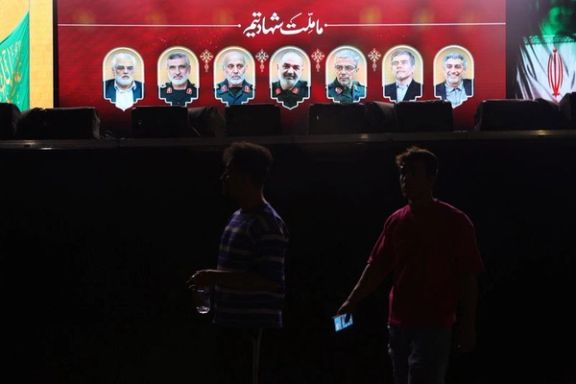
Mossad attack disabled Iranian missile launches

Jun 13, 2025, 11:26 GMT+1

An Israeli official told Iran International that Israel carried out a complex and multi-phase operation that successfully thwarted the launch of hundreds of Iranian ground-to-ground missiles aimed at Israeli territory.

An Israeli official told Iran International that Israel carried out a complex and multi-phase operation that successfully thwarted the launch of hundreds of Iranian ground-to-ground missiles aimed at Israeli territory.

Read more here.