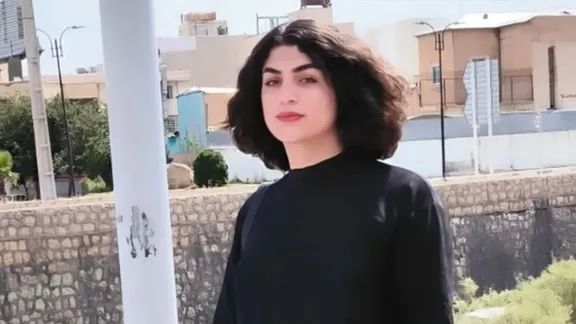
Sogand Pakdel, an Iranian trans woman, killed by her uncle in Iran.
A 25-year-old transgender woman, Sogand Pakdel, was shot in the head by her own uncle in an alleged honor killing at a family wedding near Shiraz in southern Iran last month.
Her death was the latest in a series of murders of queer Iranians by their own relatives, according to human rights groups, and testament to the grim practice's persistence in the Islamic theocracy.
Pakdel, a well-known trans activist in Iran, attended her cousin’s wedding despite threats from her family.
Upon arrival, her uncle allegedly fired a warning shot into the air before killing her, according to the Human Rights Activists News Agency (HRANA). The murder took place just days before the start of the 12-day war between Israel and Iran last month.
Pakdel had faced years of abuse, including beatings, abduction and death threats from family members.
The Norway-based Hengaw Organization for Human Rights cited a source saying she had been living in a Shiraz guesthouse after being ostracized yet remained active in Iran’s trans community.
“She never stayed silent,” the source told Hengaw, noting that Pakdel frequently used social media to advocate for trans rights and speak out against discrimination.
"As a transgender woman with lived experience in Iran, hearing this news is not only deeply distressing for me, but also traumatizing," said Shaya Goldoust, an Iranian trans activist now living in Vancouver, told Iran International. "It brings back the pain and fear I endured throughout three decades of life in that country."
Goldoust, who had gender affirmation surgery in 2012, said she feared for her life in Iran. She fled to Turkey in 2016, where she also faced discrimination, before eventually seeking refuge in Vancouver in 2020.
"Iran is a country where being different can cost you your life, and where even death is met with celebration by some," Goldoust added. "The reactions on social media, where many users justified or even welcomed her death simply because of her identity, are a chilling reminder of that truth."
Pakdel was a member of the Qashqai tribe known as “Galleh Zan.” Her killing was reportedly aimed to restore so-called family honor, a term used to justify such murders where they occur in traditional, socially conservative communities.
HRANA reported that her funeral was held in near-secrecy under family pressure, with only a small number in attendance. Her uncle later confessed and turned himself in.
No protection under the law
Shadi Amin, director of the Iranian LGBTQ+ rights group 6Rang, said Pakdel’s killing highlights how vulnerable trans people remain under Iran’s legal system.
Her murder occurred in a legal vacuum in which queer Iranians lack any formal protections and remain vulnerable to systemic abuse and lethal violence.
"As a trans person, Sogand should have been protected by the law—but they weren’t. Their murder by their uncle exemplifies the deadly intersection of patriarchy, heteronormativity, and systemic violence against the LGBT+ community," she told Iran International.
"To prevent such tragedies, we need profound political, cultural, and legal transformation."
Arsham Parsi, a queer Iranian-Canadian activist, was resigned.
“This is yet another heartbreaking and tragic incident from Iran. Sadly, it is not the first time a member of the LGBTQ+ community has been killed by their own family simply for being different — and tragically, it may not be the last,” he told Iran International.
Parsi, who founded Iran’s first underground LGBTQ+ support group in 2001, now lives in Toronto, where he leads the International Railroad for Queer Refugees (IRQR) and the Marjan Foundation, both of which support LGBTQ+ communities across the Middle East.
While being transgender is not criminalized under Iranian law, trans and queer Iranians face widespread violence, exclusion, and discrimination. Homosexuality, by contrast, is punishable by death under the Islamic Republic’s penal code.
In September 2022, two women — Zahra Sedighi-Hamadani and Elham Choubdar — were sentenced to death by the Islamic Revolution Court of Urumieh for defending LGBTQ+ rights online.
Amnesty International said the verdicts were based on their “perceived sexual orientation and gender identity.” Despite international outcry, Iranian authorities stood by the sentences.
Such honor-based killings continue to surface. In February 2024, a man in Tabriz murdered his 17-year-old queer child, Parsa, and was released after serving only six months. In May 2021, Alireza Fazeli Monfared, 20, was killed by male relatives in Ahvaz for being gay—one of the few publicly acknowledged cases.
These murders typically go unpunished and underreported, ignored by the judiciary and state-run media. Activists warn that only international pressure and public scrutiny can disrupt the cycle.
“We know the Iranian regime consistently fails to take meaningful action to prevent such violence or protect LGBTQ+ individuals," Parsi told Iran International.
That’s why the responsibility falls on us — activists, human rights defenders, and allies — to raise awareness, challenge harmful norms, and advocate for change."
But with threats continuing to grow at home, many queer Iranians seek to flee the country in search of safety abroad.
Israel conducted powerful airstrikes on July 16, 2025, targeting key government sites in Damascus, including the Defence Ministry, military headquarters, and locations near the presidential palace, reportedly killing at least one and injuring many more.
Israel’s attack on Damascus may unintentionally clear a path for its arch-foe Iran to regain influence in war-torn Syria, warns Thomas Juneau, a professor at the University of Ottawa's Graduate School of Public and International Relations.
“The best way to prevent Iran from rebuilding its influence in the new Syria is to have a strong Syria... weakening the new Syria goes exactly against that,” Juneau told Eye for Iran. “That’s why I struggle to see how Israel, in the longer term, is acting in favor of its own interests.”
Israel launched airstrikes on Syria's defense ministry and an area adjoining the presidential palace on July 16 following days of sectarian killings between Bedouin tribes and members of the Druze minority in southern Syria.
Israel cited a need to protect the Druze, an ethnoreligious community which also lives in Israel and the Israeli-occupied Golan Heights.
The UK-based Syrian Observatory for Human Rights reported on Sunday that the past week’s violence killed 1,120 people, including 427 Druze fighters, 298 Druze civilians, 354 government security forces and 21 Sunni Bedouin.
But the Israeli strikes may risk destabilizing the already fragile central government of former jihadist-turned-president Ahmed al-Sharaa, Juneau said.
“To actively work against the creation of a new Syria, where there is a once-in-a-lifetime opportunity now... this could easily fall back against Israel itself,” said Juneau, an associate fellow with the Chatham House's Middle East and North Africa Program.
“The more unstable the new Syria is, the more it creates openings for Iran to rebuild its influence.”
Israel appears to be adamantly opposed to the new rulers of Damascus.
Diaspora Affairs Minister Amichai Chikli called for Syrian President Ahmed al-Sharaa to be assassinated in a statement posted in both English and Hebrew on his X account on July 15.
“Anyone who thinks Ahmad al-Sharaa is a legitimate leader is gravely mistaken — he is a terrorist, a barbaric murderer who should be eliminated without delay,” Chikli wrote.
The next day, Israeli jets pounded heart of Damascus, in an attack that was caught live on a news broadcast as the anchor ducked for cover.
A large flag flying outside the stricken defense ministry which replaced that of the ousted Assad dynasty dictatorship was left shredded.
US Special Envoy to Syria Tom Barrack has taken aim at Israel’s intervention, describing the strikes to the Associated Press as “poorly timed” and a setback to ongoing efforts to stabilize the region.
Tehran eyes comeback amid Syrian chaos
Iran is likely exploiting Syria’s current instability to reactivate dormant networks tied to the former Assad regime, said Juneau, who previously served as the Canadian Department of National Defense's strategic policy analyst focused on the Middle East.
“There is no doubt in my mind that the Islamic Republic will try—probably already is trying—to rebuild its influence networks in Syria, especially with dissatisfied elements and former regime elements,” he told Eye for Iran.
Under Bashar al-Assad, Syria had become Iran’s closest state ally, acting as a conduit for arms to Hezbollah, a strategic launchpad for attacks against Israel, and a hub for Islamic Revolutionary Guard Corps (IRGC) commanders and loyalist militias.
Al-Sharaa, Syria's de facto president, has taken steps to block Iranian re-entry into Syria, including cutting arms transfer routes to Hezbollah that would be used against Israel and working to prevent the return of Iranian influence.
Iran has long justified its refusal to negotiate or normalize ties with Israel on ideological and strategic grounds. But Juneau warned that Israel’s current actions could validate Tehran’s narrative that diplomacy is futile.
“What message does it send when Israel not only hits Iranian and former Iranian assets in Syria, but actively hits the new Syrian government?” he asked. “I think it sends a very negative message... to the Sharaa administration itself, which has clearly said it has no hostile intentions towards its neighbors, including Israel.”
Iran’s President Masoud Pezeshkian is facing an intense backlash over his government’s endorsement of a fast-tracked bill that critics say threatens freedom of expression and targets dissent.
The proposed legislation, titled “Combating the Dissemination of False Content in Cyberspace,” was originally drafted by the judiciary but reviewed and submitted to Parliament by Pezeshkian’s cabinet on July 20.
Widespread internet restrictions imposed during the country’s 12-day conflict with Israel remain largely in place.
Given Iran's parliament is dominated by hardliners, the bill is expected to face little resistance. Some lawmakers are reportedly pushing to make it even stricter.
Vague language, severe penalties
Many have sounded the alarm over the broad and ambiguous language of what they call the cyber censorship bill.
Legal expert Mohammad-Hossein Jafari told the moderate outlet Entekhab that its lack of clear definitions could empower security agencies to arbitrarily prosecute critics.
The bill includes harsh penalties, such as steep fines, bans on media activity, and prison terms ranging from 10 to 15 years if content deemed false is posted during a “crisis”—a sentence harsher than that for armed robbery under Iranian law.
The timing has drawn further scrutiny, coming just days after a fragile ceasefire between Iran and Israel and amid fresh arrests of citizens accused of spreading falsehoods on social media.
“The bill … is not designed to fight lies, but rather to eliminate independent narratives, restrict freedom of expression, and legally target journalists and critical users,” wrote journalist Alireza Rajaei.
Critics say the legislation will stoke public mistrust, entrench self-censorship, and undermine civil liberties. Former lawmaker Mahmoud Sadeghi argued the administration could have revised or blocked the judiciary’s draft instead of submitting it.
Legal expert Kambiz Norouzi and Reform Front head Azar Mansouri also called on Pezeshkian to withdraw the bill.
“This contradicts your stated principles and Chapter Three of the Constitution,” Mansouri wrote on X, referencing sections that guarantee citizens’ rights and the free flow of information.
Mounting personal criticism
An increasing number of critics are holding Pezeshkian personally responsible.
“The bill you submitted is a final blow to freedom of expression,” wrote IT professor and activist Ali Sharifi-Zarchi, noting that state media spreading false claims—such as the supposed downing of Israeli F-35s—remains untouched, while ordinary users are punished.
Lawyer Ali Mojtahedzadeh described the bill as “shameful and frightening,” adding in a pointed jab at the president:
“Even [ultra-hardliner Saeed] Jalili couldn’t have done more harm to free speech,” he posted on X.
Others have highlighted contradictions in Pezeshkian’s own rhetoric—including some who campaigned for him in last year’s election.
“How can you talk about dialogue,” journalist Ehsan Bodaghi asked on X, “when your government just backed legislation that silences citizens? Why didn’t you stand up to the Judiciary and protect what little freedom remains?”
Iran’s Supreme Leader on Friday described Israel's killing of top military commanders and scientists in a war last month as a heavy blow but insisted Tehran's arch-enemy failed in its goal to weaken Tehran.
"The blow was delivered by the wicked and criminal Zionist ruling group, which is the vile and hostile enemy of the Iranian nation," Khamenei said in a message commemorating the 40th day after the killing of the senior military commanders and scientists.
"Without a doubt, the loss of commanders such as the martyrs Baqeri, Salami, Rashid, Hajizadeh, Shadmani and other military personnel, as well as scientists like the martyrs Tehranchi, Abbasi and other scholars, is heavy for any nation, but the foolish and shortsighted enemy did not achieve its goal," he added.
Khamenei said the Islamic Revolution's military and scientific progress would soon "press forward faster than before toward lofty horizons."
The defiant remarks by Iran's 86-year-old veteran theocrat signal no retreat from decades of official hostility to Israel and the United States despite the recent military setback and mounting economic problems.
Israel launched a surprise military campaign on Iran on June 13 that hit military, nuclear, and civilian sites nationwide, kiling hundreds of senior Iranian military commanders, nuclear scientists and civilians.
Iran retaliated with ballistic missile and drone attacks on Israel, killing 27 civilians. Iran says 1,062 people were killed during the 12-day conflict with Israel, including 786 military personnel and 276 civilians.
During the June conflict, Israel's air force took control of Iranian airspace, delivering a significant blow to the country's air defenses, while Iran's armed forces responded with successive waves of missile and drone attacks on Israeli territory.
In his message on Friday, Khamenei urged Iran's military commanders to "increasingly equip the country with tools for safeguarding security and national independence."
He also called for the acceleration of the country's "scientific and technological advancement in all sectors."
Israeli military officials say that 120 air defense systems were destroyed or disabled since the first wave of attacks—around a third of Iran’s pre-war total.
Long-range systems, including Russian-supplied S-300s and Iran’s Bavar-373 batteries, were among those targeted.
Iran challenged European powers over their threat to renew UN sanctions during nuclear talks in Istanbul on Friday, Deputy Foreign Minister Kazem Gharibabadi said, in the first negotiations since Israeli and US attacks last month.
Gharibabadi said he and Deputy Foreign Minister Majid Takht Ravanchi led what he called “serious, frank, and detailed” discussions with Britain, France and Germany. The meeting focused on sanctions relief and the future of the 2015 nuclear deal, with both sides presenting specific proposals and agreeing to continue consultations.
“We explained our principled positions, including on the so-called snapback mechanism,” Gharibabadi wrote on X, adding that Tehran strongly criticized the E3’s stance on last month’s military strikes.
Iran’s Foreign Ministry spokesman Esmail Baghaei said earlier in the day that the talks were a “test of realism” for the E3 and warned against any effort to extend UN Security Council Resolution 2231, which expires in October.
Baghaei said the three powers had “no legal standing” to pursue such a move and accused them of aligning with the United States and Israel and Israel.
Iran did not reject a European offer to extend the UN resolution tied to the 2015 nuclear deal during talks in Istanbul on Friday, The Wall Street Journal’s Laurence Norman reported citing a European diplomat.
Norman said the meeting produced no breakthrough or breakdown and involved meaningful discussion as the E3 and EU offered a clear diplomatic proposal, with the European side prepared to pursue snapback sanctions but also expressed openness to an extension if Iran takes certain steps.
“There was a sense until recently that Iran seemed uninterested in any extension. Today that seems to have shifted,” Norman said on X, describing the talks as a potential turning point ahead of a decision expected by the end of August.
The Financial Times cited Western diplomats as saying that the E3 is considering offering Iran a delay in reimposing sanctions if Tehran resumes cooperation with the International Atomic Energy Agency and engages with Washington. Without progress, the snapback could be triggered by mid-September.
Gharibabadi said a technical IAEA team will travel to Tehran in the coming weeks, but inspections of nuclear facilities are not planned. Any future cooperation, he added, will depend on Iran’s Supreme National Security Council and laws passed in response to the June strikes.
IAEA Director General Rafael Grossi delivers a lecture on “Energy and Development: Working Towards the Safe, Secure and Peaceful Uses of Nuclear Science and Technology in Southeast Asia” in Singapore on 25 July 2025.
Iran has signaled readiness to resume technical-level discussions with the UN nuclear watchdog, though IAEA chief Rafael Grossi said Friday that any planned visit would not yet involve inspectors.
Speaking in Singapore, Grossi said the agency had proposed talks with Tehran on “the modalities as to how to restart or begin [inspections] again,” beginning with procedural issues and potentially moving to high-level consultations later.
Grossi emphasized the urgency of re-engagement, warning that the agency still lacks updated information on Iran’s stockpile of highly enriched uranium. “This is why it is so important that we engage as soon as possible and that we can start our inspection,” he said.
Iran suspended cooperation with the IAEA following last month’s Israeli and US airstrikes on its nuclear facilities, accusing agency chief Rafael Grossi of bias and failing to condemn the attacks.
Iran says IAEA visit will not include nuclear site inspections
On Friday, Iranian Foreign Ministry spokesperson Esmail Baghaei said a senior IAEA official is expected to visit Tehran in the coming weeks for talks on a new cooperation framework, but emphasized that there are no plans for the delegation to inspect nuclear facilities damaged in the strikes. He said the visit will focus on procedural coordination, and any further cooperation will depend on decisions by Iran’s Supreme National Security Council.
Deputy Foreign Minister Kazem Gharibabadi had earlier confirmed that a technical IAEA delegation would travel to Tehran, reiterating that site inspections were not on the agenda. He said Iran’s engagement with the agency is being guided by legislation passed after the June attacks.