• العربية
  • فارسی
Brand
  • Iran Insight
  • Politics
  • Economy
  • Analysis
  • Special Report
  • Opinion
  • Podcast
  • Iran Insight
  • Politics
  • Economy
  • Analysis
  • Special Report
  • Opinion
  • Podcast
  • Theme
  • Language
    • العربية
    • فارسی
  • Iran Insight
  • Politics
  • Economy
  • Analysis
  • Special Report
  • Opinion
  • Podcast
All rights reserved for Volant Media UK Limited
volant media logo
TEHRAN INSIDER

Evin prison was meant to fall not by bombs but the people's will

Tehran Insider
Tehran Insider

Firsthand reports from contributors inside Iran

Jun 23, 2025, 23:25 GMT+1Updated: 07:59 GMT+0
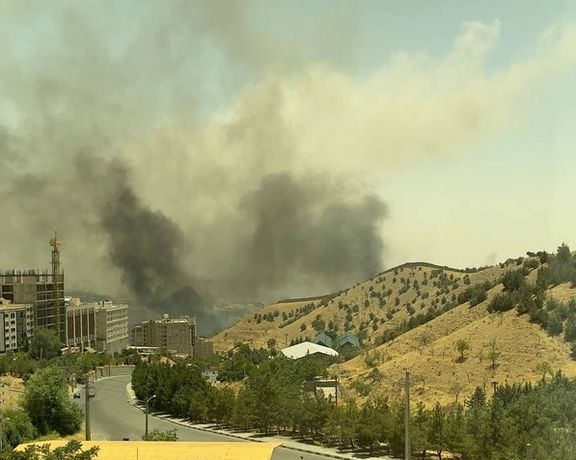
Plumes of smoke rise from what appears to be Evin prison in northern Tehran following an Israeli airstrike, June 23, 2025

I’ve spent time in Evin, Iran’s most notorious prison, the one Israel bombed on Monday. Half a dozen of my closest friends have been there too. Do we want it flattened, turned into a park? Yes. Are we pleased it was bombed? No.

I still carry its smell of damp concrete and stale fear. I dream of bulldozers flattening the walls and children playing where the interrogation rooms once were. But bombs are not bulldozers, and a missile strike is not a promise of renewal.

I picture a June afternoon. The heat in Tehran is already unbearable when the siren splits the air.

Inside Evin’s women’s ward, glass gives way with a sharp, accusing crack. Shards slice arms and cheeks before anyone even understands what happened. Outside, the scene is worse: mothers, fathers, siblings—mine among them—stand at that kiosk manned by a teenage conscript teenager who despises his post as much as we despise the regime.

In a single flash, they all disappear.

This is every visiting day at Evin: desperate faces pressing for scraps of news, hoping for a glimpse, a rumor, a promise. Now the asphalt is scorched, the kiosk mangled.

How, exactly, does bombing a prison free a nation?

Ruins attract new bosses, not playgrounds. That is not the future we fought for when we risked everything to challenge the regime.

These are strange times—to say the least.

Friends and family members are turning against one another. Geography is becoming a dividing line.

Concerned, broadly well-meaning Iranians watching from London or LA are far more likely to cheer. They don’t hear the explosions rattling our walls. They don’t see the plumes or the pale, crumpled faces—our neighbors, our parents, our children—shaking in silence.

I try not to block those who infuriate me with their aloofness, their crass humor. They’re a product of the Islamic Republic too—desensitized by a daily flood of suffering from Kyiv to Gaza, stripped of empathy by proximity to too much pain.

I try not to block them because we need each other, as many as we can, if we’re to survive this and not fall into the abyss.

I am exhausted, furious, with this regime as anyone. I despise the system that robbed me of my life with empty slogans, the man who telegraphs defiance from a bunker under my city.

But this is not deliverance.

Once we were never asked whether we wanted uranium enrichment in exchange for our aspirations. Now no one asks whether we want Netanyahu’s jets overhead or police compounds in downtown Tehran pulverized.

I shed no tears for slain IRGC generals—courtrooms would have been better—but I do mourn our own powerlessness, trapped between rulers who do not care and outsiders who use our suffering as a talking point.

Spare us the righteous speeches please. Pursue your interests if you must, but don’t pretend the collateral is a gift to the Iranian people.

A true leader would have stepped aside long ago to spare us this spiral. Instead, Khamenei hides underground while we—prisoners in and outside Evin—keep counting the costs.

I am typing this having passed by a crater’s dust on my way home. I’m not sure who will read this. But it’s the only thing I can do between mourning the lives blasted away and fearing the new bars that will rise where the old ones fell.

Most Viewed

Iran International says it won’t be silenced after London arson attack
1

Iran International says it won’t be silenced after London arson attack

2
VOICES FROM IRAN

Hope and anger in Iran as fragile ceasefire persists

3

State media slam Araghchi's Hormuz tweet, say it let Trump claim victory

4
INSIGHT

How Tehran bends its own red lines to boost state rallies

5

Iran halts petrochemical exports to supply domestic market

Banner
Banner

Spotlight

  • Too early to tell who is winning Iran war, experts say
    PODCAST

    Too early to tell who is winning Iran war, experts say

  • How Tehran bends its own red lines to boost state rallies
    INSIGHT

    How Tehran bends its own red lines to boost state rallies

  • Iran blackout cripples freelancer, small business incomes
    VOICES FROM IRAN

    Iran blackout cripples freelancer, small business incomes

  • Ideology may be fading in Iran, but not in Kashmir's ‘Mini Iran'
    INSIGHT

    Ideology may be fading in Iran, but not in Kashmir's ‘Mini Iran'

  • US blockade enters murky phase as tankers spoof signals and buyers hesitate
    ANALYSIS

    US blockade enters murky phase as tankers spoof signals and buyers hesitate

  • Why the $100 billion Hormuz toll revenue is a myth
    ANALYSIS

    Why the $100 billion Hormuz toll revenue is a myth

•
•
•

More Stories

Civilians paying the price of Israel-Iran conflict, UN warns

Jun 23, 2025, 21:50 GMT+1

The United Nations warned on Monday that Israeli and Iranian actions may violate international law, with civilians—especially in Iran—suffering mass casualties, displacement, and widespread destruction.

The ongoing war began on June 13 with waves of Israeli airstrikes across Iran.

“Hundreds of civilians, including women and children, have been killed in the Israeli airstrikes and millions have fled major cities for fear of further attacks,” the UN Fact-Finding Mission on Iran and the UN Special Rapporteur on Iran said in an online statement, describing the Iranian population as “traumatized.”

Israel says it is targeting military objectives. However, UN experts say some of Israel’s actions appear to violate the principle of distinction under international humanitarian law, including the strike on Iran’s state broadcaster (IRIB), and the targeted killing of scientists.

At least 950 people have been killed and 3,450 injured in Israeli strikes across Iran, according to the Human Rights Activists News Agency (HRANA). The dead include 380 civilians, 253 military personnel, and 317 individuals of unknown status. Israeli attacks have hit 25 provinces, damaging homes, hospitals, and critical infrastructure.

Lack of 'effective' advance warning

The UN Human Rights Council’s Fact-Finding Mission and the Special Rapporteur on Iran have also raised concerns. Among those reported killed were residents of an apartment complex, three aid workers from the Iranian Red Crescent, and patients at a hospital in Kermanshah, according to the report. Other sites struck include a clinic for children with autism.

The UN said a lack of effective advance warning may have prevented civilians from reaching safety, raising concerns over compliance with the principles of proportionality, distinction, and precaution.

Airstrikes and evacuation orders have triggered mass displacement in Iran, with millions leaving Tehran. Limited access to shelters, fuel shortages, and disruption of essential services have increased civilian vulnerability.

Iranian counterstrikes have caused casualties and damage in Israel, with at least 24 killed and 1,217 injured, according to authorities. One missile struck a hospital in southern Israel, injuring staff and patients and forcing evacuations. Other strikes hit residential areas, prompting sirens across the country.

While many projectiles were intercepted, some got through, causing fires, power outages, and structural damage.

Internet blackout

On June 18, Iran’s Ministry of Communications imposed widespread internet restrictions, further complicating efforts by civilians to coordinate evacuations or contact family. The UN says this digital blackout has made it more difficult to assess the full scale of the humanitarian impact.

UN experts have also noted reports of arbitrary arrests of journalists, activists, social media users, and Afghan nationals accused of espionage. At least two people have reportedly been executed, and Iranian authorities have announced expedited trials, raising concerns overdue process.

Target: Evin Prison

One of the sites hit in Tehran on Monday was Evin Prison, which houses political prisoners and human rights activists, among other inmates. Iran’s judiciary said the strike damaged parts of the facility. State television broadcast footage of emergency responders carrying casualties and searching through rubble.

Israel’s defense minister said the military struck “regime targets and agencies of government repression,” including Evin.

Amnesty International condemned the attack, calling it a potential war crime, and urged Iranian authorities to release those arbitrarily detained and relocate others away from sites at risk of future strikes. The group also warned against the use of force by prison officials in response to unrest among detainees.

The UN called on Iranian authorities to relocate prisoners held near potential strike sites and urged all parties to respect international humanitarian law.

“The escalating hostilities pose grave risks to civilians across the region,” the Fact-Finding Mission and Special Rapporteur said, “with ordinary families and communities bearing the brunt of a conflict that threatens their safety, livelihoods, and daily lives.”

  • Israeli strikes kill several guards and officials at Tehran’s Evin prison

    Israeli strikes kill several guards and officials at Tehran’s Evin prison

  • Israel hits Evin Prison, key security institutions in Tehran on 11th day of war

    Israel hits Evin Prison, key security institutions in Tehran on 11th day of war

Historic chance for change in Iran—but only if strategy follows, experts warn

Jun 23, 2025, 15:33 GMT+1
•
Negar Mojtahedi

The US and Israel may have altered the trajectory of the Mideast with military strikes on Iran’s nuclear infrastructure—but without a broader strategy for internal change, the window of opportunity could quickly close, experts told Iran International.

Over the weekend, US forces carried out unprecedented airstrikes targeting Iran’s Fordow, Natanz, and Isfahan nuclear facilities. B-2 stealth bombers and Tomahawk cruise missiles were used in a mission that involved more than 120 aircraft—making it one of the largest US military operations against the Islamic Republic in decades.

“This marks a dramatic and consequential shift in the region’s strategic balance,” said Dr. Eric Mandel, founder of the Middle East Political Information Network (MEPIN), a think tank focused on US foreign policy and national security in the Middle East. But he warned military strikes alone were not a strategy for lon-term success.

Mandel emphasized that lasting success depends on political vision, regional coordination, and tangible support for the Iranian people—including support for dissident networks, and a clear set of US conditions for any future negotiations.

The removal of nuclear capabilities from “the world’s most dangerous regime” makes the world safer, argued Jonathan Harounoff, spokesperson for Israel’s Mission to the United Nations and author of Unveiled: Inside Iran’s #WomanLifeFreedom Revolt.

'Rare opportunity' for change

Harounoff, whose family is of Iranian origin, said the Iranian people “deserve a government that cares more about their social and economic wellbeing and safety than in pouring hundreds of millions of dollars into constructing a dangerous foreign policy, a destructive nuclear program and a web of terror proxies across the Middle East.”

“The door has been opened to make sure Iran cannot continue its pursuit of nuclear weapons,” said former US Ambassador John Craig, who was part of the Carter administration’s mission to assess the Shah’s position just prior to the 1979 revolution. While it’s too early to predict long-term outcomes, Craig said Iran’s leadership is now under enormous pressure to either return to negotiations or risk further escalation.

“Iran is in a very, very bad place. The leadership has very few options,” said Craig.

Craig added that internal discontent is growing—but warned that the international community must consider who can credibly lead a push for regime change from within. “Time for the mullahs to go,” he said. “But who leads the way is the real question.”

Experts agree that Israel’s initial strikes—combined with US firepower—shattered the Islamic Republic’s sense of impunity. But they caution that without a coherent American strategy, this moment could be lost.

Unless the United States now moves with strategic clarity—disrupting Iran’s centers of power and actively supporting the Iranian people—this rare opportunity for meaningful change could slip away, Mandel warned.

Houthis say they are joining Iran war: can they make any difference?

Jun 23, 2025, 15:00 GMT+1

The US and Israel are preparing for a renewed wave of Houthi attacks on American shipping and Israeli territory, following the US nuclear strikes in Iran, as the Iran-backed group announced it had officially entered the war.

The Houthis' official X account posted in Hebrew on Sunday morning, warning Israelis to “leave the country immediately”, with a video of a missile launching and scenes of destruction in Israel from Iran’s recent missile attacks.

Houthis recently brokered a ceasefire with the Trump administration and agreed to cease attacks on US ships and assets in the Red Sea region. In the early hours of Sunday, the ceasefire was over.

"We will officially enter the war - keep your ships away from our territorial waters," an announcement from the group said.

The Houthis had been waging a maritime blockade since the early weeks of the Gaza war in 2023, in what it says is allegiance with the Palestinians in Gaza.

An Israeli intelligence source told Iran International that given the complexity of striking US assets, the Houthis, designated a foreign terrorist organization by the US and others, are more likely to target Israel first.

'Not a big deal'

“It’s a bit early to say but the Houthis would prefer to target Israel first, it’s less complex at this stage, but it’s hard to tell. The next 24 hours will be revealing,” he said.

“There is no major threat from the Houthis,” the intelligence source added. “They’re limited in their capability and while they will try to retaliate for the current situation, it is not a big deal.”

The Israeli military says that more than 40 surface-to-surface missiles have been fired towards Israel since the Gaza war began, with one barely missing Israel’s biggest airport, Ben Gurion, just weeks ago.

Another 320 UAVs had been fired towards Israel, over 100 of which intercepted with two effective hits as of January data. The remainder fell in open areas, failed to reach Israeli territory or caused no significant damage.

Yemeni military journalist Rashid Maarouf, based in Marib city, told Iran International on Sunday that the Houthis' next steps will depend on the extent of the impact of the American strikes on Iran's nuclear reactors.

Targeting Arab nations

He also agrees the group's capabilities are limited. “They are launching missiles at Israel, but the Houthis' missiles are limited. They do not have a large number to launch a large salvo like Iran does. Even if the Houthis struck Israel, they would not be able to strike with more than two to three missiles a day.”

Abdul Basit Al-Baher, the spokesman for Yemen's military in the governorate of Taiz, told Iran International: "The Houthis are in the crosshairs of the US-Iranian escalation, between the tool and the victim."

He says the US attacks on Iran will require the Houthis to launch new attacks on American or associated ships, using drones or missiles, in an attempt to divert attention from the US strike on Iran and to pressure Washington to halt any potential escalation against Tehran.

It may also trigger attacks on Saudi or Emirati targets, the two nations strong US allies, Al-Baher said.

"They are expected to attempt to expand the scope of the confrontation by targeting Arab coalition countries, particularly Saudi Arabia, to send a message that any targeting of Iran will destabilize the entire region," he said.

He warns that the most dangerous scenario would be full engagement in a "proxy war", Iran activating its regional military allies.

"If Iran decides to respond forcefully, it may use the Houthis as an offensive force against Western interests in the Red Sea," he said, including special attacks on commercial and military vessels or even an attempt to threaten oil and energy corridors."

Israel hits Evin Prison, key security institutions in Tehran on 11th day of war

Jun 23, 2025, 14:46 GMT+1

Israeli airstrikes on Monday targeted multiple sites linked to internal security and political control in the heart of Tehran, including the administrative and courtroom sections of Evin Prison — a facility long seen as a symbol of state repression.

The strikes, carried out under the direct orders of Israeli Prime Minister Benjamin Netanyahu and Defense Minister Yisrael Katz, focused on “regime targets and government repression bodies,” according to the Israeli Ministry of Defense.

Among the locations hit were the main gate and administrative buildings of Evin Prison.

There were no reported casualties among inmates, although several staff members were killed, according to information shared with Iran International.

Sources inside the facility confirmed to Iran International that office buildings, visitation areas, and judicial chambers were damaged in the strike.

Following the attack, families of political prisoners and local residents attempted to approach the site, according to witness accounts shared online.

Evin Prison, constructed in the 1970s, has long been associated with political detention and has housed journalists, activists, and dual nationals.

Strikes target multiple security bases

In addition to Evin, Israeli forces also struck a number of other prominent security and ideological institutions across Tehran and its suburbs.

Iran and Israel have not released an official list of the targets. Witness reports said they included the Basij headquarters, part of the IRGC’s paramilitary force, involved in controlling protests; the Tharallah Base (also known as Sarallah Base), an elite IRGC unit responsible for managing civil unrest in the capital; and the Seyyed al-Shohada IRGC base, a key provincial force in Alborz province, as well as the Intelligence Directorate of the national police.

Additionally, Iranian media reported strikes on the state media complex “9 Dey”, a technical hub for Iran’s national broadcasting system, including TV and radio transmission facilities.

Israel says goal is not regime change — but won’t rule out consequences

Israeli officials said on Monday again that the objective of the strikes is deterrence. “Our objective in Iran is not regime change,” a government spokesperson said on Monday. “But that may be the byproduct.”

Israeli Defense Minister Katz added, “For every shot fired at the Israeli home front, the Iranian dictator will be punished, and the attacks will continue with full force. We will continue until our war objectives are fully achieved.”

While Israel has previously struck infrastructure linked to Iran’s domestic security apparatus — including the headquarters of the Special Forces unit of the Islamic Republic’s Internal Security Forces and a main building of the state broadcaster IRIB — the latest campaign marks an escalation in the scope and scale of such attacks.

This wave of airstrikes has more explicitly targeted what Israeli officials describe as the “repression infrastructure” of the Islamic Republic— the institutions at the core of political surveillance, ideological enforcement, and suppression of dissent.

Tensions in the region remain high, with commercial shipping already diverting away from the Strait of Hormuz and Western governments reviewing security postures amid fears of a broader escalation.

According to data collected by rights group HRANA, 950 people were killed and 3,450 injured across Iran as of Monday. In Israel, 24 people were killed and over 2,500 injured.

Iran after Khamenei? Israeli and US threats push succession into view

Jun 23, 2025, 14:25 GMT+1
•
Behrouz Turani

The question of succession has taken on new urgency in Tehran since Israeli missile strikes began and the Supreme Leader Ali Khamenei reportedly moved to a secure location as he was threatened by Israeli leaders and President Trump.

But is he truly preparing to loosen his four-decades grip on Iran?

Khamenei has named three senior clerics as potential successors in case he is killed during the war with Israel, the New York Times reported Saturday, citing Iranian officials familiar with his emergency war plans.

Last week, Iran International reported that the 86-year-old leader has delegated authority to the Revolutionary Guards’ high command, effectively empowering the IRGC to manage critical decisions if he dies.

While these steps fall short of a formal emergency decree, they suggest an extraordinary contingency effort as missile exchanges between Israel and Iran enter a second week. Khamenei’s move appears aimed at ensuring continuity of command in the event he is incapacitated or killed.

Defiant messaging, emergency measures

Following the leader’s line, President Massoud Pezeshkian also ordered cabinet ministers last week to delegate some authority to deputies and senior managers.

Yet even as both leaders brace for escalation, Khamenei struck a defiant tone on June 18.

“Normal life is going on in Iran,” he said, rejecting retreat in what appeared to be a response to U.S. President Donald Trump’s call for “unconditional surrender.”

If the IRGC power-sharing reports are accurate, they could mark one of the most significant shifts in Iran’s post-revolution political order. For nearly four decades, Khamenei has centralized power—political, religious, military, and economic—around his office.

A legacy of control—and a quiet succession talk

Even Iran’s clerical seminaries, once independent and funded by religious donations, now fall under state control. Since 1989, Khamenei has turned clerics and seminarians into government employees, paid by his office and subject to dismissal if their loyalty is questioned.

As commander-in-chief, Khamenei exercises unilateral authority over military matters, bypassing the Majles on decisions of war and peace.

He also controls the state broadcaster IRIB, directing both leadership and editorial content. His office oversees several Tehran dailies and scores of newspapers nationwide—all part of a state-aligned media network.

Khamenei’s economic vision, framed around his concept of a “Resistance Economy,” has similarly concentrated power.

Though cabinet ministers exist, all major financial decisions—especially the annual budget—are dictated by his office. Massive state-linked economic conglomerates dominate the landscape and stifle the private sector.

In recent years, he has further sidelined parliament, issuing implicit directives that override legislation and block ministerial impeachments.

Succession has long been the Islamic Republic’s most sensitive—and unspoken—question. Few dared to discuss it openly. But in recent years, and especially in the current crisis, the topic has crept into public discourse.

Khamenei’s son, Mojtaba, is frequently floated in both establishment and opposition circles, though never officially acknowledged.

The Israeli strikes have made the issue more urgent.

One can imagine the question of who—or what—comes next, and whether that includes a possible thaw with the United States, being debated in private among Iran’s ruling elite. But no one dares say it aloud. Not yet.