• العربية
  • فارسی
Brand
  • Iran Insight
  • Politics
  • Economy
  • Analysis
  • Special Report
  • Opinion
  • Podcast
  • Iran Insight
  • Politics
  • Economy
  • Analysis
  • Special Report
  • Opinion
  • Podcast
  • Theme
  • Language
    • العربية
    • فارسی
  • Iran Insight
  • Politics
  • Economy
  • Analysis
  • Special Report
  • Opinion
  • Podcast
All rights reserved for Volant Media UK Limited
volant media logo

US citizens being detained in Iran amid Israel war - Washington Post

Jun 21, 2025, 00:12 GMT+1Updated: 07:38 GMT+1
Iran and the United States

American citizens are being detained and imprisoned in Iran, the Washington Post reported Friday citing a State Department cable, as hundreds of other US nationals left the country through land borders amid Israeli airstrikes.

"There are a small number of unconfirmed reports of Americans being detained and imprisoned," the report said, citing the cable.

US diplomats are following up on these reports, the cable said, acknowledging that many Americans are in harm's way as Donald Trump considers military action against Iran.

Many of the US citizens who were leaving Iran faced delays and harassment, the Washington Post reported, citing the cable.

There is no definitive count of how many US citizens remain in Iran. The State Department has said it is not offering US government-assisted departures from Iran. Spokeswoman Tammy Bruce said on Friday, “Americans seeking to depart should take advantage of existing means to leave.”

Detentions and diplomatic strain persist

Since the beginning of the Iran-Israel conflict on June 13, foreign nationals have been advised to leave Iran and avoid travelling to the country.

The Islamic Republic has a long history of detaining and convicting foreign nationals, using them as leverage in negotiations with world powers.

US permanent resident Shahab Dalili is among those known to be imprisoned in Iran.

Iran and the US broke diplomatic ties following the 1979 hostage crisis involving US diplomats in Tehran, which lasted 444 days.

US warns citizens to leave Iran as land borders remain limited

The US Virtual Embassy in Tehran urged American citizens to leave Iran immediately, citing continued airspace closures and security risks amid hostilities with Israel, according to a security alert issued on their website.

The alert said land borders with Armenia and Turkey are open, while crossings into Azerbaijan and Turkmenistan require prior government approval. The embassy warned it cannot guarantee the safety of those attempting to exit by land and noted internet disruptions and limited consular support.

US citizens were advised to prepare for emergencies and avoid relying on the US government for evacuation assistance.

Most Viewed

Ghalibaf defends Iran-US talks amid hardline backlash
1
INSIGHT

Ghalibaf defends Iran-US talks amid hardline backlash

2
INSIGHT

A nation in limbo: 100 days after the massacre, has the world moved on?

3
ANALYSIS

From instability to influence: Pakistan’s pivotal role in US-Iran diplomacy

4
ANALYSIS

100 days on: why Iran’s January protests spread across social classes

5

War-hit homeowners feel abandoned as Iran’s reconstruction aid fades

Banner
Banner

Spotlight

  • War-hit homeowners feel abandoned as Iran’s reconstruction aid fades

    War-hit homeowners feel abandoned as Iran’s reconstruction aid fades

  • 100 days on: the anatomy of Iran’s January crackdown
    INSIGHT

    100 days on: the anatomy of Iran’s January crackdown

  • Ghalibaf defends Iran-US talks amid hardline backlash
    INSIGHT

    Ghalibaf defends Iran-US talks amid hardline backlash

  • 100 days on: why Iran’s January protests spread across social classes
    ANALYSIS

    100 days on: why Iran’s January protests spread across social classes

  • From instability to influence: Pakistan’s pivotal role in US-Iran diplomacy
    ANALYSIS

    From instability to influence: Pakistan’s pivotal role in US-Iran diplomacy

  • A nation in limbo: 100 days after the massacre, has the world moved on?
    INSIGHT

    A nation in limbo: 100 days after the massacre, has the world moved on?

•
•
•

More Stories

Iran will lose war and nuclear program, former Iran envoy Elliott Abrams says

Jun 20, 2025, 20:19 GMT+1
•
Negar Mojtahedi

Iran will lose its ongoing conflict with Israel and its nuclear program, President Trump’s former Iran envoy and prominent neoconservative Elliott Abrams told Eye for Iran, as the conflict between the two countries entered its second week.

"I really think this is going to end by a negotiation,” said Abrams, who served as US Special Representative for Iran from 2020 to 2021.

"They're going to lose this nuclear weapons program, and the question is whether they do it the hard way or the easy way."

Even if the Islamic Republic refuses to surrender, Abrams said more Israeli strikes—followed by a possible US attack targeting an underground nuclear facility—would eventually lead to negotiations, much the way talks settled the Iran–Iraq war.

Eliminating the underground Fordow site in central Iran would likely hinder Tehran’s ability to quickly rebuild its nuclear program but it may not necessarily prevent it from using suspected secret sites to produce nuclear weapons, a prominent nuclear expert said this week.

According to Richard Nephew, a former negotiator during the Obama administration, the United States and Israel must acknowledge that Fordow is not the only pathway for an Iranian nuclear weapons program.

Iran, he argued in a Washington Institute thinktank report, may have other centrifuges available, including at secret sites, and is “probably already at work.”

For his part, Abrams said Fordow is essential to Iran’s program and a necessary military objective, but not a total solution without a broader diplomatic or military campaign.

Abrams was a prominent advocate of preemptive military action against Iraq during George W. Bush’s presidency.

Weapons of mass destruction alleged to be held by Baghdad were never found and the invasion led to a civil war which killed several thousand US troops and tens of thousands of Iraqis.

Trump’s two-week window is ‘strategic’

"Khamenei will soon have that choice: preserve the regime—or risk its collapse under American attack," said Abrams.

White House Press Secretary Karoline Leavitt told reporters Thursday that Trump would decide within two weeks whether to authorize a military strike on Iran.

Trump has previously given himself two-week deadlines on other major decisions—particularly related to the Russia–Ukraine war—and then failed to meet them.

Questions about how Trump will handle the conflict between Israel and Iran have swirled over the last week, and the president has yet to give a straight answer.

Based on Abrams' tenure as Trump’s Iran envoy, he sees this two-week window as a psychological negotiating tactic to throw his adversaries off balance.

It also provides the president with time to explore more options, he added, to see where negotiations may head, and to assess what Israel can accomplish on its own inside Iran.

If Israel is unable to destroy Iran’s fortified Fordow nuclear facility, Abrams believes Trump will likely order a US airstrike using bunker-buster bombs, without deploying troops. That window also allows the US to position its military assets and to give Iran a final chance to negotiate.

“He is moving planes and ships, particularly aircraft carriers and carrier task forces from far away into the Gulf area, the Eastern Mediterranean area, and it takes a week or 10 days,” Abrams told Eye for Iran. “So I don't read into this that he's decided not to do anything.”

“It's a way of giving yourself options until the very last minute.”

Trump’s inner circle

During his tenure as special representative on Iran, Abrams viewed influencing trusted inner-circle figures—like Pompeo during Trump’s first term—as the most effective way to shape Trump's decisions.

Trump’s decision-making is shaped by a small group of trusted advisors, not outside pressure or foreign leaders. Those around him—especially top generals and intelligence officials—play a key role in what happens next.

Currently, his trusted circle, according to Abrams, includes Vice President Vance, Secretary of State Rubio, Generals Kane and Kurilla, and CIA Director Ratcliffe—all of whom remain deeply committed to preventing a nuclear Iran.

“I think he's paying a lot of attention to these two top generals—General Kane, who's the Chairman of the Joint Chiefs of Staff, and General Kurilla, who's the head of CENTCOM, both very experienced four-star generals,” Abrams said.

The generals do not make their opinions known, but from what Abrams gathers, they tend to have a more aggressive stance on Iran and its proxies.

As tensions escalate and the clock on Trump’s two-week window ticks down, all eyes are on Fordow—and on Tehran’s next moves.
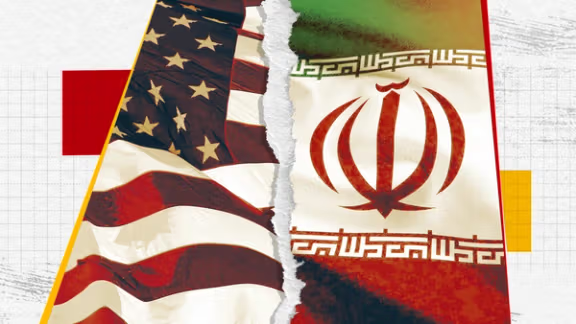
Israel will hit Fordow nuclear site in days with or without US, sources say

Jun 20, 2025, 00:28 GMT+1

Israel hopes the United States will knock out Iran's underground nuclear site Fordow with its superior firepower but may try alone within days while military gains and global opinion allow, two Israeli security sources told Iran International.

The two sources still viewed joint action alongside the United States as the most likely scenario, within 48-72 hours at most.

An attack could be underway as early Friday night, the sources added, but Israel is also weighing going it alone to avoid losing the military advantage it has gained this week.

“In order for us to force Iran into concessions it would otherwise not make, and to bring it back to the negotiating table, this is the only way; we need the US to take action," an Israeli intelligence source told Iran International on condition of anonymity.

"We need Trump to do this within the next two to three days," one source added. "Trump is extremely unpredictable right now though, so anything could happen.”

Buried deep underground, the Fordow nuclear enrichment facility has remained untouched so far in the ongoing Israeli military campaign which appeared to take Iran by surprise in the early hours of last Friday morning.

Window closing

The window of opportunity to knock out the site was closing, the second Israeli security source said, and Israel had been planning for an attack for months.

“Until now the IDF (Israeli military) has opened up the flight path to Iran and the skies are open but that will be for a limited time, it can’t go on indefinitely,” he told Iran International on condition of anonymity.

“Therefore, if America decides to get involved, it has to be a decision made as fast as possible otherwise the opportunity will be missed.”

As the war begins to impact the global economy, including the soaring price of oil, the source said world powers could quickly lose patience with the conflict.

“There are economic issues at stake, so for example if oil prices spike, then these countries could be involved due to their own economic interests. So in general, America has to take this opportunity within 48-72 hours.”

The reach and strength of Israel's bombers are more limited compared to their American peers, making an attack on Fordow by Israeli forces alone more complex.

“Israel doesn’t have the heavy B-52 capabilities to drop a 14-ton bomb to penetrate the heart of the Iranian atomic sites that have to be destroyed,” the security source said.

Israel’s F-15s travel nearly 2,000 kilometers with far smaller payloads of around 400 kilograms, the source added. "Do the math. America could do that mission within a few days, but for us, it would be a much longer, more complex operation."

The entrance to the Fordow nuclear facility in central Iran
100%
The entrance to the Fordow nuclear facility in central Iran

Destroying the Fordow enrichment facility requires a US military asset never been used in war, according to a report in the Wall Street Journal.

Known as the Massive Ordnance Penetrator, the GBU-57 is designed to tear through 200 feet of mountain rock before exploding. The United States has around 20, the newspaper reported, delivered via B-2 stealth bombers.

In the White House on Wednesday, Trump maintained studied ambiguity. “I may do it. I may not do it. I mean, nobody knows what I’m going to do,” he told reporters.

Iain Overton, the Executive Director of Action on Armed Violence, told Iran International that despite the heavy blows taken, Tehran could opt to fight on.

“Iran may lack parity in conventional military terms, but it possesses a distributed deterrent capability: armed proxies across the region, cyber warfare expertise, and a long-honed ideological machinery that frames death not as loss but as victory," he said.

"If the Ayatollah’s regime interprets US involvement as existential, it will not capitulate. It will escalate.”

Taliban weighs IRGC, al-Qaeda escape as Iran refugee intake looms

Jun 19, 2025, 12:00 GMT+1

The Taliban’s General Directorate of Intelligence (GDI) held a high-level internal session on the possible escape of Islamic Revolutionary Guard Corps and al-Qaeda members into Afghanistan, alongside a potential wave of Iranian refugees, Afghanistan International has learned.

Amid the ongoing conflict between Israel and the Islamic Republic, the session outlined several key concerns and scenarios.

IRGC members seeking asylum

Facing potential instability, senior members of the Islamic Revolutionary Guard Corps (IRGC) could flee Iran and seek refuge in Afghanistan. GDI discussed the possibility during the session that such individuals might request protection from the Taliban, according to Afghanistan International’s sources.

Risk of al-Qaeda member relocation

Senior al-Qaeda figures such as Saif al-Adel and Abu Abdulrahman, who are believed to currently reside in Iran, may attempt to escape the country amid instability. GDI has asked the Taliban leadership for guidance on how to respond if they attempt to enter Afghanistan—whether to accept them, place them under surveillance, or reject their entry altogether. This discussion was part of the internal analysis obtained by Afghanistan International.

In 2021, then–US Secretary of State Mike Pompeo accused Iran of harboring al-Qaeda leaders. US and UN intelligence agencies later confirmed that Saif al-Adel was residing in Iran and is now considered al-Qaeda’s de facto leader. In 2024, the US State Department reaffirmed that Iran continues to provide safe haven to senior al-Qaeda operatives.

Preparedness for influx of Iranian refugees

GDI has posed a critical question: Can Afghanistan absorb a possible wave of Iranian refugees? The session called for urgent contingency planning to evaluate national capacity, political risks, and humanitarian consequences.

Israel and Iran at war, Day 5: what we know so far

Jun 18, 2025, 02:20 GMT+1

Israel stepped up attacks on Iran as the war entered its fifth day on Wednesday morning, while US President Donald Trump demanded Tehran unconditionally surrender and moved US jets and ships to the region.

Here's a brief summary of major developments as the conflict entered its fifth day.

Trump's remarks on a US role

  • Trump said the US and Israel had total control of Iran's skies.
  • Trump called for Iran's unconditional surrender.
  • Trump said the US knows where Iran's Supreme Leader is hiding but would not kill him for now.
  • Trump said the US does not want missiles shot at civilians or US troops.
  • Trump said the US patience was wearing thin.

Israel steps up attacks

  • Israel ordered a Tehran district home to hundreds of thousands of people to evacuate.
  • A huge explosion sent a mushroom cloud rising over eastern Tehran after Israeli airstrikes targeted the IRGC-affiliated Imam Hossein University as well as Khojir missile production complex.
  • Multiple missile sites were struck in Isfahan, Israel said.
  • Explosions and air defense activity were reported in Tehran, Karaj and Shiraz.
  • Israel's military said 60 Israeli Air Force jets launched a major wave of strikes targeting Iranian missile launchers in the heart of Iran.
  • Israeli attacks have so far killed 585 people and injured 1,326 in Iran, the human rights group HRANA reported.

Military ramp-up

  • US warplanes departed a military base in England on Tuesday, the BBC reported.
  • The United States is deploying additional fighter aircraft to the Middle East, Reuters reported.
  • The US buildup includes F-22, F-16, and F-35 jets, one official said.
  • Abdolrahim Mousavi, Chief of Staff of Iran’s Armed Forces called for the evacuation of Haifa and Tel Aviv after Israeli evacuation warnings for Tehran.
  • The Islamic Revolutionary Guards' Aerospace Force targeted Israeli air bases.

Leaders weigh in

  • French President Emmanuel Macron said any push to overthrow Iran’s government would bring chaos to the region.
  • British Prime Minister Keir Starmer said he hoped for a de-escalation.
  • Germany’s Chancellor Friedrich Merz praised Israel and said the outcome of the crisis was up to Tehran.
  • Iran’s exiled crown prince Reza Pahlavi, an opposition leader, urged a nationwide uprising.

Western leaders at G7 express caution as Trump tilts closer to Iran war

Jun 18, 2025, 01:33 GMT+1
•
Negar Mojtahedi

France warned against toppling Tehran and other Western leaders expressed caution while the United States appeared closer to joining Israel's campaign on Tuesday, as the shock Middle East conflict dominated the G7 Summit in Alberta.

US President Donald Trump had left the summit early to address the crisis but not before signing off to a relatively diplomatic joint statement that backed Israel's right to self-defense and criticized Iran but mooted a resolution.

"We urge that the resolution of the Iranian crisis leads to a broader de-escalation of hostilities in the Middle East," the wealthy democracies said.

But Trump ratcheted up his rhetoric on Tuesday, noting "we" - Israel and the United States - had gained control of Iran's air space, suggesting Iran's Supreme Leader could be easily killed and demanding "unconditional surrender" in social media posts.

French President Emmanuel Macron warned harshly against seeking to topple Tehran's ruling theocratic system by first, citing cautionary tales in recent Mideast history.

"The biggest error would be to use military strikes to change the regime because it would then be chaos,” Macron said.

“Does anyone think that what was done in Iraq in 2003 was a good idea? Does anyone think that what was done in Libya the next decade was a good idea? No!” he added.

“We don’t want Iran to get a nuclear weapon. But our responsibility is to return discussions as quickly as possible.”

British Prime Minister Keir Starmer pushed back against suggestions that US President Donald Trump is planning imminent military intervention in Iran, following Trump’s calls on Monday for the evacuation of Tehran’s 10 million residents and his late-night convening of the US National Security Council in the White House Situation Room.

“There is nothing the president said that suggests he’s about to get involved in this conflict,” Starmer told reporters, adding that there was “no doubt in my mind” based on his dinner discussion with Trump on Monday that he sought de-escalation.

"I'm no supporter of the regime in Iran," told the BBC. Asked if he would support a popular uprising, the prime minister demurred.

"Look, it's not for me as the UK prime minister to start, you know, encouraging people in relation to what they might do at home. My absolute focus is on the need to deescalate this."

Germany’s Chancellor Friedrich Merz offered a more hedged view, praising Israel for doing "the dirty work" by confronting Iran, also a Western foe.

Israel, he added, likely could not destroy Iran’s fortified nuclear facility at Fordow without US firepower. “The Israeli army is obviously unable to accomplish that. It lacks the necessary weapons. But the Americans have them,” Merz told broadcaster ZDF.

On the possibility of the United States joining the fight, Merz said, “we have talked about this.” That decision, he added, depends on whether the Iranian regime “is prepared to return” to the negotiating table.