• العربية
  • فارسی
Brand
  • Iran Insight
  • Politics
  • Economy
  • Analysis
  • Special Report
  • Opinion
  • Podcast
  • Iran Insight
  • Politics
  • Economy
  • Analysis
  • Special Report
  • Opinion
  • Podcast
  • Theme
  • Language
    • العربية
    • فارسی
  • Iran Insight
  • Politics
  • Economy
  • Analysis
  • Special Report
  • Opinion
  • Podcast
All rights reserved for Volant Media UK Limited
volant media logo

Israeli covert ops and airstrikes crippled Iran’s ability to respond swiftly — Axios
Jun 14, 2025, 05:48 GMT+1
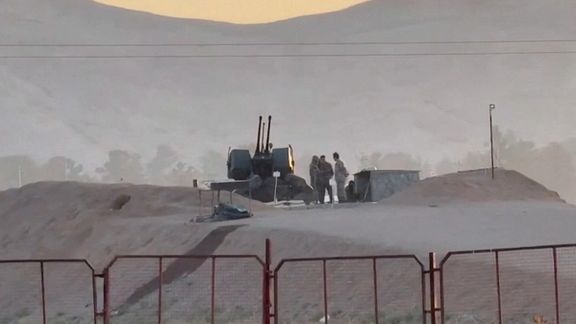
FILE PHOTO: Military personnel stand guard at a nuclear facility in the Zardanjan area of Isfahan, Iran, April 19, 2024, in this screengrab taken from video.

An extensive Israeli air and intelligence operation preempted a major Iranian counterattack, according to a report by Axios citing Israeli officials.

As Iran's Islamic Revolutionary Guard Corps (IRGC) air force commanders convened in a bunker to coordinate a response to the anticipated Israeli strike, Israeli intelligence, aware of both the emergency protocol and the bunker’s location, destroyed the facility. The strike killed senior IRGC figures, including the heads of Iran’s drone and air defense programs.

The Israeli operation targeted Iran’s military command-and-control systems across the country. Among those killed were top commanders of the IRGC, Iran’s military, and the national emergency HQ.

"The fact that there was nobody to give the order neutralized an immediate Iranian response," an Israeli official said.

Simultaneously, Israel’s Mossad conducted sabotage operations inside Iran. Axios reports that Mossad units deployed hidden weapon systems near air defense positions and established a drone base inside Iran well ahead of the strike. When activated, these assets destroyed missile launchers and air defense sites, including at Esfajabad base near Tehran.

The Israeli Air Force, having pre-mapped Iran’s radar and missile defense systems, struck most of them in the operation’s opening phase, reportedly achieving near-total air superiority.

According to Israeli assessments cited by Axios, the initial goal was to prevent Iran from launching a salvo of 300–500 ballistic missiles. Instead, Iran responded hours later with around 100 drones, most of which were intercepted.

Israeli officials expect that Iran may still attempt a large-scale retaliation. “We think they want to prepare a significant missile barrage that would be big and coordinated in order to try and overwhelm our missile defense systems,” an official told Axios.


Most Viewed

Ghalibaf defends Iran-US talks amid hardline backlash
1
INSIGHT

Ghalibaf defends Iran-US talks amid hardline backlash

2
ANALYSIS

From instability to influence: Pakistan’s pivotal role in US-Iran diplomacy

3
ANALYSIS

100 days on: why Iran’s January protests spread across social classes

4

War-hit homeowners feel abandoned as Iran’s reconstruction aid fades

5

Iran says no decision yet on talks as Pakistan prepares to host US team

Banner
Banner

Spotlight

  • Iran diplomacy wobbles as factions compete to avoid looking soft on US
    INSIGHT

    Iran diplomacy wobbles as factions compete to avoid looking soft on US

  • The politics of pink: how Iran uses cuteness to rebrand violence
    ANALYSIS

    The politics of pink: how Iran uses cuteness to rebrand violence

  • Bread shortages, soaring prices strain households in Iran, residents say
    VOICES FROM IRAN

    Bread shortages, soaring prices strain households in Iran, residents say

  • 100 days on: the anatomy of Iran’s January crackdown
    INSIGHT

    100 days on: the anatomy of Iran’s January crackdown

  • Ghalibaf defends Iran-US talks amid hardline backlash
    INSIGHT

    Ghalibaf defends Iran-US talks amid hardline backlash

  • From instability to influence: Pakistan’s pivotal role in US-Iran diplomacy
    ANALYSIS

    From instability to influence: Pakistan’s pivotal role in US-Iran diplomacy

•
•
•

More Stories

Miscalculation left Iran exposed to Israeli strikes - NYT

Jun 14, 2025, 05:15 GMT+1

Iranian officials say a critical miscalculation left the country vulnerable to Israel’s sweeping military campaign on Friday, according to a detailed New York Times report based on interviews with senior Iranian military figures.

Tehran had expected Israel to wait until after another scheduled round of US-Iran nuclear talks on Sunday in Oman before acting, and dismissed signs of imminent attack as psychological pressure.

As a result, key precautions were neglected. Top IRGC commanders, including Gen. Amir Ali Hajizadeh, reportedly ignored a directive not to gather together and were killed while meeting at a military base in Tehran.

Also, "officials said that the night of Israel’s attack, senior military commanders did not shelter in safe houses and instead stayed in their own homes, a fateful decision," the report said.

Israel struck at least 15 sites across Iran, including major cities and critical infrastructure. The attacks severely damaged air defenses, missile bases, and the aboveground portion of the Natanz nuclear facility. Iranian leadership is said to be grappling with the scale of the intelligence failure and the political cost of the unprecedented strike, which has raised questions even within the Islamic Republic’s ruling circles.

Despite internal divisions and fears of escalation, Ali Khamenei ultimately authorized a limited retaliatory missile barrage on Israel, though IRGC members admitted they were unable to launch the planned 1,000 missiles due to damage from the initial Israeli strikes. Only about 100 missiles were launched in the end.

Ramat Gan suffers damage as Iranian missiles strike Israeli cities

Jun 14, 2025, 04:49 GMT+1

Rescue teams evacuate wounded civilians and search through the rubble in Ramat Gan. According to i24NEWS, at least 63 people were injured, including two critically, and 300 residents were evacuated.

Rescue personnel work at an impact site following missile attack from Iran on Israel, in Ramat Gan, Israel June 13, 2025
100%
Rescue and security personnel carry a wounded person at an impact site following missile attack from Iran on Israel, in Ramat Gan, Israel June 13, 2025
100%
Rescue and security personnel attend a wounded person at an impact site following missile attack from Iran on Israel, in Ramat Gan, Israel June 13, 2025
100%
Rescue personnel evacuate a wounded woman at an impact site following missile attack from Iran on Israel, in Ramat Gan, Israel June 13, 2025
100%

Iranian missile hits building in Israel, raising death toll to two

Jun 14, 2025, 04:25 GMT+1

Israel's Magen David Adom says a second Israeli was killed when an Iranian missile directly hit a building in central Israel, also injuring 19 others.

Three of the injured are in critical condition, according to Israeli media.

A woman had earlier succumbed to the injuries she sustained during the first round of Iranian missile attacks against Tel Aviv.

Al-Arabiya reports that some 90 people have been injured so far in the Iranian attacks.

100%

‘Rising Lion’ operation took years to prepare, says Israeli minister

Jun 14, 2025, 03:15 GMT+1
•
Negar Mojtahedi

Israel’s ongoing military strikes on Iran—code-named “Rising Lion”—were the result of years of preparation and mark just the beginning of what’s to come, Israeli Minister of Diaspora Affairs Amichai Chikli said in an interview with Eye for Iran.

“This operation took years to prepare,” Chikli told Eye for Iran. “It's the very hard walk of the IDF intelligence, the Mossad... thousands of people are involved in this.”

“This is just the beginning,” he said, without disclosing operational details or how the mission might continue.

Iran launched over 200 missiles at Israel injuring at least 14 people after Israeli attacks killed its top military leadership and pounded armed forces and nuclear sites leaving scores of Iranians dead.

While Israel’s initial strikes hit key nuclear sites like Natanz and Fordow, Iran’s nuclear infrastructure spans dozens of locations. According to Israeli assessments, further strikes will likely be needed to eliminate what is seen as an existential threat.

Chikli said the objective was not regime change, but to stop Iran from acquiring nuclear capabilities. While many Iranians have called on Israel to help bring down the Islamic Republic, he said meaningful change must come from within.

“This is the time to seize the moment and to try and take back your country from the Revolutionary Guards," said Chikli, "Will Iranians use this moment to change the course of history, or not?”

Diplomacy may follow destruction

Major Andrew Fox, a former British Army officer, also said the Israeli strikes were deliberately calibrated to avoid full-scale regime decapitation—signaling intent, not total war.

“If they'd been serious about regime change, then Khamenei and the president would have been fully in scope for targeting.”

Fox emphasized that while regime change might remain a long-term objective, Israel’s more immediate priority is clear: "The short-term aim has to be focusing on making sure Iran doesn't gain a nuclear weapon capability."

He suggested that President Donald Trump may be using the Israeli operation as strategic leverage to push Tehran back to the negotiating table—after exhausting political and economic pressure.

“Trump is talking about giving Iran another opportunity to make a deal... That's the horse trade that Israel made with Washington.”

Fox’s analysis points to a pattern: when sanctions and diplomacy fail to alter Tehran’s behavior, military action becomes a final tool—not necessarily to start a war, but to reset the terms for diplomacy.

Iran’s weakest moment

Dr. Eric Mandel, a Middle East analyst and advisor to US and Israeli defense officials, told Eye for Iran that this moment marks the Islamic Republic’s deepest vulnerability since its founding in 1979—one of the most consequential events in modern Iranian and Middle Eastern history.

“Iran is at its weakest in 46 years,” said Mandel, who directs the Middle East Political and Information Network (MEPIN).

He says Trump now faces a defining choice—retreat into isolationism or use Israeli military action as leverage for long-term strategic change.

“The big question is, what will President Trump do? Not what the Israelis will do. What will the president do with what Israel has handed to them?”

Mandel suggests that one option remains on the table: a US strike on Iran’s deeply fortified enrichment site.

“America could retaliate and would the president make a phone call to Diego Garcia where our B-2 bombers with the massive ordinances are and attack the one place that hasn't been attacked as we know which is the deeply buried enrichment facility in Fordow”

The Lion Rises
Israeli Minister Chikli said the operation’s name, Rising Lion, came from both Iran’s original flag and a verse from the Book of Numbers: ‘A nation that rises like a lion.’

"We believe this is a moment not just for security—but for shared history and future peace.”

You can watch the full episode of Eye for Iran on YouTube or listen on any major podcast platform like Spotify, Apple, Amazon Music and Castbox.

Iran says US support for Israeli attacks rendered nuclear talks meaningless

Jun 14, 2025, 02:02 GMT+1

Iran’s Foreign Ministry says recent developments have effectively ended the possibility of continued diplomacy with the United States, blaming Washington for enabling Israel’s attack on Iranian territory.

Foreign Ministry spokesman Esmail Baghaei said on Friday that Israel had "crossed all of our red lines" in its latest strike.

"The other side (the US) did something that made dialogue meaningless," he said. "You cannot claim to seek negotiations while at the same time coordinating efforts and allowing a genocidal regime to target Iran's territorial integrity."

Baghaei added that it was inconceivable that Israel could have launched such an attack without US approval. "Israel has long dreamed of dragging Western parties into deeper conflict. It seems this time it has again succeeded in disrupting the diplomatic process."

100%