• العربية
  • فارسی
Brand
  • Iran Insight
  • Politics
  • Economy
  • Analysis
  • Special Report
  • Opinion
  • Podcast
  • Iran Insight
  • Politics
  • Economy
  • Analysis
  • Special Report
  • Opinion
  • Podcast
  • Theme
  • Language
    • العربية
    • فارسی
  • Iran Insight
  • Politics
  • Economy
  • Analysis
  • Special Report
  • Opinion
  • Podcast
All rights reserved for Volant Media UK Limited
volant media logo
ANALYSIS

Nuclear ambiguity has served Tehran well, but can it hold?

Ata Mohamed Tabriz
Ata Mohamed Tabriz

Iran analyst

Jun 7, 2025, 21:43 GMT+1Updated: 08:06 GMT+0
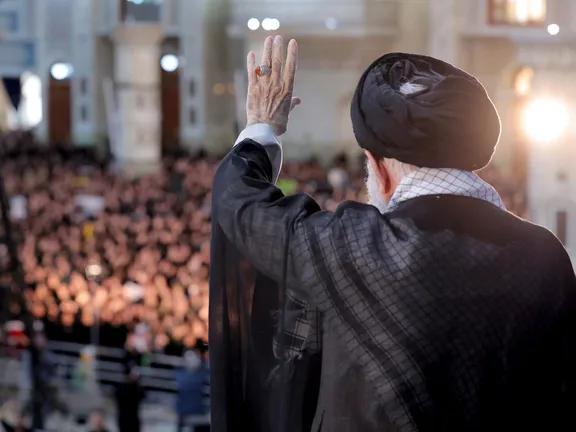
Iran's supreme leader Ali Khamenei waves at supporters in an event marking the death of his predecessor, Ruhollah Khomeini, in 1989, Tehran, Iran, June 3, 2025

Since the US exited from the 2015 nuclear deal, Tehran has neither raced toward a bomb nor returned to full compliance, maintaining a state of strategic suspension that might best be described as rule at the threshold.

Grown—partly at least—out of necessity, the inaction has with time hardened into a governing doctrine: a form of power rooted less in coherent planning than in the instincts of political survival.

Iran’s rulers have learned to wield ambiguity as leverage, drawing strength not from action but its possibility. That is why they view enrichment as essential.

Maintaining near-weapons level enrichment without actual weaponization—the threshold condition—generates enough uncertainty to make Western powers cautious about Tehran’s next move. It creates a degree of deterrence without escalation.

But that effect appears to be eroding.

Internationally, the tolerance threshold for such maneuvering has narrowed. Domestically, endless uncertainty has undercut the rulers’ legitimacy and drained public resilience—driving growing numbers into apathy or protest.

Enrichment: suspension as power

Iranian officials have repeatedly denied any intention to build nuclear weapons, citing a religious ruling by supreme leader Ali Khamenei that forbade their use in 2010.

Still, after the United States exited the nuclear deal in 2018, Iran resumed enrichment and now possesses more than 274 kilograms of uranium enriched to 60 percent, according to the IAEA’s February 2025 report.

Inspectors have also confirmed that Iran has the technical infrastructure to reach weapons-grade capacity.

Nuclear experts have been debating Iran’s ‘break out time’ for many years. But the threshold status may be less of a transitional stage than it is a chosen posture: deter without provoking.

Without ever testing a bomb, Tehran has altered the regional military balance, particularly with Israel. Ambiguity has kept global powers on alert, calculating whether to cooperate with or contain Iran.

At home, this posture yields symbolic capital: scientific progress, defiance, and dignity. Enrichment has been folded into the Islamic Republic’s core narrative.

As indirect talks with the United States resume, the threshold position remains a pillar of Tehran’s strategy. But this time, the international response is sharper.

Calling for permanent inspections, proposing offshore stockpile transfers and—above all—Washington’s insistence on “zero enrichment” may suggest that the era of ambiguity is running out of road.

Sanctions: prolonging suspension

Sanctions have reinforced the threshold logic. They have damaged Iran’s economy but not collapsed it. They have left the country on the edge—in a prolonged state of uncertainty where everything seems possible, but nothing is guaranteed.

President Trump’s maximum pressure campaign has transformed sanctions: from broad embargoes to surgical strikes, targeting Iran’s critical sectors—missiles, drones, petrochemicals, dual-use technologies—applying pressure where it hurts most.

The aim, it appears, is not just to punish, but to constrict the Islamic Republic’s strategic arteries. Yet the targeted sanctions have not forced a retreat. Even as its economy bleeds and its regional allies perish, the regime’s rhetoric sharpens.

Iran’s increasingly aggressive tone against Britain, France and Germany—who can reimpose UN sanctions halted under the 2015 deal—might be a sign of self-confidence or deep unease.

Sanctions have clearly shaped Tehran’s behavior. But they have not broken its logic.

Iran’s rulers continue to see the nuclear ambiguity as their last safeguard of strategic balance, a critical bargaining chip they cannot afford to lose.

Suspension: eroding the nation

For now, Iran is unlikely to rush toward weaponization. But it is equally unwilling to dismantle its nuclear capability.

Iran's adversaries, lacking better tools, continue to rely on sanctions and vague ultimatums. Both sides, in effect, sustain the Islamic Republic’s threshold posture.

But the logic is fraying.

The United States and Europe appear to have lost patience with Tehran. Washington’s call for zero enrichment and Europe's warnings about a return of UN sanctions may signal a wish to step out of ambiguity, a will to end chronic suspension.

Domestically, too, the cost of this posture is rising.

A society long held in suspense now faces fatigue, frustration, and declining trust. What once symbolized resistance has come to represent gridlock. “Dignity” has curdled into a deadlock.

The leadership in Tehran may persist in this suspended state, but its power to dictate the terms of uncertainty is weakening. The ‘calculated ambiguity’ looks more like a trick revealed.

What once shielded the Islamic Republic is now hastening its erosion. It will either change course or collide with reality, at home and abroad.

Most Viewed

Ghalibaf defends Iran-US talks amid hardline backlash
1
INSIGHT

Ghalibaf defends Iran-US talks amid hardline backlash

2
VOICES FROM IRAN

Bread shortages, soaring prices strain households in Iran, residents say

3
INSIGHT

Iran diplomacy wobbles as factions compete to avoid looking soft on US

4
ANALYSIS

The politics of pink: how Iran uses cuteness to rebrand violence

5
ANALYSIS

From instability to influence: Pakistan’s pivotal role in US-Iran diplomacy

Banner
Banner

Spotlight

  • Is Iran entering its Gorbachev moment?
    INSIGHT

    Is Iran entering its Gorbachev moment?

  • Iran crackdown reaches cemeteries as graves of slain protesters defaced
    EXCLUSIVE

    Iran crackdown reaches cemeteries as graves of slain protesters defaced

  • Iran diplomacy wobbles as factions compete to avoid looking soft on US
    INSIGHT

    Iran diplomacy wobbles as factions compete to avoid looking soft on US

  • The politics of pink: how Iran uses cuteness to rebrand violence
    ANALYSIS

    The politics of pink: how Iran uses cuteness to rebrand violence

  • Bread shortages, soaring prices strain households in Iran, residents say
    VOICES FROM IRAN

    Bread shortages, soaring prices strain households in Iran, residents say

  • Ghalibaf defends Iran-US talks amid hardline backlash
    INSIGHT

    Ghalibaf defends Iran-US talks amid hardline backlash

•
•
•

More Stories

Tehran releases explanatory note defending 60% enrichment

Jun 7, 2025, 08:57 GMT+1

Iran has formally defended its enrichment of uranium to 60% purity in a public statement, insisting the activity is not prohibited under the Nuclear Non-Proliferation Treaty (NPT).

The explanatory note, released ahead of a key meeting of the IAEA Board of Governors, criticized the agency’s latest report for relying on “unverified” and “politically influenced” sources, saying the findings reflect a “departure from the principles of impartiality and professionalism.”

“Enrichment to 60% is not banned by the NPT, and all related activities are declared and verifiable,” said the statement published on the Atomic Energy Organization of Iran's website.

Iran further said that traces of uranium found at certain undeclared sites may be the result of sabotage or hostile actions, citing findings by its own security investigations.

The IAEA report, leaked to Western media late last month, concluded that Iran now possesses over 400 kg of 60%-enriched uranium—enough, if further enriched, to build approximately 10 nuclear weapons. The report also cited ongoing Iranian non-cooperation on safeguards and expressed “serious concern” over the country’s continued enrichment at levels with “no civilian justification.”

Iran pushes back against pressure

Iranian officials condemned the IAEA’s findings. Deputy Foreign Minister Kazem Gharibabadi said the report was based on “fabricated Israeli intelligence” and aimed at reopening matters previously closed under a 2015 resolution. He accused the agency of acting under political pressure from the United States and European powers.

In a phone call last week with IAEA Director General Rafael Grossi, Foreign Minister Abbas Araghchi called on the agency to “reflect realities” and warned that any politically driven action by the IAEA Board would be met with a firm response. “Iran will react strongly to any violation of its rights,” Araghchi said in a separate post on X. “The responsibility lies solely with those misusing the agency to gain political leverage.”

Tensions rising ahead of IAEA board vote

The IAEA board is expected to convene next week, with diplomats telling Reuters the United States and the so-called E3 — Britain, France, and Germany — plan to table a resolution formally declaring Iran in violation of its safeguards obligations. If adopted, it would mark the first such finding since 2005, a move that could pave the way for a referral to the UN Security Council and further sanctions.

Israel has accused Iran of being “fully committed” to obtaining nuclear weapons, with Prime Minister Benjamin Netanyahu’s office saying “there is no civilian explanation” for Iran’s current enrichment levels.

Iran, for its part, continues to insist that its nuclear program is strictly peaceful and has dismissed the possibility of negotiating over the principle of enrichment.

No deal without enrichment, Tehran says

In comments echoed by other senior Iranian officials, Parliament National Security Committee chair Ebrahim Azizi said enrichment is a “red line.” “There can be no negotiation over the principle of enrichment,” he said. “It is a matter of national sovereignty.”

Iran also criticized Western suggestions of a fuel consortium or a temporary freeze on enrichment. “Without recognition of our right to enrichment, no agreement will be possible,” said Alaeddin Boroujerdi, another senior MP.

Snapback and retaliation threats

The mounting tension comes as Western capitals also weigh triggering the so-called snapback mechanism under the 2015 nuclear deal, which would restore UN sanctions. Iranian hardline media warned that such a move would be seen as “blackmail” and would provoke a fundamental shift in Iran’s nuclear doctrine.

The conservative daily Khorasan said Iran “could produce 10 atomic bombs” and that its missile program should not be underestimated. It warned that activating the snapback would mean “Iran’s cooperation with the IAEA has yielded nothing.”

US help for Syria’s new leader will deny Iran a comeback, congressman says

Jun 6, 2025, 21:55 GMT+1
•
Negar Mojtahedi

The first American lawmaker to meet Syria’s new president told the Eye for Iran podcast that Washington must give the new rulers of Damascus a chance if it hopes to banish Iran from the country.

Key to that mission, Congressman Cory Mills said, was enabling de facto president Ahmed al-Sharaa to scotch what remains of Iran's influence in Syria.

"What do we truly have to lose in this? You know, we know what we have to lose if they ... allow Iran to create a proxy state and what that means for the region and what that means for our allies," Mills said.

Syria’s new leadership is working to stamp out any Iranian activity on its soil, just months after a rebel advance led by al-Sharaa uprooted the Assad dynasty, Tehran's oldest Arab ally.

Damascus has been expelling proxy fighters, cutting off arms transfers to Hezbollah and pursuing new diplomatic partnerships across the region, including potential ties with Israel, Mills told Eye for Iran.

“He’s not allowing these proxy militias to continue to operate there as they did under the Assad regime,” Mills said.

Syria for Syrians

Mills argues this shift presents an opportunity for Washington to engage—both diplomatically and economically—before Russia, China or Iran move to fill the vacuum.

“If we actually open up the platform to allow for contract bidding, to rebuild infrastructure, that is a great first start,” he said, pointing to areas like water, electricity, and telecoms. “This is one of the most strategic geolocations in the entire region.”

100%

Such engagement, he added, would not only counter authoritarian influence—it would create opportunities for American companies, reinforce regional stability, and help prevent Syria from sliding back into sectarian violence.

“The Iranian people could take a lot away from what has happened in Syria,” he said. “This could be them too. But it has to be an Iranian strategy, not an American strategy.”

Sanctions and Syria's new leadership

Until recently, Ahmed al-Sharaa was himself under US sanctions due to his leadership of Hay’at Tahrir al-Sham (HTS), an Al-Qaeda affiliated group designated as a foreign terrorist organization by the State Department.

On May 13, 2025, President Donald Trump while visiting Saudi Arabia last month made a shock announcement that he was lifting US sanctions on Syria.

Mills stressed that engagement with al-Sharaa must come with clear-eyed realism. “Trust but verify,” he said during the interview. “I think he knows what he has to do. He’s already taken actions that are not just words.”

Diplomatic overtures and regional stability

Mills revealed that al-Sharaa expressed interest in normalizing relations with Israel—albeit cautiously. While no formal talks have begun, the signal alone marks a dramatic shift from the Assad era, which was defined by hostility toward Israel and alignment with Iran and Hezbollah.

“He actually said that we would look at a good relationship and partner with Israel—not the 'Zionist state' ... but he knows the risk that he's taking,” Mills said.

The potential for Syrian-Israeli normalization would echo the Abraham Accords, a US-brokered framework that reshaped parts of the Middle East by bringing Israel into diplomatic relations with several Arab states.

Mills said any future agreements must respect Syria’s sovereignty. “What I don’t support is a balkanization of other sovereign territories,” he said. “I think that good fences make good neighbors.”

The trip to Damascus, however, was not without danger. Mills told Eye for Iran that Islamic State had allegedly plotted to assassinate him while he was in Syria. “They had already put together where they were going to utilize a car bomb,” he said. “They had already put together the location.”

Despite the risks, Mills argued that Syria’s political realignment offers the United States a rare chance to help shape a post-war roadmap—one that sidelines Iran, opens new diplomatic channels and bolsters long-term regional stability.

You can watch the full episode of Eye for Iran with Congressman Cory Mills on YouTube or listen on any major podcast platform like Spotify, Apple, Amazon Music or Castbox.

100%

Iran needs US deal to avert UN referral, former Iranian official says

Jun 6, 2025, 19:25 GMT+1
•
Maryam Sinaiee

A former senior official in Tehran has urged the establishment of diplomatic ties with Washington and sharply criticized President Masoud Pezeshkian for downplaying the impact of US sanctions.

Hamid Aboutalebi, former political director of the presidential office, issued a forceful warning in a post on X Sunday, highlighting the layered diplomatic pressures Iran faces in preventing the referral of its case to the UN Security Council and avoiding a European snapback of 2015 nuclear deal sanctions.

“It appears that Iran has only one path forward to prevent its nuclear case from being referred to the UN Security Council,” he asserted, “(coming to) an understanding with the United States and establishing diplomatic relations with that country.”

Such a thaw would mean that Washington does not back any resolution against Iran in the Board of Governors meeting of the International Atomic Energy Agency (IAEA), he added.

If the IAEA determines Iran to be in serious breach, it could refer the case to the Security Council, which may impose sanctions under Chapter VII of the UN Charter, as it did in 2006 under Resolution 1737.

Aboutalebi also warned that withdrawal from the NPT—advocated by some hardliners, including the Supreme Leader–appointed Kayhan editor Hossein Shariatmadari—would deepen the crisis and trigger severe economic and social turmoil.

Hardline outlet Jahan News—affiliated with Tehran Mayor Alireza Zakani—accused Aboutalebi of using a “disrespectful tone” and condemned his call for ties with the US

“This anger stems from the president’s commendable stance toward the Americans,” the outlet wrote.

IAEA concerns, stalled talks

In a confidential May 31 report, the IAEA outlined Iran’s use of undeclared nuclear material at three sites and noted a rise in its 60%-enriched uranium stockpile—now at 408.6 kilograms since February.

This is enough for roughly ten nuclear weapons if further enriched to weapons-grade.

No date has been set for the next round of US-Iran talks, and both sides remain at odds over enrichment.

On Monday, Foreign Minister Abbas Araghchi said Iran would not accept any deal that denies its right to peaceful uranium enrichment.

President Trump, posting on Truth Social, reiterated that the US will not allow any enrichment by Iran. The UN Security Council is set to review Resolution 2231—the 2015 nuclear deal’s legal backbone—on June 24.

Criticism of Pezeshkian

Aboutalebi also took aim at Pezeshkian’s recent remarks that Iran has not been brought to its knees by sanctions or failed talks. He likened them to counterproductive slogans from the past.

“Your statements resemble preaching,” he wrote, referencing the slogan “Nuclear energy is our inalienable right,” which, he said, led to “failure and plunged the country into the abyss of Security Council resolutions.”

Although Pezeshkian heads Iran’s Supreme National Security Council, his influence over the nuclear file is limited.

According to senior lawmaker and IRGC general Esmaeil Kowsari, Supreme Leader Ali Khamenei has appointed a special team that sets overall nuclear strategy.

“Before each round of talks, Iranian negotiators meet separately with that team and with Parliament’s National Security and Foreign Policy Committee,” said Kowsari.

Three Iranians charged in UK spying case set to face trial in October 2026

Jun 6, 2025, 16:00 GMT+1

Three men accused of aiding Iran’s intelligence service are due to face trial in the UK in October 2026, it was announced in a preliminary hearing at London's Old Bailey on Friday.

Defense barristers for defendants Mostafa Sepahvand, 39, Farhad Javadi Manesh, 44, and Shapoor Qalehali Khani Noori, 55, indicated that they were likely to plead not guilty.

A formal plea hearing was set for September 26 and the trial for October 5, 2026 at the Woolwich Crown Court.

The men were arrested on May 3 and remain in custody. They are the first individuals from Iran to be charged under the UK’s National Security Act of 2023, which covers threats from hostile foreign states.

All three are accused of engaging in conduct likely to assist a foreign intelligence service, identified by police and the Home Secretary as Iran. The charges relate to alleged activities between August 2024 and February 2025.

Sepahvand is charged with carrying out “surveillance, reconnaissance and open-source research” with the intention of committing “serious violence” against a person in the United Kingdom. Javadi Manesh and Nouri are charged with “surveillance and reconnaissance” with the intention “that acts, namely serious violence against a person in the United Kingdom, would be committed by others”.

Alleged surveillance of individuals in the UK

The men are also charged with conducting surveillance and reconnaissance of individuals in the UK.

Their targets are allegedly journalists from Iran International, an independent Persian-language broadcaster and multilingual news outlet based in London.

Iran International has a broad following in Iran, despite government efforts to restrict internet and satellite signal access.

Government reaction

Following the announcement of the charges in May, Home Secretary Yvette Cooper said: “Iran must be held to account for its actions ... We will not tolerate growing state threats on our soil.”

The government would examine further steps to counter state-based threats to national security, she added.

All three men were granted Temporary Leave to Remain in the UK after entering illegally.

Sepahvand entered the country in 2016 in a lorry and claimed asylum.

Javadi Manesh arrived by small boat in 2019 and applied for asylum on religious grounds.

Noori's asylum application was rejected in 2024 and is currently under appeal.

Noori had previously sought asylum in Germany under a false identity, according to a report published by IranWire. The article said he entered Germany in 2019 using a fake Brazilian passport and claimed to be a political dissident.

His asylum case was rejected, including appeals, and he left the country in late 2022 before a final court ruling was issued.

Iran orders thousands of tons of ballistic-missile material from China – WSJ

Jun 6, 2025, 06:49 GMT+1

Iran has ordered thousands of tons of ammonium perchlorate, a key ingredient for ballistic missile fuel, from China in a move to expand its missile arsenal while nuclear negotiations with the United States continue, the Wall Street Journal reported on Thursday.

The shipments, expected to arrive in the coming months, could be used to produce hundreds of missiles, with some material likely to be transferred to Iranian-aligned groups such as the Houthis in Yemen, the report said, citing people familiar with the matter.

The order was placed by an Iranian company through a Hong Kong-based firm. US officials estimate the material could support the production of up to 800 missiles. Iran has one of the region’s largest ballistic missile programs and has rejected any limits on its missile capabilities as part of nuclear talks.

US sanctions and growing concerns

The US has recently sanctioned multiple individuals and entities in Iran and China linked to missile propellant procurement. A State Department official told the Journal that Chinese support for Iran’s missile program and its regional allies remains a concern.

The shipments, expected to arrive in the coming months, could be used to produce hundreds of missiles, with some material likely to be transferred to Iranian-aligned groups such as the Houthis in Yemen, the report said.

The order was placed by an Iranian company through a Hong Kong-based firm. US officials estimate the material could support the production of up to 800 missiles. Iran has one of the region’s largest ballistic missile programs and has rejected any limits on its missile capabilities as part of nuclear talks.

The US has recently sanctioned multiple individuals and entities in Iran and China linked to missile propellant procurement. A State Department official told the Journal that Chinese support for Iran’s missile program and its regional allies remains a concern.

Previous shipments linked to missile fuel

The move follows earlier shipments of sodium perchlorate—used to manufacture ammonium perchlorate—also sent from China to Iran earlier this year, aboard two Iranian cargo vessels. According to Western officials cited by CNN, Financial Times, and the Associated Press, these shipments were bound for the Islamic Revolutionary Guard Corps and could fuel hundreds of mid-range missiles.

Explosion at Shahid Rajaei port still unexplained

In April, a deadly explosion occurred at Iran’s Shahid Rajaei port, where some of the imported materials were reportedly delivered. Iranian authorities have not confirmed the cause of the blast.

However, according to the private security firm Ambrey, the explosion was “reportedly the result of improper handling of a shipment of solid fuel intended for use in Iranian ballistic missiles.” Months later, officials have not publicly provided a detailed explanation.