• العربية
  • فارسی
Brand
  • Iran Insight
  • Politics
  • Economy
  • Analysis
  • Special Report
  • Opinion
  • Podcast
  • Iran Insight
  • Politics
  • Economy
  • Analysis
  • Special Report
  • Opinion
  • Podcast
  • Theme
  • Language
    • العربية
    • فارسی
  • Iran Insight
  • Politics
  • Economy
  • Analysis
  • Special Report
  • Opinion
  • Podcast
All rights reserved for Volant Media UK Limited
volant media logo

Iran needs US deal to avert UN referral, former Iranian official says

Maryam Sinaiee
Maryam Sinaiee

Iran International

Jun 6, 2025, 19:25 GMT+1Updated: 08:06 GMT+0
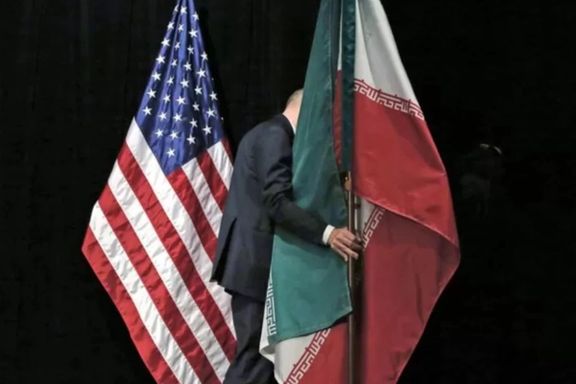
An organizer adjusts Iran's flag during the negotiations that led to the 2015 nuclear deal

A former senior official in Tehran has urged the establishment of diplomatic ties with Washington and sharply criticized President Masoud Pezeshkian for downplaying the impact of US sanctions.

Hamid Aboutalebi, former political director of the presidential office, issued a forceful warning in a post on X Sunday, highlighting the layered diplomatic pressures Iran faces in preventing the referral of its case to the UN Security Council and avoiding a European snapback of 2015 nuclear deal sanctions.

“It appears that Iran has only one path forward to prevent its nuclear case from being referred to the UN Security Council,” he asserted, “(coming to) an understanding with the United States and establishing diplomatic relations with that country.”

Such a thaw would mean that Washington does not back any resolution against Iran in the Board of Governors meeting of the International Atomic Energy Agency (IAEA), he added.

If the IAEA determines Iran to be in serious breach, it could refer the case to the Security Council, which may impose sanctions under Chapter VII of the UN Charter, as it did in 2006 under Resolution 1737.

Aboutalebi also warned that withdrawal from the NPT—advocated by some hardliners, including the Supreme Leader–appointed Kayhan editor Hossein Shariatmadari—would deepen the crisis and trigger severe economic and social turmoil.

Hardline outlet Jahan News—affiliated with Tehran Mayor Alireza Zakani—accused Aboutalebi of using a “disrespectful tone” and condemned his call for ties with the US

“This anger stems from the president’s commendable stance toward the Americans,” the outlet wrote.

IAEA concerns, stalled talks

In a confidential May 31 report, the IAEA outlined Iran’s use of undeclared nuclear material at three sites and noted a rise in its 60%-enriched uranium stockpile—now at 408.6 kilograms since February.

This is enough for roughly ten nuclear weapons if further enriched to weapons-grade.

No date has been set for the next round of US-Iran talks, and both sides remain at odds over enrichment.

On Monday, Foreign Minister Abbas Araghchi said Iran would not accept any deal that denies its right to peaceful uranium enrichment.

President Trump, posting on Truth Social, reiterated that the US will not allow any enrichment by Iran. The UN Security Council is set to review Resolution 2231—the 2015 nuclear deal’s legal backbone—on June 24.

Criticism of Pezeshkian

Aboutalebi also took aim at Pezeshkian’s recent remarks that Iran has not been brought to its knees by sanctions or failed talks. He likened them to counterproductive slogans from the past.

“Your statements resemble preaching,” he wrote, referencing the slogan “Nuclear energy is our inalienable right,” which, he said, led to “failure and plunged the country into the abyss of Security Council resolutions.”

Although Pezeshkian heads Iran’s Supreme National Security Council, his influence over the nuclear file is limited.

According to senior lawmaker and IRGC general Esmaeil Kowsari, Supreme Leader Ali Khamenei has appointed a special team that sets overall nuclear strategy.

“Before each round of talks, Iranian negotiators meet separately with that team and with Parliament’s National Security and Foreign Policy Committee,” said Kowsari.

Most Viewed

US blockade enters murky phase as tankers spoof signals and buyers hesitate
1
ANALYSIS

US blockade enters murky phase as tankers spoof signals and buyers hesitate

2
INSIGHT

Ideology may be fading in Iran, but not in Kashmir's ‘Mini Iran'

3
INSIGHT

Hardliners push Hormuz ‘red line’ as US blockade tests Iran’s leverage

4
VOICES FROM IRAN

Hope and anger in Iran as fragile ceasefire persists

5

US sanctions oil network tied to Iranian tycoon Shamkhani

Banner
Banner

Spotlight

  • Hardliners push Hormuz ‘red line’ as US blockade tests Iran’s leverage
    INSIGHT

    Hardliners push Hormuz ‘red line’ as US blockade tests Iran’s leverage

  • Ideology may be fading in Iran, but not in Kashmir's ‘Mini Iran'
    INSIGHT

    Ideology may be fading in Iran, but not in Kashmir's ‘Mini Iran'

  • War damage amounts to $3,000 per Iranian, with blockade set to add to losses
    INSIGHT

    War damage amounts to $3,000 per Iranian, with blockade set to add to losses

  • Why the $100 billion Hormuz toll revenue is a myth
    ANALYSIS

    Why the $100 billion Hormuz toll revenue is a myth

  • US blockade targets Iran oil boom amid regional disruption
    ANALYSIS

    US blockade targets Iran oil boom amid regional disruption

  • Iran's digital economy battered by prolonged blackout
    INSIGHT

    Iran's digital economy battered by prolonged blackout

•
•
•

More Stories

Three Iranians charged in UK spying case set to face trial in October 2026

Jun 6, 2025, 16:00 GMT+1

Three men accused of aiding Iran’s intelligence service are due to face trial in the UK in October 2026, it was announced in a preliminary hearing at London's Old Bailey on Friday.

Defense barristers for defendants Mostafa Sepahvand, 39, Farhad Javadi Manesh, 44, and Shapoor Qalehali Khani Noori, 55, indicated that they were likely to plead not guilty.

A formal plea hearing was set for September 26 and the trial for October 5, 2026 at the Woolwich Crown Court.

The men were arrested on May 3 and remain in custody. They are the first individuals from Iran to be charged under the UK’s National Security Act of 2023, which covers threats from hostile foreign states.

All three are accused of engaging in conduct likely to assist a foreign intelligence service, identified by police and the Home Secretary as Iran. The charges relate to alleged activities between August 2024 and February 2025.

Sepahvand is charged with carrying out “surveillance, reconnaissance and open-source research” with the intention of committing “serious violence” against a person in the United Kingdom. Javadi Manesh and Nouri are charged with “surveillance and reconnaissance” with the intention “that acts, namely serious violence against a person in the United Kingdom, would be committed by others”.

Alleged surveillance of individuals in the UK

The men are also charged with conducting surveillance and reconnaissance of individuals in the UK.

Their targets are allegedly journalists from Iran International, an independent Persian-language broadcaster and multilingual news outlet based in London.

Iran International has a broad following in Iran, despite government efforts to restrict internet and satellite signal access.

Government reaction

Following the announcement of the charges in May, Home Secretary Yvette Cooper said: “Iran must be held to account for its actions ... We will not tolerate growing state threats on our soil.”

The government would examine further steps to counter state-based threats to national security, she added.

All three men were granted Temporary Leave to Remain in the UK after entering illegally.

Sepahvand entered the country in 2016 in a lorry and claimed asylum.

Javadi Manesh arrived by small boat in 2019 and applied for asylum on religious grounds.

Noori's asylum application was rejected in 2024 and is currently under appeal.

Noori had previously sought asylum in Germany under a false identity, according to a report published by IranWire. The article said he entered Germany in 2019 using a fake Brazilian passport and claimed to be a political dissident.

His asylum case was rejected, including appeals, and he left the country in late 2022 before a final court ruling was issued.

Iran orders thousands of tons of ballistic-missile material from China – WSJ

Jun 6, 2025, 06:49 GMT+1

Iran has ordered thousands of tons of ammonium perchlorate, a key ingredient for ballistic missile fuel, from China in a move to expand its missile arsenal while nuclear negotiations with the United States continue, the Wall Street Journal reported on Thursday.

The shipments, expected to arrive in the coming months, could be used to produce hundreds of missiles, with some material likely to be transferred to Iranian-aligned groups such as the Houthis in Yemen, the report said, citing people familiar with the matter.

The order was placed by an Iranian company through a Hong Kong-based firm. US officials estimate the material could support the production of up to 800 missiles. Iran has one of the region’s largest ballistic missile programs and has rejected any limits on its missile capabilities as part of nuclear talks.

US sanctions and growing concerns

The US has recently sanctioned multiple individuals and entities in Iran and China linked to missile propellant procurement. A State Department official told the Journal that Chinese support for Iran’s missile program and its regional allies remains a concern.

The shipments, expected to arrive in the coming months, could be used to produce hundreds of missiles, with some material likely to be transferred to Iranian-aligned groups such as the Houthis in Yemen, the report said.

The order was placed by an Iranian company through a Hong Kong-based firm. US officials estimate the material could support the production of up to 800 missiles. Iran has one of the region’s largest ballistic missile programs and has rejected any limits on its missile capabilities as part of nuclear talks.

The US has recently sanctioned multiple individuals and entities in Iran and China linked to missile propellant procurement. A State Department official told the Journal that Chinese support for Iran’s missile program and its regional allies remains a concern.

Previous shipments linked to missile fuel

The move follows earlier shipments of sodium perchlorate—used to manufacture ammonium perchlorate—also sent from China to Iran earlier this year, aboard two Iranian cargo vessels. According to Western officials cited by CNN, Financial Times, and the Associated Press, these shipments were bound for the Islamic Revolutionary Guard Corps and could fuel hundreds of mid-range missiles.

Explosion at Shahid Rajaei port still unexplained

In April, a deadly explosion occurred at Iran’s Shahid Rajaei port, where some of the imported materials were reportedly delivered. Iranian authorities have not confirmed the cause of the blast.

However, according to the private security firm Ambrey, the explosion was “reportedly the result of improper handling of a shipment of solid fuel intended for use in Iranian ballistic missiles.” Months later, officials have not publicly provided a detailed explanation.

Island vibes? US and Iran joust over where to enrich uranium

Jun 5, 2025, 19:21 GMT+1
•
Maryam Sinaiee

The location of a proposed uranium enrichment consortium to help resolve Iran's nuclear impasse is emerging as a central point of contention, as Tehran insists enrichment must occur on its own soil.

Axios and The New York Times reported earlier this week that US negotiator Steve Witkoff has proposed creating a regional consortium to break the deadlock in stalled nuclear talks.

In a June 4 speech, Supreme Leader Ali Khamenei rejected the US proposal—delivered by Oman’s Foreign Minister Badr Albusaidi on May 31—saying a halt to enrichment inside Iran was “out of the question.”

Iranian Foreign Ministry Spokesman Esmail Baghaei had earlier said Tehran would welcome a nuclear fuel consortium “if it were proposed,” but added: “It cannot be a substitute for enrichment within Iran.”

Details of the proposal

According to Axios on June 2, Witkoff’s proposal would, restrict enrichment to civilian-grade levels (3%), suspend underground enrichment for a negotiated period, limit above-ground enrichment to reactor fuel standards under IAEA guidelines and require Iran’s immediate adoption of the IAEA’s Additional Protocol

On June 3, Axios quoted a senior Iranian official as saying Iran might accept a consortium based in Iran—but not if enrichment occurred elsewhere.

Qeshm, Kish or some other island?

A New York Times report on the same day noted that Omani and Saudi officials had discussed placing the facility on a Persian Gulf island.

“This would potentially give both sides a talking point,” the Times wrote, with Iran claiming enrichment is still happening and the US saying it isn’t on Iranian soil.

Israel Hayom cited an unnamed Arab source suggesting the facility might be built on one of three disputed islands: Greater Tunb, Lesser Tunb or Abu Musa. All are controlled by Iran but claimed by the UAE.

The outlet described the idea as a “diplomatic sleight of hand,” sparking backlash on Iranian social media, where critics warned it would undermine Iran’s sovereignty claims.

Alternative: the Oman model

Some nuclear experts, including former Iranian negotiator Hossein Mousavian, have promoted a model where Oman would host the facility, operated by Iran under IAEA supervision.

In this setup, ore would be processed in Saudi Arabia, enriched product would be stored there and a commercial office based in the UAE.

Possible participants

Axios reported the consortium could include the US, Iran, Saudi Arabia, the UAE, Qatar, and possibly Turkey. Other outlets have mentioned Oman, Egypt, and Russia.

A June 3 editorial in Arman-e Melli argued Egypt’s inclusion would offer both regional legitimacy and diplomatic utility.

“Egypt’s good relations with the US and Europe could serve as a bridge between Iran and the West,” it noted.

Khamenei rebuffed US nuclear offer, not talks

Jun 5, 2025, 16:45 GMT+1
•
Behrouz Turani

Tehran’s response to Washington’s proposal to halt uranium enrichment in exchange for sanctions relief has been marked by deep distrust and combative rhetoric—but not a complete break from diplomacy.

The proposal has yet to be revealed officially, but it is said to include a halt-for-sanctions-relief clause and an enrichment consortium involving the United States and some of Iran’s Arab neighbors.

“Why do you interfere in whether Iran enriches uranium or not—what business is it of yours?” Supreme Leader Ali Khamenei said on Wednesday, dismissing US objections to domestic enrichment by Iran.

Khamenei delivered one of his harshest speeches in recent memory, denouncing the proposal and pouring cold water on hopes of an immediate resolution to the nuclear standoff.

Minutes later, Foreign Minister Abbas Araghchi reiterated that no deal excluding enrichment would be accepted, and Nuclear Chief Mohammad Eslami declared that Iran’s program would continue “with full force.”

Strategic ambiguity

Despite the sharpness of his remarks, Khamenei stopped short of ending negotiations—a nuance not lost on Iranian analysts, many of whom saw room for continued backchannel diplomacy.

His tone of suspicion echoed deeper cultural themes. Some commentators likened it to the writings of novelist Sadeq Hedayat, whose characters in Alaviyeh Khanom and Haji Aghaview the world as a web of deception and distrust, responding with preemptive cynicism.

Even before Khamenei’s speech, Iranian outlets had rallied against any framework that excluded enrichment. The official news agency IRNA published two sharply worded pieces on Tuesday.

One called Washington’s position “a gamble doomed to fail,” while the other warned the talks were headed for deadlock unless Tehran’s right to enrich was preserved.

State broadcaster IRIB maintained its usual pessimism.

In a symbolic moment following Khamenei’s address, it abruptly cut a weather update to broadcast a Moscow street interview, where Russian citizens praised Iran’s founder, Ayatollah Ruhollah Khomeini, and his prophecy of communism’s fall—blending nostalgia with present-day complexity.

Press looking ahead

Wednesday marked the anniversary of Khomeini’s death in 1989, a national holiday with no newspapers in circulation. Even online publications were dominated by reverential pieces about the former Supreme Leader.

But Tuesday’s press and foreign-based Persian outlets struck a more somber tone. The reformist site Rouydad24 warned that what it called the achievements of five rounds of talks remained fragile, and that issues like zero enrichment could trigger collapse.

Though few in Iran or abroad believe war is imminent, some exiled Iranian analysts suggested the impasse could embolden Israel, long bent on dismantling Tehran’s nuclear infrastructure.

Meanwhile, U.S. media reported that a new round of indirect talks—possibly in Oman—could take place as early as next week.

Iran says it uses US-made reactors, enrichment level ‘not important’

Jun 5, 2025, 11:44 GMT+1

Iran is using American-made nuclear reactors and maintains that the level of uranium enrichment is not inherently important, the head of the Atomic Energy Organization of Iran (AEOI) said, as negotiations between Tehran and Washington remain stalled.

"The Tehran reactor we use was built by the Americans. In Canada and the United States, reactors operate with 90% enriched fuel," Mohammad Eslami said on Iranian state television. "So the percentage of enrichment has no particular significance."

The nuclear chief also stressed that 20% enrichment is necessary for research reactors. "Without the capability to design and manufacture reactors and complete the fuel cycle, one cannot claim to be nuclear-capable — and we are now at that level," he said.

Eslami emphasized that Iran’s nuclear development is rooted in national capability. "We have now reached full maturity in the nuclear fuel cycle, which is the foundation of the nuclear industry," he said.

"The West cannot tolerate this and continues to escalate its hostility toward us in every possible way."

He accused the United States and its allies of trying to maintain monopolistic control over nuclear technology. "They have always said Iran should have no domestic reactor and must import fuel indefinitely," Eslami said. "Our response has always been clear: we will not accept such dependency."

  • Khamenei dismisses US proposal: ‘US can’t do a damn thing about our program’

    Khamenei dismisses US proposal: ‘US can’t do a damn thing about our program’

  • Nuclear chief aligns with Khamenei: No retreat on Iran’s program

    Nuclear chief aligns with Khamenei: No retreat on Iran’s program

He said the West’s portrayal of Iran’s nuclear intentions was misleading. "They do not want development unless it’s under their flag," he said. "But all our progress has been achieved by our own youth."

On Wednesday, Eslami vowed to continue advancing the country’s nuclear program with “faith, revolutionary spirit, and heartfelt conviction,” asserting that Iran will resist excessive demands from the United States and other global powers in a statement addressed to Supreme Leader Ali Khamenei.

Diplomatic talks mediated by Oman between Iranian Foreign Minister Abbas Araghchi and US envoy Steve Witkoff have stalled over Iran’s insistence on maintaining enrichment activities inside the country.

US and Iran want an agreement, UN nuclear watchdog says

International Atomic Energy Agency (IAEA) Director-General Rafael Grossi, speaking in Damascus, said that the agency is not party to the negotiations but remains in close contact with both sides.

"They are negotiating, not us, but it is obvious that the IAEA will have to be the guarantor of whichever agreement they come to," he said.

Grossi expressed cautious optimism. "I think they both want an agreement, which doesn’t mean that it’s easy to get," he said. "But having two sides that want a deal is already a big advantage."

On Wednesday, US President Donald Trump urged Tehran to respond swiftly to American demands. "Time is running out on Iran’s decision pertaining to nuclear weapons, which must be made quickly!" Trump wrote on Truth Social. He also said that Russian President Vladimir Putin had offered to mediate.

In March, Trump warned that if a deal was not agreed upon within two months, the US would bomb Tehran, though he did not state a deadline.

Iran has consistently said that its nuclear program is for peaceful purposes. However, Western powers have accused Tehran of seeking nuclear weapons capabilities—allegations Iran denies.

Iran is the only non-nuclear weapon state enriching uranium to 60% U-235. The IAEA has consistently maintained that there is no credible civilian use for uranium enriched to this level, which is a short technical step from weapons-grade 90% fissile material.