Iran seminary authority slams Trump over Soleimani killing
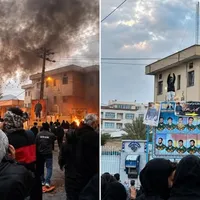
Iran’s top religious seminary authority criticized US President Donald Trump on Friday, calling his recent remarks in Saudi Arabia politically worthless and saying his order to kill Qassem Soleimani reflected the true character of his policies.
“Trump is the same person who gave the order to kill Soleimani, and with that act, he revealed his true character,” the statement from the Management of the Islamic Seminaries said. “His nonsense has no political value.”
Quds Force commander Qassem Soleimani was killed in a US drone strike near Baghdad International Airport in January 2020, a move Trump openly acknowledged ordering.
Trump, speaking in Riyadh earlier this week, sharply criticized Iran’s government and praised Arab states for their development. “The biggest and most destructive of these forces is the regime in Iran,” he said. “Instead of building their nation, they tear the region down.”
He said Iran’s actions in Syria, Lebanon, and beyond had caused “unthinkable suffering,” and accused its leaders of turning “green farmland into dry deserts” while enriching themselves. Trump added he still wants a deal with Iran, but warned, “If Iran’s leadership rejects this olive branch … we will have no choice but to inflict massive maximum pressure.”
A conference held by the Society of Seminary Teachers of Qom in Qom, Iran. (File Photo)
Iran will not pursue nuclear weapons but will continue to use and expand its nuclear capabilities, Iranian Parliament Speaker Mohammad Bagher Ghalibaf said Friday during a visit to Indonesia.
“Iran will never go toward building a nuclear weapon,” Ghalibaf said. “But using nuclear capacity is our right.”
He added that Iran would continue to enrich uranium for peaceful purposes. “We use this knowledge in medicine, agriculture, and the environment,” he said. “Today, the most advanced centrifuges are built by the creative youth of Iran.”
Speaking on the sidelines of the Parliamentary Union of the Organization of Islamic Cooperation Member States (PUIC) in Jakarta, Ghalibaf said Iran’s nuclear progress is a source of pride and should benefit the Islamic world.
“This nuclear capacity belongs to all the Islamic world,” he said.
Secretary of State Marco Rubio said Thursday the United States has offered a limited window for diplomacy with Iran for a peaceful resolution on its nuclear program, but warned that the decision now rests with Iran’s Supreme Leader.
“In the end, the decision lies in the hands of one person, and that's the Supreme Leader in Iran, and I hope he chooses the path of peace and prosperity, not a destructive path, and we'll see how that plays out,” Rubio said in an interview from Turkey.
He emphasized the US distinction between the Iranian establishment and its people. “Our problem is not with the Iranian people. The Iranian people are peaceful people, an ancient civilization and culture we admire greatly. Our problem is with a clerical regime that is behind every problem in the region.”
Rubio blamed Tehran for backing regional instability. “Hezbollah, Hamas, the Houthis, the militias that have conducted attacks out of Iraq and Syria, they all track back to the Iranian regime. Syria, all the instability in Syria tracks back to the Iranian regime.”
“It’s a regime that every day and every Friday chants, you know, death to Israel, death to America. We have to believe them when they say that,” he added. “A regime like that can never have nuclear weapons.”
Rubio pointed to the latest report from the International Atomic Energy Agency, which showed Iran’s stockpile of 60% enriched uranium grew from 182 kilograms to 275 kilograms in early 2025.
“They are fairly close. Too close for comfort, to a nuclear weapon,” Rubio said in an interview from Turkey. “Once you're at 60, you're 90% of the way there. You are, in essence, a threshold nuclear weapons state, which is what Iran basically has become.”
US and Iranian officials have held four rounds of talks since President Donald Trump took office. Both sides have described the negotiations as “constructive” so far.
The State Department said Thursday that nuclear talks between the United States and Iran have been “constructive,” and stressed that President Donald Trump remains committed to a diplomatic solution.
“The president has been clear that Iran can never have a nuclear weapon,” Deputy Spokesperson Tommy Pigott told reporters. “He wants diplomacy. He wants to see a diplomatic solution here.”
Pigott said he would not discuss private negotiations but repeated that the talks have been described as productive by those involved.
Asked about Trump’s recent comments in the Middle East suggesting a deal is near, Pigott said, “The talks have been constructive. We continue to engage in a way that supports our goal — preventing Iran from obtaining a nuclear weapon.”
The head of Iran’s Atomic Energy Organization said on Thursday that more than 25% of all International Atomic Energy Agency (IAEA) inspections in 2024 were conducted in Iran, despite the country accounting for only about 3 percent of the global nuclear industry.
“All of the country’s nuclear activities have been carried out within the framework of cooperation with the International Atomic Energy Agency and are under the continuous supervision of this body,” state media quoted Mohammad Eslami as saying on the sidelines of the closing ceremony of the 31st National Nuclear Conference in Mashhad.
"Currently, IAEA inspectors regularly, both in announced and unannounced visits, inspect the country’s nuclear facilities," he added.
Eslami criticized what he described as double standards, unfair treatment, and negative media narratives targeting Iran. “This is a repetitive and worn-out issue that has never and will never prevent our progress,” he said.
There is concern in Israel over the emerging nuclear agreement between Iran and the United States, The Jerusalem Post reported, citing two Israeli officials who said the potential deal is seen as problematic for Israel.
According to the report, Israel maintains that Iran should not be allowed to enrich uranium under any circumstances, including for civilian purposes.
The newspaper cited two Western officials saying that while negotiations have made progress, it remains uncertain whether the talks will result in a final agreement.
Iranian soldiers stand guard inside the Natanz uranium enrichment facility, 322km (200 miles) south of Iran's capital Tehran March 9, 2006.