Iran writers association says government evades responsibility in Bandar Abbas blasts
Iran’s Writers Association said the government is using the word "incident" to avoid clear reporting and responsibility after explosions in Bandar Abbas.
"The authorities, who either cause disasters or worsen them, are now trying to hide behind the word 'incident' and dodge their duty to provide transparent information and answer public concerns," the group said in a statement.
The association, known in Persian as Kanoon-e Nevisandegan-e Iran, was banned two years after the 1979 Islamic Revolution. Its members have faced systematic harassment and persecution for decades.
The group said public mourning has been tied to "dozens of unanswered questions" and criticized what it called "scattered images and contradictory official media reports," while "what has burned and been lost is the lives and existence of the people."
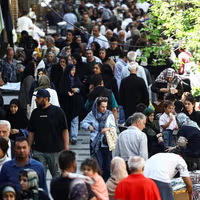
People walk after an explosion at the Shahid Rajaee port in Bandar Abbas, Iran, April 26, 2025.
Russia’s embassy in Tehran on Tuesday published a video showing a Russian plane dropping water over burning areas of Bandar Abbas, after Iranian officials said Russian planes were not used to fight the fire.
Earlier, Interior Minister Eskandar Momeni said Russian planes had arrived but were not needed. "Several planes from Russia have arrived and are stationed here, but they have not been needed so far. We thank them," he said on Monday.
Last week, Iran’s ambassador to Moscow, Kazem Jalali, said Russia sent three firefighting planes and rescue teams at Iran’s request.
The Russian embassy wrote that its emergency ministry, working closely with Iranian counterparts, carried out a "valuable and courageous" operation in Bandar Abbas.
Pierre Poilievre, a contender to become Canada’s next prime minister, has vowed to purge the country of “IRGC thugs” who, he says, feast on “stolen money from the Iranian people.” If elected on Monday, will he—or can he—deliver?
Poilievre asserted recently that about 700 operatives and affiliates of the Islamic Revolutionary Guard Corps (IRGC), which Canada has designated as a terrorist entity, must be tracked down and expelled.
But this was nothing new. He had expressed similar views in many speeches and interviews before. So what is different this time? How could rhetoric translate into action beyond gestural politics, built on a tenuous perception of Canada’s strategic leverage?
Poilievre and his caucus appear to have presumed that IRGC operatives would vanish the moment Canada listed the group.
Last June, when reports broke hours before the announcement, they erupted in a frenzy, lamenting the leak as if operatives were standing by the door moving assets in anticipation. Yet once the dust settled, everyone returned to their routines, leaving the world undisturbed.
With bells tolling for the Liberals after a lost decade, and the Conservatives hoping to be incoming sheriffs, they must face a deeper reality. Tehran’s reach is not a statistic but a network resistant to rhetoric. Something beyond grandstanding is inevitable.
The Myth of 700
First, one must ask: where did the 700 figure originate?
It came from an independent effort by a coalition named Stop IRGC, aimed at identifying those affiliated with the Islamic Republic who settled in Canada through legal channels. While notable, it was not government-backed and lacked security resources for verification. No intelligence assessment, inquiry, or briefing has substantiated it.
Poilievre nonetheless repeated it as fact, reducing complexity to a tally shaped by partisan urgency.
Mahmoudreza Khavari, senior Iranian official in Tehran (left) and Canada
I do not, for a second, believe the IRGC’s presence ends there. Years of inaction have turned lingering suspicion into undeniable reality. Activists, whether living in Canada or passing through, must now calculate their security risks.
Nor did operatives scramble to flee upon the listing. For Tehran’s fortune-brokers, Canada was never an obstacle. Even when the Conservative government had a chance over a decade ago to act against Mahmoud-Reza Khavari—a top Iranian banker who financed the IRGC’s missile program, embezzled billions, and fled to Canada—it turned a blind eye.
The regime and its IRGC presence are the product of sustained drift, allowing influence to fester across levels and seep into corners.
Beyond numbers: a real plan
Poilievre and his allies must recognize that strategy cannot rest on recital. A committed resolve is the only way to dismantle the IRGC’s hold. The Liberals never had one; when superficial action was taken, it collapsed under contradictions, punishing the wrong people.
A two-pronged strategy, I propose, is required to deal with the problem. First, focus on critical entities: IRGC and Basij members, operatives posing as civilians, financial networks, propaganda arms, and regime-linked organizations. Second, avoid actions that unjustly impact innocents.
A real strategy recognizes that IRGC operatives do not arrive in bloodstained green uniforms. They come as businessmen, investors, and tourists, traveling freely from the land they loot to the land where they hoard.
Any action has to hinge on the recognition that the IRGC and the Iranian state are one—indistinguishable in form, inseparable in purpose.
It is alarming that last December, an IRGC-affiliated news agency boasted of a “private sector” bypassing sanctions, especially in Canada. Individuals from a Canadian-registered nonprofit were interviewed on “innovative solutions” to do so.
This same group hosts webinars on exporting oil, gas, and petrochemical products, claiming collaboration with Iran’s Ministry of Industry—whose officials are sanctioned and banned from entering Canada for human rights violations.
Collaboration with entities sustaining the power structure of the Islamic Republic cannot be permitted under the pretense of legitimacy. Targeting the theocracy means little if you enable the institutions that sustain it.
Tehran’s playbook has long capitalized on Canada’s strategic vulnerability. The story is not about mythical figures who once slipped through. It is about a decades-old infiltration campaign that has unsettled our foundations from within.
Has Poilievre assigned the color of his cards before the real test calls?
Poilievre’s true test
If the Conservatives take power, let them not chase ghosts. Let them identify a handful of real, high-profile regime and IRGC operatives, transparently held accountable in full view of the public. That alone would shake Canada’s quiet standing as a sanctuary for tyranny’s enforcers more than any grand arithmetic of slogans.
The duplicity of senior Iranian officials in Canada offers a case study in calculated deceit—silencing hearings, disclaiming crimes, vanishing when accountability nears. Sadly, even rare breakthroughs fade under a Liberal establishment where secrecy lingers and accountability bends.
For any future leadership to set a real precedent, groundwork must begin before power is seized. Not hours before a designation. Not weeks into a mandate.
As a powerful voting bloc, the Iranian-Canadian community appears to be moving towards the Conservatives to turn the page on staged politics. For years, those in charge sold them a political vaudeville called a pie in the sky on Canada’s political Broadway.
If Poilievre plans to peddle another ticket to the same tired show, he should know: not a single seat will be sold. No more.
A committee investigating the explosions at Rajaei port announced in a statement that "negligence in observing safety protocols and passive defense measures has been confirmed."
The statement added, "There have also been instances of false reporting, and security and judicial agencies are actively working to identify those responsible."
The committee further noted, "A definitive determination of the cause of the incident requires a comprehensive investigation of all aspects, which, due to technical requirements, must go through detailed technical and laboratory processes."
During a mourning ceremony for the victims of the port explosion held on Monday evening in Bandar Abbas, several families of the deceased protested the authorities’ lack of accountability regarding the incident.
According to videos received by Iran International, some family members chanted slogans such as "Incompetent officials, resign, resign."
The Iranian president’s visit to Azerbaijan, soon to be followed by the Israeli prime minister's trip, highlights Baku’s sophisticated geopolitical maneuvering as Tehran and Tel Aviv vie for influence in the strategically vital South Caucasus.
It is a region where energy corridors, security alignments, and infrastructure ambitions increasingly converge.
President Masoud Pezeshkian’s trip—the first by an Iranian president since 2022—marks a cautious effort to mend a strained relationship.
Restoring Iran-Azerbaijan ties
Central to the distrust is Tehran’s long-standing fear that Azerbaijan could serve as a launchpad for Israeli operations against Iran, given Baku’s deepening military cooperation with Tel Aviv.
Relations further deteriorated after the 2023 attack on Azerbaijan’s embassy in Tehran, prompting a mutual expulsion of diplomats.
Equally important is Baku's accusation that Iran's Revolutionary Guards (IRGC) seeks to destabilize Azerbaijan through groups like the Huseyniyyun. Azerbaijani authorities assert that these groups have been involved in plotting attacks, fomenting unrest, and targeting foreign officials.
Another flashpoint is the Turkish-backed Zangezur Corridor, a proposed route connecting mainland Azerbaijan to Nakhchivan via Armenia.
Iran opposes the project, viewing it as a threat to its regional influence and access to Armenia. However, signs of de-escalation include joint Iranian-Azerbaijani naval drills in the Caspian Sea in late 2024 and progress on the North-South Transport Corridor with Russia.
While the Zangezur dispute remains unresolved, Pezeshkian’s visit focuses on practical cooperation, particularly in energy, rather than contentious territorial issues.
Israel's strategic countermove
Israeli Prime Minister Benjamin Netanyahu’s upcoming visit reflects Israel’s intention to bolster Azerbaijan’s role as a regional partner amid escalating tensions with Iran. The timing of this trip appears as a direct counter to Tehran's outreach.
Israel seeks to deepen its footprint near Iran’s borders, using Azerbaijan’s strategic geography as both a listening post and an energy partner.
Key goals of Netanyahu's visit include strengthening intelligence-sharing on Iran’s nuclear program, encouraging Baku to formalize its long-covert security ties with Israel, and leveraging Azerbaijani diplomacy to ease Turkish-Israeli frictions.
Expanding the Abraham Accords network to include Azerbaijan remains an aspirational longer-term objective.
Competing regional visions
These high-profile visits reflect a broader contest for influence across the South Caucasus.
Turkey and Israel favor the Zangezur Corridor as a means to enhance connectivity and weaken Iranian leverage, while Iran views the project as a direct challenge to its regional role.
Israel has consistently backed Azerbaijan’s position in the Nagorno-Karabakh conflict, while Iran—historically closer to Armenia—has taken a more pragmatic approach toward Baku.
In Syria, Israel and Turkey seek to curb Iranian entrenchment. Armenia’s gradual alignment with the West further deepens Tehran’s strategic anxiety.
For Israel, Azerbaijan offers a critical hub for intelligence gathering and diversification of energy supplies, anchoring its evolving South Caucasus strategy.
Enduring tensions, strategic risks
Despite gestures toward normalization, structural tensions between Iran and Azerbaijan remain deep.
The $9.3 billion in arms deals signed by Baku and Tel Aviv between 2020 and 2024 remains a major obstacle to trust. Iran has repeatedly threatened military action if the Zangezur Corridor advances without its involvement, underscoring how infrastructure projects have become proxies for larger geopolitical rivalries.
Meanwhile, regional flashpoints—such as Israel’s military operations in Gaza and Iran’s nuclear escalation—could further complicate Azerbaijan’s delicate balancing act.
As external pressures mount, Baku’s strategy of engaging both Tehran and Tel Aviv becomes increasingly fraught with risk.
Pezeshkian’s visit signals Iran’s pragmatic attempt to recalibrate its relationship with Azerbaijan after years of estrangement. It is less a breakthrough than a tactical reassessment in response to shifting regional dynamics.
Netanyahu’s impending trip adds another layer to the strategic competition, reinforcing Azerbaijan’s emergence as a pivotal mediator between rival powers.
Ultimately, the interaction between these two visits will shape not only the future of Iran-Azerbaijan ties but also the broader geopolitical realignment underway in the South Caucasus.