• العربية
  • فارسی
Brand
  • Iran Insight
  • Politics
  • Economy
  • Analysis
  • Special Report
  • Opinion
  • Podcast
  • Iran Insight
  • Politics
  • Economy
  • Analysis
  • Special Report
  • Opinion
  • Podcast
  • Theme
  • Language
    • العربية
    • فارسی
  • Iran Insight
  • Politics
  • Economy
  • Analysis
  • Special Report
  • Opinion
  • Podcast
All rights reserved for Volant Media UK Limited
volant media logo

Soaring opium prices in Iran drive users to synthetic drugs

Apr 20, 2025, 19:05 GMT+1Updated: 08:37 GMT+0
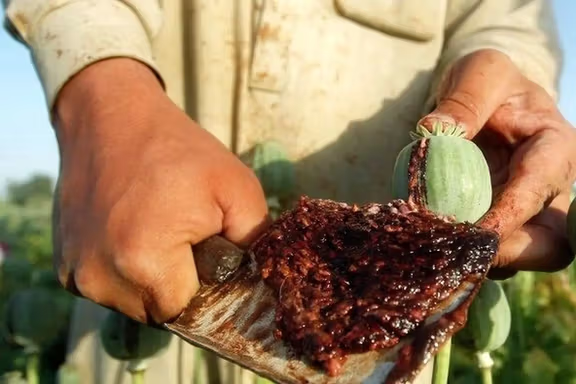
A farmer harvesting raw opium by scraping the latex from poppy pods.

A sharp rise in the price of opium in Iran has driven long-time users of the traditional narcotic toward cheaper and more dangerous synthetic alternatives, according to a field report published by Tehran-based daily.

The Haft-e Sobh paper cited market data showing a 32 percent year-on-year increase in opium prices in April, bringing the average cost to around 1.64 million rials per gram—equivalent to roughly $2.

The rial fell sharply after the start of Iran-US nuclear negotiations, trading at 820,000 to the dollar. Based on this rate, the current opium price range of 1.3 to 2 million rials per gram translates to $1.58 to $2.44.

“The price hikes in the past two years have been astronomical,” one user told Haft-e Sobh. “People can’t afford opium or its derivatives like opium extract anymore. Many have switched to industrial drugs instead.”

Over the past five years, the average price of opium has more than doubled. In 2020, it stood at around 750,000 rials per gram ($0.91), rising to 1.2 million rials ($1.46) in 2023 and now averaging 1.64 million rials ($2).

For much of the last decade, black-market opium prices had risen more slowly than Iran’s official inflation rate. But that gap has now narrowed considerably. Official inflation in the past year was 33.4 percent, nearly mirroring the 32 percent jump in opium prices.

The shift in affordability has triggered a broader change in consumption. A February 2025 field report by the Etemad newspaper found that the use of traditional narcotics like opium has declined sharply in the past seven years, with heroin and methamphetamine becoming more prevalent.

Unlike opium, meth is often easier to manufacture domestically and does not rely on cross-border supply chains.

Much of the current scarcity is linked to the Taliban’s ban on poppy cultivation in Afghanistan, enacted in early 2022. Taliban forces destroyed large swathes of opium poppy fields, disrupting regional supply and pushing up prices.

In July 2022, Iran’s Tejarat News website reported that prices had spiked nearly sixfold before partially stabilizing.

Meanwhile, as demand remains high, reports of poppy cultivation inside Iran have surfaced despite official crackdowns. Government-linked media recently aired footage of poppy fields being destroyed in southern provinces.

In one case from March, footage released by the Baloch Activists Campaign showed armed raids by Iranian forces on the village of Esfand in Sistan and Baluchistan province, aimed at destroying local poppy farms.

In 2022, the UN office on drugs and crime (UNODC) reported that an estimated 2.8 million people suffer from a drug use problem in Iran. The country also has one of the world’s highest prevalence of opiate use among its population.

Most Viewed

State media slam Araghchi's Hormuz tweet, say it let Trump claim victory
1

State media slam Araghchi's Hormuz tweet, say it let Trump claim victory

2

Iran International says it won’t be silenced after London arson attack

3
INSIGHT

How Tehran bends its own red lines to boost state rallies

4
OPINION

The Hormuz get out of jail card turned to a grave

5

Iran halts petrochemical exports to supply domestic market

Banner
Banner

Spotlight

  • Too early to tell who is winning Iran war, experts say
    PODCAST

    Too early to tell who is winning Iran war, experts say

  • How Tehran bends its own red lines to boost state rallies
    INSIGHT

    How Tehran bends its own red lines to boost state rallies

  • Iran blackout cripples freelancer, small business incomes
    VOICES FROM IRAN

    Iran blackout cripples freelancer, small business incomes

  • Ideology may be fading in Iran, but not in Kashmir's ‘Mini Iran'
    INSIGHT

    Ideology may be fading in Iran, but not in Kashmir's ‘Mini Iran'

  • US blockade enters murky phase as tankers spoof signals and buyers hesitate
    ANALYSIS

    US blockade enters murky phase as tankers spoof signals and buyers hesitate

  • Why the $100 billion Hormuz toll revenue is a myth
    ANALYSIS

    Why the $100 billion Hormuz toll revenue is a myth

•
•
•

More Stories

Iranian press shows divisions over nuclear talks after Rome meeting

Apr 20, 2025, 13:27 GMT+1

A day after the second round of nuclear talks between Iran and the United States concluded in Rome, Tehran’s major newspapers revealed the ongoing divide between reformists and hardline factions.

While reformist outlets welcomed what they described as swift progress and a move toward technical-level discussions, conservative dailies backed the negotiation team but renewed warnings against what they called US hostility and external opposition from diaspora critics.

On Sunday, Ham-Mihan, a reformist paper aligned with technocratic factions, described the shift to expert-level talks as evidence of agreement on core principles, such as Iran’s continued uranium enrichment.

It called this “a sign of rapid progress” but warned that it did not guarantee a final deal. “The stage reached suggests a framework is in place, but final terms will be decided in detail-oriented discussions,” the editorial said.

The paper also predicted the alleged indirect format of talks may soon shift to direct engagement, arguing that detailed negotiations are impractical through intermediaries.

Shargh, another reformist paper, featured interviews with four former officials and political figures. All welcomed the apparent momentum.

“If external spoilers are kept at bay, this can lead to tangible gains for the Islamic Republic,” said reformist activist Mohammad-Sadegh Javadi-Hessar, adding that European threats to trigger the snapback mechanism appear to have receded.

In contrast, the conservative Farhikhtegan focused on perceived foreign interference. Its lead story, titled “Lobbyists of Tension,” accused a range of organizations—including American Israel Public Affairs Committee (AIPAC), United Against Nuclear Iran (UANI), and the Foundation for Defense of Democracies—of undermining the talks.

It said, without evidence, that these groups, through “financial backing and intelligence ties,” aim to maintain pressure on Iran and shape US foreign policy against Tehran.

The paper also said that "Iranian dissidents abroad were spreading misleading information to derail the negotiations,” framing the process as vulnerable to outside manipulation.

The hardline Kayhan, viewed as reflecting the Supreme Leader’s position, struck a defiant tone. In a lengthy commentary, it warned that negotiations were historically a tool of colonial pressure and argued that only military and nuclear strength had forced the US to the table.

In another piece, Kayhan wrote that excluding Europe and regional states in the talks had allowed Iran to slow the pace and avoid compromise. The writer said “indirect talks humiliated the US, reinforcing Tehran’s standing.”

Saying that US enmity toward the Islamic Republic would persist regardless of the outcome, it added, “The world is watching a diplomatic clash between satanic and divine powers,” as resistance to diplomatic means continued.

Invoking sacred history, Khamenei allies justify flexibility in US talks

Apr 20, 2025, 11:32 GMT+1
•
Maryam Sinaiee

In the wake of talks with the US, Iran's hardliners have used historical parallels as a way to justify negotiations on the country's nuclear program which had initially been rejected by the Supreme Leader and his hardline allies.

In the days following the first round of indirect talks in Oman on April 12, which were followed by further discussions in Rome on Saturday, clerics, political figures, and media outlets compared a potential US-Iran agreement with a treaty the Prophet Muhammad signed with his adversaries in Mecca in 628 CE, showing a rare softened tone.

The Treaty of Hudaybiyyah allowed for a ten-year truce and provided Muslim access to pilgrimage in Mecca the following year in exchange for several concessions to the Prophet’s enemies.

Ayatollah Kazem Nourmofidi, Khamenei’s representative in Golestan Province, said in a sermon that at the time, some Muslims saw the treaty as unjust and believed the Prophet should not have conceded.

“But that peace proved to be a clear victory,” he argued, justifying the talks which had initially received so much criticism from the country's hardliners who have long opposed negotiations with the US.

An article on the current talks with the US published by Tasnim News Agency, which is affiliated with the Islamic Revolutionary Guard Corps (IRGC), similarly referred to the Prophet's negotiations with the enemies of Islam and the controversial Treaty of Hudaybiyyah, but argued that his strategic flexibility and concessions led to far greater conquests.

Supreme Leader Ali Khamenei made no direct reference to the recent Muscat talks during a speech to senior military commanders after the first round of talks in Oman but adopted a tone of cautious pragmatism later. “We are neither overly optimistic nor overly pessimistic about these talks,” he said—before offering a stark caveat: “I am very pessimistic about the other side.”

Khamenei’s calibrated remarks reflect a blend of strategic openness to diplomacy and deep skepticism about American intentions, appeasing the hardliners.

This is not the first time religious symbolism has been invoked to justify shifts in foreign policy. In 2013, as Iran began talks that led to the 2015 nuclear deal (the Joint Comprehensive Plan of Action, or JCPOA), Khamenei referred to his shift as a “heroic flexibility”—a reference to Imam Hassan, the second Shiite Imam, who accepted a truce with a hostile ruler to protect himself and his followers from harm.

Today, Khamenei’s renewed openness to negotiation has again fractured Iran’s hardline camp. Some factions have moved to align with the Supreme Leader’s position. Others—particularly ultra-hardliners who cannot openly challenge Khamenei without facing political consequences—remain visibly frustrated.

Iran signals progress in indirect US talks

Apr 20, 2025, 11:16 GMT+1

Indirect negotiations between Iran and the United States have been positive so far, the Iranian government spokesperson said on Sunday, adding that Tehran welcomes any initiative to lift sanctions.

Speaking to the state news agency IRNA, Fatemeh Mohajerani said of the second round of indirect talks held in Rome, "These negotiations are being held with Oman's mediation and in a constructive atmosphere".

Highlighting the importance of lifting sanctions which have crippled Iran's economy since 2018 when US President Donald Trump pulled out of the JCPOA nuclear agreement, she said, “In the continuation of the negotiation path, we will welcome any practical initiative aimed at lifting sanctions".

Since then, further sanctions have been levied on Iran from around the world for both its crackdown on protesters and human rights abuses at home, as well as Iran's support for Russia's war on Ukraine.

She confirmed that expert-level consultations would continue in the coming days, followed by higher-level talks in Muscat.

However, she also pointed to Supreme Leader Ali Khamenei's position of being neither optimistic nor pessimistic about the negotiations.

"We are neither extremely optimistic nor extremely pessimistic about these talks," Khamenei said last week, adding however that “we are very pessimistic about the other side, but we are optimistic about our own capabilities."

Separately, Iranian Foreign Minister Abbas Araghchi wrote on the social media platform X on Saturday night that "optimism may be justified, but only with great caution."

"The second round of negotiations of talks were good and positive in a positive atmosphere."

He added that Iran had explained why the 2015 nuclear deal (JCPOA) was no longer sufficient for many in Iran.

Iran's judiciary files lawsuit against journalists over comments on talks

Apr 20, 2025, 10:56 GMT+1

Iran's judiciary has announced legal action against the heads of two media outlets following their commentary on the ongoing nuclear negotiations between the Islamic Republic and the United States.

The judiciary's news agency Mizan reported on Saturday that "disrespectful remarks by the directors of two media outlets regarding the Iran-America negotiations led to charges being filed against them."

The agency did not initially name the individuals involved.

However, the Revolutionary Guard-affiliated Fars news agency later identified the two as Mostafa Faghihi, owner of the Entekhab News Website, and Sajjad Abedi, managing editor of Talkhand-e Siasi (Political Satire).

The move comes shortly after a commentary on Raja News, another outlet linked to the Revolutionary Guard, criticized what it described as a rise in "fake news, rumors, and false accusations" against Supreme Leader Ali Khamenei in both online spaces and some official media.

Raja News specifically accused Faghihi of labeling critics of the nuclear talks as "hardliners with clichéd and nauseating" rhetoric.

The outlet also said that Abedi had dismissed Khamenei's recent statement about not making the country's issues dependent on negotiations as "nonsense."

Abedi responded on the social media platform X, saying that his comment was directed at the hardliners' remarks, not Khamenei's.

Khamenei has shifted his stance on talks since February when he described negotiating with US President Donald Trump as "dishonorable" and "irrational," but less than two months later, he greenlit indirect talks with the US.

This is not the first instance of the Iranian judiciary taking action against media figures commenting on the nuclear issue.

Earlier this month, Mizan reported charges against Hesamoddin Ashena, a former head of the Strategic Studies Center under former president Rouhani's administration, for a social media post criticizing the Islamic Republic authorities regarding Iran's approach to negotiations with the US.

The reformist Shargh daily also offered a public apology after it published a report about the potential renewed role of Mohammad Javad Zarif in the US talks.

Additionally, the Press Supervisory Board issued a warning to the editor-in-chief of the hardline Kayhan daily, which is managed by Khamenei's representative, for threats of assassination against President Donald Trump for the 2020 killing of IRGC's Qasem Soleimani.

Tehran needs US talks to live, ex-Iranian diplomat says

Apr 18, 2025, 22:28 GMT+1
•
Negar Mojtahedi

The Islamic Republic will seek a new lease on life in US talks, former Iranian diplomat Hossein Alizadeh told the Eye for Iran podcast, adding that Iran's rulers will never abandon their hardline ideology against the West.

“It is ideology, flexible ideology. Extremist, but flexible,” Alizadeh said. “Using lies, creating lies—that’s part of their strategy.”

Alizadeh, who served in Iran’s Ministry of Foreign Affairs for 22 years, said Tehran’s current posture is motivated by a desire to stay afloat amid both internal unrest and external pressure.

Despite having defected, Alizadeh says he remains in contact with individuals inside Iran’s Ministry of Foreign Affairs and remains familiar with official policy thinking.

He offered insight into the mindset of Supreme Leader Ayatollah Ali Khamenei, calling him a revolutionary who clings to the vision of his predecessor, Ayatollah Ruhollah Khomeini, to export the Islamic Revolution.

“The reality is dictating to Khamenei that in this situation—internally because of the economic problems inside Iran, and tension with many parts of the world, particularly with Israel and the United States, and now with the European Union,” he said.

According to Alizadeh, pressure is mounting: Israel’s strikes on Iran’s regional proxies, economic hardship, domestic dissent, and the looming threat of “snapback” sanctions from the E3 (Britain, France, and Germany) are all pushing Tehran toward tactical concessions.

Despite its defiant stance, he said, Iran will most likely cave to US demands—but only temporarily.

Flipping his lights on and off, Alizadeh emphasized: “The nuclear program is like this: switch on. Switch off."

Iran permits nuclear inspectors into the country, he added, but blocks human rights monitors because Tehran can pause nuclear activities but cannot hide rights abuses.

Alizadeh served as a diplomat in Finland during the 2009 contested elections, when Mahmoud Ahmadinejad’s declared victory sparked mass protests.

Supporters of opposition candidate Mir Hossein Mousavi claimed the vote was rigged, leading to a nationwide crackdown.

That moment, Alizadeh said, shattered his lifelong beliefs.

“When the Green Movement erupted in Iran was a moment that I always describe it as rebirth for myself,” he said.

Alizadeh pointed to the lack of public outrage from Iran’s hardliners in the face of renewed diplomacy—even with President Donald Trump whom the detest for ordering the killing of military leader Qasem Soleimani and withdrew from an earlier nuclear deal during his first term.

“Trump is in office—the Trump who killed Qasem Soleimani and the Trump who withdraw his country out of the JCPOA,” Alizadeh said. “None of the hardliners are saying anything against the talks. So, in fact, it's a matter of survival. They know this is a real game.”

Alizadeh said he advises American officials that Iranian diplomacy should not be compared to the Western model. In Iran’s case, it’s a calculated tool to manipulate perception.

“For Khamenei, diplomacy is a tool. He used it as instrument to trick people that, I am a rational person. Iran under me is a normal country like all the others,” Alizadeh said.

To hear more from Hossein Alizadeh, watch the full episode of Eye for Iran on YouTube or listen on Spotify, Apple Podcasts, Castbox, or Amazon.