• العربية
  • فارسی
Brand
  • Iran Insight
  • Politics
  • Economy
  • Analysis
  • Special Report
  • Opinion
  • Podcast
  • Iran Insight
  • Politics
  • Economy
  • Analysis
  • Special Report
  • Opinion
  • Podcast
  • Theme
  • Language
    • العربية
    • فارسی
  • Iran Insight
  • Politics
  • Economy
  • Analysis
  • Special Report
  • Opinion
  • Podcast
All rights reserved for Volant Media UK Limited
volant media logo

New US sanctions target Iran drone procurement network

Apr 1, 2025, 15:35 GMT+1Updated: 07:16 GMT+1
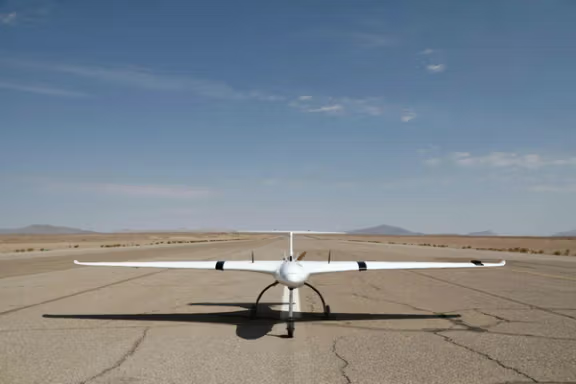
A drone is seen during a military exercise in an undisclosed location in Iran, handout image obtained on October 4, 2023

The United States on Tuesday imposed sanctions on six firms and two individuals in Iran, China and the United Arab Emirates accused of supplying drone components to Iran’s Quds Aviation Industries and its military partners.

The move marks part of a stepped-up enforcement effort under a recent presidential directive ordering a “maximum pressure” campaign of sanctions on Tehran.

“Iran’s proliferation of UAVs and missiles—both to its terrorist proxies in the region and to Russia for its use against Ukraine—continues to threaten civilians, US personnel, and our allies and partners,” Treasury Secretary Scott Bessent said.

“Treasury will continue to disrupt Iran’s military-industrial complex and its proliferation of UAVs, missiles, and conventional weapons that often end up in the hands of destabilizing actors, including terrorist proxies,” he added in a statement.

“The United States will use all available means to expose and disrupt Iran’s growing UAV and missile development programs and weapons proliferation,” the State Department said in support of the sanctions. “We will continue to act against the complex schemes Iran uses in third countries to conceal its acquisition and its transfers of sensitive technology.”

"We will continue to act against the complex schemes Iran uses in third countries to conceal its acquisition and its transfers of sensitive technology. Iran uses this technology and the proceeds from arms sales to bolster its military industrial base to build missiles and UAVs, which are used against fellow countries, as well as exported to Russia, terrorist proxy groups around the Middle East, and to other actors of concern," added Tammy Bruce, the State Department Spokesperson.

The designated entities include Rah Roshd, an Iran-based supplier linked to the Mohajer-6 drone, and Chinese manufacturer Zibo Shenbo, which allegedly shipped tens of thousands of motors to Iran. UAE firms, including Infracom and Diamond Castle, were named as intermediaries.

The sanctions freeze US-based assets and bar transactions with US persons. Concurrently, the Justice Department charged two Iranians with conspiring to smuggle US technology to the Islamic Revolutionary Guard Corps, the Iranian transnational paramilitary group the US classifies as a foreign terrorist organization.

Western powers accuse Iran of providing drones and missiles to Russia for its full-scale invasion of Ukraine.

Iranian drones have repeatedly been deployed in attacks on Ukraine’s infrastructure and other civilian targets. The Shahed 136 drone is typically launched alongside cruise and ballistic missile attacks to overwhelm Ukrainian air defenses.

Most Viewed

Ghalibaf defends Iran-US talks amid hardline backlash
1
INSIGHT

Ghalibaf defends Iran-US talks amid hardline backlash

2
INSIGHT

A nation in limbo: 100 days after the massacre, has the world moved on?

3
ANALYSIS

From instability to influence: Pakistan’s pivotal role in US-Iran diplomacy

4
ANALYSIS

100 days on: why Iran’s January protests spread across social classes

5

War-hit homeowners feel abandoned as Iran’s reconstruction aid fades

Banner
Banner

Spotlight

  • War-hit homeowners feel abandoned as Iran’s reconstruction aid fades

    War-hit homeowners feel abandoned as Iran’s reconstruction aid fades

  • 100 days on: the anatomy of Iran’s January crackdown
    INSIGHT

    100 days on: the anatomy of Iran’s January crackdown

  • Ghalibaf defends Iran-US talks amid hardline backlash
    INSIGHT

    Ghalibaf defends Iran-US talks amid hardline backlash

  • 100 days on: why Iran’s January protests spread across social classes
    ANALYSIS

    100 days on: why Iran’s January protests spread across social classes

  • From instability to influence: Pakistan’s pivotal role in US-Iran diplomacy
    ANALYSIS

    From instability to influence: Pakistan’s pivotal role in US-Iran diplomacy

  • A nation in limbo: 100 days after the massacre, has the world moved on?
    INSIGHT

    A nation in limbo: 100 days after the massacre, has the world moved on?

•
•
•

More Stories

Russia slams Trump’s threat to bomb Iran, China calls for diplomacy

Apr 1, 2025, 13:43 GMT+1

Russia has warned against strikes on Iran's nuclear infrastructure as China called for diplomatic efforts after US President Donald Trump threatened to bomb the country if Tehran did not come to an agreement over its nuclear program.

"Threats are indeed being heard, ultimatums are also being heard," Russian Deputy Foreign Minister Sergei Ryabkov told the Russian journal International Affairs in an interview on Tuesday.

"We consider such methods inappropriate, we condemn them, we consider them a way for (the United States) to impose its own will on the Iranian side," he added.

Trump on Sunday warned that Iran could face bombing and secondary tariffs if a nuclear deal was not reached with Washington.

Ryabkov warned that a US strike on Iran, particularly targeting its nuclear infrastructure, could have catastrophic consequences for the entire region.

"There is still time, and the 'train has not left the station' yet. We must intensify efforts to reach a reasonable agreement," Ryabkov said. "Russia is ready to offer its services to Washington, Tehran and all parties interested in resolving this issue."

Kremlin spokesman Dmitry Peskov also said last month that Russian President Vladimir Putin had agreed to mediate nuclear talks between Washington and Tehran.

China also expressed concerns on Tuesday, with Ministry of Foreign Affairs spokesperson Guo Jiakun saying that the Iranian nuclear issue should be resolved through diplomatic means.

"China maintains that resolving the Iranian nuclear issue through political and diplomatic means is the only right option and that new consensus needs to be reached," Jiakun said in response to a reporter's question about Trump's threats against Iran during a press briefing.

"The US needs to show political sincerity and resume talks as soon as possible. Slapping sanctions, pressuring, and threatening with the use of force will lead nowhere,” he added.

Earlier in March, an Emirati official brought a letter from Trump proposing nuclear talks with Tehran, which the Islamic Republic's Supreme Leader Ali Khamenei rejected, saying such a proposal was deception from Washington amid crippling sanctions on Iran.

Iran officially responded to a letter last Wednesday seeking a nuclear deal. While Iran has rejected direct negotiations with the United States, Iran's President Masoud Pezeshkian said indirect talks can continue, adding that Ali Khamenei's response to Trump’s letter was delivered to the US contact in Oman.

Iranian biotech entrepreneur nominated for German start-up award

Apr 1, 2025, 10:58 GMT+1

Iranian biochemist Ghazaleh Madani has been nominated for the German Start-up Award as 'newcomer of the year' for her work with cancer research.

Madani, 29, is one of three finalists for the category, as announced by the German Start-up Association, and from over 400 applications, a 27-member jury nominated 24 individuals including the young Iranian.

According to a report by German newspaper Tagesspiegel, Madani completed her medical studies at the Isfahan University of Medical Sciences before leaving Iran in 2020 Iran due to the political situation in the country without providing further details.

She studied biochemistry and molecular biology at the University of Potsdam and received her master's degree in 2023.

Tagesspiegel's report quoted Madani as saying that she dedicated herself to cancer research because she herself had lost several family members to the disease.

Her start-up, CanChip, specializes in developing 3D tumor models for cancer research.

Award finalists represent a wide range of industries, including medical technology, AI, sustainability, and engineering. The awards ceremony is scheduled to take place next month on May 22.

Iran seizes two foreign oil tankers in Persian Gulf

Mar 31, 2025, 18:45 GMT+1

Iranian Revolutionary Guard naval forces seized two foreign oil tankers in the Persian Gulf on Monday, state media reported, accusing them of smuggling diesel fuel.

The tankers were intercepted in a maritime operation by the Islamic Revolutionary Guard Corps (IRGC) Second Naval District and are now being transferred to the port of Bushehr.

“The two tankers, with a total of 25 crew members, were systematically involved in fuel smuggling in the central waters of the Persian Gulf and were collectively carrying over three million liters of smuggled diesel fuel,” read a statement by the IRGC unit.

“These two tankers were systematically engaged in fuel smuggling and were identified through intelligence monitoring by IRGC naval forces,” the statement added. “They are now being moved to the Bushehr oil pier under judicial order for fuel confiscation.”

The IRGC regularly announces such seizures, citing efforts to combat fuel trafficking in the Gulf.

In April 2023, the Iranian Navy seized the Advantage Sweet, a Marshall Islands-flagged oil tanker, in the Gulf of Oman, alleging it had collided with an Iranian vessel.

Similarly, in January 2024, Iran seized the St. Nikolas (formerly known as Suez Rajan), another Marshall Islands-flagged tanker, in retaliation for the US confiscation of its oil cargo the previous year.

In 2019, the Revolutionary Guards seized the British-flagged oil tanker Stena Impero in the same waterway for allegedly ramming a fishing boat and released it two months later.

Iran has frequently justified such actions by citing fuel smuggling, maritime violations or reciprocal measures.

Iran and the United States have traded barbs in recent years over a spate of incidents in the sensitive waters of the Persian Gulf, through which much of the world's energy supplies passes.

Secondary tariffs: US wields a powerful tool against Iran

Mar 31, 2025, 14:28 GMT+1
•
Dalga Khatinoglu

US President Donald Trump has threatened to bomb Iran and impose secondary tariffs if Tehran refuses to reach an agreement with Washington on abandoning its nuclear ambitions and making other concessions.

While the Trump administration has previously used tariff hikes as leverage against nations it regarded as rivals, this approach has little impact on Iran, which exported only $6.2 million worth of goods to the US last year and just $2.2 million in 2023.

However, secondary tariffs could pose a serious threat to Iran. Under this mechanism, the US could target countries that import sanctioned Iranian goods by imposing tariffs on their exports to the American market.

This is particularly significant given that, according to Iranian customs data, about 83% of Iran’s non-oil exports go to seven countries: China, Iraq, the UAE, Turkey, Afghanistan, Pakistan, and India. With the exception of Afghanistan, all have substantial trade ties with the US. Continued commerce with Iran could jeopardize their access to the American market.

This issue presents two major challenges for Iran. First, it threatens the country’s ability to export sanctioned goods—such as oil, petrochemicals, and metals—to key markets. Second, it disrupts Iran’s strategy of using trade partners to rebrand these goods and reroute them to third countries.

In the first 11 months of the last Iranian fiscal year, which ended on March 20, Iran exported $43 billion worth of goods to these seven key countries. Meanwhile, according to the US Census Bureau, those same countries exported over $550 billion worth of goods to the United States in 2024—more than 11 times the value of their imports from Iran.

Take China, for example. Iranian customs data show it imported around $13.8 billion in non-oil goods from Iran during that period. In addition, tanker tracking data indicate that China received approximately 1.5 million barrels per day of Iranian crude and fuel oil--worth an estimated $40 billion.

Although China benefits from steep discounts on Iranian petroleum and non-oil goods, it exported $427 billion worth of goods to the US last year--highlighting the potential cost of secondary tariffs.

Rebranding Iranian products

The gap between Iran’s official trade figures and those reported by its key trading partners suggests that a substantial share of Iranian exports is being rebranded and re-exported as if originating from those countries.

For example, Iranian customs recorded $13.8 billion in non-oil exports to China over the first 11 months of the last fiscal year, yet China’s Customs data show only $4.44 billion in non-oil imports from Iran for all of 2024. Similarly, Iran reported $6.4 billion in exports to Turkey, but Turkish data—including natural gas—registered just $2.45 billion in imports from Iran. The discrepancy persists with India: Iranian data show $1.8 billion in exports, while India’s Ministry of Commerce reported only $718 million in imports from Iran.

Iraq, the UAE, Pakistan, and Afghanistan do not publish detailed trade statistics. However, Iran's reliance on countries like the UAE for rebranding sanctioned goods and rerouting them to global markets appears highly likely.

As noted, Iran’s foreign trade is concentrated in a small group of countries. This concentration means that imposing US tariffs on those re-exporting Iranian sanctioned goods would not be especially difficult.

Another key point is that US sanctions extend well beyond crude oil. They also target Iranian exports of petroleum products (such as liquefied petroleum gas, or LPG), petrochemicals, metals, and more. These items make up the majority of Iran’s non-oil exports.

In the first 11 months of the last fiscal year, Iran exported over $10 billion in LPG, $13 billion in petrochemicals, $10 billion in metals (especially steel, aluminum, and copper), and $5 billion in gas. These four categories alone accounted for 70% of Iran’s non-oil exports, with nearly all shipments headed to the seven countries mentioned above.
Iran’s trade with East Asia crumbles under weight of sanctions

Mar 29, 2025, 11:33 GMT+0

Iran’s commercial ties with East Asia have withered under the sustained pressure of US-led sanctions, pushing once-robust relations with countries like Japan and South Korea into near dormancy, according to a former senior Iranian diplomat.

Economic ties with Japan have collapsed despite the absence of political disputes, said Ali Majedi, Iran’s former ambassador to Germany, Japan, and Brazil.

“Europe still does some business with us,” Majedi said, but “But East Asia, outside of China, doesn’t work with us at all anymore.”

The former official said sanctions had affected trade not just with the West, but with Asian economies such as Japan, South Korea, and India, where commercial relations have reached a minimum.

“When I was in Tokyo in 2004, Japan was importing 750,000 barrels of oil per day and trade between us exceeded $10 billion,” Majedi added. “Now, even for items not under sanctions, trade is practically nonexistent.”

While China remains Iran’s last major oil customer in the region, Majedi said other East Asian nations have largely fallen in line with US restrictions. He added that smaller countries in the region still depend on American security guarantees and avoid Iranian trade out of fear of secondary sanctions.

Findings by Iran International show that while Iran’s oil sales to China dropped sharply last month, the decline in export revenues began months earlier, coinciding with US sanctions on dozens of tankers carrying Iranian crude.

The Biden administration imposed sanctions on dozens of tankers carrying Iranian oil after Iran’s missile attack on Israel in early October last year. While this initially led to a relative decline in Iranian oil offloading at Chinese ports, Beijing fearing potential US sanctions under Donald Trump's administration, prohibited sanctioned oil tankers from entering Shandong port.

Iran’s only oil customers are small, independent Chinese refineries, known as "teapots," most of which are based in Shandong, where 90% of Iranian oil cargoes is discharged.

Data from Kpler shows that Iran’s oil deliveries to China fell below 850,000 barrels per day in January, compared to over 1.8 million barrels per day in October last year.







