• العربية
  • فارسی
Brand
  • Iran Insight
  • Politics
  • Economy
  • Analysis
  • Special Report
  • Opinion
  • Podcast
  • Iran Insight
  • Politics
  • Economy
  • Analysis
  • Special Report
  • Opinion
  • Podcast
  • Theme
  • Language
    • العربية
    • فارسی
  • Iran Insight
  • Politics
  • Economy
  • Analysis
  • Special Report
  • Opinion
  • Podcast
All rights reserved for Volant Media UK Limited
volant media logo

Russia slams Trump’s threat to bomb Iran, China calls for diplomacy

Apr 1, 2025, 13:43 GMT+1Updated: 15:08 GMT+1
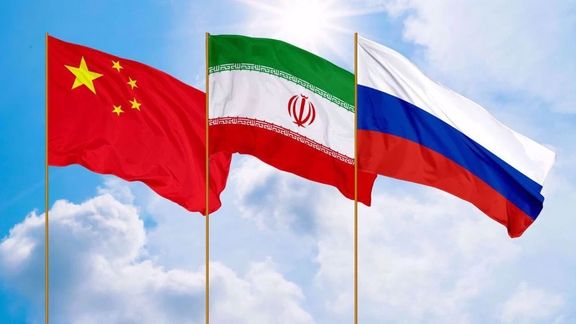
An illustration shows the flags of China, Iran and Russia

Russia has warned against strikes on Iran's nuclear infrastructure as China called for diplomatic efforts after US President Donald Trump threatened to bomb the country if Tehran did not come to an agreement over its nuclear program.

"Threats are indeed being heard, ultimatums are also being heard," Russian Deputy Foreign Minister Sergei Ryabkov told the Russian journal International Affairs in an interview on Tuesday.

"We consider such methods inappropriate, we condemn them, we consider them a way for (the United States) to impose its own will on the Iranian side," he added.

Trump on Sunday warned that Iran could face bombing and secondary tariffs if a nuclear deal was not reached with Washington.

Ryabkov warned that a US strike on Iran, particularly targeting its nuclear infrastructure, could have catastrophic consequences for the entire region.

"There is still time, and the 'train has not left the station' yet. We must intensify efforts to reach a reasonable agreement," Ryabkov said. "Russia is ready to offer its services to Washington, Tehran and all parties interested in resolving this issue."

Kremlin spokesman Dmitry Peskov also said last month that Russian President Vladimir Putin had agreed to mediate nuclear talks between Washington and Tehran.

China also expressed concerns on Tuesday, with Ministry of Foreign Affairs spokesperson Guo Jiakun saying that the Iranian nuclear issue should be resolved through diplomatic means.

"China maintains that resolving the Iranian nuclear issue through political and diplomatic means is the only right option and that new consensus needs to be reached," Jiakun said in response to a reporter's question about Trump's threats against Iran during a press briefing.

"The US needs to show political sincerity and resume talks as soon as possible. Slapping sanctions, pressuring, and threatening with the use of force will lead nowhere,” he added.

Earlier in March, an Emirati official brought a letter from Trump proposing nuclear talks with Tehran, which the Islamic Republic's Supreme Leader Ali Khamenei rejected, saying such a proposal was deception from Washington amid crippling sanctions on Iran.

Iran officially responded to a letter last Wednesday seeking a nuclear deal. While Iran has rejected direct negotiations with the United States, Iran's President Masoud Pezeshkian said indirect talks can continue, adding that Ali Khamenei's response to Trump’s letter was delivered to the US contact in Oman.

Most Viewed

Ghalibaf defends Iran-US talks amid hardline backlash
1
INSIGHT

Ghalibaf defends Iran-US talks amid hardline backlash

2
INSIGHT

Iran diplomacy wobbles as factions compete to avoid looking soft on US

3
VOICES FROM IRAN

Bread shortages, soaring prices strain households in Iran, residents say

4
ANALYSIS

The politics of pink: how Iran uses cuteness to rebrand violence

5

Scam messages seek crypto for ships’ safe passage through Hormuz, firm warns

Banner
Banner

Spotlight

  • Diplomacy tolls at Hormuz as conflict returns to its doorstep
    OPINION

    Diplomacy tolls at Hormuz as conflict returns to its doorstep

  • Opposition to US talks grows in Tehran as ceasefire deadline nears
    INSIGHT

    Opposition to US talks grows in Tehran as ceasefire deadline nears

  • Tehran moderates see ‘no deal–no war’ limbo as worst outcome
    INSIGHT

    Tehran moderates see ‘no deal–no war’ limbo as worst outcome

  • The future has been switched off here
    TEHRAN INSIDER

    The future has been switched off here

  • Lights out, then gunfire: Witnesses recount Mashhad protest crackdown
    VOICES FROM IRAN

    Lights out, then gunfire: Witnesses recount Mashhad protest crackdown

  • Is Iran entering its Gorbachev moment?
    INSIGHT

    Is Iran entering its Gorbachev moment?

•
•
•

More Stories

Iranian biotech entrepreneur nominated for German start-up award

Apr 1, 2025, 10:58 GMT+1

Iranian biochemist Ghazaleh Madani has been nominated for the German Start-up Award as 'newcomer of the year' for her work with cancer research.

Madani, 29, is one of three finalists for the category, as announced by the German Start-up Association, and from over 400 applications, a 27-member jury nominated 24 individuals including the young Iranian.

According to a report by German newspaper Tagesspiegel, Madani completed her medical studies at the Isfahan University of Medical Sciences before leaving Iran in 2020 Iran due to the political situation in the country without providing further details.

She studied biochemistry and molecular biology at the University of Potsdam and received her master's degree in 2023.

Tagesspiegel's report quoted Madani as saying that she dedicated herself to cancer research because she herself had lost several family members to the disease.

Her start-up, CanChip, specializes in developing 3D tumor models for cancer research.

Award finalists represent a wide range of industries, including medical technology, AI, sustainability, and engineering. The awards ceremony is scheduled to take place next month on May 22.

Calls grow in Tehran to defuse rifts as war and unrest loom

Apr 1, 2025, 10:15 GMT+1

While the latest exchange of threats between US President Donald Trump and Iranian Supreme Leader Ali Khamenei once again cast a shadow of war over Iran, their harsh words also appear to have stirred tensions in Iran’s domestic politics.

Pundits across Iran's political spectrum have been warning "radicals"—a label often aimed at members of the ultraconservative Paydari Party, particularly in parliament—to step back from the political spotlight and avoid fueling sociopolitical tensions at a time when Iranian society is easily agitated.

Former Deputy Intelligence Minister and government spokesman Ali Rabiei, a figure in Iran’s Reformist camp, urged radicals to scale back their political ambitions under the current circumstances. He advised them to abandon hopes of winning the next presidential or parliamentary elections and cautioned against assuming it is “their turn” to take power in Iran.

Meanwhile, conservative commentator Nasser Imani warned that hardline radicals may be seeking to disrupt the country’s security, stressing that the fallout from their actions would affect all Iranians. He urged other members of parliament not to let the radicals take the lead on pushing controversial issues in the Majles.

Imani said the radicals aim to destabilize the balance among the government’s three branches, as ultraconservatives often thrive in times of instability. He noted that although they hold only one-sixth of the seats in parliament, they are disproportionately loud, disregard boundaries, and continue to exploit public sensitivities on issues like the hijab.

Some conservatives, including Expediency Council member Mohammad Javad Bahonar, have emphasized that ultraconservative figure Saeed Jalili and his so-called “shadow government” are actively working to unseat the Pezeshkian administration. Bahonar accused the ultraconservatives of spreading resignation rumors about Pezeshkian at least three times in the past six months.

Bahonar further warned that radicals from both the conservative and reformist camps are attacking the Pezeshkian administration, frustrated by the lack of representation for their allies in the government. He also accused even moderate figures on both sides of engaging in what he called hostile criticism of the administration.

At the same time, reports of divisions within the ultraconservative camp have been circulating widely in the press and online platforms.

On Monday, some online accounts spread unverified claims that over 30 ultraconservative MPs had resigned in protest after a police crackdown on vigilantes opposing the government’s halt to enforcing a hardline hijab law passed by the Majles last year. There was no confirmation of the reports at the time.

Former ultraconservative MP Hossein Naqavi told the press that some members of the Paydari Party are distancing themselves from the radicals. “True revolutionaries do not accept radicalism,” he said, predicting that the rift between Paydari figures and hardline elements is likely to widen further in the near future.

Even Khamenei, in his Eid al-Fitr sermon on Monday, expressed deep concern about potential “seditions” from radicals on both sides and vowed to crush them. He was clearly alluding to the protest movements launched by Reformists in 2009 (the Green Movement) and the 2022 Woman, Life, Freedom movement, as well as the 2017–2018 unrest in Mashhad, which was initially stirred by ultraconservatives.

Khamenei’s warning about possible unrest followed calls by some opposition groups abroad urging Iranians to use the April 2 national picnic day as an opportunity to demonstrate their unity and strength against the Islamic Republic.

Naqavi Hosseini described Iran as being in a “special situation,” facing pressure from what he called its staunch enemies in the United States. He acknowledged the difficulty of governing during a severe economic crisis, saying: “Under the circumstances, wisdom, religion, and prudence call for national unity until all problems are resolved.” He cautioned against escalating tensions.

Referring to Mahmoud Nabavian—a prominent Paydari figure who has recently softened his hardline positions and adopted more moderate views—Naqavi Hosseini said others in the party should follow his example if they wish to avoid further tensions.

He emphasized that “the most important priority right now is ensuring the survival of the regime.”

Iran executed 58 people in March, rights group says

Apr 1, 2025, 09:48 GMT+1

Iran executed at least 58 prisoners in March, a significant rise from the previous year’s tally for the same month, according to the Norway-based rights group Hengaw.

The executions represent a sharp increase of at least 222% compared to March 2024, when only 18 executions were recorded.

Hengaw said it confirmed the identities of all 58 prisoners executed last month, adding that at least four of them were women, three of whom were convicted of murder, while one faced charges related to drug offenses.

Hengaw said that four of the executions were particularly alarming, carried out without prior notice to the prisoners' families, and the individuals not granted final visits before being put to death.

A majority of the executions were related to drug offenses, which accounted for 52% of the cases, in breach of international law. The rest were primarily linked to premeditated murder charges, accounting for 48% of the total executions, according to Hengaw's report.

Last month, the United Nations special rapporteur on human rights in Iran, Mai Sato, warned that the Islamic Republic is increasing its use of executions as a tool to suppress dissent as she presented her first report to the UN Human Rights Council in Geneva.

Sato warned of Iran's increasing use of executions to suppress dissent, with at least 169 executions recorded in January and February alone this year.

"Should this alarming rate remain consistent, the total number of executions could exceed 1,000 this year, a chilling threshold that demands a collective global response,” Sato said.

Iran executed 901 people in 2024, including 31 women, according to the United Nations human rights office.

Iranian lawmaker calls for atomic bomb, citing North Korea security model

Apr 1, 2025, 08:16 GMT+1

A member of the Iranian parliament's presiding board has publicly advocated for Iran to develop and test an atomic bomb, arguing it would bring security to the nation similar to that of North Korea.

Ahmad Naderi, a representative for Tehran, made his comments in a post on X, echoing sentiments expressed by some Iranian hardliners after threats from US President Donald Trump that Iran would be bombed if it does not agree to a nuclear deal.

"Observing the behavior and words of Trump during his first presidential term with North Korea shows that having an atomic bomb has brought security for Korea," Naderi wrote.

During his 2017-2021 presidency, Donald Trump held three meetings with North Korean leader Kim Jong Un, in Singapore, Hanoi, and at the Korean border, the first time a sitting US president had set foot in the country.

Reuters reported in November that Trump's team was discussing pursuing direct talks with North Korean leader Kim Jong Un, hoping a fresh diplomatic push could lower the risks of armed conflict.

Naderi, who was sanctioned by the European Union in 2010 for designing a plan to respond to the European Union in case the Revolutionary Guards were included in the terrorism list, added, "For a long time now, many of the country's and the revolution's elite and concerned individuals have been requesting the testing and announcement of a [atomic] bomb."

In a direct response to Trump, he added, "If we were also armed with an atomic bomb, Trump would not dare to threaten bombing."

On Monday, Ali Larijani, a veteran nuclear negotiator and advisor to Supreme Leader Ali Khamenei, suggested that such threats from the US could push Iran towards acquiring nuclear weapons for self-defense, noting that public pressure for such a move would likely increase.

In October, a group of lawmakers called on Iran's Supreme National Security Council to review the country's defense doctrine and consider adopting nuclear weapons as the risk of escalation with Israel also continues to grow. Last year the two archenemies engaging in direct aerial attacks as the once long-time shadow war came to a head.

The MPs argue that Khamenei can reconsider his religious ban on nuclear weapons on the grounds that the circumstances have changed.

While Iran denies seeking nuclear weapons and Supreme Leader Khamenei has issued a religious decree against them, recent statements from political figures and lawmakers indicate a growing debate within Iran about its nuclear policy in the face of perceived external threats.

The UN's nuclear watchdog reports that Iran has enriched more uranium than any state without nuclear weapons.

In February, the Wall Street Journal reported that Iran has "sharply increased its stockpile of highly enriched uranium in recent weeks, according to a confidential United Nations report, as Tehran amasses a critical raw material for atomic weapons."

According to the report, it said that the increase in Iran’s holdings of uranium enriched to 60%, or nearly weapons grade, gives it enough to produce six nuclear weapons.

Iran files complaint to UN over Trump bomb threats

Apr 1, 2025, 07:11 GMT+1

Iran has formally lodged a complaint with the United Nations Security Council over US President Donald Trump's threat to bomb the country.

Iran's UN Ambassador Amir Saeid Iravani said in a letter that Tehran "strongly warns against any military adventurism and will respond swiftly and decisively to any act of aggression or attack by the United States or its proxy, the Israeli regime, against its sovereignty, territorial integrity, or national interests."

Trump on Sunday threatened to bomb Iran if the country did not come to an agreement with Washington over its nuclear program.

"If they don't make a deal, there will be bombing — and it will be bombing the likes of which they have never seen before," Trump was quoted as saying during a phone interview with NBC News' Kristen Welker.

Earlier on Monday, Iran's Supreme Leader Ali Khamenei vowed the United States would face retaliation if it follows through on Trump’s threat to bomb Iran.

While Iran denies seeking a nuclear weapon the UN's nuclear watchdog says Tehran has enriched more uranium than any state lacking a bomb.

Last month, Trump signed a directive restoring the so-called maximum pressure policy on Iran of his first term and warned of "catastrophic" consequences if Tehran does not make a deal on its nuclear program.