• العربية
  • فارسی
Brand
  • Iran Insight
  • Politics
  • Economy
  • Analysis
  • Special Report
  • Opinion
  • Podcast
  • Iran Insight
  • Politics
  • Economy
  • Analysis
  • Special Report
  • Opinion
  • Podcast
  • Theme
  • Language
    • العربية
    • فارسی
  • Iran Insight
  • Politics
  • Economy
  • Analysis
  • Special Report
  • Opinion
  • Podcast
All rights reserved for Volant Media UK Limited
volant media logo

Iran's ex-president blames Tehran for missed US nuclear deal
Mar 19, 2025, 11:15 GMT+0
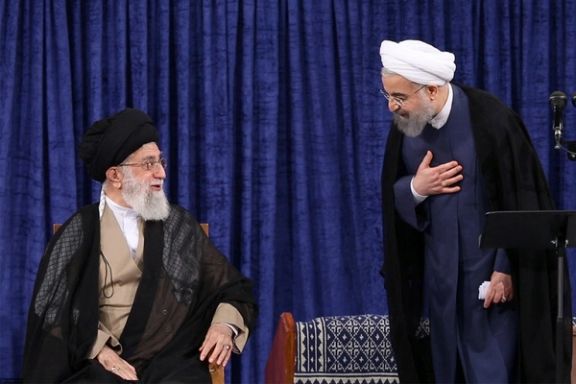
 Supreme Leader Ali Khamenei and former President Hassan Rouhani.
Supreme Leader Ali Khamenei and former President Hassan Rouhani.

Former President Hassan Rouhani has acknowledged that his administration came close to reviving the 2015 nuclear deal under Biden, but Tehran’s internal divisions prevented the agreement.

"Biden’s election was a golden opportunity for the Islamic Republic," Rouhani said Tuesday in an interview with Iran newspaper. "We could have restored the nuclear deal in 2021, but due to political disputes over who would take the presidency next, that opportunity was lost. Now, our situation is harder than ever."

According to Rouhani, who served from 2013 to 2021, his top negotiator at the time, Abbas Araghchi—now Iran’s foreign minister—had reached a framework agreement for reviving the deal with Robert Malley, President Joe Biden’s special envoy for Iran.

Malley, who led US efforts to restart nuclear negotiations, was placed on unpaid leave in April 2023 amid an FBI investigation into his handling of classified information. A Wall Street Journal report in September said that Malley had clicked on a phishing link that compromised his personal email and may have moved classified meeting notes to an unauthorized account.

During Malley’s tenure, the Biden administration informally eased enforcement of US oil sanctions on Iran which were imposed by President Donald Trump in 2018. Iranian oil exports, which had dropped to 250,000 barrels per day in 2019 under Trump’s maximum-pressure campaign, surged to nearly 2 million barrels per day during Biden’s presidency.

Rouhani also said that Malley and Araghchi’s agreement would have ensured not only a US return to the nuclear deal but also the reversal of Trump-era policies, including sanctions on Iran’s Supreme Leader’s office and the designation of the Islamic Revolutionary Guard Corps (IRGC) as a terrorist organization.

Rouhani, who according to Iranian laws could run for a third term, was succeeded by hardliner cleric Ebrahim Raisi in June 2021. His administration resumed talks with JCPOA signatories, but negotiations collapsed after Russia’s invasion of Ukraine.

The former president blamed internal power struggles for the failure of the negotiations. “Some were more concerned about preventing my administration from achieving success than about the national interest,” he said.

Rouhani’s latest remarks come after he suggested last week that Supreme Leader Ali Khamenei’s firm rejection of direct negotiations with Washington might not be absolute—despite Khamenei himself maintaining otherwise. Nevertheless, with Trump back in the White House, Rouhani acknowledged that engaging with Washington will be even more challenging. “Working with Trump is extremely difficult and complex,” he said. “I hope our officials find a way forward.”

As tensions between the US and Iran remain high, Rouhani’s comments hint at the differing views within Tehran’s leadership on how to approach Washington, both in the past and moving forward.


Most Viewed

Hardliners push Hormuz ‘red line’ as US blockade tests Iran’s leverage
1
INSIGHT

Hardliners push Hormuz ‘red line’ as US blockade tests Iran’s leverage

2

Iran International says it won’t be silenced after London arson attack

3
VOICES FROM IRAN

Hope and anger in Iran as fragile ceasefire persists

4

US sanctions oil network tied to Iranian tycoon Shamkhani

5

Iran halts petrochemical exports to supply domestic market

Banner
Banner

Spotlight

  • Hardliners push Hormuz ‘red line’ as US blockade tests Iran’s leverage
    INSIGHT

    Hardliners push Hormuz ‘red line’ as US blockade tests Iran’s leverage

  • Ideology may be fading in Iran, but not in Kashmir's ‘Mini Iran'
    INSIGHT

    Ideology may be fading in Iran, but not in Kashmir's ‘Mini Iran'

  • War damage amounts to $3,000 per Iranian, with blockade set to add to losses
    INSIGHT

    War damage amounts to $3,000 per Iranian, with blockade set to add to losses

  • Why the $100 billion Hormuz toll revenue is a myth
    ANALYSIS

    Why the $100 billion Hormuz toll revenue is a myth

  • US blockade targets Iran oil boom amid regional disruption
    ANALYSIS

    US blockade targets Iran oil boom amid regional disruption

  • Iran's digital economy battered by prolonged blackout
    INSIGHT

    Iran's digital economy battered by prolonged blackout

•
•
•

More Stories

Huge Nowruz celebrations sweep Iran despite mass security presence

Mar 19, 2025, 10:31 GMT+0

Iranians across the country defied government warnings and took to the streets en masse on Tuesday night in celebration of the ancient festival of Charshanbe Suri in spite of a huge security presence.

Celebrations of the ancient festival were marred by clashes with security forces who came to blows with revellers and reports that 19 had died and 5,000 were left injured.

There are no details on whether any of the injuries were caused by security forces who used tear gas and force to disperse crowds in some areas and most incidents occurring in the provinces of Tehran, West Azarbaijan, and East Azarbaijan.

Videos circulating on social media showed large crowds gathering in cities like Tehran, Karaj and Rasht, with bonfires illuminating the night sky and the sounds of music and cheering filling the air.

The festival, marked by jumping over bonfires and setting off fireworks, is a deeply rooted cultural tradition, but it has increasingly become a flashpoint for defiance against the Islamic Republic's restrictions.

The celebrations went ahead with full force in spite of the government warnings against celebrations, young people seeing it as an expression of their cultural identity and a way to challenge authority.

Iranian authorities, including the country’s deputy police commander, have issued warnings of a decisive response to any violations during Nowruz celebrations, as security forces deploy in Kurdish regions to disrupt festivities. The warnings coincide with the IRGC banning official celebrations in Ilam province.

The confluence of Nowruz and Ramadan has heightened tensions, with authorities emphasizing religious adherence.

In the wake of the 2022 uprising, the festival has been turned into an ever growing display of defiance, and in some cases, open protests against the government.

On Tuesday, protests broke out in cities such as Tehran, Karaj, Mashhad and Isfahan, with young Iranians setting fire to images of Supreme Leader Ali Khamenei.

The authorities' attempts to discourage the celebrations have also drawn criticism.

"The efforts made to forget the Charshanbe Suri celebration have made the city unsafe for people," said Jalal Maleki, spokesman for the Tehran Fire Department, calling for designated spaces to ensure public safety.

Iranian captain detained as Iraq seizes fuel smuggling ship

Mar 19, 2025, 09:10 GMT+0

Iraqi naval forces seized an unidentified vessel in the Persian Gulf suspected of fuel smuggling, detaining the Iranian captain and ten Indian and Iraqi crew, the navy said Tuesday.

The vessel, intercepted in Iraqi territorial waters, was towed to Umm Qasr naval base for investigation and the crew was handed over to local police. Its name was not visible in a picture released by the navy.

Fuel smuggling is common in the Persian Gulf, where heavily subsidized fuel is sold on the black market to buyers across the region, but Iraqi seizures are relatively rare.

In December, Iran's President Masoud Pezeshkian said that 20 to 30 million liters of fuel are smuggled out of the country daily, calling it a catastrophe amid the country's energy crisis.

Pezeshkian did not specify the destinations but fuel smuggling in Iran often involves routes to neighboring countries where fuel prices are significantly higher.

In December, Reuters reported that a sophisticated oil smuggling network generating at least $1 billion a year for Iran and its proxies has flourished in Iraq since Prime Minister Mohammed Shia al-Sudani took office in 2022.

Earlier this month Iranian authorities discovered and sealed four illegal taps on a major oil pipeline near the southern city of Bandar Abbas.

Last month, Iran said it dismantled 130 fuel smuggling depots and arrested 41 key suspects in Tehran province.

Border closures mark Iranian police plans for new year

Mar 19, 2025, 08:31 GMT+0

Iran's police chief said the new Iranian year starting on Friday will mark a significant push towards sealing the country's borders and intensifying the fight against crime.

General Ahmad-Reza Radan, the national police commander, announced on Wednesday that enhanced equipment and operational capabilities would enable a leap in border security for the Iranian year 1404.

"The border and its closure were among the challenges for the police in 1403," Radan stated, promising a decisive shift in the coming year without elaborating on details.

Up to 8 million Afghans have illegally entered Iran since 2021, compounding the country's economic challenges such as shortage of energy and water. The authorities have not been able or unwilling to commit resources to protecting the long border.

Last April, Deputy Police Chief Qasem Rezaei said that the construction of a border wall with Afghanistan would "help prevent drug trafficking, the movement of outlaws, and terrorist infiltrations."

The border fortification plan, which entails building a four-meter concrete wall, along with barbed wire, fencing, and proper roads along the northwestern and eastern borders, is scheduled for completion within the next two years.

In addition to border security, Radan outlined key priorities for the police in the coming year, 1404, including, reducing traffic violations, combating theft and the trade of stolen goods and leveling up the fight against drugs.

"1404 will be a bitter year for thieves and those who deal in stolen goods," Radan warned, as crime has increased amid the current economic crisis.

Radan detailed the extensive deployment of security forces during the Nowruz 1404 Exercise which showcased the police's readiness for the Iranian New Year holidays.

"More than 16,000 patrols, 20 helicopters, dozens of drones, and over 250,000 police personnel will secure the country from the borders to the cities," he said.

Tehran's police chief, General Abbas Ali Mohammadian, reported a 19% decrease in thefts in the capital during the past year, attributing it to increased police activity. He also noted a rise in emergency call responses and significant seizures of narcotics.

Iranian police called for public cooperation and adherence to Islamic fasting rules during the coinciding Nowruz and Ramadan periods, emphasizing that celebrations must align with Islamic rules.

While Nowruz is not officially banned, its pre-Islamic roots have long been a point of contention among religious hardliners who dominate key centers of power. These groups often discourage traditional Persian festivals, viewing them as remnants of the past that glorify pre-Islamic Persian history.

In previous years, authorities have attempted to limit gatherings at historically significant sites such as Persepolis and the tomb of Cyrus the Great in Pasargadae, sometimes leading to clashes with participants.

Iran ends its worst year and enters an uncertain future

Mar 19, 2025, 08:16 GMT+0
•
Mardo Soghom

The Iranian year 1403 ending on March 20 marked one of the most challenging yet for the country’s ruling elite, which has been beset by economic malaise at home and historic setbacks abroad.

At the start of the year in March 2024, Iran was already grappling with a broken economy and the looming threat of political unrest. Regionally, however, it still appeared strong and could plausibly project itself as a serious challenge to US and Israeli interests.

Conflict with Israel

As the year began, Israel was deeply engaged in its war with Iran-backed Hamas in Gaza. Tehran confidently claimed that its regional adversary was stuck in an unwinnable conflict, boasting about its so-called Resistance Front and threatening to escalate against both Israel and US interests. Yemen's Houthis were already disrupting shipping in the Red Sea and launching missiles at Israel.

Houthi attacks on maritime trade which began in November 2023 following a declaration by Iran’s Supreme Leader Ali Khamenei inflicted an estimated $200 billion in losses on the global economy.

Israeli tanks in Gaza still confronting remnants of Hamas
100%
Israeli tanks in Gaza still confronting remnants of Hamas

Less than a month into the Iranian year, Tehran launched a large-scale missile and drone strike on Israel In April 2024 in response to Israeli attacks on Iranian targets in Syria.

While most projectiles were intercepted with minimal damage, the Islamic Republic framed it as a significant blow against the "Zionist entity." At the time, Tehran appeared strong, seemingly capable of deterring its most determined adversary.

However, the tide began to turn in late July when Hamas leader Ismail Haniyeh was killed in an explosion while staying at a government guesthouse in Tehran.

It remains unclear whether the incident was caused by a planted explosive or an Israeli missile strike, but the ability of Tehran's arch-foe to strike seemingly anywhere was lost on no one.

The assassination would be just one of many, crescendoing with the killing of Hezbollah leaders via their bomb-laden communication devices and culminating in the assassination of its storied leader Hassan Nasrallah.

Political crisis

Before these epochal blow, Iran suffered another major shock in May when hardline President Ebrahim Raisi and his foreign minister died in a mysterious helicopter crash in northwestern Iran.

Many doubted the official explanation of bad weather, which was never conclusively proven, fueling speculation about a high-level internal plot or an Israeli operation.

Raisi had been widely regarded as ineffective, presiding over a rapidly deteriorating economy since taking office in 2021.

Rescuers at the remote region where Raisi's helicopter crashed in May 2024
100%
Rescuers at the remote region where Raisi's helicopter crashed in May 2024

In June, Iran held presidential elections, with several key candidates disqualified through a vetting process controlled by Khamenei. Ultimately, Masoud Pezeshkian, a politician with no executive experience, faced hardliner Saeed Jalili in a low-turnout runoff and won.

During his campaign, Pezeshkian made it clear that he had no plans beyond executing Khamenei’s directives.

Some Iranians still hoped for limited reforms and a diplomatic breakthrough to ease US sanctions. However, when Khamenei formally banned negotiations in early February 2025, Pezeshkian pledged loyalty to his decision, disappointing even his Reformist supporters.

Economic crisis

By mid-2024, with Hezbollah and Hamas weakened and Israel growing more confident in striking Iranian military targets, Iran’s economic woes deepened. The rial, which had been around 550,000 per dollar in September, plunged to 900,000 by February and even hit one million by March 18.

The worsening economic picture underscored a government unable to halt a downward spiral. Severe energy shortages crippled both households and industries throughout fall and winter, with the government regularly announcing power shutdowns across the country due to heating and electricity failures.

Blackouts hit Iran in the fall and winter of 2024-2025
100%
Blackouts hit Iran in the fall and winter of 2024-2025

Iran’s oil exports to China continued through intermediaries and at deep discounts, but the Trump administration escalated sanctions on oil tankers and trading entities following Biden’s late-term crackdown on exports.

Revenues from these limited exports fell far short of meeting the government’s foreign currency needs, especially given Tehran’s ongoing financial commitments to regional proxy groups.

Bleak outlook

Many political insiders in Tehran now say Pezeshkian’s administration may be incapable of addressing the worsening economic crisis. The only potential relief would come from easing US sanctions, but Khamenei has so far resisted Trump’s pressure to make concessions.

It remains unclear whether Washington seeks only a binding agreement to prevent Iran from enriching uranium to weapons-grade levels or whether it also aims to curb Tehran’s ballistic missile program and regional activities.

Khamenei appears to be employing delaying tactics, hoping circumstances shift in his favor or that he can stall until the next US elections. Meanwhile, Trump continues to tighten sanctions and increase military threats, either directly or through Israel.

Another critical challenge is the risk of public unrest due to soaring prices and a growing sense of political instability.

While the Islamic Republic has repeatedly demonstrated its willingness to use deadly force against protesters, its ability to quash mass uprisings is not guaranteed.

If essential goods approach hyperinflation levels, even the security forces and loyalist cadres—who rely on fixed incomes—could begin to waver.

Gaza and Yemen strikes set Mideast aflame anew

Mar 18, 2025, 19:16 GMT+0

Israeli attacks in Gaza killed hundreds of people and took fire from Yemen's Houthis after US airstrikes on the group, shattering a relative calm with the Iran-backed groups as the standoff over Tehran's festers.

Israel launched air strikes on the battered coastal enclave on Monday killing over 400 people according to the Hamas-run health ministry, appearing to end a two-month ceasefire brokered by the United States.

The strikes on some 80 targets aimed at Hamas mid-level and senior personnel and were over in about 10 minutes, an Israeli security official said according to an official press release.

Israeli Prime Minister Benjamin Netanyahu accused Hamas of intransigence as talks for it to release 59 hostages seized in the Oct. 7, 2023 attack on Israel - many of them dead - floundered.

Iran's foreign ministry spokesman Esmaeil Baghaei blamed the United States for the attack, saying it had direct responsibility for "the continuation of genocide in the occupied Palestinian territories".

A Palestinian woman gestures as people inspect the site of an Israeli strike on a tent camp housing displaced people, in Al-Mawasi area, in Khan Younis in the southern Gaza Strip March 18, 2025.
100%
A Palestinian woman gestures as people inspect the site of an Israeli strike on a tent camp housing displaced people, in Al-Mawasi area, in Khan Younis in the southern Gaza Strip March 18, 2025.

Hours later, the Israeli military said it intercepted a ballistic missile fired from Yemen, shooting it down beyond Israel's borders.

Meanwhile, the US Central Command announced it had carried out fresh air raids on the armed Houthi movement in Yemen allied to Tehran, publishing videos on X showing fighter jets taking off from an aircraft carrier.

The ceasefire in Gaza had tamped down 15 months of conflict pitting Iran and its proxies against Israel throughout the region which saw Iran's so-called "Axis of Resistance" much degraded, with Hamas and Lebanese Hezbollah heavily hit.

Looming behind the uptick of violence, Iran has so far defied a demand by US President Donald Trump to come to a new deal over its disputed nuclear program or face a military intervention.

According to an official White House readout of a phone call between Trump and Russian President Vladimir Putin on Tuesday, "the two leaders shared the view that Iran should never be in a position to destroy Israel."

"The leaders spoke broadly about the Middle East as a region of potential cooperation to prevent future conflicts," the White House added. "They further discussed the need to stop proliferation of strategic weapons and will engage with others to ensure the broadest possible application."

The remarks suggest a fresh US bid to end the war in Ukraine may see Russia attempt to head off a conflict between its Iranian ally and the United States.

Tehran denies seeking nuclear weapons and top Iranian officials have vowed a devastating response to any attack.

US airstrikes hit dozens of Houthi targets throughout Yemen on Saturday in a bid to halt the Shi'ite armed groups attacks on commercial shipping and its own naval vessels, which have ensnared US sailors in the most intense fighting since World War II.

Yemen's Houthi foreign minister said the group will not halt its Red Sea attacks on shipping in solidarity with the Palestinians, saying Iran did not dictate its actions.

Trump on Monday warned the United States would punish Iran for any further attacks by the Houthis, which would be treated as emanating from the Islamic Republic itself.

Iran's military said its manned fighter aircraft had chased away an armed American attack drone in the skies off the Iranian coast, state media reported on Tuesday. There was no immediate reaction by the US armed forces.

The Pentagon on Monday indicated it did not seek an open-ended campaign in Yemen nor did it seek regime change, in an apparent reference to Iran.

“We will use overwhelming lethal force until we achieve our objective. And this is a very important point, this is not an endless offensive," spokesman Sean Parnell said.

"This is not about regime change in the Middle East, this is about protecting American interests.”