• العربية
  • فارسی
Brand
  • Iran Insight
  • Politics
  • Economy
  • Analysis
  • Special Report
  • Opinion
  • Podcast
  • Iran Insight
  • Politics
  • Economy
  • Analysis
  • Special Report
  • Opinion
  • Podcast
  • Theme
  • Language
    • العربية
    • فارسی
  • Iran Insight
  • Politics
  • Economy
  • Analysis
  • Special Report
  • Opinion
  • Podcast
All rights reserved for Volant Media UK Limited
volant media logo

Border closures mark Iranian police plans for new year
Mar 19, 2025, 08:31 GMT+0

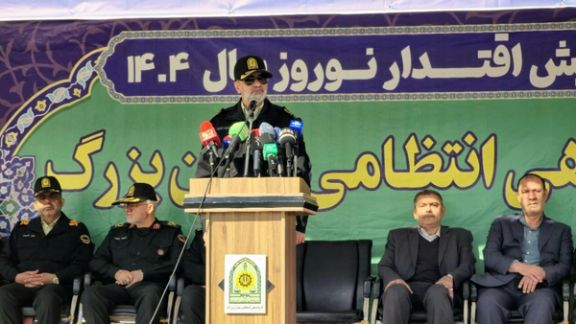
Iran's police chief said the new Iranian year starting on Friday will mark a significant push towards sealing the country's borders and intensifying the fight against crime.

General Ahmad-Reza Radan, the national police commander, announced on Wednesday that enhanced equipment and operational capabilities would enable a leap in border security for the Iranian year 1404.

"The border and its closure were among the challenges for the police in 1403," Radan stated, promising a decisive shift in the coming year without elaborating on details.

Up to 8 million Afghans have illegally entered Iran since 2021, compounding the country's economic challenges such as shortage of energy and water. The authorities have not been able or unwilling to commit resources to protecting the long border.

Last April, Deputy Police Chief Qasem Rezaei said that the construction of a border wall with Afghanistan would "help prevent drug trafficking, the movement of outlaws, and terrorist infiltrations."

The border fortification plan, which entails building a four-meter concrete wall, along with barbed wire, fencing, and proper roads along the northwestern and eastern borders, is scheduled for completion within the next two years.

In addition to border security, Radan outlined key priorities for the police in the coming year, 1404, including, reducing traffic violations, combating theft and the trade of stolen goods and leveling up the fight against drugs.

"1404 will be a bitter year for thieves and those who deal in stolen goods," Radan warned, as crime has increased amid the current economic crisis.

Radan detailed the extensive deployment of security forces during the Nowruz 1404 Exercise which showcased the police's readiness for the Iranian New Year holidays.

"More than 16,000 patrols, 20 helicopters, dozens of drones, and over 250,000 police personnel will secure the country from the borders to the cities," he said.

Tehran's police chief, General Abbas Ali Mohammadian, reported a 19% decrease in thefts in the capital during the past year, attributing it to increased police activity. He also noted a rise in emergency call responses and significant seizures of narcotics.

Iranian police called for public cooperation and adherence to Islamic fasting rules during the coinciding Nowruz and Ramadan periods, emphasizing that celebrations must align with Islamic rules.

While Nowruz is not officially banned, its pre-Islamic roots have long been a point of contention among religious hardliners who dominate key centers of power. These groups often discourage traditional Persian festivals, viewing them as remnants of the past that glorify pre-Islamic Persian history.

In previous years, authorities have attempted to limit gatherings at historically significant sites such as Persepolis and the tomb of Cyrus the Great in Pasargadae, sometimes leading to clashes with participants.


Most Viewed

State media slam Araghchi's Hormuz tweet, say it let Trump claim victory
1

State media slam Araghchi's Hormuz tweet, say it let Trump claim victory

2

Iran International says it won’t be silenced after London arson attack

3
INSIGHT

How Tehran bends its own red lines to boost state rallies

4
VOICES FROM IRAN

Hope and anger in Iran as fragile ceasefire persists

5

Iran halts petrochemical exports to supply domestic market

Banner
Banner

Spotlight

  • Too early to tell who is winning Iran war, experts say
    PODCAST

    Too early to tell who is winning Iran war, experts say

  • How Tehran bends its own red lines to boost state rallies
    INSIGHT

    How Tehran bends its own red lines to boost state rallies

  • Iran blackout cripples freelancer, small business incomes
    VOICES FROM IRAN

    Iran blackout cripples freelancer, small business incomes

  • Ideology may be fading in Iran, but not in Kashmir's ‘Mini Iran'
    INSIGHT

    Ideology may be fading in Iran, but not in Kashmir's ‘Mini Iran'

  • US blockade enters murky phase as tankers spoof signals and buyers hesitate
    ANALYSIS

    US blockade enters murky phase as tankers spoof signals and buyers hesitate

  • Why the $100 billion Hormuz toll revenue is a myth
    ANALYSIS

    Why the $100 billion Hormuz toll revenue is a myth

•
•
•

More Stories

Gaza and Yemen strikes set Mideast aflame anew

Mar 18, 2025, 19:16 GMT+0

Israeli attacks in Gaza killed hundreds of people and took fire from Yemen's Houthis after US airstrikes on the group, shattering a relative calm with the Iran-backed groups as the standoff over Tehran's festers.

Israel launched air strikes on the battered coastal enclave on Monday killing over 400 people according to the Hamas-run health ministry, appearing to end a two-month ceasefire brokered by the United States.

The strikes on some 80 targets aimed at Hamas mid-level and senior personnel and were over in about 10 minutes, an Israeli security official said according to an official press release.

Israeli Prime Minister Benjamin Netanyahu accused Hamas of intransigence as talks for it to release 59 hostages seized in the Oct. 7, 2023 attack on Israel - many of them dead - floundered.

Iran's foreign ministry spokesman Esmaeil Baghaei blamed the United States for the attack, saying it had direct responsibility for "the continuation of genocide in the occupied Palestinian territories".

A Palestinian woman gestures as people inspect the site of an Israeli strike on a tent camp housing displaced people, in Al-Mawasi area, in Khan Younis in the southern Gaza Strip March 18, 2025.
100%
A Palestinian woman gestures as people inspect the site of an Israeli strike on a tent camp housing displaced people, in Al-Mawasi area, in Khan Younis in the southern Gaza Strip March 18, 2025.

Hours later, the Israeli military said it intercepted a ballistic missile fired from Yemen, shooting it down beyond Israel's borders.

Meanwhile, the US Central Command announced it had carried out fresh air raids on the armed Houthi movement in Yemen allied to Tehran, publishing videos on X showing fighter jets taking off from an aircraft carrier.

The ceasefire in Gaza had tamped down 15 months of conflict pitting Iran and its proxies against Israel throughout the region which saw Iran's so-called "Axis of Resistance" much degraded, with Hamas and Lebanese Hezbollah heavily hit.

Looming behind the uptick of violence, Iran has so far defied a demand by US President Donald Trump to come to a new deal over its disputed nuclear program or face a military intervention.

According to an official White House readout of a phone call between Trump and Russian President Vladimir Putin on Tuesday, "the two leaders shared the view that Iran should never be in a position to destroy Israel."

"The leaders spoke broadly about the Middle East as a region of potential cooperation to prevent future conflicts," the White House added. "They further discussed the need to stop proliferation of strategic weapons and will engage with others to ensure the broadest possible application."

The remarks suggest a fresh US bid to end the war in Ukraine may see Russia attempt to head off a conflict between its Iranian ally and the United States.

Tehran denies seeking nuclear weapons and top Iranian officials have vowed a devastating response to any attack.

US airstrikes hit dozens of Houthi targets throughout Yemen on Saturday in a bid to halt the Shi'ite armed groups attacks on commercial shipping and its own naval vessels, which have ensnared US sailors in the most intense fighting since World War II.

Yemen's Houthi foreign minister said the group will not halt its Red Sea attacks on shipping in solidarity with the Palestinians, saying Iran did not dictate its actions.

Trump on Monday warned the United States would punish Iran for any further attacks by the Houthis, which would be treated as emanating from the Islamic Republic itself.

Iran's military said its manned fighter aircraft had chased away an armed American attack drone in the skies off the Iranian coast, state media reported on Tuesday. There was no immediate reaction by the US armed forces.

The Pentagon on Monday indicated it did not seek an open-ended campaign in Yemen nor did it seek regime change, in an apparent reference to Iran.

“We will use overwhelming lethal force until we achieve our objective. And this is a very important point, this is not an endless offensive," spokesman Sean Parnell said.

"This is not about regime change in the Middle East, this is about protecting American interests.”

Iran’s shrinking water reserves threaten crisis

Mar 18, 2025, 11:38 GMT+0

Iran’s key reservoirs are reaching dangerously low levels as years of declining rainfall and heavy reliance on hydropower take their toll, a senior water official warned.

Isa Bozorgzadeh, spokesman for Iran’s water industry, said on Tuesday that the usable capacity of Karaj Dam near Tehran has dropped to nearly half, much of it rendered useless due to sediment buildup.

“Lar Dam has practically dried up, and Latian, Taleqan, and Mamloo reservoirs are facing a 46% decrease in rainfall compared to the average and 25% compared to last year,” he told ILNA news agency.

Water shortages have triggered growing concerns in recent weeks, particularly in Tehran and Isfahan provinces, where officials have raised the possibility of rationing.

Bozorgzadeh cautioned that Tehran is consuming 50 million cubic meters of surface water each month while the combined reserves of the capital’s five main dams—including dead storage and sediment—amount to just 60 million cubic meters.

100%

“Conditions have deteriorated to the point where even a motorcyclist could drive through the reservoirs,” he said.

Eastern Tehran’s water and wastewater company reported that Latian and Mamloo dams are each only 12% full, while Lar is down to just 1%. Karaj, a historically stable reservoir, has shrunk to 7% capacity.

Iran’s water supply depends largely on rainfall, snowmelt, and underground aquifers, but decades of over-extraction have left groundwater tables severely depleted. The sharp decline in precipitation—down more than 40% in Tehran province relative to long-term averages—has compounded the problem.

Beyond Tehran, Bozorgzadeh identified Hormozgan, Sistan and Baluchestan, Khuzestan, Kohgiluyeh and Boyer-Ahmad, and Bushehr as regions struggling with a 50% drop in rainfall.

100%

Government spokeswoman Fatemeh Mohajerani acknowledged the severity of the situation, saying, “A nationwide decrease in average rainfall this year has led to shortfalls as high as 75% in some provinces.”

Iran’s energy ministry reports show that despite lower rainfall, hydropower generation increased by 24% in the fiscal year beginning March 2023, amid the country's energy crisis, reaching 17 terawatt-hours and maintaining that level into the current year.

Dalga Khatinoglu, an oil and gas analyst, suggested the government’s decision to sustain hydroelectric output was a factor in the current crisis.

“Iran failed to achieve its planned growth in thermal and renewable energy, leaving it dependent on hydropower,” he told Iran International. “Over the past two years, the country commissioned just 4 gigawatts of new plants—about 30% of its target—with 90% being gas-fired. The rest came from renewables.”

Hydropower reliance, combined with a persistent drought, has accelerated reservoir depletion, leaving little room for recovery even if precipitation levels were to improve.

Meanwhile, Iranian media has begun to raise alarms about broader implications. Etemad newspaper warned that 2025 could mark a turning point in the country’s water and energy crisis, predicting that shortages could become more severe than any previously experienced. Some hydrologists have cautioned that Iran has used up nearly 1,000 years' worth of groundwater reserves in just three decades.

UN rapporteur warns Iran is accelerating use of executions to crush dissent

Mar 18, 2025, 10:52 GMT+0

The United Nations special rapporteur on human rights in Iran, Mai Sato, has warned that the Islamic Republic is increasing its use of executions as a tool to suppress dissent as she presented her first report to the UN Human Rights Council in Geneva on Tuesday.

“The pace is accelerating with at least 169 known executions identified in January and February alone. Should this alarming rate remain consistent, the total number of executions could exceed 1,000 this year, a chilling threshold that demands a collective global response,” Sato warned.

Last year, at least 975 people were executed in Iran, a 17% increase from the 834 executions recorded the previous year, according to a joint report released by the Iran Human Rights Organization (IHRNGO) and Together Against the Death Penalty (ECPM).

It has stepped up since the 2022 uprising. In 2023, the UN quickly identified Tehran's utilising the death penalty to quash dissent.

"Criminal proceedings and the death penalty are being weaponised by the Iranian government to punish individuals participating in protests and to strike fear into the population so as to stamp out dissent, in violation of international human rights law," the UN Human Rights Office (OHCHR) said at the time.

Sato also highlighted the ongoing discrimination against religious and ethnic minorities, the lack of transparency in human rights cases, and the continued crackdown on protests and dissent.

Religious minorities, including Baha’is, Sunnis, and Christian converts, as well as ethnic groups such as Turks, Kurds, Arabs, and Baluchis, remain targets of state repression, she said.

She cited reports of arbitrary arrests, unfair trials, and executions targeting these communities.

Sato also raised concerns about the rising number of executions of women, naming three political prisoners—Pakhshan Azizi, Varishe Moradi, and Sharifeh Mohammadi—who are currently on death row.

At least 179 cases of femicide were documented in Iran last year, she said, adding that women in Iran continue to face systemic discrimination under laws that devalue their testimony in court and restrict their rights in employment and other areas.

Sato said human rights defenders, journalists, and lawyers are being harassed, intimidated, and threatened, particularly in Iranian prisons, where many are denied medical treatment.

She also noted that families of political prisoners face threats outside of prison.

UN fact-finding mission reports sexual violence in Iranian prisons

Sara Hussain, the head of the UN Independent Fact-Finding Mission on Iran, told the council that Iranian authorities have committed widespread human rights violations, including extrajudicial detentions, torture, and sexual violence against prisoners.

"These acts constitute crimes against humanity and gender-based violence," she said.

The fact-finding mission has previously documented the use of torture, forced confessions, and intimidation tactics against detainees.

Calls for Iran to end repression

Representatives from multiple countries called on Iran to halt executions and end its crackdown on dissent.

Germany urged the Islamic Republic to stop executions and guarantee fundamental freedoms, while Switzerland highlighted multiple human rights violations and called for an end to repression.

Spain, Australia, and North Macedonia demanded an end to the persecution of human rights activists and the execution of political prisoners.

The Netherlands called for an extension of the UN fact-finding mission’s mandate, saying Iran has committed "crimes against humanity."

Belgium said the sharp rise in executions was deeply concerning, while Albania condemned the Islamic Republic’s attempts to assassinate dissidents.

Chile described a recent visit by a UN human rights delegation to Iran as a positive step but stressed that "without gender equality, there is no democracy."

Iran's allies push back against criticism of Tehran's human rights record

In contrast, Iran's ally, Venezuela, dismissed the UN fact-finding mission as a politically motivated effort to pressure Iran.

North Korea, also an ally of Iran, accused the international community of systematically targeting Iran and called on the Human Rights Council to end its "double standards."

Allies China, Venezuela, Cuba, and Ethiopia also defended Iran’s human rights record, with Ethiopia criticizing what it called the "politicization" of the issue.

Sudan also said that Iran’s human rights situation was improving and called for respect for each country’s right to determine its own approach to human rights.

Yemen’s Houthis vow to continue Red Sea attacks, defying Iran's plea for calm

Mar 18, 2025, 10:24 GMT+0

Yemen's Houthi foreign minister said the group will not halt its Red Sea attacks on shipping, despite Iran's reported calls for de-escalation.

Jamal Amer told Reuters late on Monday that the Houthis would continue their actions despite US military strikes and requests from allies, including Iran.

"There will be no talk of any dialing down of operations before ending the aid blockade in Gaza. Iran is not interfering in our decision but what is happening is that it mediates sometimes but it cannot dictate things," Amer said.

This comes as two senior Iranian officials told Reuters on condition of anonymity that Tehran had delivered a verbal message to the Houthi envoy in Tehran on Friday, urging them to de-escalate. Amer said, however, that he had not been informed of any message Iran delivered to the Houthi envoy in Tehran.

Iran's Foreign Minister asked Oman, a known mediator with the Houthis, to convey a similar message during a visit to Muscat earlier this week, according to Reuters.

Iran has not made any public comment about recent outreach to the Houthis over their renewed action. Tehran says the group takes decisions independently, a statement echoed by the Houthis themselves.

"(The US) is threatening Iran and hitting Yemen. Now all scenarios are possible. We will do what they will do to us. If they are hitting us from (US aircraft carrier USS Harry S) Truman, we will retaliate by hitting Truman," the Houthi foreign minister said.

Amer acknowledged messages from other powers to de-escalate, but declared, "Now we see that Yemen is at war with the US and that means that we have a right to defend ourselves with all possible means, so escalation is likely."

US President Donald Trump warned Iran on Monday that it will be punished if its Yemeni allies the Houthis retaliate against a US air assault over the weekend, escalating his rhetoric against Tehran.

"Every shot fired by the Houthis will be looked upon, from this point forward, as being a shot fired from the weapons and leadership of IRAN, and IRAN will be held responsible, and suffer the consequences, and those consequences will be dire!" Trump wrote on his Truth Social platform.

Trump on Saturday ordered large-scale military strikes against dozens of targets in Yemen controlled by Tehran-backed Houthi armed group, saying the attacks aimed at ensuring freedom of navigation through shipping lanes the militants have targeted.

Earlier this week, IRGC Commander Hossein Salami denied US accusations of Iranian control over the Houthis' actions.

"We have always declared, and we declare today, that the Yemenis are an independent and free nation in their own land and have an independent national policy," Salami said.

"Ansarullah, as the representative of the Yemenis, makes its own strategic decisions, and the Islamic Republic of Iran has no role in setting the national or operational policies of any movement in the resistance front, including Ansarullah in Yemen," he added.

Six dead, hundreds injured in Iran's fire festival mishaps

Mar 18, 2025, 09:12 GMT+0

Six people have died and 770 others injured in incidents related to Iran's traditional fire festival since mid-February, the country's emergency services said on Tuesday.

"Since the start of Esfand (February 19), at least 770 people have been injured in these incidents, a 26% increase compared to last year," said Babak Yektaparast, spokesperson for Iran's Emergency Organization, in an interview with state broadcaster IRIB.

He added that 91 people remain hospitalized due to severe injuries, 57 have suffered amputations, 200 sustained eye injuries, and 285 suffered burns.

The Islamic Republic’s crackdown over the years has gradually turned the ancient festival of lighting bonfires before Nowruz, known as Chaharshanbeh Suri, into a night of youth defying authorities.

Despite its evolving nature, the festival remains a deeply rooted cultural event—one that continues to reflect both the resilience of tradition and the defiance of Iran’s youth.






