• العربية
  • فارسی
Brand
  • Iran Insight
  • Politics
  • Economy
  • Analysis
  • Special Report
  • Opinion
  • Podcast
  • Iran Insight
  • Politics
  • Economy
  • Analysis
  • Special Report
  • Opinion
  • Podcast
  • Theme
  • Language
    • العربية
    • فارسی
  • Iran Insight
  • Politics
  • Economy
  • Analysis
  • Special Report
  • Opinion
  • Podcast
All rights reserved for Volant Media UK Limited
volant media logo

Trump cuts US-funded media broadcasting to non-democratic states

Mar 16, 2025, 07:22 GMT+0Updated: 10:52 GMT+0
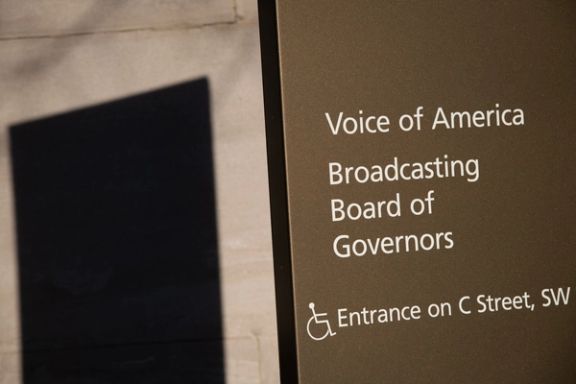
VOA's headquarters in Washington DC.

More than 1,300 Voice of America (VOA) employees were placed on leave Saturday, and funding for two US news services broadcasting to foreign countries was terminated after President Donald Trump ordered major cuts to VOA’s parent agency and six other federal entities.

Along with the VOA, the government's grantee agreement with Radio Free Europe/Radio Liberty (RFE/RL) was also terminated, essentially closing down the 75-year-old broadcaster and media organization based in Prague, Czechia.

Both media organizations have extensive news-gathering and dissemination operations covering Russia, Ukraine, and Iran. The Persian department of VOA beams television news programs into Iran and maintains a news website. RFE/RL's Persian Service, Radio Farda, produces news and analysis in audio and video formats, as well as maintains a news website. Both also have extensive social media operations.

Michael Abramowitz, VOA’s director, said nearly the entire staff had been put on administrative leave, crippling the broadcaster, which operates in nearly 50 languages. “For the first time in 83 years, the storied Voice of America is being silenced,” he wrote on LinkedIn, calling it a blow to press freedom.

The US Agency for Global Media (USAGM), which oversees VOA, also cut funding for Radio Free Asia, which broadcast to China, and North Korea. Trump’s directives are expected to devastate these organizations, which serve as rare sources of independent news in authoritarian or semi-democratic states.

The White House in another announcement on Saturday listed several issues with VOA and criticism of its operations and approach, with the headline, "The Voice of Radical America."

RFE/RL CEO Stephen Capus said that cutting funding to the organization "would be a massive gift to America’s enemies. The Iranian Ayatollahs, Chinese communist leaders, and autocrats in Moscow and Minsk would celebrate the demise of RFE/RL after 75 years. Handing our adversaries a win would make them stronger and America weaker."

RFE/RL was established in the early 1950s at the height of the Cold War to broadcast into Russia and its expanding sphere of influence in Eastern Europe. Initially operated by the CIA, it became a publicly funded entity under direct congressional oversight in 1974.

Founded in 1942 to counter Nazi propaganda, VOA now reaches 360 million people weekly. USAGM employs about 3,500 workers with an $886-million budget, according to its latest congressional report.

VOA’s Seoul Bureau Chief William Gallo told Reuters he had been locked out of company systems. “All I’ve ever wanted to do is tell the truth. If that’s a threat to anyone, so be it,” he posted on Bluesky.

Kari Lake, Trump’s nominee for VOA director, called USAGM “a giant rot and burden to taxpayers” and vowed to shrink it to the legal minimum. Meanwhile, Czech Foreign Minister Jan Lipavsky praised VOA and RFE as “beacons” for those under totalitarian rule, while free press advocates condemned the move.

Paris-based Reporters Without Borders warned the cuts “threaten press freedom worldwide,” and National Press Club President Mike Balsamo said they undermine America’s commitment to independent journalism. Radio Free Asia’s president, Bay Fang, called the move “a reward to dictators.”

Some Republicans have accused VOA of left-wing bias and backed its closure, aligning with Elon Musk’s Department of Government Efficiency (DOGE), which has already cut 100,000 federal jobs, frozen foreign aid, and canceled thousands of contracts. Musk mocked the USAGM cuts on X, temporarily renaming it the “Department of Propaganda Everywhere (DOPE).”

Trump’s order also targeted the Woodrow Wilson Center, the US Interagency Council on Homelessness, and several other agencies, directing them to operate at only the legally required minimum. The White House defended the cuts, saying they would prevent taxpayers from funding “radical propaganda.”

Most Viewed

US blockade enters murky phase as tankers spoof signals and buyers hesitate
1
ANALYSIS

US blockade enters murky phase as tankers spoof signals and buyers hesitate

2

US tightens financial squeeze on Iran, warns banks over oil money flows

3
INSIGHT

Ideology may be fading in Iran, but not in Kashmir's ‘Mini Iran'

4
INSIGHT

Hardliners push Hormuz ‘red line’ as US blockade tests Iran’s leverage

5
VOICES FROM IRAN

Hope and anger in Iran as fragile ceasefire persists

Banner
Banner

Spotlight

  • Hardliners push Hormuz ‘red line’ as US blockade tests Iran’s leverage
    INSIGHT

    Hardliners push Hormuz ‘red line’ as US blockade tests Iran’s leverage

  • Ideology may be fading in Iran, but not in Kashmir's ‘Mini Iran'
    INSIGHT

    Ideology may be fading in Iran, but not in Kashmir's ‘Mini Iran'

  • War damage amounts to $3,000 per Iranian, with blockade set to add to losses
    INSIGHT

    War damage amounts to $3,000 per Iranian, with blockade set to add to losses

  • Why the $100 billion Hormuz toll revenue is a myth
    ANALYSIS

    Why the $100 billion Hormuz toll revenue is a myth

  • US blockade targets Iran oil boom amid regional disruption
    ANALYSIS

    US blockade targets Iran oil boom amid regional disruption

  • Iran's digital economy battered by prolonged blackout
    INSIGHT

    Iran's digital economy battered by prolonged blackout

•
•
•

More Stories

Trump authorizes dozens of airstrikes on Yemen in warning signal to Iran

Mar 15, 2025, 18:41 GMT+0

US President Donald Trump on Saturday ordered large-scale military strikes against dozens of targets in Yemen controlled by Tehran-backed Houthi militants, warning Iran about the consequences of its continued support for the rebels.

"Today, I have ordered the United States Military to launch decisive and powerful Military action against the Houthi terrorists in Yemen," Trump said in a post on his Truth Social account.

He urged the Houthis' sponsors in Iran to "immediately stop their support."

"Do NOT threaten the American People, their President... If you do, BEWARE, because America will hold you fully accountable and, we won’t be nice about it!" the US president said in his warning to Iran.

The New York Times cited US officials as saying the Saturday airstrike, the most significant military action of Trump’s second term so far, "was also meant to send a warning signal to Iran."

The airstrikes against Yemen's Houthis may continue for days or even weeks, Reuters reported, citing an American official.

Trump said the Houthis "waged an unrelenting campaign of piracy, violence, and terrorism against American, and other, ships, aircraft, and drones."

"The Houthis have choked off shipping in one of the most important Waterways of the World, grinding vast swaths of global commerce to a halt, and attacking the core principle of Freedom of Navigation upon which International Trade and Commerce depends," he said.

Trump warned the Houthis that their time is up. "Your attacks must stop, starting today. If they don’t, hell will rain down upon you like nothing you have ever seen before!"

Following the Hamas attack on Israel on October 7, 2023, and the beginning of the Gaza war, the Houthis started massive missile and drone strikes against commercial vessels in an effort to pressure for a ceasefire in Gaza. They imposed a blockade in the Red Sea region, significantly disrupting global shipping routes.

Shortly after Trump's inauguration, Iran directed its allied forces across the Middle East including the Houthis to act with restraint, the Telegraph reported, citing a senior Iranian official in Tehran.

“Forces and allies in the region have been instructed to act with caution as [the regime] feels an existential threat with Trump’s return,” the Iranian official said.

However, the Houthis for the first time fired surface-to-air missiles at a US F-16 fighter jet over the Red Sea last month in what officials described as a significant escalation in the Iran-backed group's ongoing conflict with the US military.

They also fired a surface-to-air missile at an American MQ-9 Reaper drone that the US military was flying over Yemen.

The Houthis have earlier shot down several MQ-9 Reaper drones over the past year. Every single one of these drones costs about $32 million, according to a Congressional report.

Ex-president signals potential shift in Khamenei’s stance on US talks

Mar 15, 2025, 09:50 GMT+0

Former Iranian President Hassan Rouhani suggested that Supreme Leader’s opposition to negotiations with the United States could change depending on circumstances.

“There is no absolute opposition to negotiations,” Rouhani said in a meeting with former ministers and officials on Thursday.

“Did we not negotiate with the US on Iraq, Afghanistan, and the nuclear deal? Even back then, when I was secretary of the Supreme National Security Council, the leader himself wrote that negotiations should adhere to certain principles.”

His remarks contrast with Ali Khamenei’s previous statements, particularly following Donald Trump’s outreach to Tehran, in which he ruled out talks with Washington. The Supreme Leader had also maintained that if negotiations were to happen, they would not take place during Trump’s presidency.

Rouhani linked Iran’s economic difficulties to the US withdrawal from the Joint Comprehensive Plan of Action (JCPOA) in 2018, when Washington reimposed Tehran sanctions halted under the 2015 nuclear deal.

“Since then, Iran has lost $100 billion per year,” he said. By that measure, the total economic toll would amount to $650 billion during the six and a half years since the US pullout.

Iran’s foreign minister on Thursday also signaled Tehran's willingness to engage in indirect negotiations with the United States through Oman.

During an interview with the Iran newspaper, Araghchi, when asked about using indirect channels like those in Muscat, said, "Yes, it is not a strange method, and it has happened repeatedly throughout history."

"Therefore, indirect negotiation is feasible... What is important is that the will to negotiate and reach a fair and just agreement comes up in equal conditions, and the form of it does not matter."

This apparent change came shortly after Tehran acknowledged receiving a letter from President Donald Trump, which outlined the terms of a possible agreement on Iran’s nuclear program and, potentially, other issues, including Tehran’s regional proxies.

Shifting to domestic politics, Rouhani highlighted low voter turnout in the 2024 snap presidential election, where official figures put participation at 40%.

“The most important factor in national security is having a people,” he said, adding that many who voted in the second round did so “to avoid being stuck with someone else.”

This was widely interpreted as a reference to the runoff between Masoud Pezeshkian and Saeed Jalili. Official results have been met with skepticism, but even by the government’s own tally, the 2024 vote marked the lowest turnout in the history of the Islamic Republic.

Trump administration eyes US visa ban for Iranians

Mar 15, 2025, 07:11 GMT+0

The Trump administration is considering sweeping travel restrictions that could fully suspend visa issuance for citizens of ten countries, including Iran, according to an internal memo seen by Reuters.

Iran is among the countries facing the strictest new US travel restrictions, alongside Afghanistan, Syria, Cuba, and North Korea, Reuters reported on Friday. If implemented, the policy would fully suspend visa issuance for Iranians, effectively cutting off legal entry into the United States and further tightening Trump’s already restrictive immigration policies.

This move comes as Iranian migrants deported by the US struggle in dire conditions in Panama. Dozens of Iranians were among nearly 100 migrants transferred to a detention camp deep in the Panamanian jungle in February under an agreement between the US and Panama.

Deported migrants, including children, were initially held in a locked hotel before being moved to the Darién province—an area notorious for its harsh environment and prevalence of diseases like dengue. One Iranian migrant, Artemis Ghasemzadeh, described the facility as resembling a “zoo” with “fenced cages” and inadequate food.

The Panamanian government, under pressure from the US, insists the site is a temporary migrant center. However, reports indicate that some detainees, fearing persecution if repatriated, remain in limbo. Iranian Christians, in particular, face potential death sentences under Iranian law for converting from Islam.

Facing mounting criticism, Panama recently announced that it will issue temporary 90-day permits to some migrants, including those deported from the US. This measure applies to individuals unable or unwilling to return to their home countries due to security concerns. However, for many, these permits offer little clarity on their long-term future.

The new travel ban proposal echoes Trump’s first-term immigration crackdown, which included a travel ban primarily targeting Muslim-majority nations. That policy went through multiple legal battles before being upheld by the US Supreme Court in 2018.

Mother of gunman hired to kill Masih Alinejad identifies co-conspirator to order hit

Mar 14, 2025, 20:27 GMT+0
•
Negar Mojtahedi

The mother of Khalid Mehdiyev, the gunman who tried to kill Iranian-American journalist Masih Alinejad, delivered emotional testimony in court Friday identifying her son's alleged co-conspirator Polad Omarov as the man who ordered the hit job.

Appearing visibly shaken in court, Ms. Mehdiyeva recounted a video phone call Omarov made to her and her husband sometime in 2022.

“My husband was praying. We had a caller, and I covered my head. We exchanged hellos," said Ms. Mehdiyeva, "He said, ‘My name is Polad. Where is your son? I sent him to do a job for me."

He allegedly told Ms. Mehdiyeva that her son had failed at the task he ordered him to do. Mehdiyev's attempt to murder Alinejad was unsuccessful. Because of the botched murder attempt, Omarov told Ms. Mehdiyeva her son put all of them in trouble.

Once Alinejad spotted Khalid, who was lurking around her home in Brooklyn, peering into her window and wandering around her, she reported him to the FBI. He had been stalking Alinejad's every move, even sleeping in his vehicle outside her home for at least two days.

Threats from the Russian Underworld

Just hours after Omarov's call, at 3 a.m., an unfamiliar American number appeared on Ms. Mehdiyeva's phone. It was Khalid. Unbeknownst to her and Omarov, Khalid was in jail.

Ms. Mehdiyeva's voice trembled as she looked her son's alleged co-conspirator in the eye.

“He (Omarov) is the one who devastated our lives,” said Ms. Mehdiyeva, speaking in Azeri through an interpreter.

The threats did not stop after that call.

Ms. Mehdiyeva testified that members of the Russian mafia group that her son belonged to —Vor Zakone, also known as "Thieves-in-Law"— continued to harass her.

Fearing for their safety, the family fled Baku for the countryside.

Eventually, with assistance from the FBI, they were brought to the United States.

Cross Examination

During cross-examination, the defense sought to challenge Ms. Mehdiyeva’s credibility.

They questioned whether she had sought a U.S. green card prior to her arrival. She denied it, insisting she was only in the country due to threats in Azerbaijan.

“Do you remember telling your son on a recorded jail call that you would travel to Macedonia to enter the U.S.?” the defense asked.

“I don’t remember that,” she replied.

The defense further revealed that the U.S. government had provided financial support to the Mehdiyev family, including securing employment for her husband and eldest son.

Ms. Mehdiyeva had also worked as a nanny before quitting to attend the trial, leaving her in debt to her employer for $4,000 in prepaid wages. In total, the government provided the family with $31,120 in support.

Who are Vor Zakone?

The Russian criminal underworld developed in the gulags or the prisons of the Soviet Union and globalized in the post- Soviet world. The Vor Zakone evolved into a transnational organization with operations in 15 former Soviet republics and the countries of the former Eastern bloc.

Dr. Louise Isobel Shelley, an academic who specializes in terrorism, corruption, and transnational crime testified on behalf of the state as expert in court Friday. Shelley often consults with governments around the world about the Russian mafia.

Shelley said members of the Russian mafia carry out assassinations on behalf of state actors and are also involved in kidnappings, extortion, and money laundering.

Her testimony significant to the state which alleges the Iranian government-sponsored the murder-for-hire plot.

The plot to assassinate Alinejad was allegedly orchestrated as part of Iran’s campaign to silence one of its most vocal critics, according to Assistant U.S. Attorney Jacob Gutwillig.

As the trial continues, the chilling testimonies shed light on the dangerous intersection of organized crime and states, a web reportedly stretching from Tehran to Baku to the streets of New York City.
Turkey arrests five suspects over alleged espionage for Iran

Mar 14, 2025, 18:30 GMT+0

Turkish security forces arrested five people accused of spying for Iranian intelligence in a coordinated operation across Istanbul, Antalya, and Mersin, the Istanbul Chief Public Prosecutor’s Office said on Friday.

The suspects, three Turkish citizens and two foreign nationals, had allegedly been involved in "military and political espionage," Turkey’s state-run Anadolu Agency reported citing the prosecutor.

The operation was carried out as part of an investigation by the prosecutor’s office and Turkey’s National Intelligence Organization (MIT).

The report added that the individuals had contacted members of Iran’s Revolutionary Guards (IRGC) intelligence, obtained information about military bases and important regions in Turkey and critical points abroad, and transferred it to Iranian intelligence.

Relations between Ankara and Tehran have grown frostier after Iran's oldest Arab ally the Assad dynasty was swept from Syria by rebels close to Turkey last year.

Turkish Foreign Minister Hakan Fidan this month hit out at Iran's reliance on regional militias as dangerous and called for a policy shift, stoking Iran's ire.

He also suggested that "if you are attempting to destabilize a third country, other nations may reciprocate by supporting groups within your own borders."

Arrest warrants for the suspects were issued, and they were apprehended in operations carried out in Istanbul, Antalya, and Mersin provinces, the agency reported.

​In recent years, Turkey has experienced several incidents involving alleged espionage activities linked to Iran.

Last month, Israeli authorities sentenced a businessman to serve a 12 years in prison for spying for Iran and plotting to assassinate the country's leaders including the country’s PM and defense chief.

The man who was based in Turkey, but hailed from northern Israel, had entered Iran and met with agents who had instructed him to carry out operations in Israel.

In September 2022, Istanbul police arrested four Iranian citizens on suspicion of espionage, forgery of official documents, and human trafficking. The suspects were found in possession of numerous stolen passports, identification documents and espionage equipment.

In June 2022, Turkish authorities, in collaboration with Israeli intelligence agency Mossad, foiled an alleged Iranian plot to kidnap and assassinate Israeli tourists in Istanbul. The operation led to the detention of several Iranian and Turkish operatives Ankara accused of being linked to the IRGC.