• العربية
  • فارسی
Brand
  • Iran Insight
  • Politics
  • Economy
  • Analysis
  • Special Report
  • Opinion
  • Podcast
  • Iran Insight
  • Politics
  • Economy
  • Analysis
  • Special Report
  • Opinion
  • Podcast
  • Theme
  • Language
    • العربية
    • فارسی
  • Iran Insight
  • Politics
  • Economy
  • Analysis
  • Special Report
  • Opinion
  • Podcast
All rights reserved for Volant Media UK Limited
volant media logo

Trump rails against Biden's Iran policy in CPAC speech

Feb 22, 2025, 21:34 GMT+0Updated: 08:40 GMT+0
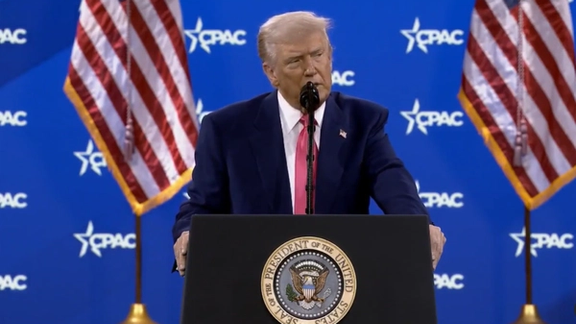
Trump at CPAC 2025
Trump at CPAC 2025

Donald Trump used his speech at the Conservative Political Action Conference (CPAC) to once again boast about the outcomes of pressuring Iran during his first time but stopped short of talking about his current plans for dealing with Tehran's rulers.

"Iran was broke. They had no money for Hamas or Hezbollah. They had no money to give. Everybody knows that...They were not giving money around," the US president said in his Saturday speech outside Washington DC.

He had previously made similar remarks about how his “maximum pressure” policy against the Islamic Republic helped reduce the country's oil sales and strip it of enough funds to sponsor its armed allies in the Middle East.

Trump has long argued that the deadly attack launched by Tehran-backed Hamas militants against Israel on October 7, 2023, would have never happened if he were in office.

"And when I got out, they took all the sanctions off, Biden, and Iran became rich very quickly. With oil, you can become rich very, very quickly. And the rest is history. What a horrible thing," Trump told the CPAC, criticizing his predecessor Joe Biden for what Republicans call a lax enforcement of US sanctions on Iran.

Data from oil tanker tracking firms reveal that during Joe Biden's presidency, Iran exported approximately 2 billion barrels of oil—a significant increase compared to the volumes recorded between 2019 and 2021.

Details from Kpler, a commodity intelligence company, reveal that Iran, whose daily oil exports had fallen below 400,000 barrels in January 2021, at the start of the Biden Administration, exported 1.6 million barrels daily last year.

Trump this month reinstated the maximum pressure campaign on Iran with the stated aim of driving its oil sales to zero, warning of "catastrophic" consequences if Tehran does not make a deal with the US on its nuclear program.

After restoring the sanctions policy, he said he would prefer a deal with Tehran to an Israeli attack on their nuclear sites.

Trump, however, refrained from addressing the issue in his speech at the CPAC.

The meeting was scheduled to host prominent exiled Iranian opposition figure Prince Reza Pahlavi but he cancelled his speech citing family commitments.

Most Viewed

Ghalibaf defends Iran-US talks amid hardline backlash
1
INSIGHT

Ghalibaf defends Iran-US talks amid hardline backlash

2
ANALYSIS

From instability to influence: Pakistan’s pivotal role in US-Iran diplomacy

3
ANALYSIS

100 days on: why Iran’s January protests spread across social classes

4

War-hit homeowners feel abandoned as Iran’s reconstruction aid fades

5
INSIGHT

100 days on: the anatomy of Iran’s January crackdown

Banner
Banner

Spotlight

  • Bread shortages, soaring prices strain households in Iran, residents say
    VOICES FROM IRAN

    Bread shortages, soaring prices strain households in Iran, residents say

  • War-hit homeowners feel abandoned as Iran’s reconstruction aid fades

    War-hit homeowners feel abandoned as Iran’s reconstruction aid fades

  • 100 days on: the anatomy of Iran’s January crackdown
    INSIGHT

    100 days on: the anatomy of Iran’s January crackdown

  • Ghalibaf defends Iran-US talks amid hardline backlash
    INSIGHT

    Ghalibaf defends Iran-US talks amid hardline backlash

  • 100 days on: why Iran’s January protests spread across social classes
    ANALYSIS

    100 days on: why Iran’s January protests spread across social classes

  • From instability to influence: Pakistan’s pivotal role in US-Iran diplomacy
    ANALYSIS

    From instability to influence: Pakistan’s pivotal role in US-Iran diplomacy

•
•
•

More Stories

Netherlands releases Iranian national accused of violating US sanctions

Feb 22, 2025, 15:40 GMT+0

Iran confirmed that an Iranian national jailed in the Netherlands over alleged violation of Washington's sanctions against Tehran will return home after the Dutch authorities denied his US extradition.

Iran’s Deputy Foreign Minister Kazem Gharibabadi announced on X that Mahdi Kiasati, who was jailed in the Netherlands at the US's request over alleged sanctions violations, will be returning to Iran within hours following the Dutch decision to reject his extradition. No further details were given.

At the same time, Dutch Foreign Minister Caspar Veldkamp held a phone conversation with Iranian Foreign Minister Abbas Araghchi, covering Tehran’s nuclear program and the ongoing territorial dispute over Abu Musa, Greater Tunb, and Lesser Tunb islands between Iran and United Arab Emirates.

"Spoke with Iranian Foreign Minister Araghchi about developments in the Middle East. Also highlighted Iran’s nuclear program and the window of opportunity for a new nuclear deal," Veldkamp wrote on X.

He also said that the Netherlands supports a peaceful resolution of the islands dispute through bilateral engagement based on international law.

The status of the islands has been a longstanding source of tension between Iran and the UAE. The islands have been under Iranian control since 1971, when Tehran took possession following the withdrawal of British forces from the Persian Gulf.

Iran insists the islands have always been an integral part of its territory, while the UAE claims that they were historically under the jurisdiction of the Qasimi sheikhs and that their claim transferred to the UAE upon its formation in 1971.

The conversation also addressed Iran’s nuclear program, with Veldkamp stressing the “window of opportunity” for a new nuclear deal. The Netherlands, alongside other European nations, has supported efforts to revive negotiations after the Trump administration’s 2018 withdrawal from the Joint Comprehensive Plan of Action (JCPOA) and its “maximum pressure” campaign of sanctions against Iran.

Since the US exit, Iran has gradually scaled back its compliance with the JCPOA, enriching uranium beyond agreed limits and restricting international inspections.

The call between Veldkamp and Araghchi comes as European nations continue to emphasize diplomacy amid growing tensions over Iran’s nuclear program.

Earlier this month, a German Foreign Office spokesperson reaffirmed that Germany, France, and the UK had held preliminary talks with Iran on its nuclear activities and regional issues. While Washington escalates its "maximum pressure" campaign, European allies remain committed to diplomatic engagement—keeping communication channels open despite Tehran’s hardened stance against negotiations with the US.

Voices in Tehran persist in calling for talks with Washington

Feb 22, 2025, 13:14 GMT+0
•
Mardo Soghom

Two weeks after Iran’s Supreme Leader banned talks with the United States, voices in Tehran are calling for negotiations to address the country’s growing economic challenges.

The prominent newspaper Jomhuri Eslami on Saturday called for reconsidering Ali Khamenei ban, without directly naming him. In an editorial titled “Reconsideration is beneficial bravery,” the newspaper said, “Moves by several Arab countries to encourage the Islamic Republic of Iran to negotiate with the US, and the changes in the tone of statements from US officials, including Trump himself, indicate that the ground is ready for a new perspective from Iranian officials.”

Since Trump reinstated his “maximum pressure” policy earlier this month and indirectly warned Tehran of a possible Israeli attack if it refused to negotiate, Iranian officials have insisted that the US president adopt a different tone if he seeks negotiations with the Islamic Republic.

However, Khamenei’s ban on talks with the US has raised concerns among officials and citizens as Iran’s economic situation continues to worsen. The national currency has lost over 50% of its value in the past six months, leading many to warn that without diplomatic efforts to lift US sanctions, there is little hope of reversing the decline.

Jomhuri Eslami daily, known for advocating a more conciliatory approach to negotiations, argued that Tehran had previously resolved major conflicts through diplomacy. It cited the negotiations with Saddam Hussein that ended the bloody Iran-Iraq war in the 1980s as a clear example.

Heshmatollah Falahatpisheh, former chairman of Iran’s parliamentary national security committee, expressed skepticism about the possibility of rapprochement between Tehran and Washington. Speaking to a local news website, he argued that the rift has become deeply ideological during Trump’s presidency, making it difficult to bridge differences. He also noted that regional countries attempting to mediate are primarily motivated by the need to prevent a regional conflict that could threaten their own security.

Gholamreza Kashi, a professor of political science in Tehran, openly advocated for a major review of Iran’s foreign policy, arguing that past policies have imposed a heavy burden on the country and the people.

“We have placed a heavy burden on ourselves, the people, and the country. The governing system must make a brave decision, and this is the only condition for reviving the true spirit of the revolution,” Kashi said.

He argued that ideological systems increasingly entrench themselves in their dogma, losing flexibility in governance. “These regimes view reality as a seven-headed dragon that constantly threatens their position. Ideological systems try to conceal the gap between situational logic and their ideals through propaganda, lies, or repression. The gap between what was intended and what actually took shape eventually becomes the greatest threat to the very existence of the system itself.”
Iran foreign minister, parliament speaker to attend Nasrallah funeral

Feb 22, 2025, 12:27 GMT+0

Iranian foreign minister Abbas Araghchi and parliament speaker Mohammed Bagher Ghalibaf are due to attend the funeral of slain Hezbollah leader Hassan Nasrallah in Beirut on Sunday.

His assassination by Israel last year marked an epochal setback to Tehran and its network of armed allies in the Middle East.

Ghalibaf secured attendance after personal follow-ups and an official invitation from Lebanese Parliament Speaker Nabih Berri, IRGC-affiliated Fars News reported Saturday.

The outlet also said Lebanese authorities did not extend an official invitation to Iranian President Masoud Pezeshkian..

Additionally, Fars noted that religious and Islamic jurisprudential considerations, specifically the obligation to expedite burial after a temporary interment, prevented the funeral from being held in Iran.

Lebanese authorities recently blocked Iranian flights from landing in Beirut, citing security risks and warnings from the US that Israel might target incoming Iranian planes. According to AFP, Israel had informed Lebanon via Washington that it would consider an Iranian flight landing in Beirut as a military escalation, alleging that Hezbollah uses civilian flights to transfer weapons and funds from Iran.

The flight restrictions have prevented a larger Iranian delegation and citizens from attending the funeral, according to Iranian media.

Nasrallah’s burial, five months after his assassination by Israel, will take place at Beirut’s Camille Chamoun Sports City Stadium and also honor Hashem Safi al-Din, who briefly led Hezbollah before being assassinated by Israel.

Once Iran’s most powerful regional proxy armed militia, Hezbollah was founded with the support of the Revolutionary Guards in 1982 but suffered heavy losses in last year’s war, with Israel significantly weakening its military and political power. While Tehran remains its key backer, the group’s diminished strength has raised questions about its ability to project power as it once did.

Earlier this month, US envoy Morgan Ortagus declared that Hezbollah’s “reign of terror” was over, crediting US pressure on Iran for the group’s decline. After meeting Lebanese President Joseph Aoun, she warned that Hezbollah’s involvement in the new government crosses a US “red line.”

As the group prepares for its leader’s funeral, it faces mounting challenges both militarily and politically.

Russian Foreign Minister to visit Iran on Tuesday, Tehran says

Feb 22, 2025, 10:50 GMT+0

Russian Foreign Minister Sergey Lavrov will visit Iran this week to discuss bilateral relations, as well as regional and international developments, Iran's foreign ministry announced on Saturday.

Iranian domestic media specifically mentioned Tuesday as the expected date of the visit, with a focus on discussions about Syria. No further details have yet emerged regarding the nature of the visit, as stopping Iran's nuclear program is a top priority for President Donald Trump.

While the Trump administration has engaged in talks with Moscow to end the war in Ukraine, it has taken a hardline approach toward Iran, demanding a reversal of Tehran's nuclear, military, and regional policies.

Meanwhile, the US has suggested that Washington and Moscow might share a strategic interest in preventing Iran from acquiring nuclear weapons. Speaking to independent journalist Catherine Herridge, Senator Marco Rubio said Thursday, “There are things we could cooperate on geopolitically,” adding, “I’m not sure the Russians are fans of the Iranian regime having nuclear weapons.”

His remarks come as US and Russian officials held their first discussions in Saudi Arabia on ending a three-year conflict this week.

While Iran has close ties and military cooperation with Moscow under Supreme Leader Ali Khamenei’s “Look East” policy, some Iranian media have warned that Russia may not be a reliable partner and could shift its stance depending on its geopolitical priorities.

Police storm stage, arrest rap artists in Tehran underground show

Feb 21, 2025, 20:37 GMT+0

Security forces arrested Iranian rapper Arash Seyedi, known as Eycin and his producer Rasam Sohrabi during a live underground performance at a cafe in western Tehran on Thursday, eyewitnesses told Iran International.

“He had a performance at a café in western Tehran in Janatabad when plainclothes officers and the police arrived, arrested him and his composer, and detained several people there,” one source said, requesting to remain anonymous for security reasons.

A video obtained by Iran International shows the moment the officers storm the venue and detain the underground rapper. A masked man can be seen in the footage, who the source said was one of those who detained Eycin.

“They came with a van and took everyone away. The venue was also sealed off,” the source added, "Eycin had scheduled several performances in cafes, on a tour, in Qeshm in recent weeks."

The fans were later released but two sources told Iran International that Eycin and his composer remained in detention.

A source said that both Eysin and Sohrabi appeared in court on Friday morning, however the charges against them remain unknown.

An image of duo surfaced on Iranian rap Telegram channels on Friday evening, showing them handcuffed.
100%
An image of duo surfaced on Iranian rap Telegram channels on Friday evening, showing them handcuffed.

“Lately, rappers have been organizing a lot of underground performances through various methods. It seems like they want to crack down before it spreads,” the source said.

International human rights organizations have condemned Iran's suppression of artistic expression in recent years.

In the aftermath of Iran's nationwide protests sparked by the death in custody of Mahsa Amini in September 2022, at least two rappers - Toomaj Salehi and Saman Yasin - were sentenced to death in connection with their music. Following an international outcry, their death sentences were revoked.