• العربية
  • فارسی
Brand
  • Iran Insight
  • Politics
  • Economy
  • Analysis
  • Special Report
  • Opinion
  • Podcast
  • Iran Insight
  • Politics
  • Economy
  • Analysis
  • Special Report
  • Opinion
  • Podcast
  • Theme
  • Language
    • العربية
    • فارسی
  • Iran Insight
  • Politics
  • Economy
  • Analysis
  • Special Report
  • Opinion
  • Podcast
All rights reserved for Volant Media UK Limited
volant media logo

Netherlands releases Iranian national accused of violating US sanctions

Feb 22, 2025, 15:40 GMT+0Updated: 19:05 GMT+0
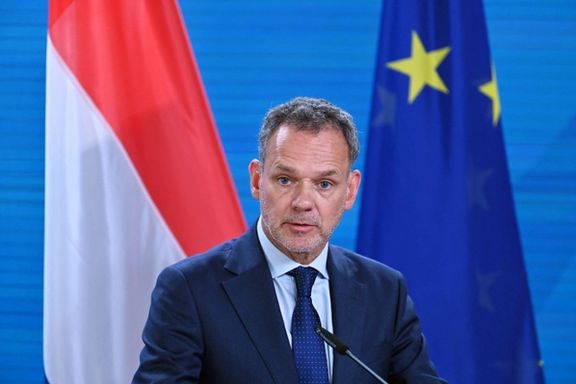
Dutch Foreign Minister Caspar Veldkamp

Iran confirmed that an Iranian national jailed in the Netherlands over alleged violation of Washington's sanctions against Tehran will return home after the Dutch authorities denied his US extradition.

Iran’s Deputy Foreign Minister Kazem Gharibabadi announced on X that Mahdi Kiasati, who was jailed in the Netherlands at the US's request over alleged sanctions violations, will be returning to Iran within hours following the Dutch decision to reject his extradition. No further details were given.

At the same time, Dutch Foreign Minister Caspar Veldkamp held a phone conversation with Iranian Foreign Minister Abbas Araghchi, covering Tehran’s nuclear program and the ongoing territorial dispute over Abu Musa, Greater Tunb, and Lesser Tunb islands between Iran and United Arab Emirates.

"Spoke with Iranian Foreign Minister Araghchi about developments in the Middle East. Also highlighted Iran’s nuclear program and the window of opportunity for a new nuclear deal," Veldkamp wrote on X.

He also said that the Netherlands supports a peaceful resolution of the islands dispute through bilateral engagement based on international law.

The status of the islands has been a longstanding source of tension between Iran and the UAE. The islands have been under Iranian control since 1971, when Tehran took possession following the withdrawal of British forces from the Persian Gulf.

Iran insists the islands have always been an integral part of its territory, while the UAE claims that they were historically under the jurisdiction of the Qasimi sheikhs and that their claim transferred to the UAE upon its formation in 1971.

The conversation also addressed Iran’s nuclear program, with Veldkamp stressing the “window of opportunity” for a new nuclear deal. The Netherlands, alongside other European nations, has supported efforts to revive negotiations after the Trump administration’s 2018 withdrawal from the Joint Comprehensive Plan of Action (JCPOA) and its “maximum pressure” campaign of sanctions against Iran.

Since the US exit, Iran has gradually scaled back its compliance with the JCPOA, enriching uranium beyond agreed limits and restricting international inspections.

The call between Veldkamp and Araghchi comes as European nations continue to emphasize diplomacy amid growing tensions over Iran’s nuclear program.

Earlier this month, a German Foreign Office spokesperson reaffirmed that Germany, France, and the UK had held preliminary talks with Iran on its nuclear activities and regional issues. While Washington escalates its "maximum pressure" campaign, European allies remain committed to diplomatic engagement—keeping communication channels open despite Tehran’s hardened stance against negotiations with the US.

Most Viewed

US blockade enters murky phase as tankers spoof signals and buyers hesitate
1
ANALYSIS

US blockade enters murky phase as tankers spoof signals and buyers hesitate

2
INSIGHT

Ideology may be fading in Iran, but not in Kashmir's ‘Mini Iran'

3
INSIGHT

Hardliners push Hormuz ‘red line’ as US blockade tests Iran’s leverage

4
VOICES FROM IRAN

Hope and anger in Iran as fragile ceasefire persists

5

US sanctions oil network tied to Iranian tycoon Shamkhani

Banner
Banner

Spotlight

  • Hardliners push Hormuz ‘red line’ as US blockade tests Iran’s leverage
    INSIGHT

    Hardliners push Hormuz ‘red line’ as US blockade tests Iran’s leverage

  • Ideology may be fading in Iran, but not in Kashmir's ‘Mini Iran'
    INSIGHT

    Ideology may be fading in Iran, but not in Kashmir's ‘Mini Iran'

  • War damage amounts to $3,000 per Iranian, with blockade set to add to losses
    INSIGHT

    War damage amounts to $3,000 per Iranian, with blockade set to add to losses

  • Why the $100 billion Hormuz toll revenue is a myth
    ANALYSIS

    Why the $100 billion Hormuz toll revenue is a myth

  • US blockade targets Iran oil boom amid regional disruption
    ANALYSIS

    US blockade targets Iran oil boom amid regional disruption

  • Iran's digital economy battered by prolonged blackout
    INSIGHT

    Iran's digital economy battered by prolonged blackout

•
•
•

More Stories

Voices in Tehran persist in calling for talks with Washington

Feb 22, 2025, 13:14 GMT+0
•
Mardo Soghom

Two weeks after Iran’s Supreme Leader banned talks with the United States, voices in Tehran are calling for negotiations to address the country’s growing economic challenges.

The prominent newspaper Jomhuri Eslami on Saturday called for reconsidering Ali Khamenei ban, without directly naming him. In an editorial titled “Reconsideration is beneficial bravery,” the newspaper said, “Moves by several Arab countries to encourage the Islamic Republic of Iran to negotiate with the US, and the changes in the tone of statements from US officials, including Trump himself, indicate that the ground is ready for a new perspective from Iranian officials.”

Since Trump reinstated his “maximum pressure” policy earlier this month and indirectly warned Tehran of a possible Israeli attack if it refused to negotiate, Iranian officials have insisted that the US president adopt a different tone if he seeks negotiations with the Islamic Republic.

However, Khamenei’s ban on talks with the US has raised concerns among officials and citizens as Iran’s economic situation continues to worsen. The national currency has lost over 50% of its value in the past six months, leading many to warn that without diplomatic efforts to lift US sanctions, there is little hope of reversing the decline.

Jomhuri Eslami daily, known for advocating a more conciliatory approach to negotiations, argued that Tehran had previously resolved major conflicts through diplomacy. It cited the negotiations with Saddam Hussein that ended the bloody Iran-Iraq war in the 1980s as a clear example.

Heshmatollah Falahatpisheh, former chairman of Iran’s parliamentary national security committee, expressed skepticism about the possibility of rapprochement between Tehran and Washington. Speaking to a local news website, he argued that the rift has become deeply ideological during Trump’s presidency, making it difficult to bridge differences. He also noted that regional countries attempting to mediate are primarily motivated by the need to prevent a regional conflict that could threaten their own security.

Gholamreza Kashi, a professor of political science in Tehran, openly advocated for a major review of Iran’s foreign policy, arguing that past policies have imposed a heavy burden on the country and the people.

“We have placed a heavy burden on ourselves, the people, and the country. The governing system must make a brave decision, and this is the only condition for reviving the true spirit of the revolution,” Kashi said.

He argued that ideological systems increasingly entrench themselves in their dogma, losing flexibility in governance. “These regimes view reality as a seven-headed dragon that constantly threatens their position. Ideological systems try to conceal the gap between situational logic and their ideals through propaganda, lies, or repression. The gap between what was intended and what actually took shape eventually becomes the greatest threat to the very existence of the system itself.”

Iran foreign minister, parliament speaker to attend Nasrallah funeral

Feb 22, 2025, 12:27 GMT+0

Iranian foreign minister Abbas Araghchi and parliament speaker Mohammed Bagher Ghalibaf are due to attend the funeral of slain Hezbollah leader Hassan Nasrallah in Beirut on Sunday.

His assassination by Israel last year marked an epochal setback to Tehran and its network of armed allies in the Middle East.

Ghalibaf secured attendance after personal follow-ups and an official invitation from Lebanese Parliament Speaker Nabih Berri, IRGC-affiliated Fars News reported Saturday.

The outlet also said Lebanese authorities did not extend an official invitation to Iranian President Masoud Pezeshkian..

Additionally, Fars noted that religious and Islamic jurisprudential considerations, specifically the obligation to expedite burial after a temporary interment, prevented the funeral from being held in Iran.

Lebanese authorities recently blocked Iranian flights from landing in Beirut, citing security risks and warnings from the US that Israel might target incoming Iranian planes. According to AFP, Israel had informed Lebanon via Washington that it would consider an Iranian flight landing in Beirut as a military escalation, alleging that Hezbollah uses civilian flights to transfer weapons and funds from Iran.

The flight restrictions have prevented a larger Iranian delegation and citizens from attending the funeral, according to Iranian media.

Nasrallah’s burial, five months after his assassination by Israel, will take place at Beirut’s Camille Chamoun Sports City Stadium and also honor Hashem Safi al-Din, who briefly led Hezbollah before being assassinated by Israel.

Once Iran’s most powerful regional proxy armed militia, Hezbollah was founded with the support of the Revolutionary Guards in 1982 but suffered heavy losses in last year’s war, with Israel significantly weakening its military and political power. While Tehran remains its key backer, the group’s diminished strength has raised questions about its ability to project power as it once did.

Earlier this month, US envoy Morgan Ortagus declared that Hezbollah’s “reign of terror” was over, crediting US pressure on Iran for the group’s decline. After meeting Lebanese President Joseph Aoun, she warned that Hezbollah’s involvement in the new government crosses a US “red line.”

As the group prepares for its leader’s funeral, it faces mounting challenges both militarily and politically.

Russian Foreign Minister to visit Iran on Tuesday, Tehran says

Feb 22, 2025, 10:50 GMT+0

Russian Foreign Minister Sergey Lavrov will visit Iran this week to discuss bilateral relations, as well as regional and international developments, Iran's foreign ministry announced on Saturday.

Iranian domestic media specifically mentioned Tuesday as the expected date of the visit, with a focus on discussions about Syria. No further details have yet emerged regarding the nature of the visit, as stopping Iran's nuclear program is a top priority for President Donald Trump.

While the Trump administration has engaged in talks with Moscow to end the war in Ukraine, it has taken a hardline approach toward Iran, demanding a reversal of Tehran's nuclear, military, and regional policies.

Meanwhile, the US has suggested that Washington and Moscow might share a strategic interest in preventing Iran from acquiring nuclear weapons. Speaking to independent journalist Catherine Herridge, Senator Marco Rubio said Thursday, “There are things we could cooperate on geopolitically,” adding, “I’m not sure the Russians are fans of the Iranian regime having nuclear weapons.”

His remarks come as US and Russian officials held their first discussions in Saudi Arabia on ending a three-year conflict this week.

While Iran has close ties and military cooperation with Moscow under Supreme Leader Ali Khamenei’s “Look East” policy, some Iranian media have warned that Russia may not be a reliable partner and could shift its stance depending on its geopolitical priorities.

Khamenei calls for intelligence ministry to back government policies

Feb 22, 2025, 09:58 GMT+0

Iran’s Supreme Leader urged the country’s intelligence services to remain committed to the principles and ideology of the Islamic revolution and work closely with the government.

Ali Khamenei’s remarks on Wednesday, reported on Saturday, were made during a meeting with the ministry’s leadership to commemorate the 40th anniversary of its establishment.

“The Ministry of Intelligence must always cooperate fully with the government so that the current administration can carry out the heavy task of running the country well,” he said, adding that effective intelligence work is central to such cooperation.

The minister of intelligence and several other key ministers are directly selected by Khamenei . The structure reinforces the Supreme Leader’s overarching control over intelligence, military and security operations.

Esmail Khatib, the current intelligence minister delivered a report on countering security threats during the meeting, which highlights the direct line of accountability.

Khatib has been sanctioned by the US Treasury Department for his alleged role in cyber operations and human rights abuse. In 2022, Washington designated both him and the ministry of intelligence for involvement in cyber activities against the US and its allies.

He had also played a key role in suppressing Iran’s 2009 Green Movement protests and demonstrations since 2019.

In recent years, the intelligence arm of the Revolutionary Guard has also assumed a prominent role in suppressing dissent, often arresting more protesters and prominent figures and maintaining its own detention centers.

Khamenei’s comments come amid growing domestic discontent over misgovernance and inflation, as well as external pressure, particularly from US President Donald Trump’s reinstatement of his “maximum pressure” policy.

Prominent lawmaker proposes Khamenei directly appoint Iran's presidents

Feb 22, 2025, 07:55 GMT+0
•
Behrouz Turani

A senior member of the Iranian parliament (Majles) has proposed replacing Iran's problematic presidential election system with a model in which the Supreme Leader directly appoints the President.

Speaking to Didban Iran (Iran Monitor) on Thursday, Osman Salari, the deputy chairman of the parliament's legal committee, defended his proposed system, arguing that it “is not against religious democracy.” In Iran’s political structure, this form of pseudo-democracy restricts voter choice by allowing only candidates approved and shortlisted by the hardliner-dominated Guardian Council to appear on the ballot. In addition, political parties are severely restricted, and media is either government owned or monitored and controlled.

Salari added that although the Supreme Leader is the true head of the government, there is nothing wrong with him appointing a President to lead the executive branch.

Several Iranian media outlets and politicians have previously suggested replacing the public election of the President with a parliamentary system in which the President is chosen by members of parliament.

Public trust in the president's office and the tightly controlled election system has declined over the past 15 years, as it has become increasingly clear that the president has limited authority over major state issues.

According to the government-owned Iranian Students News Agency (ISNA), the parliamentary system was most recently discussed in January 2022 when the agency analyzed the pros and cons of the two systems, drawing on the views of prominent Iranian political scientist Hossein Bashirieh.

ISNA outlined the advantages and disadvantages in a report, stating, "In the presidential system, both the parliament and the President are elected by the people for fixed terms. The parliament cannot remove the President from office, although it can impeach him. Conversely, the President does not have the authority to dissolve the parliament."

ISNA contrasted this with the parliamentary system, noting, "In the parliamentary system, the parliament can dismiss the head of the government (usually a prime minister) by withdrawing its vote of confidence. The Prime Minister also has the power to dissolve the parliament and call for new elections." The report also highlighted that the separation of the three branches of government is more clearly defined in the parliamentary system.

The push by Iranian politicians and media to change the political system stems from the ongoing conflict between the Supreme Leader and the President since the establishment of the Islamic Republic in 1979. Since Khamenei became Supreme Leader the situation has gradually worsened as he has systematically monopolized power.

As Salari observed in his interview with Didban Iran, "all of Iran's former Presidents since 1989 have been accused of deviation," and Khamenei distanced himself from each of them before the end of their terms. Salari added that although these Presidents initially received Khamenei's endorsement, they often pursued political, economic, and social policies that diverged from his views. This divergence complicated decision-making, particularly on key economic and foreign policy issues.

Salari argued that “directly appointing presidents by Khamenei is still democratic because Khamenei was indirectly elected by the people.” However, this claim is controversial given the circumstances of his election by the Assembly of Experts, which was heavily influenced by its former deputy chairman, Akbar Hashemi Rafsanjani. Videos available online show Rafsanjani using his considerable influence to suppress opposition to Khamenei’s election.

In 2011, Khamenei expressed support for the idea of the president being elected by parliament, but he did not pursue it further despite the concept being revisited several times since then.

However, Salari's proposal is fundamentally different, as it places the choice of a president in the hands of one individual. It is unlikely that this idea will progress beyond mere suggestion, as Khamenei has consistently avoided taking direct responsibility for decisions that could significantly impact the structure of the government. He appears to prefer having a president elected by others, allowing him to distance himself and criticize the president if things go wrong.