• العربية
  • فارسی
Brand
  • Iran Insight
  • Politics
  • Economy
  • Analysis
  • Special Report
  • Opinion
  • Podcast
  • Iran Insight
  • Politics
  • Economy
  • Analysis
  • Special Report
  • Opinion
  • Podcast
  • Theme
  • Language
    • العربية
    • فارسی
  • Iran Insight
  • Politics
  • Economy
  • Analysis
  • Special Report
  • Opinion
  • Podcast
All rights reserved for Volant Media UK Limited
volant media logo
ANALYSIS

Between bluffing and blessing, Khamenei maps cryptic course on Trump talks

Navid Hamzavi
Navid Hamzavi

Iran International

Feb 20, 2025, 13:35 GMT+0
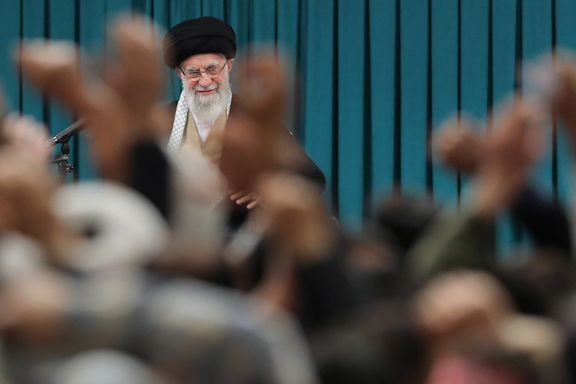
Iran's supreme leader Ali Khamenei speaking to his supporters, Iran, February 2025

Iran’s supreme leader Ali Khamenei has dismissed talks with the United States but history shows that his defiance can be a strategic bluff as much as it may be a genuine rejection of negotiation.

On 7th February, Iran’s Supreme Leader unequivocally rejected negotiations with Washington, saying, “Negotiating with a government like the US is neither wise, nor intelligent, nor honorable."

Just ten days earlier, he had cautiously signaled openness to talks. This is what he said.

“We must be mindful of whom we are dealing with, whom we are trading with, and whom we are speaking to—this is something we must know. When a person understands the other party, they may still engage in a transaction, but they will know how to act. We must recognise and be aware.”

How should one interpret Khamenei’s stance on a potential engagement with the US under President Donald Trump? Two hypotheses come to mind.

First, he may secretly be open to negotiations but publicly rejects the idea to maintain a strong front. By doing so, he creates room for backchannel diplomacy while avoiding the perception of weakness.

Alternatively, he may see talks with Trump as an existential threat, believing that it would undermine Iran’s strategic position or ideological foundations. Refusing to talk, in this case, would be more than posturing but a firm line in the sand.

A Strategic Bluff

Strategic bluffing and covert negotiations with the US have long been a cornerstone of Iran's policy, stretching back to the days and weeks before the Islamic Republic was founded.

In 1979, secret negotiations between Iran’s revolutionaries and the United States helped facilitate Ruhollah Khomeini's return while preventing a military coup. Washington sought assurances for the safety of American citizens and the prospect of future cooperation.

Barely a year later, Iran’s foreign minister at the time, Sadegh Ghotbzadeh, held covert talks with President Jimmy Carter’s Chief of Staff, Hamilton Jordan, to negotiate the release of the Americans held hostage in the US embassy in Tehran.

Then came the secret arms deal widely known as the Iran-Contra affair, where the Reagan administration agreed to send American weapons to Iran via Israel.

More recently, Tehran and Washington negotiated secretly in 2013, paving the way for the eventual 2015 nuclear deal with the Obama administration.

The latest alleged instance is Elon Musk holding undisclosed discussions with Iran’s UN representative, Amir-Saeed Iravani, in New York—a reminder that, whatever the rhetoric, real negotiations often happen in the shadows.

As Supreme Leader, Khamenei remains above the law and outside the cycle of direct negotiations. Holding the title of Imam—a designation for the infallible leaders of the Islamic community after the Prophet, as recognized by the majority of Shia Muslims—he embodies both spiritual and political authority.

By positioning himself as both a sovereign and a holy figure, he can maintain consistency in his hostility toward the United States, allow negotiations with it, and when necessary, criticize Iran’s negotiators as if they weren’t under his command.

Anti-Americanism and Anti-Zionism have been cornerstones of the Islamic Republic from the outset. Khamenei’s ongoing enmity with the US is not just political; it is an ideological imperative.

And then there’s President Donald Trump’s patronizing attitude, which Khamenei may view as a direct challenge to his quasi-holy position—something he cannot afford to let pass.

A Genuine Refusal

On the very same day that he floated the idea of negotiating with Tehran, Trump also ordered a return to his so-called maximum pressure on Iran and expressed his desire to take over Gaza.

If these were to materialize, not only further Iran’s ailing economy would be crippled but the Palestinian dream of statehood would be crushed and Khamenei’s plans for a US-free Middle East would end in ruins.

Some, including the Israeli ambassador to the US, have stressed that the only effective way to halt Iran's nuclear ambitions is through a deal akin to the Libyan model, involving the total dismantling of Iran’s nuclear infrastructure.

This is perceived in Tehran as a precursor to regime change by armed force, as was the case with Libya in 2011.

Khamenei may believe he can withstand maximum pressure for another four years, holding out for an administration that’s less assertive with Tehran. The outcome of the US midterm elections could help him with that.

As a sovereign ruler above law, Khamenei grants himself the luxury of time, delaying decisions at will.

“We can only enter the dangerous game of negotiations with the United States when we have achieved the desired level of economic, political, and cultural strength, so that their pressures and propaganda cannot affect us," Khamenei said in 2018.

"However, at present, negotiations would undoubtedly be to our detriment and are strictly forbidden.”

The real danger now lies in prolonged uncertainty. With talks yet to start and the decision to negotiate still in limbo, the threat of war grows ever closer.

However, as long as Khamenei is confident that his absolute sovereignty and the sanctity of his position remain uncontested, the door to US-Iran talks may remain slightly ajar—though always at the risk of being slammed shut at any given moment.

Most Viewed

Iran negotiators ordered to return after internal rift over Islamabad talks
1
EXCLUSIVE

Iran negotiators ordered to return after internal rift over Islamabad talks

2
ANALYSIS

US blockade enters murky phase as tankers spoof signals and buyers hesitate

3
ANALYSIS

Why the $100 billion Hormuz toll revenue is a myth

4

US tightens financial squeeze on Iran, warns banks over oil money flows

5
INSIGHT

Ideology may be fading in Iran, but not in Kashmir's ‘Mini Iran'

Banner
Banner

Spotlight

  • Hardliners push Hormuz ‘red line’ as US blockade tests Iran’s leverage
    INSIGHT

    Hardliners push Hormuz ‘red line’ as US blockade tests Iran’s leverage

  • Ideology may be fading in Iran, but not in Kashmir's ‘Mini Iran'
    INSIGHT

    Ideology may be fading in Iran, but not in Kashmir's ‘Mini Iran'

  • War damage amounts to $3,000 per Iranian, with blockade set to add to losses
    INSIGHT

    War damage amounts to $3,000 per Iranian, with blockade set to add to losses

  • Why the $100 billion Hormuz toll revenue is a myth
    ANALYSIS

    Why the $100 billion Hormuz toll revenue is a myth

  • US blockade targets Iran oil boom amid regional disruption
    ANALYSIS

    US blockade targets Iran oil boom amid regional disruption

  • Iran's digital economy battered by prolonged blackout
    INSIGHT

    Iran's digital economy battered by prolonged blackout

•
•
•

More Stories

Donald Trump wants to be king, not president, says Iranian official

Feb 20, 2025, 11:02 GMT+0

Mohsen Rezaei, a member of Iran's Expediency Council and former commander of the Revolutionary Guards, has accused Donald Trump of seeking authoritarian rule after the US president called himself a king.

"The US has entered a new era, characterized by the emergence of an international dictatorship led by Donald Trump. He wants to be a king rather than a president," he said on X.

US President Donald Trump is facing widespread criticism after referring to himself as a king on social media, following his administration’s decision to revoke New York City's congestion pricing program.

On Wednesday, after Transportation Secretary Sean Duffy sent a letter to New York Governor Kathy Hochul terminating the federal agreement supporting the program, Trump took to Truth Social, saying: "CONGESTION PRICING IS DEAD. Manhattan, and all of New York, is SAVED. LONG LIVE THE KING!"

The White House later amplified Trump’s statement by sharing it on social media, along with a digitally altered image of him grinning on a fake Time magazine cover, wearing a golden crown, with the New York City skyline in the background.

Iranian migrants moved to remote Panama jungle camp

Feb 20, 2025, 10:38 GMT+0

Dozens of Iranians were among nearly 100 migrants transferred Tuesday night to a detention camp deep in the Panamanian jungle, The New York Times reported.

Deported by the United States under an agreement with Panama, the group had been held in a locked hotel before being moved by bus to the Darién province, an area known for its harsh conditions.

“It looks like a zoo, there are fenced cages,” said Artemis Ghasemzadeh, a 27-year-old Iranian migrant, after the four-hour journey from Panama City. “They gave us a stale piece of bread. We are sitting on the floor.”

The detainees include eight children, a source told The Times. Under Panamanian law, detention beyond 24 hours without a court order is illegal, but it remains unclear how long they will remain at the site. Authorities have blocked journalists and aid groups from entering, while diseases like dengue are prevalent in the area.

Panama’s deputy foreign minister, Carlos Ruiz-Hernández, confirmed the transfer, denying it was a detention facility. “It’s a migrant camp where they will be taken care of,” he said. Security Minister Frank Ábrego added that migrants were being held for their own protection while officials verified their identities.

“What we agreed with the United States government is that they remain and are in our temporary custody for their protection,” he added.

The deportation is part of a broader effort by the Trump administration to send undocumented migrants to third countries.

The US faces legal and diplomatic hurdles in returning people to nations like Iran, China, and Afghanistan but has pressured Panama into accepting some deportees. Some migrants, including Iranian Christians, fear persecution if repatriated. Under Iranian law, converting from Islam is considered apostasy, punishable by death.

On Tuesday night, Panamanian authorities told detainees to pack their bags. Buses departed the hotel under tight security, passing the airport before heading east to the jungle camp.

According to the report, one Iranian woman wept on the bus, worried for her sick child. She said her child had been sick with a sore throat for days and the uncertainty and constant displacement was taking a toll on her.

Upon arrival, officials collected fingerprints and had migrants fill out forms.

Panamanian officials say some detainees are voluntarily accepting repatriation through the International Organization for Migration. Others remain in limbo, fearing what awaits if sent back home.

Iran's 2024 executions soar to nearly 1,000

Feb 20, 2025, 10:01 GMT+0

At least 975 people were executed in Iran in 2024, a staggering 17% increase from the 834 executions recorded the previous year, according to a joint report released by the Iran Human Rights Organization (IHRNGO) and Together Against the Death Penalty (ECPM).

"While the world's attention was focused on the growing tensions between Iran and Israel the Islamic Republic took advantage of the lack of international oversight to terrorize its own people by carrying out 5 to 6 executions daily," said Mahmoud Amiri-Moghaddam, director of IHRNGO.

Highlighting the executions as a form of crackdown on dissent, he said: "The death penalty remains its most powerful tool of political repression. These executions are part of the Islamic Republic's war against its own people to maintain power."

The report reveals a disturbing lack of transparency surrounding the executions. Less than 10% (95 cases) were officially reported, a sharp decline from the 15% reported in 2023.

This deliberate lack of transparency, the report argues, not only undermines accountability but also conceals the true extent of the government's use of capital punishment.

A disproportionately large number of executions – at least 503, or 51.6% – were for drug-related offenses, a significant increase compared to previous years.

International law stipulates that death penalties should not be given for drug offences, though 34 countries continue to use it.

The report highlights that these executions disproportionately affect marginalized minorities, including the Baluch community.

For the predominantly Sunni Baluch people of Sistan-Baluchestan province, where unemployment and lack of infrastructure make smuggling—of fuel, goods, and sometimes drugs—a lifeline, even petty drug sales can lead to execution.

According to Mowlavi Abdolhamid, Iran’s top Sunni cleric, many are executed for amounts as small as $15 to $20.

At least 419 executions were for murder, and 31 people were executed on security charges. The report also documents the executions of at least 31 women (the highest number in 17 years), one juvenile offender, and at least 80 Afghan citizens.

Despite the alarming trend, the report also notes a positive development, with at least 649 prisoners sentenced to death for murder pardoned by the victims' families, highlighting the potential impact of grassroots initiatives to reduce the use of capital punishment.

However, the overall picture painted by the report is one of escalating state-sanctioned executions. The report emphasizes the need for increased international pressure and scrutiny to address this critical issue.

Downed Iranian drone captured in Ukraine displayed in US

Feb 20, 2025, 08:51 GMT+0

A disassembled Iranian-designed Shahed 136 military drone seized in Ukraine arrived at Joint Base Andrews in Maryland this week and was displayed as part of a political conference addressing the ongoing threat of Iran.

The drone, brought down by Ukrainian forces, was transported with cooperation from Ukrainian and Polish special forces and United Against Nuclear Iran (UANI), a US-based nonprofit, Wall Street Journal reported.

“The Iranians have tried to conceal the role of this terror WMD weapon for years,” said UANI’s head Mark Wallace, who served as a US ambassador at the United Nations.

Wallace and Thomas Kaplan, a funder of UANI, were the ones who persuaded Polish Foreign Minister Radoslaw Sikorski at a meeting in Warsaw to procure an Iranian drone for Wallace to import into the United States.

The drone was displayed at the Conservative Political Action Conference this weekend and Donald Trump, the President of the United States, spoke at the conference.

According to the report, the Shahed-136 drone is considered the most widely used military drone in the world and is manufactured in Iran's military industries under the supervision of the IRGC. The IRGC is designated as a terrorist organization in the United States.

Russian forces have used thousands of these drones—rebranded as Geran-2—in Ukraine, with one striking Chernobyl’s radiation containment shelter on February 14.

Iranian-backed militants also launched a Shahed that killed three US service members in Jordan on January 28.

Former US intelligence official Norman Roule describes Iran as a “serial arsonist that openly nurtures other arsonists who operate in regional countries.” and supports proxies like Hezbollah, Hamas, and the Houthis.

“Russia also serves as a proxy because it’s extending Iran’s power projection and allows Iran to perform on the world stage,” he said.

The United States first warned in July 2022 that Iran was preparing to supply Russia with battlefield drones, and September 13 marked the anniversary of the first Shahed drone being shot down by Ukraine.

Russia soon began large scale use of the Iranian drones in attacks on Ukraine’s infrastructure and civilian targets. The Shahed 136 drones have been used alongside cruise and ballistic missile attacks to overwhelm Ukrainian air defenses.

Iran has fixed Israeli damage to air defenses, military commander says

Feb 19, 2025, 19:04 GMT+0

Iran has repaired damage to its air defenses from an Oct. 26 Israeli attack, a senior military official said on Wednesday, adding that Tehran would punish Israel and any power helping it strike Iran.

The remarks were the first official confirmation that the Israeli air attacks had damaged Iran's air defense systems but emphasized a hawkish stance which appeared to allude to US assistance to a future Israeli raid.

"The air defense of Islamic Iran is at the height of readiness, and the minor damage inflicted on it has been completely repaired," Mohammad Bagheri, chief of staff of Iran's armed forces was quoted by state media as saying.

His remarks were the third time in as many days that a top Iranian military official rebutted US and Israeli assertions that Iran was weakened by the bombardment and come after US media reported that Israel is mulling striking Iranian nuclear sites.

"The air defense of the Armed Forces of the Islamic Republic is at peak readiness for offensive operations, and missile production is continuously being carried out with very high quantity and quality," Bagheri added.

The Wall Street Journal and The Washington Post reported last week citing US intelligence findings from last month that Israel saw an opening for an attack on Iranian nuclear sites as early as the first half of this year.

Visiting the White House this month, Israeli Prime Minister Benjamin Netanyahu said the Israeli strikes had "crippled Iran's air defenses." Trump the next day said any reports of a devastating US-Israeli attack on Iran were "greatly exaggerated".

Israel is basing its assessment, the papers reported, on Iran's weakness after an Oct. 26 Israeli attack knocked out much of its air defenses and a greater perceived receptiveness to military action from US President Donald Trump.

"If the enemy makes any mistake, Israel’s security—and that of those involved in equipping and planning its operations—will be at risk, and the region will not see peace," Bagheri added.

Supreme Leader Ali Khamenei said on Monday that Iran could fend off an attack by its enemies, after rejecting an overture from Trump for a deal over Iran's nuclear program, which Tehran says is peaceful but Israel insists aims at building a bomb.







