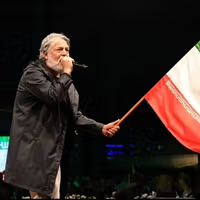
Senior cleric says he wants to impeach Trump over Iran policies
Iranian hardline cleric Ahmad Khatami
A member of Iran's Assembly of Experts has called for the impeachment of US President Donald Trump during Tehran’s Friday prayers, condemning his policies against Tehran.
“In this public gathering, I want to impeach Trump,” Ahmad Khatami, who also serves as Tehran's interim Friday prayer leader, said. “For 45 years, they have tried maximum pressure on Iran, and they have achieved nothing. Their pressure only brings maximum hatred from the Iranian people.”
Khatami, formerly a member of the Assembly of Experts presidium, was also once a prominent figure in the influential Supreme Council of Seminaries, responsible for setting policies and overseeing different programs for the Qom seminary and other affiliated Shiite seminaries. Though he has been sidelined from these key institutions, Iran's government-controlled online media widely covered his remarks.
The cleric blasted Trump’s foreign policy, particularly his opposition to the Islamic Revolutionary Guard Corps (IRGC) and his administration’s stance on Iran. “Trump called the IRGC terrorists, but they are our heroes, defending our nation from the terror networks America created,” he said.
On February 4, Trump signed a directive reviving his maximum pressure policy from his first term, aiming to drive Iran’s oil exports to zero. This strategy, originally launched in 2018, had severely battered Iran's economy, causing a sharp drop in oil exports and a surge in inflation. After signing the directive, Trump said he preferred a deal with Tehran over an Israeli strike on Iran’s nuclear sites.
In response, Iranian President Masoud Pezeshkian vowed on Wednesday that Iran would not bow to threats. “We will never yield to pressure or intimidation,” Pezeshkian said.
Earlier on Wednesday, Iran’s Supreme Leader Ali Khamenei praised President Masoud Pezeshkian for rejecting talks with the United States, emphasizing that Tehran must continue advancing its military capabilities in the face of Trump’s threat to halt Iran's nuclear program by force.
“The president said what needed to be said,” Khamenei said during an address to defense officials.
After weeks of mixed signals about potential negotiations and tensions within Tehran's political landscape, Khamenei made his stance unequivocally clear on February 7, saying that talks with the US are “neither smart, nor wise, nor honorable.”
Iran will deny Lebanon’s request for flights to Tehran, an official said Friday, as long as the Lebanese government prevents Iranian airliners from landing in Beirut.
The announcement comes after Lebanon halted flights by Iranian carriers, including Mahan Air and Iran Air.
Saeed Chalondari, CEO of Imam Khomeini Airport City, after demanding reciprocity from Lebanon, confirmed that a Tehran–Beirut flight scheduled for 7:30 a.m. on Friday was canceled after Lebanese aviation authorities denied the permit.
He added that Lebanon has announced a suspension of Iranian flights until February 18, directing passengers to use Lebanese carriers instead.
“We do not agree with this decision,” Chalondari said. “If there are to be flights between the two countries, they must be on a reciprocal basis.” Adding that Iran’s Civil Aviation Organization and the Ministry of Foreign Affairs are pursuing discussions with Lebanon to resolve the matter.
The dispute follows accusations from Israel that Iran’s IRGC Quds Force has been using civilian flights to smuggle funds to Hezbollah via Beirut International Airport. Israeli military spokesperson Avichay Adraee said on X that Iran and Hezbollah were exploiting commercial flights to transfer money for attacks on Israel.
The flight ban has sparked tensions in Lebanon. Images circulated on social media showed Hezbollah supporters blocking roads to Beirut Airport in protest against the refusal to allow Mahan Air to land.
Lebanese media also reported that flights arriving from Iraq are undergoing increased inspections to prevent potential cash transfers to Hezbollah.
The standoff comes amid a fragile ceasefire between Israel and Hezbollah, with both sides accusing each other of violations. Israel says Hezbollah is rearming, while Lebanon accuses Israel of continued military actions that have caused civilian casualties.
Divisions over US negotiations, economic hardship from sanctions, and concerns that Russia may use Iran’s nuclear program as leverage with Washington dominate debate in Tehran’s government-controlled media.
Addressing the uncertainty surrounding foreign policy and relations with the United States after Khamenei's rejection of talks, the centrist daily Ham Mihan wrote, "What Khamenei said highlighted a tactic rather than a strategy. Conservatives should not assume that their hardline stance has prevailed over the Reformists' push for compromise, nor should Reformists be discouraged by Khamenei's latest remarks on negotiations."
Meanwhile, Reformist figure Mostafa Hashemi-Taba criticized President Masoud Pezeshkian’s “national reconciliation” policy, particularly his cooperation with hardliners and their growing influence in the government. In a commentary in Shargh, Hashemi-Taba questioned the lack of consensus with hardliners on Iran’s most pressing foreign policy issues. "Well, you advanced a national reconciliation plan, but what happened next? You could claim success if there were some agreements among officials on how to address Iran’s problems."
"If you still insist that what you pursued was truly national reconciliation, then ask yourself—so what? What’s next? Beyond repeatedly stating your desire to solve the country’s problems, what concrete steps will you take?" Hashemi-Taba challenged Pezeshkian, criticizing his inaction and his government's lack of a clear plan.
He also condemned Iran’s ruling circles for “claiming to be revolutionary while squandering the country’s resources.”
Meanwhile, hardliners continued to reject President Trump's offer for negotiations. The hardline daily Farhikhtegan accused Iranian reformists of "trying to pave the way for talks with America by distorting Trump's statement and pretending his behavior is normal."
The newspaper acknowledged that the people face serious economic and financial hardships, stating, “The government cannot tackle the nation's increasing dissatisfaction and foreign pressures at the same time." However, it echoed Supreme Leader Ali Khamenei and hardliners, insisting that the government should address the crisis without turning to negotiations with the United States.
Hardliners have maintained this argument for the past seven years, but without the removal of US sanctions, the government has limited options to revive the economy.
Farhikhtegan further accused reformists of idealism and attempting to downplay what it called Trump’s anti-Iran executive memorandum, stating, "They are lost in their dreams, ignoring reality."
The news of a lengthy phone call between Trump and Russia’s Vladimir Putin intensified debate in Tehran’s media over Moscow’s true intentions and its possible plans to use Iran as a bargaining chip with the US president.
Even before that phone call, the centrist website Entekhab quoted Mahmoud Shouri, deputy director of the Iranian and Eurasian Studies Center, as saying, "At present, Russia has no opportunity to intervene in discussions between Iran and the United States over Tehran’s nuclear program. However, Moscow is certainly uneasy about the program becoming unmanageable."
Shouri added, "Russia does not want Iran to become a nuclear power, but Iran should not be preoccupied with Moscow’s concerns, as Russia does not play a decisive role in the future of Iran’s nuclear program."
These remarks came days after Moscow’s ambassador in Tehran told the press, "Negotiations with Iran will not yield results without Moscow and Beijing." He emphasized that "Russia supports the 5+1 framework for talks with Iran, but unfortunately, Western countries are trying to exclude Russia and China from the negotiations."
US lawmakers are urging European allies to reinstate strict United Nations sanctions on Iran, citing Tehran’s continued violations of the 2015 nuclear deal.
A bipartisan resolution, introduced in both the Senate and the House, calls on the United Kingdom, France, and Germany to trigger the “snapback” mechanism that would restore comprehensive sanctions on Iran through the UN Security Council.
The Senate version of the legislation is being led by Sen. Pete Ricketts (R-Neb.), the number two Republican on the Senate Foreign Relations Committee, with 11 cosponsors.
"Iran is the leading state sponsor of terrorism, and their actions have led to the murder of American servicemembers," Ricketts said. "Iran’s possession of a nuclear weapon would threaten our security and the security of our allies. Snapback sanctions are key to ensuring that President Trump’s maximum pressure campaign is successful."
In the House of Representatives, Reps. Claudia Tenney (R-NY) and Josh Gottheimer (D-NJ) have introduced companion legislation, urging European nations to act before key provisions of the Iran deal expire in October 2025.
"These snapback sanctions would include export controls, travel bans, asset freezes, and other restrictions on those involved in Iranian nuclear and missile activities," a press release shared on Tenney's website read.
The 2015 agreement, formally known as the Joint Comprehensive Plan of Action (JCPOA), had lifted UN, US, and EU sanctions on Iran in exchange for commitments to limit its nuclear program. The Trump administration withdrew the US from the deal in 2018, implementing a "maximum pressure" sanctions effort. In response, Iran later restricted access for international inspectors and resumed uranium enrichment beyond permitted levels.
The US lawmakers' call comes amid reports from the International Atomic Energy Agency (IAEA) that Iran is enriching uranium to 60% purity, just below the 90% threshold for weapons-grade material. IAEA Director Rafael Grossi warned that there is no civilian use for uranium enriched to such a level, raising concerns over Tehran's nuclear intentions.
With the October 2025 deadline looming, US lawmakers are pressing their European counterparts to act swiftly and decisively, warning that failure to reimpose sanctions could further embolden Iran’s nuclear ambitions.
A senior Iranian defense official has asserted that the country’s air defense systems are stronger than ever, despite reports that an Israeli attack in October severely damaged Iran’s Russian-supplied defenses.
Speaking on Friday, Brigadier General Mahdi Farahi, Deputy Minister of Defense for Industrial and Research Affairs, said: "The reality is that in war, clashes happen. But the idea that our defense system has weakened or, as some ignorant individuals say, has been destroyed, is absolutely false".
"Our defense system, in terms of deployment, diversity, and capabilities, has not only not weakened but has become even stronger since before the Zionist regime's aggression," he added.
Farahi’s remarks come on the heels of statements from other top Iranian leaders earlier in the week. On Thursday, President Masoud Pezeshkian, speaking in Bushehr, home to a major nuclear plant, warned against potential strikes on the country's nuclear facilities, stating: "If you (the enemy) strike a hundred of those, we will build a thousand other ones. You can hit the buildings and places, but you cannot hit those who build them... you cannot erase the minds of our scientists."
On Wednesday, Supreme Leader Ali Khamenei, during a visit to an exhibition of Iran’s latest military products, emphasized the importance of advancing the country’s missile capabilities: "Progress should not be stopped. We cannot be satisfied with our current level. If we previously set a limit for the accuracy of our missiles but now feel that limit is no longer sufficient, we must push forward. Today, our defensive power is well-known, and our enemies fear it. This is crucial for our country."
The wave of statements from Iranian officials comes after former US President Donald Trump raised the possibility of an Israeli attack on Iran’s nuclear facilities this month. Speaking to Fox News, Trump said: "Everyone thinks Israel, with our help or our approval, will go in and bomb the hell out of them. I would prefer that not to happen."
Meanwhile, The Wall Street Journal reported on Wednesday that Israel is considering strikes on Iran’s nuclear sites, citing US intelligence assessments that view Iran as vulnerable in the final days of the Biden administration.
The leaders of US adversaries Iran, Russia and China are working together to dominate their respective regions and undermine US security and values, Senator John Kennedy said on Thursday.
"I am convinced, based on classified classified information, that President Xi in China is working with President Putin in Russia and is working with the Ayatollah in Iran against the United States of America and western values, including, but not limited to freedom," the Louisiana Republican said in congress.
Russia plays a pivotal role in Iran's nuclear infrastructure, leading initiatives such as the expansion of the Bushehr Nuclear Power Plant. Iranian drones have aided Russia's full-scale invasion of Ukraine, leading to stricter US-led sanctions.
Iran's president said shortly after the election of President Donald Trump that the country seeks greater cooperation with Beijing and Moscow to confront what he called Washington's unilateralism.
"I believe their ultimate goal was to have Iran dominate the Middle East," Kennedy added, saying Moscow sought to hold sway over Eastern and Central Europe.
China's Xi Jinping, whom Kennedy described as "the quarterback of this ball club" would control the Indo-Pacific, sub-Saharan Africa and South America.
Tehran and Beijinginked a comprehensive strategic partnership in 2016 aimed at increasing bilateral trade to $600 billion by 2026. However, trade volume reached just $12.5 billion last year according to the International Monetary Fund.
China remains Iran's largest trade partner and purchases nearly all of Iran's crude oil in defiance of US sanctions.
"I don't want America to be the world's policeman, but I don't want President Xi or President Putin or the Ayatollah in Iran to be the world's policeman either," Kennedy said.
The objectives of our enemies, if I am correct, is not a world that would be safe for America. Weakness invites the wars. We have to spend more money on defense."
Fellow Republican senatorson Tuesday told Iran International that Supreme Leader Ali Khamenei was unwise to dismiss nuclear talks with the United States and President Trump is no paper tiger.