• العربية
  • فارسی
Brand
  • Iran Insight
  • Politics
  • Economy
  • Analysis
  • Special Report
  • Opinion
  • Podcast
  • Iran Insight
  • Politics
  • Economy
  • Analysis
  • Special Report
  • Opinion
  • Podcast
  • Theme
  • Language
    • العربية
    • فارسی
  • Iran Insight
  • Politics
  • Economy
  • Analysis
  • Special Report
  • Opinion
  • Podcast
All rights reserved for Volant Media UK Limited
volant media logo

Dozens arrested protesting continued house arrest of 2009 protests leaders

Maryam Sinaiee
Maryam Sinaiee

Iran International

Feb 13, 2025, 11:45 GMT+0Updated: 17:33 GMT+0
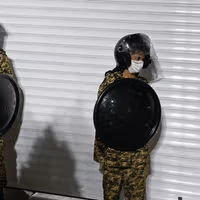
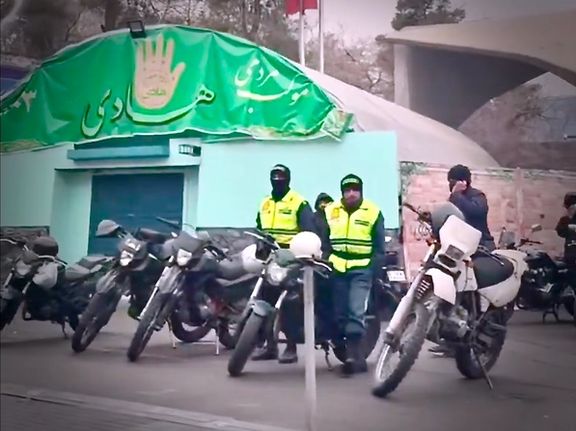
Security forces stationed outside the main gate of Tehran University, February 13, 2025

Iran's security forces on Thursday arrested dozens who gathered in central Tehran to protest the ongoing house arrest of the 2009 Green Movement leaders.

The protest was called to demand an end to the incarceration of former prime minister and presidential candidate Mir-Hossein Mousavi and his wife, Zahra Rahnavard, held in their home since February 2011.

It was the first such public demonstration since the couple were effectively jailed alongside the other 2009 leader, former parliamentary speaker Mehdi Karroubi, who also rejected the results of Iran's election that year.

Marking the 14th anniversary of the day the house arrest began, several hundreds gathered in Tehran for a "silent rally" that had been called a couple of days earlier by dissident activist Rahim Ghomeishi, a 60-year-old former IRGC member and Iran-Iraq War veteran who had spent four years as a prisoner of war in Iraq.

Ghomeishi was detained on Wednesday along with two other activists who had backed his call to action, Akbar Danesh-Sararoudi and Naser Daneshfar.

Their social media campaign received backing from over 500 former IRGC members, war veterans, and their families, who joined a few thousand for the silent protest on Thursday, according to the organizers.

Shortly after, Iran's security forces who had been stationed in and around the announced location arrested dozens including known activists and ordinary citizens.

Crackdown, arrests, and intimidation

On Thursday, Ardshir Amir-Arjomand, a former Mousavi advisor and spokesman for the Iranian Green Movement’s Coordinating Council, claimed that security forces blocked several activists from leaving their homes to participate in the rally.

Ghomeishi had previously announced that he and other veterans planned to stage a peaceful, “silent” protest outside the main gate of Tehran University to oppose the continued house arrest of political figures and the imprisonment of activists.

He also insisted that the law allows citizens to protest peacefully whenever they wish, and authorities cannot deny this right to them under the pretext that the country is in “sensitive circumstances” or that the “enemy” may exploit their protests for its own propaganda purposes.

Ghomeishi also said the group had informed the Interior Ministry and “other official bodies” of the intention to hold a rally but had not heard back from them, assuming that there was no objection to the plan.

While Article 27 of Iran’s constitution technically allows peaceful assembly, authorities almost categorically deny permits for opposition protests, citing “sensitive circumstances” or the risk of “enemy propaganda” or ignore their permit requests. At the same time, pro-regime vigilante groups face no such restrictions.

Assembly permits are often denied to most political groups, effectively suppressing their protests. In contrast, hardliner vigilante groups are allowed to hold rallies freely, without authorization.

After Thursday's crackdown, Azar Mansouri, the head of the Reformist Front, protested in an X post.

He wrote: "Why do some people freely hold gatherings and meetings anywhere ... without permission, chant slogans against the president and his team, and have ironclad immunity, but another group, who happen to be veterans of the country, are arrested before holding a peaceful gathering?"

Information received from Iranians on the ground by Iran International TV on Thursday and eyewitness reports on social media, described a heavy security presence on Enghelab Avenue and around Tehran University hours before the planned demonstration. Videos showed police cars and vans lining the streets.

One witness told Iran International that around 1,000 uniformed officers—including both male and female forces—were stationed near the university, along with nearly as many plainclothes agents. Officers stopped and searched people, checking their phones for footage.

Iran International has learned that the government’s Information office instructed local media and journalists not to report on the crackdown.

In addition to the initial arrests, several university students and Saeed and Saeedeh Montazeri—children of the late dissident cleric Ayatollah Hossein-Ali Montazeri— and Hossein Loghmanian, a former lawmaker and also a war veteran, were detained when they attempted to join the rally.

The case has gained international attention. Back in 2017, the US State Department said of the pair's house arrest: "Their continued house arrest contradicts Iran’s international obligations including those under the International Covenant on Civil and Political Rights, to which Iran is a state party, to provide minimum fair trial guarantees and not to subject citizens to arbitrary arrest or detention.

"We join the international community in condemning the continued arbitrary detention of these three individuals without charges or fair trials and in calling for their immediate release."

Most Viewed

Ghalibaf defends Iran-US talks amid hardline backlash
1
INSIGHT

Ghalibaf defends Iran-US talks amid hardline backlash

2
ANALYSIS

From instability to influence: Pakistan’s pivotal role in US-Iran diplomacy

3
ANALYSIS

100 days on: why Iran’s January protests spread across social classes

4

War-hit homeowners feel abandoned as Iran’s reconstruction aid fades

5

Iran says no decision yet on talks as Pakistan prepares to host US team

Banner
Banner

Spotlight

  • Iran diplomacy wobbles as factions compete to avoid looking soft on US
    INSIGHT

    Iran diplomacy wobbles as factions compete to avoid looking soft on US

  • The politics of pink: how Iran uses cuteness to rebrand violence
    ANALYSIS

    The politics of pink: how Iran uses cuteness to rebrand violence

  • Bread shortages, soaring prices strain households in Iran, residents say
    VOICES FROM IRAN

    Bread shortages, soaring prices strain households in Iran, residents say

  • 100 days on: the anatomy of Iran’s January crackdown
    INSIGHT

    100 days on: the anatomy of Iran’s January crackdown

  • Ghalibaf defends Iran-US talks amid hardline backlash
    INSIGHT

    Ghalibaf defends Iran-US talks amid hardline backlash

  • From instability to influence: Pakistan’s pivotal role in US-Iran diplomacy
    ANALYSIS

    From instability to influence: Pakistan’s pivotal role in US-Iran diplomacy

•
•
•

More Stories

Iran bans pre-revolution period drama over hijab, dance scenes

Feb 12, 2025, 20:35 GMT+0
•
Maryam Sinaiee

An Iranian drama series was abruptly banned after just one episode for depicting women without hijab, dance scenes and using wigs and hats to portray life before the 1979 Islamic Revolution more realistically.

On February 3, the Iranian Audio-Visual Media Regulatory Authority (SATRA) ordered the video-on-demand platform Filimo to stop airing Tasian, a historical romance drama set in the late 1970s. The decision came after backlash from religious hardliners who deemed the series indecent.

The ban on Tasian follows other instances of increasing censorship by SATRA. Last year the regulator ordered the removal of a scene from another series, The End of the Night, in which an elderly mother and her son briefly dance together at a care home.

Despite efforts to suppress it, Tasian has sparked intense debate about artistic freedom, censorship and the portrayal of Iran’s history—highlighting the growing divide between Iran’s conservative establishment and modern audiences.

A vague justification

SATRA, which is affiliated to the country's sole radio and television program provider the Islamic Republic of Iran Broadcasting (IRIB), announced on Wednesday that the series was released without its approval, and an investigation is underway into the violations by the production team and the publishing platform.

According to SATRA, the series includes violations such as "lack of hijab, promotion of smoking, mixed-gender dancing, and promotion of alcohol consumption."

It had earlier said that authorities had yet not been able to establish the eligibility of the series’ director Tina Pakravan to produce films.

The regulatory body also announced that advertisements for Tasian which had appeared on billboards in several cities must be removed and that no further review of the series would take place until Pakravan’s qualifications were officially assessed.

Pakravan is a well-known filmmaker in Iran, recognized for her historical drama Once Upon a Time in Iran (2021) and films such as It Happened at Midnight (2016) and Lady (2014).

In 2022, she won the Best Home Video Director award at the 1st Iranian Cinema Directors’ Great Celebration.

Hijab dilemma for pre-revolutionary period pieces

Tasian follows the story of a young woman arrested for political activism a few months before the 1979 Islamic Revolution.

However, a romance develops between her and her interrogator, making the series an unusual love story set against Iran’s turbulent history.

Portraying pre-revolutionary Iranian women realistically has long been a challenge for filmmakers, as strict hijab regulations have been enforced for films since 1979.

Tasian's costume designers attempted to navigate these rules by using wigs and hats to cover actresses’ hair, reflecting styles of the era. But social media users noted that the show exaggerated the prevalence of hats among Iranian women of the time.

Another major reason cited for the ban is the depiction of mixed-gender gatherings with music and dancing—acts strictly prohibited under the Islamic Republic. Women dancing and singing solo in public are also banned, making such portrayals particularly sensitive.

Famous photo of Tehran University students before the Islamic Revolution
100%
Famous photo of Tehran University students before the Islamic Revolution

Navigating censorship

Iranian filmmakers often try clear the hurdles of censorship by avoiding scenes where women normally go without the hijab, such as among family members, in intimate moments between couples or amid women dancing or singing.

As streaming platforms grow in popularity, they pose a significant challenge to Iran’s heavily censored state television, which has suffered a major decline in viewership. IRIB employs around 40,000 people and its head is directly appointed by Supreme Leader Ali Khamenei.

Trump touts negotiations but tries to cripple Iran, Pezeshkian says

Feb 12, 2025, 16:47 GMT+0

Iran's President Masoud Pezeshkian insisted on Wednesday that the country would not yield to external threats after US President Donald Trump mooted the bombing of its adversary earlier this week.

"Trump stands at the podium and says, 'I want to negotiate,' but on the other hand, he is closing all the doors," Pezeshkian said during a speech in Bushehr province on Wednesday.

"He takes every decision necessary to cripple us, issues orders, and pressures the world to prevent dealings with Iranians. If you are truly a man of negotiation, then why do you do these things?"

On February 4, Trump signed a directive reviving his so-called maximum pressure policy on Iran from his first term aimed at driving the Islamic Republic's oil exports to zero. After signing the memorandum, he said he would prefer a deal with Tehran to an Israeli attack on their nuclear sites.

"I would love to make a deal with them without bombing them," he said on Fox News.

Pezeshkian, however, said “Iran will not back down or surrender in the face of any threat," in a sign that the Iranian political establishment -- from the president’s relatively moderate government to the ultra-conservative clerical establishment -- has coalesced against Trump’s hoped-for deal.

He also condemned efforts to limit Iran’s defense capabilities, saying, “They demand we abandon missiles and military strength so they can repeat what they did in Gaza, but they should know Iran will never surrender to such pressures.”

Earlier in the day, Iran’s Supreme Leader praised Pezeshkian for rejecting talks with the United States and said Tehran must continue its military progress after Trump’s threat to stop Iran's nuclear program by force.

"The president said what needed to be said," Ali Khamenei said, addressing defense officials on Wednesday.

Following a few weeks of ambivalent signals regarding negotiations and a struggle in Tehran's political scene, Khamenei finally voiced his clear opposition to negotiations on February 7, saying talks with the US are "not smart, wise, or honorable."

'Trump is America's deal-maker-in-chief'

White House Press Secretary Caroline Leavitt on Wednesday said Donald Trump "has made it very clear that he will never allow Iran to have nuclear capabilities."

"That is a red line that he has drawn, and he will not allow that to happen."

Asked why Trump wants to reach a deal with Tehran instead of helping overthrow the Islamic Republic, Leavitt said, "He is the master of the art of the deal. He is America's deal maker in chief. He leads from a position of securing peace through strength."

While Leavitt did not answer the question about putting an end to the clerical establishment in Iran, Trump has publicly announced he does not aim for a regime change in Iran and only wants to prevent the country from acquiring nuclear weapons.

IRGC intelligence chief threatens US interests globally after Trump ultimatum

Feb 12, 2025, 14:17 GMT+0

The head of the IRGC Intelligence Protection Organization dismissed negotiations with the United States, calling them a "red line" and warning that any threat to Iran’s national interests would be met with reciprocal action worldwide.

“If the US attempts any mischief, as the Supreme Leader has warned, we will respond decisively,” Brigadier General Majid Khademi said in the wake of US President Donald Trump's ultimatum for Iran to come to the negotiating table or risk military action.

“Should they threaten us, we will threaten them. If they act on their threats, we are fully prepared to retaliate, putting their national interests at risk across the world," added Khademi.

Last week, Trump reinstated his so-called "maximum pressure" policy on Iran, which includes efforts to drive its oil exports down to zero.

In several interviews, however, Trump said he preferred striking a deal to prevent Tehran from developing a nuclear weapon over bombing the country.

“Trump approached negotiations with deception, revealing some of his goals while hiding others,” Khademi said. “He aimed to dismantle Iran’s nuclear, missile, and conventional defense programs—capabilities essential for any nation.”

The IRGC commander also accused the US of misunderstanding the Iranian people while asserting that Trump had exposed America’s true nature. “As the Supreme Leader has stated, we have no limits on global engagement, but negotiations with the US remain off-limits.”

Supreme Leader Ali Khamenei voiced his clear opposition to negotiations with the US on February 7, saying such talks are "not smart, wise, or honorable."

Khademi said that any negotiation must be "intelligent, honorable, and rational," aligning with the Supreme Leader’s messaging.

Khamenei praises president’s opposition to US talks, calls for military progress

Feb 12, 2025, 12:01 GMT+0

Iran’s Supreme Leader on Wednesday praised the president for rejecting talks with the United States and said Tehran must continue its military progress after US President Donald Trump’s threat to stop Iran's nuclear program by force.

"The president said what needed to be said," Ali Khamenei said, addressing defense officials on Wednesday, adding, “(Masoud) Pezeshkian spoke the words of the people and conveyed their true sentiments."

During this week's rally marking the anniversary of the 1979 Islamic Revolution, Pezeshkian accused the US of duplicity, saying that President Donald Trump called for negotiations while continuing sanctions.

Following a few weeks of ambivalent signals regarding negotiations and a struggle in Tehran's political scene, Khamenei finally voiced his clear opposition to negotiations on February 7, saying talks with the US are "not smart, wise, or honorable."

The Supreme Leader spoke during a visit to an exhibition of the country’s latest military products, where he said Iran should further develop its military, including its missiles.

"Progress should not be stopped. We cannot be satisfied with our current level. If we previously set a limit for the accuracy of our missiles but now feel that limit is no longer sufficient, we must push forward," he said. "Today, our defensive power is well-known, and our enemies fear it. This is crucial for our country."

Khamenei made no mention of Trump during the event.

In spite of scattered protests around the country over economic conditions, he described this week's state-sponsored rallies as a message of unity from the Iranian people.

“Despite the constant, idiotic threats against us, the people of Iran showed the world their identity, their strength, and their unwavering resolve," he said.

Khamenei’s comments came a day after Iran's UN ambassador, Amir Saeid Iravani, condemned what he called "reckless and inflammatory statements" by Trump in interviews with The New York Post and Fox News, in which Trump said that he preferred striking a deal to prevent Tehran from developing a nuclear weapon rather than bombing the country.

Last week, Trump reinstated his so-called "maximum pressure" policy on Iran, which includes efforts to drive its oil exports down to zero.

US-Iran talks possible if Trump dials down rhetoric - conservative daily

Feb 12, 2025, 11:00 GMT+0
•
Behrouz Turani

Negotiations between Iran and the United States remain possible if President Donald Trump adopts a less "confrontational and arrogant" tone toward Tehran, wrote the editor of a conservative newspaper founded by Supreme Leader Ali Khamenei.

In a sign of growing internal debate, Massih Mohajeri of the Jomhouri Eslami newspaper sharply criticized officials and media figures who brand supporters of negotiations as “infiltrators” and “dishonored elements”, describing this stance as “utterly against freedom of expression.”

Despite Khamenei’s strong opposition to talks with the United States, some Iranian officials and media have continued to discuss the possibility of negotiations.

Though Mohajeri—personally appointed by Khamenei as the paper’s editor—did not name specific targets, his remarks were widely interpreted as aimed at ultraconservative lawmakers and Kayhan, another newspaper funded by Khamenei.

Mohajeri argued that such individuals and media outlets oppose the principles and teachings of Islam and cannot persuade public opinion to reject negotiations.

Meanwhile, Vice President Mohammad Reza Aref reinforced Khamenei’s stance against talks with the Trump administration.

"Both sides should benefit from transactions, but I believe there is no profit in dealing with the United States. Trump has shown that he is not trustworthy," he said, adding that "Trump may be trusted only if he is reformed, and that is unlikely to happen."

Massih Mohajeri, editor of an influential daily in Tehran. Undated
100%
Massih Mohajeri, editor of an influential daily in Tehran

Kourosh Ahmadi, a former Iranian diplomat who served at Iran’s mission to the United Nations in New York, highlighted what he called a disinformation campaign by Iranian officials aiming to distort Trump’s message to Tehran. He also dismissed as “meaningless” the claim that negotiations are tantamount to surrender, arguing instead that maintaining a tough stance can compel the other side to retreat or modify its position.

Ahmadi added that as it has been stated in a White House document issued last week, "the fact that negotiation has become a taboo in Iran is not understandable."

He said that the National Security Presidential Memorandum (NSPM) signed by Trump is aimed at "restoring maximum pressure on the government of the Islamic Republic of Iran, denying Iran all paths to a nuclear weapon, and countering Iran’s malign influence abroad."

He further characterized Iranian Parliament Speaker Mohammad Bagher Ghalibaf's statement, that alleged Trump wishes to disarm Iran, as disinformation and fake news and added that only the text that has been signed by Trump should be considered as his and the White House's official view.

However, he noted, "During the first two weeks after his inauguration, Trump created some hope for the start of negotiations with Iran. I have no idea what led to the unexpected shift in his position." Ahmadi suggested that Trump's approach might have been a negotiation tactic, similar to his dealings with Mexico and Panama, where he initially took an aggressive stance but softened his tone once he saw signs of agreement from the other side.

Despite perceptions in Tehran that Trump has taken a harsher stance toward the Islamic Republic, his position remains unchanged from his first term. This time, however, he has balanced his renewed “maximum pressure” strategy with a stronger emphasis on seeking peace through diplomacy.

The former Iranian diplomat urged officials to consider Trump's memorandum and the White House statement within a broader context to avoid being misled. He also cautioned those influenced by the disinformation campaign, emphasizing that "proper decision-making requires accurate information."

In his editorial, Mohajeri emphasized that the Iranian constitution grants everyone the right to express their views, including on negotiations with the United States. However, he reiterated that "Khamenei is the one who has the final say about relations with the United States" and criticized Trump’s approach, stating, "The US president spoke arrogantly and put forward irrational expectations."

"If the US president gives up his arrogant rhetoric and speaks modestly with Iran, then the roads to negotiation are open," he concluded.