• العربية
  • فارسی
Brand
  • Iran Insight
  • Politics
  • Economy
  • Analysis
  • Special Report
  • Opinion
  • Podcast
  • Iran Insight
  • Politics
  • Economy
  • Analysis
  • Special Report
  • Opinion
  • Podcast
  • Theme
  • Language
    • العربية
    • فارسی
  • Iran Insight
  • Politics
  • Economy
  • Analysis
  • Special Report
  • Opinion
  • Podcast
All rights reserved for Volant Media UK Limited
volant media logo

Iranian currency hits record low after Khamenei rejects US talks

Feb 8, 2025, 10:20 GMT+0Updated: 18:47 GMT+0

Iran’s currency, the rial, plunged to a record low of 891,000 per US dollar on Saturday, following Supreme Leader Ali Khamenei’s rejection of talks with Washington the day before.

Compared to the same period last year, when the dollar stood at 510,000 rials, the national currency has devalued by 75%.

The economic fallout from the rial's collapse has been profound. Consumer goods inflation in Iran has surged to approximately 50%, leaving more than one-third of the population below the poverty line.

“Negotiating with such a government should not be done; it is neither wise, intelligent nor honorable,” said the 85-year-old cleric during a meeting with air force personnel in Tehran.

“No problem will be solved through negotiations with the United States,” he added, despite calls by many insider politicians and commentators in Tehran to open negotiations with the United States to ease sanctions.

"We must understand this correctly; they should not make it seem to us that if we sit at the negotiation table with that government, this or that problem will be solved. No, no problem will be solved through negotiations with the United States."

Meanwhile, the US State Department told Iran International on Friday that the Trump "maximum pressure" sanctions on Iran would remain unless a deal was reached.

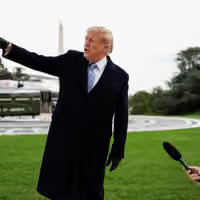
Although President Donald Trump reaffirmed his sanctions strategy earlier this week, he left the door open for an agreement, saying that he preferred a diplomatic resolution.

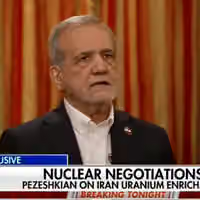
Masoud Pezeshkian, Iran's relatively moderate president, has expressed tentative openness to talks, contrasting with Khamenei's firm stance.

Over the past five years, tens of millions of Iranians have experienced a steady decline in living standards, as wages have failed to keep pace with rising prices. Since the reintroduction of US sanctions in 2018, the rial’s value has plummeted more than twentyfold. The iannual inflation rate has hovered at around 40% for the past five years.

Basic living costs have become unattainable for many, with the average worker’s monthly earnings shrinking to the equivalent of $135 from $ 200 earlier this year, while official data estimates $500 is necessary to cover basic needs.


Most Viewed

US blockade enters murky phase as tankers spoof signals and buyers hesitate
1
ANALYSIS

US blockade enters murky phase as tankers spoof signals and buyers hesitate

2

US tightens financial squeeze on Iran, warns banks over oil money flows

3
INSIGHT

Ideology may be fading in Iran, but not in Kashmir's ‘Mini Iran'

4
INSIGHT

Hardliners push Hormuz ‘red line’ as US blockade tests Iran’s leverage

5
VOICES FROM IRAN

Hope and anger in Iran as fragile ceasefire persists

Banner
Banner

Spotlight

  • Hardliners push Hormuz ‘red line’ as US blockade tests Iran’s leverage
    INSIGHT

    Hardliners push Hormuz ‘red line’ as US blockade tests Iran’s leverage

  • Ideology may be fading in Iran, but not in Kashmir's ‘Mini Iran'
    INSIGHT

    Ideology may be fading in Iran, but not in Kashmir's ‘Mini Iran'

  • War damage amounts to $3,000 per Iranian, with blockade set to add to losses
    INSIGHT

    War damage amounts to $3,000 per Iranian, with blockade set to add to losses

  • Why the $100 billion Hormuz toll revenue is a myth
    ANALYSIS

    Why the $100 billion Hormuz toll revenue is a myth

  • US blockade targets Iran oil boom amid regional disruption
    ANALYSIS

    US blockade targets Iran oil boom amid regional disruption

  • Iran's digital economy battered by prolonged blackout
    INSIGHT

    Iran's digital economy battered by prolonged blackout

•
•
•

More Stories

Khamenei’s stance on US talks shapes Iran’s foreign policy, says FM

Feb 8, 2025, 10:10 GMT+0

Iran’s Foreign Minister Abbas Araghchi said Saturday that the country’s diplomatic corps now bears an even greater responsibility after Supreme Leader Ali Khamenei firmly rejected negotiations with the United States.

Speaking to a group of air force personnel in Tehran on Friday, Khamenei dismissed the idea of talks with Washington, saying, “Negotiating with such a government should not be done; it is neither wise, intelligent, nor honorable.”

His remarks seemed to undermine both US President Donald Trump’s call for a new nuclear deal and Iranian President Masoud Pezeshkian’s stated willingness to engage with Washington.

Araghchi thanked Khamenei for his guidance and said, "The Ministry of Foreign Affairs, in fulfilling its core duties and based on the three principles of dignity, wisdom, and expediency, will utilize all available capacities to advance a comprehensive, active, and effective foreign policy. This will be aimed at safeguarding national interests and security, as well as enhancing the country's strength and stature through political and diplomatic engagements."

The three principles Araghchi cited are the same ones Khamenei has used to justify rejecting negotiations with Washington.

Khamenei also accused the US of betrayal regarding the 2015 nuclear deal, from which Trump withdrew in 2018, reinstating the "maximum pressure" policy earlier this week despite signaling a preference for a new agreement.

In response to Khamenei’s speech, Araghchi said that his words, as always, serve as a guide for government officials, particularly within the Ministry of Foreign Affairs.

“His Excellency’s recognition of our efforts is a source of pride, but it further heightens our critical responsibility in advancing the lofty goals of the system in the realm of diplomacy and foreign policy,” Araghchi said.

Khamenei has the final say in all state matters, but specially regarding the country's foreign policy and control of the military.

Khamenei meets Hamas leaders, doubles down on anti-US stance

Feb 8, 2025, 09:03 GMT+0

Iran’s Supreme Leader Ali Khamenei met with senior Hamas officials in Tehran on Saturday, reaffirming Tehran’s support for the Palestinian group and renewing his criticism of the United States, a day after rejecting the possibility of nuclear talks.

“The issue of Palestine is a fundamental matter for us, and the victory of Palestine is a certainty,” Khamenei said during the meeting.

The Hamas delegation was led by Mohammad Ismail Darwish, Chairman of the Hamas Shura Council, and included Khalil al-Hayya, Deputy Head of Hamas' Political Bureau, and Zaher Jabarin, Hamas’ head in the West Bank. The senior officials celebrated what they described as a 'great victory of the resistance in Gaza' and praised Iran's consistent support.

The meeting took place as the US reinstated its “maximum pressure” policy on Tehran, with President Donald Trump indicating a preference for renewed nuclear talks. However, in a separate address on Friday, Khamenei firmly rejected any prospect of negotiations, stating, "Negotiating with such a government should not be done; it is neither wise, intelligent, nor honorable."

100%

On Saturday, Khamenei also dismissed US pressure on Iran, asserting, "These threats do not affect the mindset of our nation, our officials, or our youth." He reiterated that Iran’s support for the Palestinian cause remains steadfast, describing it as "a resolved matter in the minds of the Iranian people."

Addressing the Hamas leaders, Khamenei said, “You have not only defeated the Zionist regime but, in reality, you have overcome the United States,” framing Gaza’s recent military actions as part of a broader resistance against Western influence.

In addition to rejecting diplomatic overtures, Khamenei dismissed the notion that negotiations could ease Iran’s economic struggles.

Since 2018, when Trump reimposed sanctions targeting Iran’s oil exports and banking sector, the country’s economy has sharply deteriorated. This decline has been further compounded by decades of domestic mismanagement, corruption, and a focus on foreign activities over internal welfare.

The Iranian rial has lost 95% of its value, plunging 22-fold, while inflation has hovered around 40% for the past five years. Official estimates suggest that more than one-third of the population now lives below the poverty line.

Iran starts manufacturing key radiotherapy material at nuclear facility

Feb 8, 2025, 08:33 GMT+0

Iran says it has officially launched the production line for Iridium Hexafluoride (IR46) at the Shahid Raeisi Nuclear Site in Isfahan (UCF site) on Saturday amid US pressure to curb Iran's nuclear program.

Iridium Hexafluoride (IR46) has multiple applications, including in brachytherapy (internal radiotherapy), low-dose medical radiography, and the production of IR192, which serves as a substitute for cobalt-60 (Co-60) in radiotherapy, according to state news ISNA. Additionally, Iran says IR192 is widely used as a radiography source, particularly in the oil and gas industries, non-destructive testing (NDT), and radiobiology research to study the effects of radiation on living tissues.

With the successful production of IR46, Iran says it joins a select group of countries possessing this advanced technology, opening possibilities for exporting the product to other nations.

Mohammad Eslami, the Head of the Atomic Energy Organization of Iran (AEOI), visited Isfahan on Saturday to inaugurate several key projects, including the Iridium Hexafluoride (IR46) production line, a comprehensive technical safety testing facility, a semi-industrial sintering furnace for fuel pellets, and a resistance welding (RW) machine at the Shahid Raeisi Nuclear Site.

A poster announcing the official launch of the Iridium Hexafluoride (IR46) production line at the Shahid Raeisi Nuclear Site in Isfahan (UCF site).
100%
A poster announcing the official launch of the Iridium Hexafluoride (IR46) production line at the Shahid Raeisi Nuclear Site in Isfahan (UCF site).

The Trump administration has reinstated its "maximum pressure" policy on Iran, emphasizing that sanctions will remain unless Tehran agrees to a new deal with the US.

Under pressure for uranium enrichment and alleged secret nuclear activities, Iran always insists that its nuclear program is only for peaceful purposes and scientific advancement.

While President Trump has expressed openness to negotiations, Iran's Supreme Leader Ali Khamenei firmly rejected the idea, calling talks with Washington unwise and dishonorable. Khamenei criticized the US for withdrawing from the 2015 nuclear deal, labeling it an act of betrayal. Despite Trump's stated desire for peace, he remains committed to preventing Iran from acquiring nuclear weapons, maintaining a hardline stance unless a new agreement is reached.

US vows to keep up Iran pressure if no will shown for deal

Feb 8, 2025, 01:30 GMT+0

The Trump administration's "maximum pressure" policy on Iran will remain in place unless the Islamic Republic reaches a deal with the United States, the State Department told Iran International on Friday.

"President Trump has been clear that the United States is committed to preventing Iran from acquiring a nuclear weapon and expressed his willingness to discuss a deal with Iran," a State Department spokesperson told Iran International.

"If the Iranian regime does not want a deal, the President is clear, Iran will remain under the restored maximum pressure campaign," the spokesperson added.

The comments were made in reaction to Friday remarks made by Iran's Supreme Leader Ali Khamenei who firmly rejected the idea of negotiations with the United States, appearing to pour cold water on optimism by Trump and his own government for a nuclear deal.

Trump on Tuesday reinstated the so-called maximum pressure policy on Iran from his first term but said he preferred a deal. Relative moderate President Masoud Pezeshkian has publicly expressed openness to US talks.

“Negotiating with such a government should not be done; it is neither wise, intelligent nor honorable,” the the 85-year-old veteran theocrat who has the ultimate say over Iranian policy told a group of air force personnel in Tehran.

Khamenei accused Washington of perfidy over the last international nuclear deal in 2015, from which Trump withdrew the United States in 2018.

The comments were his strongest since Trump returned to office and come after the hawkish US president appeared to offer Tehran an olive branch this week, saying, "I really want to see peace ... (but) they cannot have a nuclear weapon".

Syria arrests IRGC-linked militia leader for drug, antiquities smuggling

Feb 7, 2025, 21:16 GMT+0

Syrian security forces arrested a former protocol officer at Deir ez-Zor airport in eastern Syria near the Iraqi border on charges of drug trafficking and antiquities smuggling, the Syrian Observatory for Human Rights reported on Friday.

The Observatory said Mohammad Saleh Hamidi also led a militia faction affiliated with Iran’s Revolutionary Guard (IRGC).

Security forces raided his home before detaining him for questioning over his alleged involvement in smuggling operations.

Images published after his arrest show a tattoo of slain IRGC commander Qassem Soleimani on his arm.

Experts say the Middle East in the last decade has witnessed a surge in drug manufacturing and trafficking, largely fueled by the Syrian conflict, in which the Iran-backed toppled government of President Bashar al-Assad played a key role.

Smuggling operations allegedly facilitated by Iran-linked militias channel Captagon - a drug combining amphetamines and caffeine - into Persian Gulf countries, providing an important revenue stream for sanctioned armed groups.