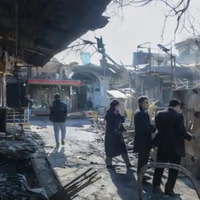
A Palestinian man, who was displaced at Israel's order during the war, speaks with a child after returning to his destroyed house, January 28, 2025
In a press conference that few saw coming, US president Donald Trump stood alongside Israeli Prime Minister Benjamin Netanyahu to announce a jaw-dropping plan to take over and rebuild Gaza.
As Trump spoke, Netanyahu’s eyes darted back and forth between Trump and the gathered press, perhaps looking out for the potential fallout.
In a region where diplomacy often plays out at full volume, Trump’s announcement shattered the sonic barrier, leaving both allies and adversaries scrambling to adjust.
The Disrupter
The announcement was just the latest chapter in Trump's long history of disruption.
The man who started his 2016 presidential campaign polling near 1% in the Republican primaries soon bulldozed through the political establishment, knocking out seasoned contenders like Jeb Bush and Ted Cruz.
His unexpected victory over Hillary Clinton that year defied political logic. Even after losing the 2020 election, Trump managed to disrupted the system again, emerging in 2024 as a force that reshaped American politics yet again.
The Real Estate Mogul
Trump’s vision for rebuilding Gaza brings to mind his early triumphs as a real estate mogul, most famously in the Wollman Rink saga.
For six years, New York City bureaucrats had floundered in their attempts to restore the iconic Central Park ice skating rink, wasting millions of dollars.
On May 31, 1986, Trump declared in an interview with The New York Times, “I don’t want my name attached to losers. So far the Wollman Rink has been one of the great losers. I’ll make it a winner.”
He did take over the project shortly after, completing ahead of schedule and under budget. The rink became a thriving tourist attraction and a successful business, much loved by the city's residents.
To this day, Trump’s association with Wollman Rink remains visible — check the rink’s website, and boom, there's Trump’s unmistakable logo.
Much like Wollman Rink, Gaza is seen by many as a project doomed to failure, weighed down by decades of entrenched problems. But it’s precisely the kind of challenge that energizes Trump.
If nothing else, Trump’s announcement alone has already made people rethink what’s possible.
The Dealmaker
Trump’s proposal sparked reactions among Palestinian including those in the United State.
While some in Gaza, driven by their dire circumstances, may like the idea of relocation to other countries, many view the suggestion as an affront to their rights and aspirations
Tump's plan for Gaza has also pitted him against an ensemble of Middle Eastern strongmen: Egypt’s Abdel Fattah el-Sisi, Saudi Arabia’s Mohammed bin Salman, Jordan’s King Abdullah, Netanyahu himself, and Turkey’s Recep Tayyip Erdoğan.
But Trump’s most strategic target is none of the above. It’s the Ayatollah in Iran. The Gaza plan seeks to isolate the Islamic Republic and break the cycle of dysfunction that has plagued the region for decades.
Trump understands that sometimes ideas matter more than execution. By planting this idea in people’s heads, he’s already forced conversations that many considered impossible.
Whether or not the US ever commits to take over and Gaza, the ripple effects of his announcement are undeniable. Suddenly, everyone is talking about Gaza in a way they weren’t before.
The Ayatollah
While Trump’s plan is disruptive, it coincides with another seismic shift: the slow unraveling of the long-held dream of Iran's supreme leader Ali Khamenei: to push America out of the Middle East.
The Islamic Republic’s overreach in its quest for regional dominance has alienated many of its neighbors, at times pushing Arabs and Israelis closer together.
Instead of driving America out, Khamenei now finds itself in the midst of a conversation about a hypothetical take over of Gaza by the United States.
Trump, ever the disruptor, thrives in the chaos he creates. Whether it’s a New York ice rink or the Gaza Strip, he knows how to break through the noise — and make everyone listen.
The Elva oil tanker believed to be involved in transporting Iranian oil to China.
The economic impact of the so-called maximum pressure on Iran will be significant, with a zero-exports goal set by US president Donald Trump.
On Tuesday, Trump signed a directive reinstating the "maximum pressure" policy from his first term, warning of "catastrophic" consequences if Tehran doesn't reach a deal on its nuclear program. His goal of eliminating Iran’s oil exports is particularly alarming for Tehran, as it would eliminate nearly half of the government's revenues during a seven-year economic crisis.
In its first move, the US Treasury Department on Thursday imposed sanctions on an international network, alleging that it has facilitated the shipment of Iranian oil to China. In a coordinated step, the Treasury and State Departments announced sanctions targeting networks involved in shipping Iranian oil to China. The measures cover multiple countries, including China, India, and the United Arab Emirates, and affect several vessels linked to Iran's oil exports.
While the impact of this order, if fully implemented, would be significant for Iran’s oil exports, there is doubt as to whether it will actually reduce the oil exports to zero or to the levels seen in 2020, the final year of Trump's previous presidency. In 2017, before US sanctions were imposed, Iran exported 2.5 million barrels per day (bpd). By 2020, this figure had plummeted to around 350,000 bpd.
As Joe Biden took office in 2021, Iran’s oil exports rebounded, peaking at nearly 1.9 million bpd in the summer of 2024. After President Biden administration’s imposed sanctions on dozens of tankers involved in smuggling Iranian oil, exports dropped by 500,000 bpd in the final quarter of 2024.
Yet, in January this year, exports once again surged to 1.6 million bpd.
The ship-tracking company Tanker Trackers told Iran International that the recent fluctuations in Iran’s oil exports are typical, noting that such variations are common. "We saw a similar drop during the final months of Biden's presidency, followed by a rebound. There's nothing unusual about it. The average for crude oil exports over the past year is 1.572 million barrels per day, and since January, it has been 1.567 Mbpd. So, it's too early to draw conclusions," the company said.
Iran's Kharq Island in the Persian Gulf is the main loading point for Iranian oil.
Regarding Iran's logistical challenges, Tanker Trackers explained, "There are policies, and then there are logistics. We’re not yet convinced that Iran’s oil exports will drop to the levels seen in May 2019 (439 Kbpd), mainly because there wasn’t an extensive global dark fleet available back then, unlike what we have today."
The United Against Nuclear Iran (UANI) organization, a non-profit group dedicated to preventing Iran from acquiring nuclear weapons, in collaboration with tanker-tracking companies, has identified nearly 400 vessels involved in smuggling Iranian oil, collectively known as the "dark fleet." However, fewer than half of these vessels have been sanctioned.
These tankers attempt to smuggle Iranian oil covertly by turning off their automatic identification systems (AIS).
Currently, China is virtually Iran’s only oil customer. However, it does not purchase oil directly from Iran. Instead, Iranian oil is sold through intermediaries and changes ownership documentation, being rebranded as oil from Iraq, the UAE, Oman, and especially Malaysia before being sold to China’s small, independent refineries.
Tanker Trackers noted that China has already stated repeatedly that importing oil is a matter of national security, regardless of the source.
Meanwhile, the energy consultancy firm Wood Mackenzie told Iran International that the recent drop in Iranian crude oil exports is due to a combination of tighter sanctions on tankers imposed by former President Biden and China’s Shandong port declaring that sanctioned vessels will not be allowed to discharge their cargoes to independent refinery clients.
Wood Mackenzie said that given the recent US sanctions on China and Beijing’s retaliatory tariffs, we do not expect China to comply with Trump’s ‘maximum pressure’ policy on Iran.”
Senior commodity analyst Homayoun Falakshahi from Kpler, a commodities intelligence firm, told Iran International that Iran’s daily oil exports stood at 1.66 million bpd last month. However, he predicted that due to the reinstatement of Trump’s maximum pressure policy, exports could fall to around 500,000 bpd in the coming months.
He added that the extent of this decline depends on Beijing’s cooperation with US sanctions.
China and the US conduct $750 billion in annual commodity and service trade, heavily favoring China. However, Trump recently ordered an increase in tariffs on Chinese imports, prompting Beijing to threaten retaliation.
While China has repeatedly stated that it does not recognize US unilateral sanctions against Iran, its recent ban on US-sanctioned vessels docking at its ports suggests that it takes Washington’s sanctions somewhat seriously.
Iran’s share of China’s oil imports exceeds 10%, with an annual value of around $40 billion. China is also the largest buyer of sanctioned Iranian goods, including metals and petrochemical products. Additionally, a significant portion of Iranian refined petroleum products, such as fuel oil (mazut) and liquefied petroleum gas (LPG), is shipped to China.
Iranian customs data shows that, excluding crude oil, the country exported $12.3 billion worth of goods to China and imported $14.4 billion from China in the first ten months of the current Iranian calendar year (which began on March 21, 2024).
US deputy special envoy for the Middle East Morgan Ortagus walks to give a statement after a meeting with the Lebanese President Joseph Aoun at the presidential palace in Baabda, Lebanon February 7, 2025.
US Deputy Special Envoy for the Middle East, Morgan Ortagus, said on Friday that Hezbollah's "reign of terror" in Lebanon and the region is over, crediting increased US pressure on Iran for the group's decline.
Speaking after meeting with newly elected Lebanese President Joseph Aoun in Beirut, Ortagus said Hezbollah’s involvement in Lebanon’s new government crosses a clear red line for Washington.
"We are committed to making sure that Hezbollah is not a part of this government in any form and that Hezbollah remains disarmed and militarily defeated. That starts with the pressure President Trump is placing on the Islamic Republic of Iran so they can no longer fund their terror proxies in the region," Ortagus said.
Her remarks come as Lebanon’s political landscape experiences what experts have called a seismic shift, with the election of US- and Arab-backed Aoun as president and Hezbollah reeling from its bruising defeats at the hands of Israel.
"The end of Hezbollah’s reign of terror in Lebanon and around the world has started, and it’s over," she said.
Ortagus emphasized that the US will continue efforts to prevent Iran from achieving nuclear capabilities and from destabilizing countries across the Middle East. "Iran was allowed to inflict chaos and harm in this country and so many others for decades, that ends with President Trump," Ortagus said.
Hezbollah suffered its most significant setbacks in years during Israeli strikes last year, with coordinated attacks in September and October decimating thousands of its operatives through precision airstrikes and targeted explosions. The killing of key figures, including Hassan Nasrallah, the group's longtime secretary-general, shattered Hezbollah’s leadership core and left its command structure in disarray.
As Prime Minister-designate Nawaf Salam works to form his cabinet, US officials are urging Beirut to block Hezbollah and its allies from securing key posts, particularly the finance ministry.
Citing sources, Reuters reported that Washington relayed that Lebanon could face difficulties securing foreign financial aid crucial for post-war reconstruction if Hezbollah or Amal—a Shia political party and longtime Hezbollah ally—were to select the country's next finance minister.
Israeli Prime Minister Benjamin Netanyahu and US President Donald Trump hold a press conference on Feb. 4, 2025
Israeli Prime Minister Benjamin Netanyahu told US President Donald Trump at a White House Press conference on Tuesday that the two leaders agree on the danger posed by Iran after the Islamic Republic tried to kill them both.
The Israeli premier praised Trump for pulling out of a deal on Iran's nuclear program, helping midwife a Gaza ceasefire deal freeing some Israeli hostages and restoring on Tuesday the so-called maximum pressure policy of sanctions on Iran from his first term.
"We see eye to eye on Iran. That's the same Iran that tried to kill us both. They tried to kill you, Mr. President, they tried, through their proxies, to kill me."
Iran-backed Hezbollah fighters launched a drone attack from Lebanon on Netanyahu's vacant seaside residence at the height of its conflict with Israel last year. US law enforcement accused Iran of seeking Trump's assassination as retaliation for his order to kill top Iranian commander Qassem Soleimani in 2020.
"The roar of the Lion of Judah is heard loudly throughout the Middle East," Netanyahu said. "Israel has never been stronger and the Iran terror axis has never been weaker."
An attack by Iran-backed Hamas militants on Israel from Gaza on Oct. 7, 2023 triggered a multi-front confrontation embroiling the Jewish state, Iran and the armed groups the Islamic Republic supports in the Middle East.
Over the course of the 15-month war which is now paused by the ceasefire, Israel throttled Hamas in Gaza, decapitated Hezbollah's leadership and helped bring about the downfall of the Assad dynasty in Syria, Iran's oldest Arab ally.
A direct attack on Iran on Oct. 26, 2024 knocked out much of its air defenses and left the Houthi group in Yemen its last largely undeterred affiliate in the region.
"We've devastated Hamas, we decimated Hezbollah, we destroyed Assad's remaining armaments and we crippled Iran's air defenses," Netanyahu added. "We've defeated some of America's worst enemies."
The Israeli premier cited the Americans among the over 1,200 Israelis killed by Hamas in its Oct. 7 attack and among the scores taken captive in Gaza.
"We're both committed to rolling back Iran's aggression in the region and ensuring that Iran never develops a nuclear weapon," Netanyahu continued.
"Mr. President, ladies and gentlemen, Israel will end the war by winning the war. Israel's victory will be America's victory. We will not only win the war working together, we will win the peace."
Trump has repeatedly vowed to not allow Iran to possess a nuclear weapon and said he much prefers a diplomatic solution.
A Palestinian man operates heavy machinery to open the road and remove the rubble, amid a ceasefire between Israel and Hamas, in the southern Gaza Strip, February 4, 2025.
Iran’s foreign minister called on the militant groups it backs in the Middle East to rebuild, in a sign Tehran may be determined to restore regional military influence eroded by Israel in a 15-month conflict.
“The resistance has gone through a difficult and significant period; it must rebuild itself, rebuild its forces, and apply the lessons learned from this war," Abbas Araghchi told a news conference at a Gaza-related event in Tehran on Tuesday.
“We are confident that the resistance will return to the field stronger than before.”
His remarks come as Gaza faces widespread devastation following Israel’s military response to the October 7, 2023, Hamas attacks.
Israeli bombardments and ground operations have left much of the enclave in ruins, with tens of thousands of Palestinians displaced.
A long-sought ceasefire-for-hostages deal was brokered on January 15 after intense negotiations in Doha, mediated by the United States, Egypt and Qatar.
Hamas seized control of the territory in 2007. The armed cadres and military infrastructure of group, designated a terrorist organization by the United States and Britain, have been pummeled by a devastating Israeli incursion into the enclave.
Araghchi said that so-called resistance groups must adapt now that the conflict in Gaza is paused. The array of Islamist armed factions in the occupied Palestinian territories, Lebanon, Iraq and Yemen have long been funded and armed by Tehran.
Israel decapitated the leadership of Hezbollah in Lebanon and helped bring about the downfall of the Assad dynasty in Syria, Iran's oldest Arab ally.
Still, Araghchi said Israel had been defeated in the conflict and described the ceasefire as tenuous.
"Some think that this regime, due to this feeling (of defeat), may take action and violate the ceasefire, which is not unlikely given the nature of the criminal Zionist regime."
“The resistance movement is a school of thought and ideology that cannot be eliminated with weapons,” Araghchi added. “Its main weapon is not conventional arms; it is the blood of the martyrs.”
Israel has denied a Channel 12 report claiming the Prime Minister is seeking US President Donald Trump’s support for a military strike on Iran’s nuclear sites and normalization with Saudi Arabia before advancing the second phase of the Gaza ceasefire.
Netanyahu’s office dismissed the claims as “a total lie that harms the families of the hostages,” Times of Israel reported.
The report alleged that Netanyahu’s plan included delaying negotiations with Hamas for several months while Trump approves an attack on Iran and seals a deal with Saudi Arabia, like those done with countries such as the United Arab Emirates under Trump in 2020.
Netanyahu is set to meet Trump on Tuesday, the first foreign premier to do so since his taking office, in an effort to reset ties after often strained relations with the Biden administration amid the war in Gaza.
The two leaders are expected to discuss the Gaza ceasefire and strategies to counter Iran, according to a statement released by Netanyahu's office.