• العربية
  • فارسی
Brand
  • Iran Insight
  • Politics
  • Economy
  • Analysis
  • Special Report
  • Opinion
  • Podcast
  • Iran Insight
  • Politics
  • Economy
  • Analysis
  • Special Report
  • Opinion
  • Podcast
  • Theme
  • Language
    • العربية
    • فارسی
  • Iran Insight
  • Politics
  • Economy
  • Analysis
  • Special Report
  • Opinion
  • Podcast
All rights reserved for Volant Media UK Limited
volant media logo

Iranian ex-president Khatami sues hardline editor over Soros meeting claim

Maryam Sinaiee
Maryam Sinaiee

Iran International

Jan 25, 2025, 07:58 GMT+0Updated: 11:48 GMT+0
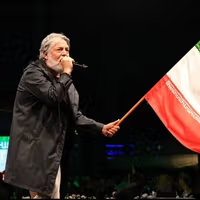
Iran's former President Mohammad Khatami

Former Iranian President Mohammad Khatami is taking legal action against Hossein Shariatmadari, the editor of Kayhan newspaper, over claims that Khatami conspired with American philanthropist George Soros to instigate a "velvet revolution" in Iran.

Soros, the Hungarian-born Jewish financier and philanthropist, is the frequent target of numerous conspiracy theories.

The lawsuit marks another chapter in the ongoing legal disputes between Khatami and Shariatmadari, with the former alleging slander regarding these accusations.

Over the past 15 years, Shariatmadari has repeated his claims that in 2006, a year after leaving office, Khatami met with Soros twice during a private visit to the United States.

The editor-in-chief has yet to present any evidence to substantiate the alleged meetings, which he and other hardliners consider to be acts of treason and a threat to national security.

Shariatmadari is known to be a staunch ally of the country's Supreme Leader, Ali Khamenei, who appointed him to the position in 1993.

Shariatmadari insists that Khatami, in collusion with Soros, attempted to engineer a "velvet" or "color revolution" in Iran during the late 2000s. He holds them responsible for the Green Movement protests that erupted after the highly-contested 2009 presidential election. Hardliners, including Kayhan newspaper, have branded Khatami, along with the defeated presidential candidates Mir-Hossein Mousavi and Mehdi Karroubi, as the "leaders of the 2009 sedition."

In reaction to the lawsuit, reformist political figure and journalist Ahmad Zeidabadi noted that Khatami should not feel the need to defend himself over the claims.

“I would clearly state if I were Mr. Khatami, that I do not need the permission of the managing editor of Kayhan to meet with international figures, and I do not consider meeting with Mr. Soros to be a criminal or unjustified act to defend myself against it,” Zeidabadi said in a Telegram post Wednesday.

In a previous lawsuit filed by Khatami in 2018, Shariatmadari refused to appear in court during preliminary investigations. According to Khatami's lawyers, the country’s Judiciary, also controlled by Khamenei, later closed the case without explanation.

This time around, Khatami’s legal team has said it would pursue the case diligently and keep the public informed of the proceedings.

Allegations rooted in coerced confessions

Shariatmadari's allegations hinged primarily on the forced confessions of Kian Tajbakhsh, an Iranian-American scholar who worked for Soros's Open Society Foundation in Iran during Khatami's term as president.

During mass show trials organized by the Iranian state in the wake of the Green Movement protests—public spectacles where opposition figures were tried en masse to discredit them and suppress dissent— Tajbakhsh claimed that Khatami and Soros had met in the US, with Javad Zarif, then Iran's ambassador to the UN, also present.

Tajbakhsh later withdrew his statements, asserting they were extracted under coercion by the state's security forces. This was a common experience for many political figures, journalists, and activists put on trial in 2009 — and throughout the history of the Islamic Republic.

Shariatmadari’s controversial role

Shariatmadari's editorials, often seen as reflective of the Supreme Leader's views, frequently spark domestic and international controversy.

Despite Kayhan’s dwindling circulation—reportedly below 10,000, with most subscribers being government entities—it remains influential due to its perceived connection to Khamenei.

Critics argue that Shariatmadari and Kayhan enjoy immunity from prosecution, even though the editor has repeatedly accused political rivals and cultural figures of espionage, corruption, and moral failings.

Double standards in legal prosecution

While many Iranian journalists face harassment, threats, and imprisonment for far less, Shariatmadari has avoided accountability for libel and defamation.

Journalist and human rights activist Mehdi Mahmoudian is set to begin serving an eight-month prison sentence this week for “propaganda against the system.” Mahmoudian was convicted for supporting political prisoner Zia Nabavi, who exposed a severe bedbug infestation in Tehran’s notorious Evin prison in May 2024.

While a court found Nabavi not guilty of libel, Mahmoudian was prosecuted for backing his claims.

The former reformist politician has been arrested over ten times and spent eight years in prison since 2009.

Most Viewed

Iran International says it won’t be silenced after London arson attack
1

Iran International says it won’t be silenced after London arson attack

2

State media slam Araghchi's Hormuz tweet, say it let Trump claim victory

3
VOICES FROM IRAN

Hope and anger in Iran as fragile ceasefire persists

4
INSIGHT

How Tehran bends its own red lines to boost state rallies

5

Iran halts petrochemical exports to supply domestic market

Banner
Banner

Spotlight

  • Too early to tell who is winning Iran war, experts say
    PODCAST

    Too early to tell who is winning Iran war, experts say

  • How Tehran bends its own red lines to boost state rallies
    INSIGHT

    How Tehran bends its own red lines to boost state rallies

  • Iran blackout cripples freelancer, small business incomes
    VOICES FROM IRAN

    Iran blackout cripples freelancer, small business incomes

  • Ideology may be fading in Iran, but not in Kashmir's ‘Mini Iran'
    INSIGHT

    Ideology may be fading in Iran, but not in Kashmir's ‘Mini Iran'

  • US blockade enters murky phase as tankers spoof signals and buyers hesitate
    ANALYSIS

    US blockade enters murky phase as tankers spoof signals and buyers hesitate

  • Why the $100 billion Hormuz toll revenue is a myth
    ANALYSIS

    Why the $100 billion Hormuz toll revenue is a myth

•
•
•

More Stories

Tehran girls taunt clerical rule with Sambas and hair unveiled

Jan 24, 2025, 19:17 GMT+0
•
Parisa Khoshnami

In northern and central Tehran, certain streets have become buzzing hangouts where the well-off youth gather in trendy cafes to eat, drink, and quietly but glaringly challenge Iran’s rulers with their outfits.

Lined with chic cafes, these streets aren’t just about coffee; they’re unofficial runways where visitors are dressed to impress, turning casual spots into a parade of cutting-edge fashion.

One item, Adidas Samba shoes has emerged as the ultimate statement, a symbol of youth embracing global trends and modern fashion. The iconic sneakers complement the uncovered hair of young women whose appearance is their struggle—it’s been turned into that by their rulers’ incessant encroachment on their lives.

“What we wear, like our Sambas, is a statement,” says Sima, a young fashion journalist I talked to over an encrypted messaging app. The statement? “We know what’s out there, and we’re part of it too,” she adds.

“The government has tried for years to wrap Iranians in ideology and keep them apart from the rest of the world. But it has failed at every turn, and young women today are living proof of it.”

For those frequenting Tehran’s upscale cafes, fashion isn’t just about rebellion; it’s about belonging to a global culture. Wearing Sambas is a subtle yet powerful way to project a freer identity in a society that’s not too fond of individuality. The minimalist design and timeless appeal of Sambas makes it a perfect vehicle for that desire.

No wonder it’s become a craze. Oneat times taken too far.

Samba or out!

Recently, a new restaurant called Pasata caused controversy when some customers alleged they were denied service for not meeting their high fashion standards.

The restaurant—with its innovative twist on pasta and Instagrammable aesthetic—is a magnet for Tehran’s trendsetters. The hype is so intense that long lines form daily outside its doors, with diners eager to taste what some have called “the best pasta ever.”

But things took a strange turn when some customers claimed they waited for hours without being served. Rumors spread that Pasata catered only to the fashionable elite, and one diner even alleged she was turned away for not being stylish enough.

The chatter reached a new level when the young woman took to X to share her experience, creating a social media buzz. Another woman claimed she was only served after donning a pair of Samba sneakers.

Replicas republic

As popular as Sambas are, acquiring them is not easy. Western brands like Adidas are often unavailable due to sanctions and import restrictions.

“Original pairs are really expensive,” Sima, the fashion journalist, says. “There’s even a small black market for it. But most people buy replicas.”

The phenomenon is by no means limited to Sambas, of course.

Replicas are everywhere in Iran, not least because official brand stores are almost non-existent. Real brands are smuggled and sold at exorbitant prices. Even then, you cannot be sure they’re not replicas.

So for Sambas, at least, some turn to innovative local shoemakers who give them the iconic sneakers—or something closely resembling it—at a fraction of the price.

One way or another, you have to have a pair.

“It’s impossible to walk into a café like Lamiz these days and not notice Samba shoes everywhere.” Mina, a 25-year-old architect and self-proclaimed trendspotter, frequents some of Tehran’s hotspots for stylish youth.

Lamiz, a coffeehouse chain often compared to Starbucks for its interior design and urban vibe, has become a favorite gathering spot for young Iranians.

“You can always tell what’s trending by what people are wearing here,” Mina tells me on an encrypted call from the cafe. “Even the baristas are on trend. There are two girls and two guys and they all wear Sambas.”

A quiet revolution in style

While authorities continue to enforce Islamic guidelines, including mandatory head coverings, the reality on the streets tells a different story: a generation expressing individuality, freedom, and a connection to the wider world through their style.

It’s nothing short of revolutionary.

The cafés of Tehran, especially in the affluent neighborhoods like Tajrish, Farmanieh, and Shahrak-e-Gharb, have become vibrant spaces of freedom where young people gather to express themselves—in words and in looks.

Outfits here reflect a fascinating blend of individuality and global influences, with Samba shoes often standing out, paired with everything from minimalist trousers to bold, oversized jackets.

Most striking, however, is the absence of head coverings—a growing trend that gained momentum with the 2022 protests, the Woman, Life, Freedom movement.

The combination of free hair and Sambas is becoming a symbol of resistance and individuality, blending global fashion with a distinctly Iranian narrative of personal and cultural expression.

But resistance is a risky affair.

Young women not wearing headscarves can be harassed by fanatics or the police. Their cars are regularly stopped and towed. Many businesses, including the trendy cafés of northern Tehran, have been shut down by authorities for allowing women to enter without their mandatory hijabs.

Iranian president heckled in poor oil-rich province

Jan 24, 2025, 17:10 GMT+0

Iran's President Masoud Pezeshkian was heckled during a visit to oil-rich yet underprivileged Khuzestan Province on Thursday, as residents voiced frustration over rising unemployment and other economic concerns.

A local state TV reporter disrupted the President's speech on Thursday by shouting questions about dire conditions in Khuzestan, according to Rouydad24, a relatively independent news outlet. A crowd quickly joined in, chanting slogans highlighting financial hardships and the province's persistent water and power issues.

Pezeshkian attempted to calm the crowd. "I have come here to listen to you, but you do not allow me to speak."

While he claimed to be ready to hear their concerns, he insisted on continuing his speech. Critics in the media later commented that his remarks sounded more like those of an opposition figure than a responsible state official.

Later in the day, Pezeshkian and one of his vice presidents posed for photos dressed as construction workers while laying bricks for the construction of a school in Khuzestan.

Sazandegi, a pro-government publication praised Pezeshkian’s brick-laying gesture as "beautiful." But independent reporter Azadeh Mokhtari remarked on social media: "To prove this wasn’t just a show, the president and his aide should have completed the building!"

100%

"The exchange rate for every US dollar has soared to 838,000 rials, and the president is busy shoveling dirt and cement," one user on X quipped.

Another anonymous user, a cleric, commented, "If the previous ultraconservative President (Mahmoud) Ahmadinejad had done the same, the media would have criticized him with all kinds of harsh words."

Conservative journalist Ali Gholhaki also posted on X: "The country is engulfed in the flames of mismanagement and countless other problems. Who advised the President to stage such a spectacle?"

"I have no idea why Khuzestan has so many problems," media outlets quoted Pezeshkian as saying, adding, "I will change the situation in Khuzestan." Similar promises made by former Presidents Ahmadinejad and Hassan Rouhani did little to improve standards of living in the province.

Over the past 20 years, Khuzestan has been the epicenter of several major protests. Many of those killed during the 2019 nationwide protests in Iran were from Khuzestan, according to human rights organizations.

The Iranian Human Rights News Agency (HRNA) reported that security forces in the province recently arrested dozens of cultural and public figures. The crackdown was carried out to suppress dissent, HRANA reported citing local sources, especially after the fall of the Iran-allied government of Bashar al-Assad in Syria.

Pezeshkian pledged to solve the problems of water supply, unemployment and insufficient educational facilities in the province. "I have inherited these problems from the previous governments," he said.

"I have realized that factories in the province were shut down before my arrival to ensure I see clear skies," the pro-government centrist website Entekhab quoted Pezeshkian as saying. "But you can't fool me! I know this province suffers from pollution all the time."

In an interview, local MP Mojtaba Yousefi highlighted the severe infrastructure challenges in Khuzestan Province, saying, "The government has consistently failed to fulfill its promises to address the province’s water and sewage system issues."

"Despite Khuzestan producing 78 percent of the country’s oil and gas output and being home to five major rivers and six dams, we still struggle to provide clean and fresh water to the local population."

Iran faces wage dilemma amid sanctions, economic malaise

Jan 24, 2025, 07:58 GMT+0
•
Mardo Soghom

As Iran's fiscal year draws to an end in March, the government and parliament grapple with the challenge of raising wages in line with an inflation rate of 40% that has pushed millions of workers to poverty.

Raising wages would be fraught with challenges. The heavily dominant government sector lacks the funds to pay higher wages, while quasi-governmental and private enterprises could face bankruptcy if they attempt to double workers’ pay.

But why is doubling wages even being considered? Ordinary workers currently earn less than $150 a month, while official estimates indicate that a family of three needs at least $450 a month to cover basic necessities.

This disparity stems from persistent inflation, averaging 40% annually over the past five years. Since early 2018, Iran's current has plummeted twentyfold, while wages have increased less than eightfold.

Economists warn, however, that doubling wages is not a viable solution. The government cannot afford the increases, and if it resorts to printing money to meet the demand, inflation will only worsen.

Morteza Afqah, an economics professor, told the conservative Nameh News website in Tehran that Iran’s economic crisis cannot be solved through purely economic measures because the root cause lies in its foreign policy. He argued that the only path forward is to reach agreements with the United States and Europe on nuclear and other contentious issues. According to Afqah, sanctions relief is essential before Iran can even consider sustainable economic solutions.

Top decision-makers have acknowledged the severity of the economic crisis in public, emboldening some media outlets and commentators to be increasingly vocal about the urgent need to strike deals with the West.

Ahmad Zeidabadi, a prominent writer and commentator in Tehran, expressed the frustration of many in a tweet on Thursday. Referring to insiders who suggest they are willing to “negotiate with the devil” to save the Islamic Republic but remain opposed to talks aimed at rescuing the economy, Zeidabadi warned that this mindset could further anger a public already bearing the brunt of inflation and hardship.

Similarly, Sadeq Zibakalam, another well-known commentator, reminded his followers in a post on X that over a decade ago, the head of Iran’s nuclear program had promised to build five nuclear reactors for energy production. “

Where are the reactors?” he asked, noting that nothing materialized while Iran has lost hundreds of billions of dollars to sanctions imposed for its nuclear activities. “It’s time to negotiate,” he urged the government.

Despite these calls for action, Iran’s Supreme Leader has yet to signal any willingness to allow direct talks with the United States or to compromise on key issues. Meanwhile, US President Donald Trump has not officially outlined his policy toward Tehran, though his aides have indicated a tough stance on enforcing sanctions.

With the economy in crisis and public discontent rising, Iran’s leadership faces mounting pressure to make difficult decisions that could reshape the country’s trajectory. Whether they choose to engage with the West or continue their current path remains to be seen, but the stakes could not be higher for the Iranian people.

Iranian official calls for Zarif's arrest over Davos hijab comments

Jan 23, 2025, 20:25 GMT+0

A senior Iranian official has demanded the immediate arrest of Mohammad Javad Zarif, strategic deputy to President Masoud Pezeshkian, over his remarks on the Islamic headscarf hijab made at the Davos Economic Forum.

“Anti-coup forces must arrest Zarif upon his return to the country and subject him to interrogation," the secretary of Tehran’s Promotion of Virtue and Prevention of Vice Council, Momeni-Nasab, wrote on X Thursday. "Otherwise, the country will soon face more complex and highly dangerous crises.”

The criticism arose after Zarif signaled a softer line on hijab enforcement in a CNN interview on the sidelines of the Davos Forum in Switzerland.

“The Islamic Republic has decided not to pressure women regarding the hijab,” Zarif said. “If you walk on the streets of Tehran, you will see some women without hijab. Although this is illegal, the government has chosen not to put women under pressure.”

Tehran’s Promotion of Virtue and Prevention of Vice Council is a governmental body tasked with enforcing Islamic behavioral codes, including mandatory hijab laws. It plays a significant role in shaping and implementing the Islamic Republic’s social policies.

In November 2024, the council announced plans to establish a "hijab clinic" aimed at providing "scientific and psychological treatment" for women who defy compulsory hijab regulations.

In addition to Momeni-Nasab, Zarif’s remarks on the hijab issue sparked backlash on social media, with critics accusing him of misrepresenting the Islamic Republic's stance.

Many argue that the enforcement of the new and more restrictive hijab law has merely been suspended temporarily and it could be revived at any time.

Ultra-hardliners have doubled down on their criticism of Zarif’s remarks. They emphasize Supreme Leader Khamenei’s clear stance on the hijab, citing an April 2023 speech in which he declared that flouting the hijab was both "religiously and politically haram (forbidden)."

Iran criticizes Trump's decision to relist Cuba as state sponsor of terrorism

Jan 23, 2025, 12:14 GMT+0

Iran's Foreign Ministry spokesman called US President Donald Trump's decision to re-add Cuba to the list of state sponsors of terrorism 'baseless and arbitrary', standing alongside Tehran's long-time ally.

"The US has a long history of using such baseless, arbitrary listings and defaming independent countries as a tool to advance its foreign policy," Esmaeil Baghaei was quoted as saying by IRNA, Iran's state news agency, on Thursday.

On Monday, newly sworn-in President Donald Trump reversed the Biden administration's last-minute decision to remove Cuba from the US list of state sponsors of terrorism, the White House said.

The Cuban president responded late on Monday by calling Trump's decision to revoke Biden's measures an "act of mockery and abuse."

"Trump's goal is to continue to escalate the cruel economic war against Cuba with the aim of domination," Miguel Diaz-Canel said.

Cuba announced it would release 553 prisoners in a deal brokered by the Catholic Church after Biden's administration removed Cuba from the list.

Both Iran and Cuba are currently experiencing significant economic crises. Cuba is in its most severe economic crisis since the Soviet era, facing critical shortages of essential goods such as food, medicine and fuel.

Meanwhile, Iran continues to battle severe currency depreciation and hyperinflation in the worst depression since the founding of the Islamic Republic.

Iran has cultivated alliances with Latin American nations like Bolivia, Nicaragua, and Venezuela, strategically positioning itself to challenge Western influence in the region through diplomatic and ideological channels.