• العربية
  • فارسی
Brand
  • Iran Insight
  • Politics
  • Economy
  • Analysis
  • Special Report
  • Opinion
  • Podcast
  • Iran Insight
  • Politics
  • Economy
  • Analysis
  • Special Report
  • Opinion
  • Podcast
  • Theme
  • Language
    • العربية
    • فارسی
  • Iran Insight
  • Politics
  • Economy
  • Analysis
  • Special Report
  • Opinion
  • Podcast
All rights reserved for Volant Media UK Limited
volant media logo

Eggs, sperm and wombs for sale on Iran's reproductive black market
Jan 15, 2025, 18:47 GMT+0Updated: 11:52 GMT+0

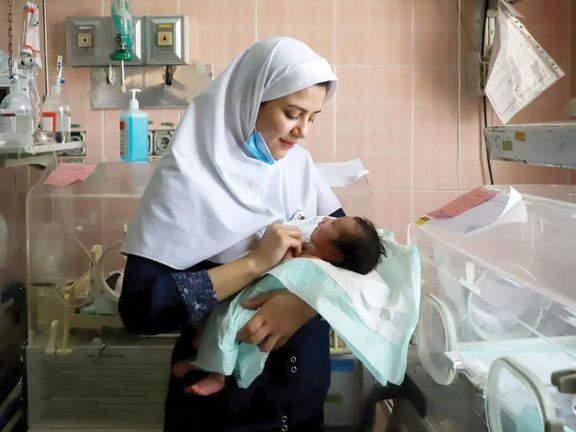
A widespread network of brokers online are working to facilitate a trade in eggs, sperm, embryos and surrogate wombs, Iranian newspaper Ham-Mihan reported in an investigation.

The report on Wednesday details how the transactions are advertised using coded language such as "work from home" on platforms like Divar - a popular Iranian online classifieds site - Instagram and Telegram.

Iran's lack of a clear legal framework governing the donation of reproductive cells and embryos has allowed the brokers to flourish, with some even collaborating directly with doctors.

The advertisements primarily target young adults aged 18 to 31, with varying prices, Ham-Mihan added. Surrogacy typically costs between 3 and 4 billion rials (approximately $3,750 to $5,000), plus an additional 90 million rials (less than $110) paid monthly to the surrogate until delivery.

In May, Tejarat News, another Iranian news outlet, reported a wider range for surrogacy costs, from 4 to 9 billion rials (roughly $5,000 to $11,000). Citing a gynecologist and a maternity ward nurse, it reported that individuals born in the 1990s are the most common surrogates.

Ham-Mihan reported that sellers are required to provide a physician-certified ultrasound confirming the size and reserve of each ovary, along with a certified copy of their national identity card obtained through a designated notary public.

For married donors written spousal consent is mandatory, while unmarried donors must provide a divorce or death certificate. A psychiatric evaluation is also required for all donors.

Zahra Ahmadi, director of social work at the Royan Infertility Treatment Center, a leading facility in Iran, told Ham-Mihan that brokers and intermediaries profit from the unregulated market.

She emphasized that donors can bypass these intermediaries by contacting the Royan Center directly for anonymous donations, dealing directly with the center rather than individual recipients. Ahmadi added that direct egg donors at Royan receive 160 million rials (about $200) per donation under a formal contract.

The report by Ham-Mihan also connects this trade to a broader trend of organ selling in Iran, which has sharply increased in recent years, even involving buyers in neighboring countries.

In June 2023, Hossein Biglari, head of the Kermanshah Kidney Patients Support Association, reported that kidneys were being sold in the province for negotiated prices between 2.5 billion rials (approximately $3,000 at current exchange rates).

Iranian media reports over the past two years have documented the growing prevalence of advertisements for liver, bone marrow, and cornea transplants, as well as sperm and egg donations appearing publicly alongside the sale of kidneys. Some advertisements even offer hearts for sale.

In May 2023, the Jahan-e-Sanat daily reported that some brokers facilitate the sale of organs in neighboring countries like the United Arab Emirates, Turkey and Iraq, fetching prices between of up to $15,000 for sellers.


Most Viewed

State media slam Araghchi's Hormuz tweet, say it let Trump claim victory
1

State media slam Araghchi's Hormuz tweet, say it let Trump claim victory

2
OPINION

The Hormuz get out of jail card turned to a grave

3

Iran International says it won’t be silenced after London arson attack

4
INSIGHT

How Tehran bends its own red lines to boost state rallies

5

Iran halts petrochemical exports to supply domestic market

Banner
Banner

Spotlight

  • Too early to tell who is winning Iran war, experts say
    PODCAST

    Too early to tell who is winning Iran war, experts say

  • How Tehran bends its own red lines to boost state rallies
    INSIGHT

    How Tehran bends its own red lines to boost state rallies

  • Iran blackout cripples freelancer, small business incomes
    VOICES FROM IRAN

    Iran blackout cripples freelancer, small business incomes

  • Ideology may be fading in Iran, but not in Kashmir's ‘Mini Iran'
    INSIGHT

    Ideology may be fading in Iran, but not in Kashmir's ‘Mini Iran'

  • US blockade enters murky phase as tankers spoof signals and buyers hesitate
    ANALYSIS

    US blockade enters murky phase as tankers spoof signals and buyers hesitate

  • Why the $100 billion Hormuz toll revenue is a myth
    ANALYSIS

    Why the $100 billion Hormuz toll revenue is a myth

•
•
•

More Stories

Iran’s atomic chief says nuclear doctrine rests with top leadership

Jan 15, 2025, 17:20 GMT+0

Decisions concerning Iran's nuclear doctrine are made exclusively by the nation’s highest authorities, the head of the Atomic Energy Organization of Iran (AEOI) said on Wednesday.

Iran's potential interest in nuclear weapons has come into focus days ahead of the return to the White House of Donald Trump, who has vowed to deny Tehran a bomb.

Responding to parliamentary discussions on nuclear weapons, Eslami said, "Parliament members express their own views, but decisions regarding the nuclear doctrine are made at the highest levels of the system and by the relevant authorities."

Eslami added that Iran’s nuclear program operates within its established framework, with the Atomic Energy Organization overseeing technical aspects and the Foreign Ministry handling diplomatic negotiations.

Despite Eslami’s assurance of continuity, calls for a more aggressive nuclear posture have grown among influential lawmakers.

Ahmad Bakhshayesh Ardestani, a member of the National Security and Foreign Policy Committee, proposed in November to escalate uranium enrichment and initiating nuclear weapon production in response to an International Atomic Energy Agency (IAEA) censure resolution.

“Under current circumstances, Iran should first move toward increasing uranium enrichment, potentially raising the enrichment level to 70% or 80%. In the second phase, Iran should pursue nuclear weapon production,” Ardestani told Didban News in November.

Iran is currently stockpiling 60-percent enriched uranium, which can be quickly refined to the 90% threshold required for nuclear weapons. Estimates suggest Iran could achieve this level within weeks, but producing an operational warhead involves additional technological and logistical challenges.

Centrifuges in Natanz, Iran (undated)
100%
Centrifuges in Natanz, Iran

Former AEOI chief Fereydoun Abbasi also addressed the nuclear issue last week, saying that Iran has long surpassed the stage of constructing nuclear weapons.

“We can enrich uranium to any level we desire,” Abbasi said, advocating for stockpiling enriched uranium in secure locations to bolster deterrence. He justified this approach by citing perceived threats from nuclear-armed states, including the US and Israel.

Fatwa and international scrutiny

President Masoud Pezeshkian reaffirmed Iran’s adherence to a peaceful nuclear policy last week, citing Supreme Leader Ali Khamenei’s fatwa prohibiting nuclear weapons.

“The Islamic Republic has absolutely no intention of utilizing its nuclear capabilities for military purposes based on its ideological beliefs and a fatwa by Supreme Leader Ali Khamenei,” Pezeshkian said during a meeting with Britain’s ambassador to Tehran.

The fatwa has been a cornerstone of Iran’s nuclear doctrine for over two decades, though some experts note it could be revised. “The Leader’s opinion forbids this direction now, but opinions can change,” said nuclear engineer Mahmood-Reza Aghamiri.

A top foreign policy advisor to Khamenei said last year that Iran is capable of producing nuclear weapons and an existential threat could cause a rethink of the Supreme Leader's injunction against them.

"If the Islamic Republic of Iran faces an existential threat, we would have no choice but to adjust our military doctrine," former foreign minister Kamal Kharrazi said.

Meanwhile, concerns over Iran’s uranium enrichment activities have intensified. The International Atomic Energy Agency recently reported that Tehran is approaching weapons-grade enrichment levels, prompting European nations to question the absence of a credible civilian justification for its stockpiles.

Amid escalating domestic debates and mounting international scrutiny, Iran’s nuclear doctrine remains at a crossroads, with high-level decisions poised to determine its future trajectory and global implications.

Iranian filmmaker's drama on 2022 protests earns BAFTA nomination

Jan 15, 2025, 16:00 GMT+0

The Seed of the Sacred Fig, the latest film made by Iranian dissident filmmaker Mohammad Rasoulof, has been nominated in BAFTA's hotly contested Film Not In The English Language category.

The film has been nominated in the category alongside All We Imagine As Light, Emilia Pérez, I’m Still Here, and Kneecap.

In 2024, the movie won the Cannes Film Festival's Jury Special Prize, the FIPRESCI Award, the Prize of the Ecumenical Jury, and the François Chalais Award for Best Film, solidifying its reputation as a cinematic masterpiece.

It was also nominated for a Golden Globe for Best Motion Picture in a Non-English Language and won the Audience Award for Best International Feature at the Sydney Film Festival.

Rasoulof’s film delves into the protest movement in Iran following the death of Mahsa Amini in 2022.

"Investigating judge Iman grapples with paranoia amid political unrest in Tehran. When his gun vanishes, he suspects his wife and daughters, imposing draconian measures that strain family ties as societal rules crumble," reads the film's summary on the Internet Movie Database (IMDB).

The film led to an eight-year prison sentence for its director Mohammad Rasoulof, forcing him to flee Iran last May. Rasoulof made his daring escape on foot, traversing rugged mountainous borders to avoid imprisonment.

“Knowing that the news of my new film would be revealed very soon, I knew that without a doubt, a new sentence would be added to these eight years. I didn’t have much time to make a decision. I had to choose between prison and leaving Iran. With a heavy heart, I chose exile. The Islamic Republic confiscated my passport in September 2017. Therefore, I had to leave Iran secretly," Rasoulof said at the time.

Rasoulof’s lawyer, Babak Paknia, disclosed on April 29 that several crew members associated with the film had been summoned by authorities, with some facing interrogation and others barred from international travel.

Germany, the country where Rasoulof has taken refuge, has selected The Seed of the Sacred Fig as its official entry for Best International Feature Film at the 97th Academy Awards.

“It is an outstanding work by one of the great directors of world cinema and someone who has found refuge in Germany from state despotism in Iran. We are very happy to know that Rasoulof is safe in our country. And we are delighted that he will be representing Germany at the Oscars in 2025," German Films said in their statement.

Tajikistan hosts Iranian president on his first foreign visit of 2025

Jan 15, 2025, 12:56 GMT+0

Iranian President Masoud Pezeshkian has arrived in Tajikistan for his first foreign visit of 2025.

Announcing the visit, the Foreign Ministry spokesman, Esmail Baghaei, wrote on X, that the visit is a "symbol of the two nations' leaders’ commitment to further strengthening relations."

During the visit, approximately 20 cooperation agreements are expected to be signed between the two countries, according to Iran's Foreign Minister Abbas Araghchi.

Speaking to Iranian media, Araghchi said Tuesday that the agreements will span various sectors, including trade, investment, water and electricity industries, technical engineering services, transportation, tourism, university research, and more.


Iranian-Swedish death row scientist accuses Sweden of neglect

Jan 15, 2025, 11:46 GMT+0

Ahmadreza Jalali, an Iranian-Swedish scientist currently sentenced to death in Iran, accused the Swedish government of neglecting his case in an audio message from Evin Prison.

In the message, which was sent to his wife, Vida Mehrannia, and received by Iran International, Jalali said: "I have been abandoned under these horrific conditions, with the imminent threat of execution looming. It appears that because of my dual nationality, I am regarded as a second-class citizen."

As part of a prisoner exchange agreement in June, Sweden repatriated a former Iranian official convicted of war crimes, Hamid Nouri, in exchange for the release of two Swedish citizens, Johan Floderus, an EU representative, and Saeed Azizi, who had been detained in Iran on charges of "spying for Israel."

However, Jalali, who was sentenced to death in October 2017 on charges of “corruption on earth”, was left behind in Iran.

“Swedish authorities are aware of my situation, yet no actions have been taken to improve it," he added.

"It seems that what might happen to me as a Swedish citizen is not a priority for Swedish officials. I face the risk of death, either by execution or due to my deteriorating health condition."

Since last year's prisoner exchange, Jalali has criticized the decision, describing the Swedish government’s exclusion of him as discriminatory.

In June, he publicly challenged the Swedish Prime Minister to meet with his son and family to explain why he was left behind and what actions would be taken to support them in the event of his execution.

Jalali's trial in Tehran’s Revolutionary Court, Branch 15, was criticized by Amnesty International for relying on confessions obtained under torture.

Iran unveils advanced signals intelligence ship alongside military drills

Jan 15, 2025, 10:16 GMT+0

Iran’s navy unveiled its first signals intelligence (SIGINT) vessel, Zagros, on Wednesday, said to be designed for electronic surveillance and cyber intelligence operations.

The announcement follows the news that Iran's army received 1,000 new drones, bolstering its military capabilities.

"The Zagros will serve as the watchful eye of Iran's navy in the depths of the seas and oceans," Navy Commander Shahram Irani said during the unveiling ceremony.

The launch coincides with extensive military exercises aimed at safeguarding the country's nuclear infrastructure, including key facilities in Natanz and Fordow.

The drills, involving both the Islamic Revolutionary Guard Corps (IRGC) and the Iranian army, are expected to continue until mid-March.

The head of the Atomic Energy Organization, Mohammad Eslami, announced on Wednesday that two additional exercises will be conducted in the coming days, focusing on passive defense to demonstrate maximum operational readiness.

The unveiling of the Zagros comes amid intensified and ongoing international scrutiny of Iran's nuclear program.

Tehran maintains its nuclear activities are solely for peaceful purposes, a claim increasingly challenged due to its elevated uranium enrichment levels.

The International Atomic Energy Agency (IAEA) has confirmed that Iran holds uranium enriched to 60%, approaching weapons-grade levels.

Tensions between Iran and the United States have escalated in recent years, especially after the US withdrew from the 2015 nuclear deal during Donald Trump's presidency and reimposed sanctions. Relations were further strained by the killing of General Qassem Soleimani in 2020, as well as Tehran's support for regional proxy groups, and alleged attacks on commercial shipping in the Persian Gulf.

Reports earlier this month suggested that the Biden administration considered potential strikes on Iranian nuclear facilities if Tehran continued its progress toward developing a nuclear weapon.

Iran’s investment in the Zagros and other military technologies underscores its focus on strengthening surveillance and defensive capabilities in response to regional and international challenges.

Admiral Shahram Irani asserted that the ship is domestically constructed and will play a key role in securing maritime domains, including the Indian and Pacific Oceans.

"The Iranian navy has successfully addressed the nation’s defensive demands through local expertise and advanced intelligence capabilities," Admiral Irani said.






