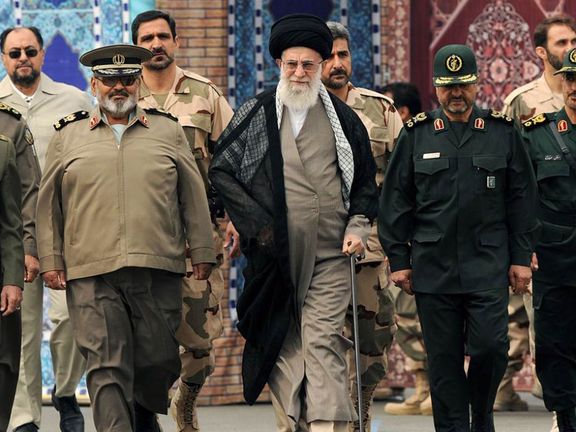
Iranian Supreme Leader Ali Khamenei (2nd left) and a group of Revolutionary Guards commanders during an event in Tehran
While many analysts agree that Iran finds itself in a weakened position, a conservative commentator inside Iran claims that the unstable situation might shift in Tehran's favour.
Former politician Abolfazl Hassanbeigi, who is permitted to express his views in Iran's domestic media, also cautioned the country's officials that Iran is likely to face two challenging years ahead.
In the interview with the conservative Nameh News site, Hassanbeigi suggested that with proper management, the situation could improve -- ultimately bringing the region in line with Iran’s interests.
In its analysis, Nameh News noted that recent developments in the region have led many to believe that Tehran's influence has been weakened.
The diminishing influence of Hamas and Hezbollah, coupled with the fall of Assad in Syria, and the rise of Joseph Aoun—viewed as a candidate favored by both the US and Saudi Arabia—as Lebanon's president, has led many analysts to conclude that the dominance of Iranian-backed forces in the region might be drawing to a close.
Several Iranian observers, including imprisoned government critic Mostafa Tajzadeh, have argued that the fall of Assad, along with Israeli strikes on Hezbollah and Hamas, signals the collapse of what Iran refers to as the "axis of resistance," a term Tehran uses to describe its network of allies and proxies in the region. These observers view this as a strategic defeat for the Islamic Republic, attributing Iran’s growing isolation and economic difficulties to Supreme Leader Khamenei’s commitment to the "axis."
Meanwhile, Iran's ambassador to Lebanon, Mojtaba Amani, said last week that the election of Aoun, who has not been Hezbollah's candidate, does not represent a defeat for Iran.
Nameh News dismissed the idea of the "axis of resistance" ending as a delusional, suggesting that over time, the prevailing perception might shift towards viewing the region as increasingly aligned with the US.
However, the outlet also noted that some analysts believe the "axis" has experienced similar fluctuations in the past but has ultimately been revitalized, continuing to influence regional developments.
The website also pointed out that "none of the two views reflect the whole truth. In fact, both of them reflect what the analysts like to happen. West Asia has always been giving birth to new developments that disrupted previous equilibriums. However, the main question is that where will Iran be standing and what role Tehran is likely to play in the region."
Hassanbeigi told Nameh News that Iran's regional strength depends on resolving its internal disputes, asserting that the country is powerful enough to deter opposition if united.
He criticized radicals in Iran's political landscape, particularly in the parliament, for undermining the presidential administration through psychological warfare and efforts to tarnish its image.
"The radicals think of themselves as a new political force and that they can do anything they want even if their behavior harms the country's national interests," Hassanbeigi argued.
Addressing tensions with the US, Hassanbeigi remarked that despite Netanyahu's efforts, Washington does not appear to view a war with Iran as being in its best interest.
He acknowledged the challenges ahead, stating, "We face a couple of difficult years, but if we navigate this period effectively, the regional dynamics will shift."
He claimed that American policies often create adversaries wherever they intervene, as their excessive demands alienate others in the region.
Iranian President Masoud Pezeshkian has arrived in Tajikistan for his first foreign visit of 2025.
Announcing the visit, the Foreign Ministry spokesman, Esmail Baghaei, wrote on X, that the visit is a "symbol of the two nations' leaders’ commitment to further strengthening relations."
During the visit, approximately 20 cooperation agreements are expected to be signed between the two countries, according to Iran's Foreign Minister Abbas Araghchi.
Speaking to Iranian media, Araghchi said Tuesday that the agreements will span various sectors, including trade, investment, water and electricity industries, technical engineering services, transportation, tourism, university research, and more.
Ahmadreza Jalali, an Iranian-Swedish scientist currently sentenced to death in Iran, accused the Swedish government of neglecting his case in an audio message from Evin Prison.
In the message, which was sent to his wife, Vida Mehrannia, and received by Iran International, Jalali said: "I have been abandoned under these horrific conditions, with the imminent threat of execution looming. It appears that because of my dual nationality, I am regarded as a second-class citizen."
As part of a prisoner exchange agreement in June, Sweden repatriated a former Iranian official convicted of war crimes, Hamid Nouri, in exchange for the release of two Swedish citizens, Johan Floderus, an EU representative, and Saeed Azizi, who had been detained in Iran on charges of "spying for Israel."
However, Jalali, who was sentenced to death in October 2017 on charges of “corruption on earth”, was left behind in Iran.
“Swedish authorities are aware of my situation, yet no actions have been taken to improve it," he added.
"It seems that what might happen to me as a Swedish citizen is not a priority for Swedish officials. I face the risk of death, either by execution or due to my deteriorating health condition."
Since last year's prisoner exchange, Jalali has criticized the decision, describing the Swedish government’s exclusion of him as discriminatory.
In June, he publicly challenged the Swedish Prime Minister to meet with his son and family to explain why he was left behind and what actions would be taken to support them in the event of his execution.
Jalali's trial in Tehran’s Revolutionary Court, Branch 15, was criticized by Amnesty International for relying on confessions obtained under torture.
Gas flares from an oil production platform at the Soroush oil fields in the Persian Gulf, south of the capital Tehran
The latest US sanctions targeting Russian and Iranian oil could significantly disrupt Russia's oil supply chains, the International Energy Agency (IEA) said in its monthly report on Wednesday.
The new US sanctions on Iran and Russia announced last Friday, target entities responsible for over one-third of Russian and Iranian crude exports in 2024.
"We maintain our supply forecasts for both countries until the full impact of sanctions becomes more apparent, but the new measures could result in a tightening of crude and product balances," the IEA said.
Washington's latest sanctions package includes over 160 tankers, which the IEA estimates transported about 22% of Russia's seaborne oil exports in 2024.
The agency highlighted the effectiveness of earlier vessel designations, saying they had "reduced the activity of designated tankers by 90%."
The US Treasury on Friday imposed sanctions on several vessels involved in transporting Iranian oil, as part of a broader effort to disrupt Russia's network of ships evading US-led energy sanctions.
Of the 183 blacklisted vessels, eight were identified as having transported both Russian and Iranian oil, the Treasury reported.
"Several of the vessels sanctioned today have shipped not only Russian oil but also sanctioned Iranian oil," the Treasury said.
The vessels are part of a "shadow fleet," described by the Treasury as a network using "high-risk shipping practices" to avoid detection.
Many of these ships have been involved in transporting Russian oil at prices exceeding the $60-per-barrel cap imposed by G7 countries, the Treasury added.
Early January saw crude oil prices rise above $80 a barrel, what the IAE described as a result of tighter sanctions and a cold snap in the northern hemisphere.
However, the IEA anticipates that strong supply growth outside OPEC+ and the potential for OPEC+ to ease production cuts could moderate further price increases.
The IEA forecasts global oil supply growth of 1.8 million barrels per day (bpd) in 2025, with non-OPEC+ production contributing 1.5 million bpd.
While IEA's latest report did not provide an estimate for market surplus in 2025, its December forecast projected at least 950,000 bpd, indicating comfortably supplied market.
Iran has been reduced to its weakest point in decades, President Joe Biden said in a valedictory foreign policy speech on Monday, citing Tehran's dire economy, knocked-out air defenses and loss of Syria as an ally.
"Iran's air defenses are in shambles. Their main proxy, Hezbollah, is badly wounded, and as we tested Iran's willingness to revive the nuclear deal, we kept the pressure with sanctions. Now Iran's economy is in desperate straits," Biden said in a White House speech to applause.
"All told, Iran is weaker than it's been in decades," he added, also citing Washington's and other allies' assistance of Israel in shooting down drones and ballistic missiles the Islamic Republic launched in two direct attacks last year.
Biden has been repeatedly criticized by President-elect Trump, who is due to return to the White House next week, as being too soft on Iran.
In 2023, the Biden administration unfroze $6 billion in Iranian funds to bank accounts in Qatar in exchange for the release of five US-Iranian prisoners held by Tehran. That move was lambasted by Republican critics as indulging Iranian hostage diplomacy.
Amid bipartisan pressure following the Oct. 7 attack by Iran-backed Hamas against Israel, the Biden administration told lawmakers it would effectively refreeze those funds for the foreseeable future.
"You want more evidence we seriously weakened Iran and Russia? Let's take a look at Syria. President Assad was both countries' closest ally in the Middle East. Neither could keep him in power. Quite frankly, neither really tried very hard," Biden added.
"Now I cannot claim credit for every factor that led to Iran and Russia growing weaker in the past four years," Biden added. "They did plenty of damage all by themselves, (and) Israel did plenty of damage to Iran and its proxies, but there's no question our actions contributed significantly," he said without elaborating.
Hawkish Israeli Prime Minister Benjamin Netanyahu has said not heeding US warnings to ease up attacks on Iran's armed allies help put them on the backfoot.
Biden had counseled Netanyahu not to retaliate strongly after the Islamic Republic's first ever direct attack on Israel in April - advice he largely heeded. But the White House blessed a sharp response to another salvo in October in which Israel pounded military targets and destroyed Tehran's Russian-provided anti-aircraft missiles.
"Now major authoritarian states are aligning more closely - Iran, Russia, China, North Korea - but that's more out of weakness than out of strength," Biden said.
Data from oil tanker tracking firms shows that during Biden's presidency, Iran exported approximately 2 billion barrels of oil—a significant increase compared to the volumes recorded between 2019 and 2021.
Trump has pledged to crack down on the trade to deprive Iran of revenue for foreign military activities, saying he will pressure China - Iran's top customer - to stop buying.
Iran's president told NBC News that Tehran is ready for talks with the United States and European Union, emphasizing that Iran is committed to peace in a dovish message likely aimed at the incoming US administration.
"We are ready for dialogue; we accept an equal conversation that considers our dignity and wisdom, and we will not submit to force in any way," Masoud Pezeshkian told NBC in an interview in Tehran.
His official website framed the remarks as referring to the United States and European Union.
"The Islamic Republic of Iran is committed to peace and de-escalation in the region and globally, condemns the Zionist regime's war-mongering, aggression, and genocide, and stands ready for honorable and equal negotiations," he added.
The interview was broadcast on the American television network on Wednesday in spite of the fact the two nations have no diplomatic ties and Iran's Supreme Leader has spoken out against negotiating with the US.
Pezeshkian has consistently advocated for regional and global peace, as the nation's armed allies across the region face increasing challenges.
“We desire friendly relations with the countries of the region and the world, and we are striving to establish peace and security both inside and outside the country,” he said last month during a visit to North Khorasan province.
Pezeshkian made similar remarks in September, accusing Israel of provoking an all-out war as the Jewish state was in the midst of a series of airstrikes targeting Iran's largest military ally, Hezbollah in Lebanon, alongside the war in Gaza against Iran-backed Hamas.
"We want to live in peace; we don't want war," Pezeshkian told Reuters. "It is Israel that seeks to create this all-out conflict."
Iran's Supreme Leader Ali Khamenei said in a speech last week that advocates of negotiating with the United States are "intimidated by the enemy", the two countries not having diplomatic ties since 1980.
He urged officials of the Islamic Republic to disregard "the unreasonable demands of Americans" when addressing key issues, including the hijab, inflation, and currency.
Responding to the question, "Why do we negotiate with Europeans but not engage with the United States?" Khamenei said, "America's enmity toward Iran and the Revolution is deeply rooted and relentless."
US President-elect Donald Trump is set to officially assume office as President of the United States in less than a week, on January 20.
During his first term, Trump implemented a series of measures aimed at weakening Iran’s economy and curbing its regional influence, notably its nuclear program. He withdrew the United States from the nuclear deal with Tehran but did not pursue negotiations that could lead to a new agreement.
In a clear signal of the incoming administration’s intentions, Trump’s newly appointed senior adviser on the Middle East, Massad Boulos, said that President-elect Donald Trump plans to revive his maximum pressure strategy against Iran, further emphasizing the goal of enforcing Iran’s isolation.
On Monday, The Economist described Iran as "vulnerable to a Trumpian all-out economic assault." Similarly, The Spectator wrote, "Trump’s presidency could spell the end of Iran’s regime."