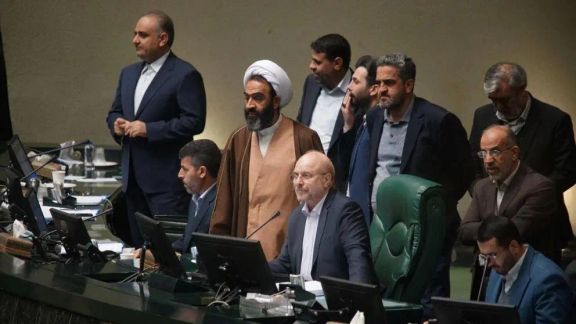
Parliament speaker Ghalibaf with a group of lawmakers during a session.
Hardliners in the Iranian parliament are determined to impeach four cabinet ministers just five months after the government’s formation, during an unprecedented economic crisis.
The hardliners' push began last week with a motion to impeach Economy Minister Abdolnasser Hemmati. According to the conservative Nameh News website, after Speaker Mohammad Bagher Ghalibaf opposed the move, the hardliners expanded their efforts to include three additional ministers: Labor Minister Ahmad Maydari, Oil Minister Mohsen Paknejad, and Energy Minister Abas Aliabadi.
However, moderate MP Gholamreza Tajgardoon suggested on Tuesday that Speaker Ghalibaf might still manage to persuade lawmakers to withdraw the impeachment motion.
The new government was barely a month old when Iran’s already weakened currency, the rial, began to plummet in September, losing 33% of its value. This sharp decline followed a series of consecutive regional setbacks for the Islamic Republic, including significant blows dealt by Israel to Hezbollah.
Iran's economy minister Abdolnasser Hemmati
The ultraconservative daily Vatan Emrooz reported that "the motion for impeachment has been submitted to the Majles Presidium despite Ghalibaf's opposition." The newspaper noted that "the number of MPs supporting the impeachment of Hemmati exceeds those seeking to unseat the other three ministers." According to the report, while the motions to impeach the other ministers have been signed by around 10 MPs each, the call to impeach Hemmati has garnered over 70 signatories.
The new additions to the list of impeachments could be a tactic by hardliners to make sure that they can unseat at least one minister to demonstrate their power. That is important for hardliner majority as they have not been able to ratify any significant legislation since entering the parliament in May 2024.
Tajgardoon, chairman of the Majles Budget Committee, commented that "the calls for impeachment are rooted in factional motivations." He suggested that hardliners might be targeting the Oil and Labor Ministers, who only narrowly secured the parliament's vote of confidence. While recognizing that the primary target of the impeachment efforts is the Economy Minister, Tajgardoon expressed hope that the motion would not lead to Hemmati's removal from the government.
The conservative Nameh News has reported that "if successful, the impeachment would bring about a significant shift in the government and is likely to escalate tensions between the cabinet and parliament."
According to Nameh News, the hardliners have justified their impeachment efforts by stating that they are targeting Hemmati for the surging exchange rates, Paknejad for failing to supply fuel to power plants, Aliabadi for recurring power outages, and Meydari for his inability to improve workers' livelihoods or reduce unemployment in Iran.
However, none of these issues are new, as the newly formed government inherited longstanding shortages and structural problems from previous administrations, compounded by years of sanctions and ineffective governance.
The Alef website suggested that the true motive behind the impeachment push might lie in the economic interests of powerful insiders. As the rial plummeted, the government restricted access to cheap dollars previously supplied to influential importers—well-connected figures within Iran. According to Alef, "Eliminating the special lower exchange rate for importers and exporters, along with requiring exporters to repatriate their hard currency earnings to Iranian banks, has fueled the impeachment effort." The website supported its claims with statements from government spokeswoman Fatemeh Mohajerani and Vice President Mohammad Reza Aref, who defended Hemmati's foreign exchange policy reforms.
Reformist media outlets, including Rouydad24, have criticized the impeachment motions, noting that they come "during severe economic and foreign policy crises in Iran," while also citing "heightened international tensions in the region." Highlighting the factional motivations behind the push to impeach Hemmati, the website questioned, "Why was former President Raisi's economy minister never impeached, even after a 120-percent rise in exchange rates?"
While Ghaibaf has branded the impeachment as a "political show by hardliners," ultraconservative media such as Vatan Emrooz say "impeachments are a way of making the government accountable."
Iraq's Prime Minister Mohammed Shia' al-Sudani during a joint press conference with Iran's President Masoud Pezeshkian on January 8, 2025.
Iraq's prime minister emphasized the need for stability in Syria during a joint press conference with Iranian President Masoud Pezeshkian in Tehran on Wednesday, his first visit since Islamist rebels in neighboring Syria toppled the decades-old rule of the Assad dynasty.
Mohammed Shia' al-Sudani said: “Stability in Syria is the key to stability in the region."
He called for halting foreign interventions and ensuring that Syrians decide their future without external influence.
“We are ready to work with all parties to achieve stability in Syria, ensuring that all Syrians and various groups participate in shaping the country's future,” he added.
The meeting came in the wake of the December collapse of long-time President Bashar al-Assad’s government, marking a pivotal moment for Syria and the wider region.
Since the outbreak of Syria's conflict in 2011, Iran played a central role in supporting Assad’s regime.
Viewing Syria as a strategic ally in its Axis of Resistance against Israel and the West, Iran deployed financial and military resources, including IRGC personnel and Shiite militias.
However, Iran’s extensive involvement came at a severe cost to Syria's sovereignty and economy, fostering widespread resentment among Syrians.
“We hope this visit, combined with the mutual trust between the two sides, will accelerate the development of cooperation and lead to significant progress in relations between the two countries,” he said.
Iraqi Prime Minister Mohammed Shia al-Sudani and his accompanying delegation attend a meeting with Iranian President Masoud Pezeshkian in Tehran, Iran, January 8, 2025.
Pezeshkian also said, “Both countries share common concerns regarding Syria. These include ensuring stability and peace in Syria, preserving its territorial integrity, combating terrorist groups, the necessity of the Zionist regime's withdrawal from occupied territories, and respecting religious sentiments, particularly concerning Shiite holy sites.”
Iraq’s risk of Iranian influence
While Iran remains a key partner, its actions in Iraq parallel its approach in Syria, fostering Shiite militias under the Popular Mobilization Forces (PMF). These groups, acting as extensions of Tehran’s interests, have strained Baghdad's authority and fueled fears that Iraq could face a fate similar to Syria.
“We invite all countries to engage in dialogue among the nations of the region to ensure peace, stability, and security. Since its victory over ISIS, Iraq has consistently worked towards fostering calm in the region. Iraq operates based on understanding and dialogue between nations," al-Sudani said.
He also held talks with Mohammad Bagher Ghalibaf, the Iranian Parliament Speaker after the joint press conference in a bid to smooth out a pathway for the future without the risk of extensive Iranian involvement in Iraq.
Iran will relocate its capital to the southern coastal region of Makran, the government spokeswoman said on Tuesday, in an ambitious plan aimed at bypassing Tehran’s enduring overpopulation, power shortages and water scarcity.
While officials emphasize the strategic and economic advantages of the shift, critics have voiced concerns over likely enormous financial and logistical demands.
“The new capital will definitely be in the south, in the Makran region, and this matter is currently being worked on,” government spokeswoman Fatemeh Mohajerani said on Tuesday.
She highlighted Tehran’s growing ecological pressures, including water scarcity and announced the formation of two councils to examine the feasibility of the move and develop a sea-based economy in the Makran region.
“We are seeking assistance from academics, elites and experts, including engineers, sociologists and economists,” she added, while stressing that the issue remains in the exploratory phase and is not urgent.
A divisive, costly undertaking
President Masoud Pezeshkian reignited the debate over the location of the capital, advocating for a move by describing the imbalance between Tehran’s financial resources and expenditures as unsustainable.
Advocating for a shift closer to the Persian Gulf, he said last week, “transporting raw materials from the south to the center, processing them, and returning them south for export drains our competitive capacity.”
However, critics, including conservative journalist Ali Gholhaki, have lambasted the proposal.
“Rebuilding Azadi Stadium takes 18 months and costs 19 trillion rials ($23.75 million); how much time and money does relocating the capital require? Think over a century and hundreds of billions of dollars!” Gholhaki wrote on X, calling the idea unrealistic and risky for a country under severe economic strain.
A view of Iran’s capital Tehran
Discussions about relocating Iran’s capital have persisted since the 1979 Islamic Revolution but have been consistently derailed by financial constraints, political inertia and logistical challenges.
Previous Iranian administrations have considered various versions of the idea, but financial limitations and political stagnation have repeatedly hindered progress.
The concept gained momentum during Mahmoud Ahmadinejad’s presidency, primarily due to concerns over Tehran’s vulnerability to earthquakes.
In the mid-2010s, President Hassan Rouhani revived the discussion, emphasizing the city's unsustainable growth and mounting environmental issues.
An Iranian woman without mandatory hijab in public
The Iranian government said on Tuesday that the implementation of the controversial "Chastity and Hijab" law has been postponed due to the potential unrest it may spark.
Fatemeh Mohajerani, the spokeswoman for the administration of President Masoud Pezeshkian, said at a press conference: "Some clauses of the law could have had social consequences, and with these considerations and with wisdom, it was postponed."
The announcement comes despite repeated calls from hardliners for the law’s swift enforcement in a bid to combat the country's mass hijab rebellion in the wake of the 2022 Woman, Life, Freedom uprising.
In mid-December, Iran's vice-president for parliamentary affairs, Shahram Dabiri, announced that the administration is drafting a bill to amend the hijab law, which the Parliament Speaker Mohammad Bagher Ghalibaf had promised would take effect on December 13.
Fearing social unrest, Mohajerani said no alternative legislation regarding hijab is currently under consideration.
Expert work has begun within the Presidential Legal Department, but she indicated that formulating new legislation on the issue would be a lengthy process.
The government's delay in implementation suggests a recognition of the potential for further social unrest, particularly given the widespread protests that followed the death of Mahsa Amini in 2022 in the custody of Iran’s so-called morality police.
However, the pause is not reflective of any shift in the government's stance on the issue. "Iranian women have been chaste since ancient Iran," Mohajerani said.
The final text of the so-called "Support for Family through Promoting the Culture of Chastity and Hijab" law, published by Iranian media in December, has faced widespread criticism and protests.
In December, UN experts expressed their concerns about the law's implications in a statement in December.
Human Rights group Amnesty International also condemned the law, saying it would intensify the repression of women and girls and warning that Iranian authorities are attempting to solidify the existing system of oppression against women.
According to the US-based Human Rights Activists News Agency (HRANA), over 30,000 women in Iran faced legal action in 2024 for defying mandatory hijab.
A little girl sitting on the sidewalk asking for change, Iran
As voices associated with Iran’s ruling establishment increasingly advocate for negotiations with the United States, a prominent newspaper has warned that up to 50% of the population is now living below the poverty line.
Aftab News observed that “Given Trump’s return and the persistence of a faction within the country opposing any structural reforms or negotiations to lift sanctions and expand global relations, some economists predict tougher living conditions for the majority of Iranians in 2025.”
The newspaper quoted a lawmaker specializing in budgetary issues, highlighting the stark economic challenges faced by ordinary Iranians. According to the report on Tuesday, the average monthly income for most Iranians is approximately $150, while the minimum budget required for the survival of a small family is around $450. In large cities, rent alone accounts for $250 to $300 per month, further straining household finances.
Professionals and government officials earn slightly higher salaries, but another newspaper reported that even general practitioners are now struggling to make ends meet.
The crisis deepened as Iran's currency, the rial, suffered a dramatic decline, dropping from 600,000 to the dollar to 800,000 since September—a staggering 33% depreciation. This sharp fall immediately eroded the purchasing power of citizens on fixed incomes, as prices surged in step with the weakening currency.
The newspaper estimated that, based on these figures, approximately 50% of the population now lives below the poverty line, defined as having a monthly income of less than $450.
After a hiatus of almost two years, Iran’s Central Bank recently announced the annual inflation rate, claiming that it has dropped to 36%, its lowest level in recent years. Some experts speaking to the media dismissed this figure as misleading and contrary to economic realities in the country.
In another article, Aftab News drew a comparison between Iran and African countries, particularly Morocco, highlighting that without the advantage of oil and gas resources, average monthly salaries in Morocco are around $2,000—more than ten times the average salary in Iran.
The fact that Morocco is both an Islamic country and a monarchy is unlikely to go unnoticed by Iranians reading the article. Many in Iran already reflect with nostalgia on the pre-revolution era, when the country headed by the Shah was considered the leading economic power in the Middle East.
The Islamic Republic newspaper, founded by Ali Khamenei four decades ago, warned on Tuesday that Iran is confronting a hostile regional environment due to the change of government in Syria and called on authorities to remain attuned to public sentiment.
“The only way to navigate the challenging crossroads we are currently facing is for governance to rely on popular support. This support can only be secured by prioritizing the people and respecting their rights in all material and spiritual aspects,” the newspaper said.
Families gathered at the crash site of Flight PS752 near Tehran, January 7, 2025.
Families of those killed in the downing of Flight PS752 gathered at the crash site in Shahedshahr, Tehran Province, on the fifth anniversary of the tragedy under the slogan "Never Forget, Never Forgive."
The Ukrainian passenger plane was shot down by missiles from the Islamic Revolutionary Guard Corps (IRGC) on January 8, 2020, shortly after takeoff, killing all 176 people onboard, including the crew.
For three days after the incident, authorities concealed the fact that the plane had been shot down, repeatedly claiming the crash was an accident.
Masoud Ebrahim, whose daughter Niloufar was one of the victims, began his speech with the phrase “Woman, Life, Freedom” and honored “all those who have lost their lives and suffered oppression over the past 46 years.”
He said, “We didn’t know that everyone in [Khamenei’s] circle had gathered to decide to down the plane.”
Families brought items belonging to their loved ones to the site to honor their memories, videos of the gathering shared by theAssociation of Families of PS752 Victims.
Memorial ceremonies for the victims were also held in multiple countries, including Canada and Sweden, as they have been every year since the tragedy.
The families' association released a statement Tuesday on X, referring to "the great injustice that continues".
"Five years of crime, five years of lies, five years of repression, five years of longing, five years of standing firm, five years of reminding, and five years of the burning flame of anger that will not subside," the group said.
Legal battle continues
Lawyer Mahmoud Alizadeh Tabatabai, representing several victims’ families, criticized how Iranian judicial authorities handled the case. Speaking to Iran’s Didban news, he said the families were denied access to the plane’s wreckage and the full legal case file.
In April 2023, a Tehran military court sentenced the missile operator responsible for downing the plane to 13 years in prison and ordered him to pay compensation. During the investigation, Amir Ali Hajizadeh, the IRGC Aerospace Commander, was summoned as a suspect but was cleared of charges.
According to Tabatabai, Hossein Salami, the IRGC Commander-in-Chief, said in Iran’s parliament that “national interests required this missile strike.”
Tabatabai said that during the trial, a prosecutor’s representative told some families, “We did it, and it was the right thing to do.”
While 10 people were convicted in connection with the case, many families felt the process lacked transparency and withdrew their complaints. However, some, including Mohsen Asadi Lari and his wife, continued to appeal the ruling.
The Supreme Court reviewed the case and identified 12 flaws in the decision, returning it to the First Military Court for retrial. However, Tabatabai said, “Six months have passed, and no further action has been taken.”
He added, “We are following up regularly, but the court keeps delaying, saying ‘today or tomorrow,’ and we are waiting for the trial to restart in the First Military Court".
Military courts in Iran operate under the Judiciary Organization of the Armed Forces, a specialized branch of the judicial system for handling cases involving military personnel. The organization includes its own prosecutor’s office and specialized courts to oversee cases within its jurisdiction.
International actions
The four affected countries—Ukraine, Canada, Sweden, and the UK— have filed a formal complaint with the International Court of Justice and also the International Civil Aviation Organization against Iran. The complaints allege that the downing of the plane was deliberate.
"In the coming months, we envisage the response of the International Civil Aviation Organization (ICAO) and the convening of an initial session at the International Court of Justice (The Hague), and we hope the path of truth-finding will be properly followed," the families' association's statement read.
Flight PS752 was downed during a period of heightened tensions between Iran and the United States, following Iran's missile attack on US military bases in Iraq.
The missile attack was carried out in retaliation for the US killing of Iranian Quds Force commander Qassem Soleimani in Baghdad just days earlier.