• العربية
  • فارسی
Brand
  • Iran Insight
  • Politics
  • Economy
  • Analysis
  • Special Report
  • Opinion
  • Podcast
  • Iran Insight
  • Politics
  • Economy
  • Analysis
  • Special Report
  • Opinion
  • Podcast
  • Theme
  • Language
    • العربية
    • فارسی
  • Iran Insight
  • Politics
  • Economy
  • Analysis
  • Special Report
  • Opinion
  • Podcast
All rights reserved for Volant Media UK Limited
volant media logo

Jimmy Carter, blamed by many Iranians for the revolution, dies at 100
Dec 30, 2024, 10:00 GMT+0Updated: 11:58 GMT+0
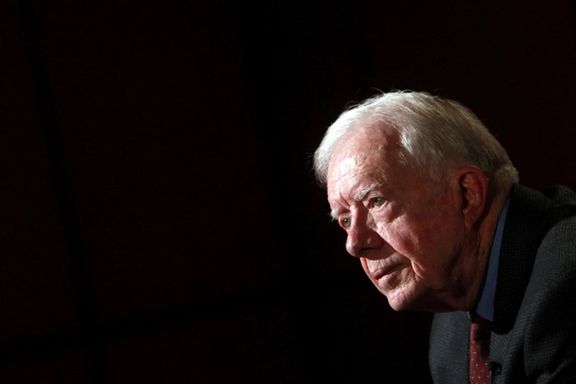
Former US President Jimmy Carter attends an interview with Reuters in Cairo, Egypt, January 12, 2012.

Jimmy Carter, the 39th US president, blamed for the 1979-1981 Iran hostage crisis and, by many, the rise of the Islamic Republic, has died at the age of 100.

President Joe Biden announced that January 9 will be a national day of mourning throughout the US. "I call on the American people to assemble on that day in their respective places of worship, there to pay homage to the memory of President James Earl Carter," Biden said.

Carter, a Democrat, assumed office in January 1977 but his one-term presidency was marked by the highs of the 1978 Camp David accords between Israel and Egypt and conversely, the 444 day hostage crisis which saw more than 50 Americans held captive in the US embassy in Tehran.

It is not only in Iran that the former statesman has become a divisive figure. Even in the US, the Washington Historical Association says that “The Iran Hostage Crisis was one of the most important issues of Jimmy Carter’s presidency and likely one of the reasons for his election loss in 1980,” losing in a landslide to Ronald Reagan in 1980.

The US State Department is today more open about the failings of Carter's administration. While at the beginning of Carter’s presidency, the United States and Iran were allies, today, they say, “The Iran hostage crisis undermined Carter’s conduct of foreign policy”.

Carter's letter to Khomeini  (file)
100%
A photo of Carter's letter to Khomeini

Like last year’s hostage crisis under Joe Biden in which five dual-nationals were released by Tehran for $6 billion of Iranian frozen funds, the crisis dominated the headlines and made the administration look weak, in echoes of history repeating itself.

When Secretary of State Cyrus Vance opposed a mission to rescue the hostages in Iran in favor of diplomatic channels, the administration was left wide open for the incoming Reagan presidency.

In a 2014 interview with CNBC, Carter tried to justify the disaster that led to his election defeat, failing to admit that it was on the very day his rival was sworn in that the release of hostages took place. American television networks broadcasting Reagan's inauguration, showed hostages on a split screen boarding a flight to the United States.

Carter said: “I could have been re-elected if I had taken military action against Iran. It would have shown that I was strong and resolute and manly. ... I could have wiped Iran off the map with the weapons that we had. But in the process a lot of innocent people would have been killed, probably including the hostages. And so I stood up against all that advice, and then eventually all my prayers were answered and all the hostages came home safe and free.”

US President Jimmy Carter announces new sanctions against Iran in retaliation for taking US hostages, at the White House in Washington, April 7, 1980.
100%
US President Jimmy Carter announces new sanctions against Iran in retaliation for taking US hostages, at the White House in Washington, April 7, 1980.

Relations before the 1979 Islamic revolution had been strong between Iran and the US. Carter even called Iran during the monarchy “an island of stability in one of the more troubled areas of the world” during a visit to Tehran and maintained a strategic relationship with the Shah, Mohammed Reza Pahlavi.

However, this relationship was contentious for both nations. In November 1977, President Carter and First Lady Rosalynn Carter hosted the Shah and his wife, Empress Farah Pahlavi, at the White House for a State Visit.

Protests broke out between the pro and anti-Shah factions which ended up with over 100 protesters injured as well as police officers. It further pushed Iranians into the hands of the incoming Islamic Republic and its narrative of anti-US policy, which continues to today.

After his January 1979 exile of the Shah, suffering from terminal cancer was allowed to receive medical care in New York, but he later decided to spend his remaining days in Egypt. He was buried with full honors in a Cairo mosque.

Just 16 days after the Shah left, the incoming Supreme Leader, Ruhollah Khomeini, returned to Iran to a thunderous welcome, paving the way for the Islamic Republic’s birth, with the US embassy first attacked in those initial days after.

US President Jimmy Carter, Egyptian President Anwar Sadat, and Israeli Prime Minister Menachem Begin review U.S. Marines during the Camp David summit, at Camp David, Maryland, September 6, 1978.
100%
US President Jimmy Carter, Egyptian President Anwar Sadat, and Israeli Prime Minister Menachem Begin review U.S. Marines during the Camp David summit, at Camp David, Maryland, September 6, 1978.

In Iran, sentiment against the US grew when Carter allowed the exiled Shah into the US for what Carter believed to be life-saving medical treatment in October 1979, one of the final triggers leading to the hostage crisis.

Carter failed to grasp the magnitude of sentiment against the Shah by Iranians in Iran and abroad in the heydays of the revolution, many thinking it was part of a plan to return him to power. Again, it led to demonstrations around the US embassy.

The legacy of Carter’s Middle East policy will now always be torn between the historic peace deal he secured between Israel and Egypt, while for others, it will be the failings of his policy on Iran.

In 1984, during a national debate with Walter Mondale, Reagan blamed Carter for the fall of the Shah, who he said had been a major ally in the Middle East.

He said: “The shah, whatever he might have done, was building low-cost housing and taking land away from the mullahs and distributing it to the peasants so they could be landowners. ... But we turned it over to a maniacal fanatic who has slaughtered thousands and thousands.”

Former President George H.W. Bush, President-elect Barack Obama, President George W. Bush, former President Bill Clinton and former President Jimmy Carter meet in the Oval Office of the White House in Washington, U.S. January 7, 2009.
100%
Former President George H.W. Bush, President-elect Barack Obama, President George W. Bush, former President Bill Clinton and former President Jimmy Carter meet in the Oval Office of the White House in Washington, January 7, 2009.

Many Iranians have already spoken out against Carter. Political researcher Arvin Khoshnood wrote on X: “He bears responsibility for the deaths of hundreds of thousands of Iranians. By actively supporting Khomeini and enabling the Islamic Revolution, Carter is complicit in every life lost to the regime’s brutality and inhumane policies over the past 45 years.”

Israel’s President Isaac Herzog said of Carter: “In recent years I had the pleasure of calling him and thanking him for his historic efforts to bring together two great leaders, [Menachem] Begin and [Anwar] Sadat, and forging a peace between Israel and Egypt that remains an anchor of stability throughout the Middle East and North Africa many decades later. His legacy will be defined by his deep commitment to forging peace between nations.”

Egyptian President Abdel Fattah al-Sisi said in a post on X: ”His significant role in achieving the peace agreement between Egypt and Israel will remain etched in the annals of history.”
A couple stands in front of The Carter Presidential Center's sign, after the death of former US President Jimmy Carter at the age of 100, in Atlanta, Georgia, December 29, 2024.
100%
A couple stands in front of The Carter Presidential Center's sign, after the death of former US President Jimmy Carter at the age of 100, in Atlanta, Georgia, December 29, 2024.

Most Viewed

Iran negotiators ordered to return after internal rift over Islamabad talks
1
EXCLUSIVE

Iran negotiators ordered to return after internal rift over Islamabad talks

2
ANALYSIS

US blockade enters murky phase as tankers spoof signals and buyers hesitate

3
ANALYSIS

Why the $100 billion Hormuz toll revenue is a myth

4

US tightens financial squeeze on Iran, warns banks over oil money flows

5
ANALYSIS

US blockade targets Iran oil boom amid regional disruption

Banner
Banner

Spotlight

  • Hardliners push Hormuz ‘red line’ as US blockade tests Iran’s leverage
    INSIGHT

    Hardliners push Hormuz ‘red line’ as US blockade tests Iran’s leverage

  • Ideology may be fading in Iran, but not in Kashmir's ‘Mini Iran'
    INSIGHT

    Ideology may be fading in Iran, but not in Kashmir's ‘Mini Iran'

  • War damage amounts to $3,000 per Iranian, with blockade set to add to losses
    INSIGHT

    War damage amounts to $3,000 per Iranian, with blockade set to add to losses

  • Why the $100 billion Hormuz toll revenue is a myth
    ANALYSIS

    Why the $100 billion Hormuz toll revenue is a myth

  • US blockade targets Iran oil boom amid regional disruption
    ANALYSIS

    US blockade targets Iran oil boom amid regional disruption

  • Iran's digital economy battered by prolonged blackout
    INSIGHT

    Iran's digital economy battered by prolonged blackout

•
•
•

More Stories

One woman’s protest against hijab seven years ago lives on

Dec 29, 2024, 21:50 GMT+0
•
Maryam Sinaiee

The anti-hijab protests of Vida Movahed seven years ago have become a legacy that haunts the Islamic Republic today as a nationwide movement against the Islamic headscarf continues to blight Tehran's leadership.

Videos and photos of Movahed’s unprecedented act of defiance went viral on social media very quickly, becoming known only as “The Enghelab Avenue Girl” after, having climbed a utility box on Enghelab (Revolution) Ave in Tehran on December 27, 2017, removed her white headscarf, tied it on a stick, and waved it in protest.

The young mother of 32 was arrested within minutes.

Movahed was freed from prison a month later after her first arrest, but her bravery inspired several other young women who came to be known as the 'Enghelab Avenue Girls', protesting on the same spot.

Authorities were eventually forced to build a gable on top of the utility box to stop more girls from climbing it to protest.

Nearly a year later, the young mother climbed a turquoise dome in the center of the very busy Enghelab Square in downtown Tehran with a bunch of red, white, and turquoise balloons and a red and black headscarf in her hand to protest again. She was arrested and was this time sentenced to one year in prison for “inciting people to corruption and immorality” by unveiling.

Movahed served eight months at the notorious Qarchak Prison in the south of Tehran. She has not been seen in public since being freed in 2019 but her name and memory are honored by many every year on social media.

And today, her legacy lives large, thousands of women now appearing unveiled in public arenas, forcing authorities to retreat from implementing a harsh new hijab law drawn up by ultra-hardliners.

The movement was given a rebirth in the wake of the death of 22-year-old Mahsa Amini in the custody of the morality police. It sparked the Woman, Life, Freedom protests across the country in September 2022, protests which lasted for months and saw a tide turn against the compulsory Islamic dress.

During and after the Woman, Life, Freedom protests, scores of celebrities including artists and athletes posted unveiled photos on social media or attended public events with no headscarves. Most of the artists who expressed solidarity with the anti-compulsory hijab movement have been banned from acting, suffering other penalties such as bank account freezes and travel bans.

The public pressure has grown so much in the past year that even Supreme Leader Ali Khamenei appears to have agreed to the shelving of a new and more radical law to enforce hijab, for the fear of inciting unrest if brought into effect.

In a speech in April 2023, Khamenei said that flouting hijab was “religiously and politically haram (forbidden)”, accused foreign intelligence services of encouraging Iranian women to disobey the mandatory head-dress, and urged the authorities to do whatever it took to enforce it.

In his latest speech to a group of women on 17 December, very uncharacteristically, he did not refer whatsoever to the hijab issue and the controversies surrounding it.

Public acts in defiance of the hijab have grown to new heights in recent months despite authorities' threats of severe legal crackdowns, occasional violence against women on the streets, and measures such as impounding vehicles if unveiled women are spotted in them.

There have been a string of now iconic protesters since. In early November, another young woman, Ahu Daryaei, shed her clothes at a university campus in Tehran, reportedly after being harassed by hijab enforcers. She was arrested and sent to a mental health facility but was freed later without charges being brought against her after the story went worldwide.

A few weeks later, Parastoo Ahmadi, a songstress, performed in a historic caravansary in a black evening dress that showed her bare shoulders and streamed her concert live on YouTube. Ahmadi and her band were arrested too but were later released on heavy bail.

Before Movahed’s public act, women’s defiance of hijab had only been done in safe spaces. A campaign was launched by women’s rights activist Masih Alinejad in 2014 on Facebook, My Stealthy Freedom.

Women contributed photos of themselves taken in the car on quiet roads with their hair flowing on their shoulders or in other places where they could “stealthily” remove their headscarves.

But nothing could have predicted the country's biggest rebellion against the mandatory hair covering which has swept the nation, posing the biggest challenge to the government since the Islamic Republic was founded as women from all over Iran continue to rise up.

Have Iranian authorities decided to rein in ultra-hardliner vigilantes?

Dec 29, 2024, 11:12 GMT+0
•
Maryam Sinaiee

Iran's government has warned the country's ultra-hardliners and their vigilante groups of serious consequences if they continue to sow “discord” with their apparently growing protests against the President's new, more progressive policies.

Ali Zeynivand, the political deputy of Iran's Interior Ministry, told the Iranian Labour News Agency (ILNA) on Saturday that individuals behind recent protests against issues such as the easing of internet restrictions, have been summoned and cautioned.

“There have been discussions within the Ministry of Interior regarding the recent rallies,” Zeinivand said. Provincial governors have been instructed to take firm action against protests that could jeopardize national unity and solidarity. All rallies must have official permits in Iran, he added.

Zeynivand’s warning follows growing criticism from political figures and media outlets, who have pointed out that while political parties and groups are routinely denied permits for rallies, ultra-hardliner vigilantes continue to stage protests with impunity against the government whenever and wherever they wish.

It remains unclear whether the Interior Ministry’s move to curb the activities of vigilantes is driven by the President's admiinstration, a higher authority such as the Supreme National Security Council (SNSC), or is a direct directive from Supreme Leader Ali Khamenei whose policies guide Iran's key security ministries of interior, intelligence, and defense.

Ultra-hardliners have accused President Masoud Pezeshkian of colluding with Iran's enemies by advocating negotiations with the West to lift crippling sanctions that have devastated Iran's economy.

They also criticize him for what they say is undermining Islamic values by resisting demands to implement a new hijab law and for taking steps to ease internet restrictions.

The group of hardliners also hold Pezeshkian responsible for the lack of a military response to Israeli airstrikes on Iran in October, accusing him of delaying the so-called “True Promise 3” retaliation.

As they look to attribute blame, the president has also become the fall guy for the depreciation of the national currency and the ongoing power outages, which the government attributes to the previous administration’s failure to stockpile fuel for power plants adequately.

Vigilantes have a long record of attacking political meetings and universities, threatening and slandering top officials including presidents and government officials in street rallies and in their media over the years but their recent focus on Pezeshkian’s government has become particularly relentless now, the reformist Arman-e Melli newspaper wrote in an editorial Saturday.

The newspaper’s editorial referred to these actions as ultra-hardliners' “street maneuvers” to pressure the government.

Vigilantes, often linked to the Revolutionary Guards' Basij militia, were behind the high-profile attacks on the British embassy in November 2011 and the Saudi embassy in January 2016, both of which led to significant diplomatic crises for Iran.

Although the perpetrators were well-known to authorities, they were never held accountable for the extensive damage inflicted on Iran's international reputation and relations.

Ultra-hardliner protesters climbing over the gate of the UK Embassy in Tehran in November 2011
100%
Ultra-hardliner protesters climbing over the gate of the UK Embassy in Tehran in November 2011

Earlier this week, ultra-hardliners linked to the Paydari (Steadfastness) Party and another group with close ties to the former nuclear negotiator Saeed Jalili announced plans to protest after Friday prayers on motorbikes against the government’s decision to unblock WhatsApp and Google Play. However, reports indicated that turnout for the protest was minimal, with only about a dozen participants.

“The question is, who has allowed them to have such power to be able to cause disruptions in the city, make baseless allegations against authorities, and to insult and threaten them,” the article asked while contending that Pezeshkian’s government will not be able to deal with ultra-hardliners and stop them from harming the system under the name of the revolution by talks and invitation to unity.

Iran's government is grappling with multiple crises, both domestic and international. Abroad, its military stand-off with Israel and the collapse of Bashar al-Assad's rule in Syria have thrown foreign policy into chaos. Direct attacks from Israel have seriously damaged Iran's defense systems while losing its stronghold in Syria has weakened its influence across the region.

Meanwhile, at home, economic challenges such as high inflation and the unprecedented depreciation of the national currency, serious energy shortages, and widespread popular discontent over issues like hijab enforcement and internet filtering still risk sparking further unrest.

Italy negotiates journalist swap with Iran - La Repubblica

Dec 28, 2024, 16:30 GMT+0

Italy is negotiating for the release of a journalist detained in Iran via a potential exchange for an Iranian citizen arrested in Milan at the request of the United Sates, according to Italian daily La Repubblica.

“The subject of Italy’s negotiations with Iranian officials has been the release of Mohammad Abedini Najafabadi in exchange for Cecilia Sala,” the daily reported.

Although La Repubblica linked Sala’s case to a potential swap involving Abedini, sources in the Italian Foreign Ministry denied he was part of the negotiations. Some officials also ruled out financial exchanges.

Cecilia Sala, 29, a newspaper journalist and podcaster, has been jailed in Iran on unknown charges for over a week.

Her arrest is widely seen as retaliation for the arrest of Abedini, whom US authorities say provided materials for a deadly Iran-linked drone attack on US troops in Jordan.

He was apprehended at Milan’s Malpensa Airport on December 16 and investigators found in his luggage electronic components linked to the US charges.

Earlier this month, the US Justice Department charged Abedini and another Iranian, Mahdi Mohammad Sadeghi - who was arrested in the United States - with conspiring to export sensitive US technology to Iran’s Revolutionary Guards.

Iran last week summoned a senior Italian diplomat and the Swiss ambassador in Tehran, who represents US interests in the country, over the US and Italian arrest of the two Iranians, Iranian media reported.

Prime Minister Giorgia Meloni and Foreign Minister Antonio Tajani are leading diplomatic efforts, supported by Italy’s External Intelligence and Security Agency (AISE), Italian news outlets reported.

The Italian Ministry of Foreign Affairs initially kept Sala’s arrest confidential, aiming for a quiet resolution, the newspaper reported. Her detention has again highlighted Iran’s use of foreign detainees as leverage in international negotiations.

'Hostage-taking'

The International Federation of Journalists called for Sala’s immediate release, with secretary-general Anthony Bellanger condemning Tehran’s tactics as political leverage.

Nobel laureate Shirin Ebadi echoed the criticism, describing Sala’s detention as hostage-taking and extortion and warning that such practices would persist without stronger Western policies.

Prior to her detention, Sala had reported on contentious topics in Iran, including widespread defiance of mandatory hijab laws and the presidency of Masoud Pezeshkian.

As diplomatic talks continue, the case highlights broader tensions over Iran’s exploitation of detainees for political gains, a practice condemned by rights groups and Western nations.

Iran's political discourse sharpens amid mounting crises

Dec 28, 2024, 11:57 GMT+0
•
Mardo Soghom

Several analysts, officials and media outlets in Iran are warning that multiple crises have gripped the country in recent months and those in charge should deal with this reality.

“In recent months, the surge in both the number and variety of major challenges has intensified, pushing the situation beyond mere concern. Issues that were previously warned about as future risks have now become reality, exposing their full impact and severity,” Massoud Nili, professor of economics in Tehran, warned on social media.

Thousands of social media posts and numerous media reports from Tehran reflect a growing sense of decline and instability gripping the country. Multiple economic crises, including severe energy shortages and a rapidly depreciating currency, have converged with significant regional setbacks. Among these is the recent ousting of Bashar al-Assad, a major blow to Tehran’s regional standing. After investing tens of billions of dollars to sustain Assad’s rule, the Islamist opposition seized the capital, Damascus, in a matter of days, underscoring the fragility of Iran’s regional influence.

Ali Rabiei, the president's social affairs advisor, has highlighted the pressing issue of "social fatigue" in a recent op-ed published by the newspaper Shargh. In his analysis, Rabiei examined the current challenges facing the country and criticized the approach taken by the government's opponents. He urged Masoud Pezeshkian to prioritize addressing this growing societal concern, emphasizing its critical role in shaping the nation’s future.

“Iran's society is grappling with profound exhaustion, with younger generations showing signs of rebellion against the status quo. Addressing this widespread social fatigue demands a comprehensive effort to rebuild the nation’s social fabric. While foreign investment may not be immediately necessary for this endeavor, it is undeniable that prolonged sanctions have significantly contributed to the prevailing sense of despair, leaving deep social and political scars,” Rabiei wrote.

The most visible symbol of the current crisis, apart from shortages of electricity, is the rapid decline of the rial. The Iranian currency stands at a historic low against major currencies, with the US dollar trading well-above 810,000 rials on Saturday. The battered currency has lost one-third of its value since early September, when Israeli attacks weakened Tehran’s main regional military arm, the Lebanese Hezbollah.

Islamic Republic's aging leader, Ali Khamenei, has been largely silent on the growing crises at home, focusing his public remarks on regional developments. On December 22, he denied that Tehran has regional proxies, while at the same time threatening Syria's new government with impending instability.

A Reformist figure, Ataollah Mohajerani, warned the government of the continuing influence of the military in politics in an article published on Saturday, drawing a parallel with India and Pakistan, arguing that Iran risks becoming another state where the armed forces dictate policy. He then urged President Pezeshkian and other officials to pay attention to people’s demands.

“The government must pay attention to the people, seeing them clearly and hearing their voices. Ignoring their concerns risks a day when the public responds with a forceful, bitter, and unmistakable message.”

Iranian armed forces threaten ‘decisive’ action amid regional tensions

Dec 28, 2024, 09:39 GMT+0

Iran’s armed forces have threatened a forceful response to any aggression on the country.

“The powerful Armed Forces of Iran, with full strength and complete readiness, are always prepared to deliver a decisive and crushing response to any threat,” said the General Staff of the Armed Forces in a statement on Saturday.

The recent overthrow of Syrian President Bashar al-Assad has dealt a significant blow to Iran's influence in the Middle East.

As a key ally and conduit for Iranian support to groups like Hezbollah, Assad's government was central to Iran's proxies. His fall disrupts these alliances and supply routes, diminishing Iran's regional leverage.