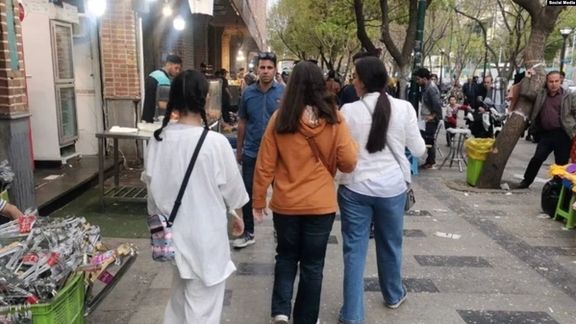
Iran's Chief Justice has ordered prosecutors to take "decisive" action against those who are allegedly encouraging defiance of hijab rules in an "organized manner."
Gholamreza Mohseni-Ejei directed prosecutors this week to act in the name of the public and identify those "organized and foreign-affiliated elements" who oppose hijab rules. They are to be put on trial and punished within the framework of the law with the assistance of law enforcement.
This directive suggests a shift in focus from merely not wearing hijab to charging individuals involved in "organized" opposition to hijab with offenses such as "collusion and assembly to act against national security." In recent years, anti-compulsory hijab activists have faced fabricated charges, with some sentenced to prison, like Vida Movahed, who received a one-year sentence for her protest against mandatory hijab in 2017.
The 32-year-old woman had climbed a utility box in a busy Tehran Street, removed her headscarf, tied it to a stick and silently waved it in protest to mandatory hijab in Iran in 2017.
Iran's Chief Justice Gholamreza Mohseni-Ejei (right) speaking during a meeting with Iran's ruler Ali Khamenei
Mohseni-Ejei emphasized the Islamic principle of "amr-e be marouf va nahy az monkar," which urges Muslims to encourage good deeds and discourage forbidden ones. However, he noted that not all problems can be solved through preaching and called for legal action against those with ties to foreign countries who resist Iran's values and security.
“People who have ties to foreign [countries] and intend to resist the people's values, their chastity, and [harm] their psychological and physical security should be dealt with the sword of justice,” he said.
Iranian authorities often use the tactic of accusing dissidents of having ties to foreigners, in order to charge them with security crimes, rather than just political offences.
In recent years, many Iranian women have protested mandatory hijab, leading to arrests and imprisonment. Authorities have also impounded thousands of cars and closed businesses for failing to enforce hijab rules.
A police official in the religious city of Qom, where most of Iran's Shiite seminaries are located, said last week that in the past ten months owners of 74,000 cars had received warnings for hijab violations with nearly 20,000 impounded and nearly 2,000 cases referred to courts.
These numbers showed a six-fold increase in comparison to the same period last year, he said.
This move by the chief justice appears to address criticism from high-ranking clerics and seminary teachers who have expressed concerns about the perceived weakening of hijab enforcement. Grand Ayatollah Hossein Nouri-Hamedani and a group of seminary teachers in Qom have called for stronger measures to address defiance of hijab rules, expressing fears that it could lead to "extensive immorality" and harm the country's independence.
In a letter addressed to the president, chief justice, and parliament speaker earlier this week, one hundred teachers of Qom seminaries demanded decisiveness in dealing with what they called the “phenomenon” of defiance of hijab.
The signatories of the letter insisted on enforcing Islamic rules and alleged that the refusal of women to abide by mandatory hijab rules could be used by “enemies” and “feminists”.
“Enforcement of the law and prevention of [moral] corruption, of course, entails costs which we have to pay if we want to implement Islam,” they wrote.
“One hundred have written a petition to the heads of the state under the name of seminarians and complained about everything, from cinema and women's sports to hijab, but said nothing about inflation, the state of people’s livelihood, and the country's economy!” dissident journalist Saeed Maleki tweeted, suggesting that after the upcoming elections authorities will be taking tougher measures to address the concerns of these clerics.
Amid international concerns about the proliferation of Iranian drones, the Islamic Republic is scaling up, including supplying Sudan and launching drone carriers.
Maritime news website Splash247 reported this week that Iran is readying to launch its first drone carrier, the Shahid Bagheri, a converted boxship -- previously called Sarvin -- that has undergone modifications to accommodate a large fleet of long-range drones.
Exclusive Planet Labs satellite images obtained by Splash, following an investigation by TankerTrackers.com, revealed how the 3,280 TEU (twenty-foot equivalent unit) boxship delivered from Hyundai Heavy Industries in the year 2000 went through the reconfiguration at a shipyard west of Bandar Abbas in southern Iran.
The Shahid Bagheri, now controlled by Iran’s Revolutionary Guards, has added width to its deck and has around 170 meters (about 558 ft) of runway. It can now accommodate the departure and landing of a very large fleet of fixed-wing drones, adding to merchant shipping’s long list of concerns surrounding the security situation in the Middle East.
“We anticipate Iran’s coming drone carrier will eventually wreak havoc against commercial vessels in the Arabian Sea, somewhere halfway to India,” TankerTrackers CEO Samir Madani told Splash.
Export destinations of Iranian drones (Map by The United States Institute of Peace via the Iran Primer)
Iran's foray into drone carrier technology comes as the Islamic Republic has been assisting the Houthis in Yemen in their targeting of merchant vessels since November. Around 35 merchant ships have been targeted by dozens of drones and missiles. One car carrier, the Galaxy Leader, was hijacked, along with 25 crew members.
The Iran-backed Houthis say the campaign aim is to force Israel to end its offensive in Gaza, which followed the October 7 invasion of Israel, when Hamas, another Iran-backed militia, killed 1,200 mostly civilians and took hundreds of hostages.
Vice Admiral Brad Cooper, the head of the US Navy’s 5th Fleet, in charge of operations in the Middle East, said, “What I’ll say is Iran is clearly funding, they’re resourcing, they are supplying and they’re providing training. They’re obviously very directly involved. There’s no secret there.”
While the world seems united to bring back security to the Red Sea shipping, with the US leading a large naval coalition there and China calling on Tehran to rein in its Yemeni proxy, the Islamic Republic has been supplying combat drones to Sudan, which has a 700-kilometer Red Sea coastline.
Through supplying Sudan’s army, Iran is taking sides in a nine-month civil war fueled by armed groups keen for Red Sea access that has displaced millions so far and risks further destabilizing the wider region. Iran’s drones can give an edge to the Sudanese military, which has been losing territory to a paramilitary group allegedly backed by the United Arab Emirates (UAE).
Tehran and the Sudanese army re-established diplomatic ties just days after the Hamas attack on Israel after a seven-year hiatus linked to Sudan’s role in a Saudi Arabia-led coalition that fought the Houthis in Yemen.
Iran's support for Sudan, which involves shipments of Mohajer-6 drones capable of air-to-surface precision-guided attacks, may pit Iran against the UAE, which Sudan’s military, UN experts and Western diplomats say backs the Rapid Support Forces. The rival group is now controlling many of the country’s major cities. In addition to Russia, Iran is also providing Mohajer-6 drones to Ethiopiatoo.
Arming Sudan would enhance Tehran's military sway across the broader Middle East where it backs Hamas and Islamic Jihad in Gaza, Lebanon's Hezbollah, Houthis in Yemen, Kata’ib Hezbollah in Iraq, and Ethiopia’s army as well as dozens of other armed groups.
Despite mounds of evidence on the use of Iran’s drones in current conflicts such as the Russian invasion of Ukraine and the Houthis’ destabilizing of the Red Sea, Iran keeps denying its role with Foreign Minister Hossein Amir-Abdollahian saying this week that it is a “misconception” that Iran has “the remote control over the Houthis, Hezbollah, and Hamas.” The Red Sea blockade came directly from Iran's Supreme Leader, whose brainchild was to create a network of regional proxies to exert Iranian might.
Iran’s top Sunni cleric Mowlavi Abdolhamid urged reforms in the Iranian constitution on the eve of upcoming elections.
“The current constitution was ratified at the time of the previous generation. A new generation and new conditions and demands have emerged but the law has not changed,” said the top religious leader of Iran’s largely Sunni Baluch (Baloch) population in his Friday prayer sermons in Zahedan.
Abdolhamid also criticized the vetting process of the Guardian Council which only allows hardliners to run as candidates in the elections, further questioning the council’s decision to disqualify Iran’s former president Hassan Rouhani.
On Wednesday, it was announced that Rouhani, once considered to be one of the candidates for succeeding Supreme Leader Ali Khamenei, has been barred from running for re-election at the Assembly of Experts that is tasked with electing the next leader.
Abdolhamid also called on the Islamic Republic to review its execution campaign, warning that it will widen the gap between the people and the political establishment.
The Halvash website, which covers developments in Sistan-Baluchestan Province, reported the extensive presence of the security forces in Zahedan at the same time as the Friday prayers were held.
The people of Sistan-Baluchestan, with Zahedan as provincial capital, have been holding weekly demonstrations after security forces opened fire at peaceful protesters, killing nearly 100 on September 30, 2022, a day known as the Bloody Friday of Zahedan.
Former president Hassan Rouhani (right) and his vice president Es’haq Jahangiri
Iran’s former vice president has criticized the Guardian Council’s decision to bar former president Hassan Rouhani from running in the upcoming election.
“How can someone who had been the secretary and the chairperson of the Supreme National Security Council, who had served several terms as a member of the parliament and the Assembly of Experts be disqualified?” Es’haq Jahangiri said.
Jahangiri stressed that “today, more than ever,” the Islamic Republic needs to restore hope and gain people’s trust, amid dire economic and sociopolitical hardships.
On Wednesday, Iranian hardliners controlling a conspicuous vetting mechanism told the former president that he was barred from running for re-election at the Assembly of Experts that will elect the next Supreme Leader after Ali Khamenei’s death.
However, the Iranian public remains indifferent to Rouhani’s disqualification. Iran International TV analyst Mehdi Mahdavi Azad said Rouhani left a legacy of disappointment after over 20 million Iranians voted for him in 2013 and 2017 before he aligned with Supreme Leader Ali Khamenei and his supporters.
Now, Khamenei has effectively alienated all of Iran’s former presidents, including Rouhani, who was once believed to be one of the candidates for succession as Supreme Leader. He is the last one to be jettisoned out of what many see as Khamenei’s sinking ship.
Iran’s parliamentary and Assembly of Experts elections are to be held on March 1. According to the results of the vetting process, the Guardian Council has only allowed hardliners and supporters of the regime to run as candidates.
China has called on Iran to intervene in the Red Sea shipping blockade by the Iran-backed Houthis, Reuters reports.
The Yemeni militia have disrupted the Red Sea with dozens of attacks in solidarity with Gaza militants Hamas since the Palestinian group declared war on Israel on October 7.
Meetings have allegedly taken place in Beijing and Tehran as China aims to protect its own shipping, threatening that if action isn’t taken by Iran to reign in its proxy, business relations between the two nations will be at risk.
"Basically, China says: 'If our interests are harmed in any way, it will impact our business with Tehran. So tell the Houthis to show restraint'," Reuters quoted an Iranian official briefed on the talks, speaking on condition of anonymity.
The attacks, which began in November, have raised the cost of shipping and insurance by disrupting a key trade route between Asia and Europe used widely by ships from China. The passage is responsible for 12 percent of global trade.
For the last decade, China has been Iran’s biggest trading partner, with Chinese oil refiners buying over 90 percent of Iran’s crude exports last year alone, according to Kpler.
While global sanctions weigh heavily on Iran, China has offered a lifeline, gaining huge discounts in the process, though Iran’s oil only accounts for 10 percent of China’s crude imports.
Iranian President Ebrahim Raisi stands next to Chinese President Xi Jinping during a welcoming ceremony in Beijing, China, February 14, 2023.
Though the two nations signed a 25-year economic cooperation agreement in 2021, China has not invested as much as was hoped in Tehran, nor engaged in non-oil trade to the extent envisaged.
Iranian state media says Chinese firms have only invested $185 million since then. State media also said last year that Iranian non-oil exports to China fell 68% in the first five months of 2023 while Iran's imports from China rose 40%.
By contrast, Chinese companies committed last year to invest billions in Saudi Arabia after the countries signed a comprehensive strategic partnership in December 2022.
China has been slowly increasing its influence in the region as was seen in last year’s reinstating of ties between Iran and Saudi Arabia after seven years of tensions, China among the nations facilitating the detente.
However, while China holds sway in Tehran, the situation is complex. Tehran risks backlash from its proxies in Lebanon, Syria and Iraq, which have also been acting in allegiance with Hamas against both Israeli and US targets since the Gaza war began.
China's ministry of foreign affairs told Reuters: "China is a sincere friend of the countries of the Middle East and is committed to promoting regional security and stability and seeking common development and prosperity."
"We firmly support Middle Eastern countries in strengthening their strategic independence and uniting and collaborating to resolve regional security issues," without directly referring to the talks over the Red Sea passage. Iran's foreign ministry did not comment.
The disruption by the Yemeni militia, trained and backed by Tehran, has triggered military strikes by the US and British forces but it has failed to stem the tide.
According to Reuters, a senior US official said Washington had asked China to use its leverage with Iran to persuade it to restrain the Houthis, including in conversations Secretary of State Antony Blinken and National Security Advisor Jake Sullivan had this month with senior Chinese Communist Party official Liu Jianchao.
Iran denied the claims that China had since expressed concerns but on January 14, China's foreign minister Wang Yi called to end the attacks on civilian ships in the Red Sea, though did not name the Houthis or reference Iran.
On Thursday, Houthi spokesman Mohammed Abdulsalam said Iran had not conveyed any message from China about scaling back attacks.
"They will not inform us of such a request, especially since Iran's stated position is to support Yemen. It condemned the American-British strikes on Yemen, and considered Yemen's position honourable and responsible," he told Reuters.
While Tehran claims that the Houthis’ action is independent, in spite of the blockade being called for by Iran’s Supreme Leader himself, the complexity of Iran’s shadow war against Israel and the US continues, and the influence of China yet to be seen.
Firefighters put out a fire at a hospital in Tehran, Iran January 25, 2024.
Hours after a fire broke out in the Gandhi Hospital in Tehran on Thursday, city officials have started a blame game in an attempt to shirk their responsibilities.
“We had three meetings with the management of the Gandhi Hospital before the incident and issued the necessary warnings regarding the safety of the building”, said Mehdi Khosravani, crisis manager of the 6th district of Tehran municipality, where the hospital is located.
According to the official, the Gandhi Hospital was required to have a consultant on how to implement the most advanced firefighting and fire alarm systems in order to maintain safety in the building.
“In general, we have warned about 40 large public and private hospitals in this district over their unsafe conditions”, he stressed.
Motahar Mohammadkhani, the spokesperson for Tehran municipality, also blamed the hospital’s management for the blaze. “This would not have happened if the hospital administrators had heeded earlier warnings. The judicial system should step in,” he stated.
Meanwhile, Hossein Nazari, deputy of urban services of Tehran municipality, said images broadcast made the fire look larger than the reality due to the composite façade of the building. “The fire was an ordinary one,” he claimed, downplaying the scale of the incident.
State TV said the area was cordoned off and the hospital evacuated.
Pedram Pak-Ayin, the spokesperson for Iran’s Health Ministry, said that “none” of the staff and patients at the Gandhi Hospital were harmed but said patients were transferred to other medical centers.
The exact cause of the fire has yet to be determined.