• العربية
  • فارسی
Brand
  • Iran Insight
  • Politics
  • Economy
  • Analysis
  • Special Report
  • Opinion
  • Podcast
  • Iran Insight
  • Politics
  • Economy
  • Analysis
  • Special Report
  • Opinion
  • Podcast
  • Theme
  • Language
    • العربية
    • فارسی
  • Iran Insight
  • Politics
  • Economy
  • Analysis
  • Special Report
  • Opinion
  • Podcast
All rights reserved for Volant Media UK Limited
volant media logo

Iran's currency was hollowed out by our sanctions, US says
Dec 18, 2024, 19:48 GMT+0Updated: 15:17 GMT+0
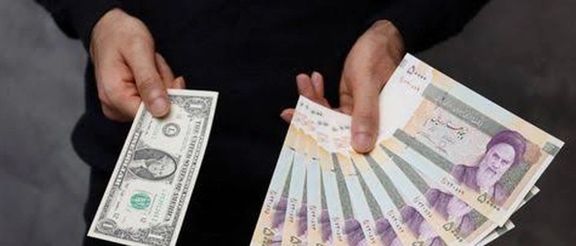
Iranian man holds a one dollar bill in one hand and several Iranian notes in other

The US State Department said on Wednesday that its ongoing sanctions have played a significant role in the sharp devaluation of the Iranian rial to record lows against the US dollar.

During a briefing on Wednesday, Deputy Spokesperson Vedant Patel highlighted that the sanctions have contributed to Iran's inability to meet its budget projections.

“As a result of US sanctions, Iran's government has failed to meet its budget projections again this year,” Patel said. “The rial is the lowest it has ever been against the dollar."

He also pointed to the broader economic impact, saying that sanctions have disrupted Iran's access to essential goods, services and technology.

"These efforts all work to cut off Iran's ability to perpetuate destabilizing actions across the region," he added, stressing the ongoing determination of the United States and its allies to prevent Iran from generating revenue.

Critics of Biden's Iran policy have long argued that his administration has allowed China to increase imports of sanctioned Iranian crude oil since 2021, allowing the shipments to increase from less than 300,000 barrels per day in 2020 to around 1.5 million in 2024.

In the latest in a wave of sanctions, the State Department announced on Wednesday that it targeted Majid Mousavi Eftekhari, Deputy Commander of the IRGC Aerospace Force, and two entities based in Iran for their support of the development of Iran's ballistic missile and drone programs.

The Iranian rial’s dramatic fall continues to exacerbate the country’s economic crisis. On Wednesday, the rial was trading at over 780,000 to the US dollar.

This sharp decline, coupled with soaring inflation, has eroded the purchasing power of ordinary Iranians, leaving many struggling to afford basic goods and services.

Iran’s economic woes are further compounded by a severe energy crisis. The country is grappling with critical shortages in electricity and natural gas, with supply failing to meet demand, especially during the cold winter months.

Power outages have become a frequent occurrence, even in major cities like Tehran. The energy crisis has reached alarming levels, with insufficient infrastructure investment, inefficiencies in energy management, and sanctions blocking access to advanced technology further exacerbating the situation.

As Iran faces its most severe economic downturn in decades, the Iranian population’s resilience is being tested as never before, with increasing uncertainty about the government’s ability to manage the nation’s worsening crises.


Most Viewed

Iran International says it won’t be silenced after London arson attack
1

Iran International says it won’t be silenced after London arson attack

2
VOICES FROM IRAN

Hope and anger in Iran as fragile ceasefire persists

3
INSIGHT

How Tehran bends its own red lines to boost state rallies

4

Iran halts petrochemical exports to supply domestic market

5

US arrests Iranian national over alleged Basij-linked visa fraud

Banner
Banner

Spotlight

  • Too early to tell who is winning Iran war, experts say
    PODCAST

    Too early to tell who is winning Iran war, experts say

  • How Tehran bends its own red lines to boost state rallies
    INSIGHT

    How Tehran bends its own red lines to boost state rallies

  • Iran blackout cripples freelancer, small business incomes
    VOICES FROM IRAN

    Iran blackout cripples freelancer, small business incomes

  • Ideology may be fading in Iran, but not in Kashmir's ‘Mini Iran'
    INSIGHT

    Ideology may be fading in Iran, but not in Kashmir's ‘Mini Iran'

  • US blockade enters murky phase as tankers spoof signals and buyers hesitate
    ANALYSIS

    US blockade enters murky phase as tankers spoof signals and buyers hesitate

  • Why the $100 billion Hormuz toll revenue is a myth
    ANALYSIS

    Why the $100 billion Hormuz toll revenue is a myth

•
•
•

More Stories

Iranian president visits Egypt in rare diplomatic outreach

Dec 18, 2024, 19:08 GMT+0

Iranian President Masoud Pezeshkian has traveled to Egypt to attend an economic summit in a rare visit that may signal thawing relations between the Islamic Republic and the Arab world's most populous nation.

Pezeshkian arrived in Cairo on Wednesday to attend in summit of the eight major Muslim developing countries, known as the D-8 Organization for Economic Cooperation, slated to be held Thursday. 

"The more we can strengthen relations with Islamic countries, the more we can thwart threats against Iran," said the president as before he departed for Egypt.

Earlier in the day, the head of Iran's Interests Section in Cairo Mohammad Hossein Soltanifar said that Iran can cooperate with Egypt in all spheres and take positive steps towards upgrading bilateral relations.

“This trip would mark a final step towards upgrading bilateral relations to the embassy level," he added.

The visit is the culmination of months of discreet diplomatic efforts, primarily facilitated by Iraq and Oman.

Last year, Iranian lawmaker Fada-Hossein Maleki, a member of the parliament’s National Security and Foreign Policy committee, said that talks to bolster ties between Iran and Egypt were being held regularly in Iraq, predicting that bilateral relations between Iran and Egypt would soon be restored, including the reopening of embassies.

Iran’s relations with Egypt, a close ally of Saudi Arabia and other Persian Gulf Arab nations, have been fraught since the Shah fell in 1979. The Shah sought refuge in Egypt during the presidency of Anwar Sadat, straining ties.

Iran named a Tehran street after Khaled Eslamboli, Sadat's Islamist assassin. The name was changed following the recent resumption of Iran’s ties with Saudi Arabia in anticipation of further extending the regional rapprochement.

Relations improved after President Hosni Mubarak resigned in 2011. In 2012 Egypt's then-President Mohamed Morsi visited Tehran to attend the Non-Aligned Movement summit. However, he was ousted in a military coup led by current Egyptian President Abdel Fattah el-Sisi just a year later.

Iran's Foreign Minister Abbas Araghchi visited Egypt in October. Sharing a photo of himself at Cairo's famous Abu Tarek restaurant, he lamented the absence of a similar Egyptian restaurant in Tehran.

Since last year, Egypt has permitted direct flights from Tehran.

The last time an Iranian president visited Cairo was in 2013 when Mahmoud Ahmadinejad attended an OIC summit during Mohamed Morsi's presidency.

Last year, Iranian Supreme Leader Ali Khamenei greenlit the resumption of relations, saying, "there are no obstacles to this."

Israel urges Iranians to topple 'Shi'ite supremacist empire'

Dec 18, 2024, 18:35 GMT+0

Israel’s Ambassador to the United Nations urged the Iranian people to seize what he described as a historic opportunity to bring down the Islamic Republic and what he described as its "Shi'ite supremacist empire".

“People of Iran, do not miss this historic opportunity. Act now. The people of Israel stand with you,” Danny Danon, speaking in strained Persian, said during a Security Council meeting on Wednesday in remarks aimed at Iran's people.

His speech is part of Israel’s effort to spotlight the threat it says its arch-enemy the Islamic Republic poses to the Middle East and comes after Tehran's key Arab ally Bashar al-Assad in Syria was toppled this month by hardline Sunni insurgents.

“The opportunity to end Iran’s ambitions to create a Shi'ite supremacist empire is within reach,” framing the Islamic Republic as a sectarian menace to global stability.

His rhetoric closely aligns with that of Israeli Prime Minister Benjamin Netanyahu, who has been ramping up his criticism of Iran in recent weeks. Netanyahu, who has long voiced concerns over Iran’s nuclear ambitions and its regional influence, framed the Islamic Republic as the head of a broader destabilizing axis.

“A year ago, I said we'd change the face of the Mideast, and we're indeed doing so. Syria is not the same Syria. Lebanon is not the same Lebanon. Gaza is not the same Gaza. And the head of the axis, Iran, is not the same Iran," Netanyahu said in a statement on Sunday. "It has also felt the might of our arms,” he added, underscoring Israel’s military role in reshaping the region.

At the same time Tehran faces mounting external pressure with historic setbacks to its armed allies in Lebanon and Syria, days-long nationwide shutdowns due to gas and electricity shortages underscore domestic woes.

Tehran bristles at UN resolution condemning its human rights record

Dec 18, 2024, 18:08 GMT+0

Iran on Wednesday rejected a sweeping United Nations General Assembly resolution condemning Tehran's human rights record the day before, calling it shameful and hypocritical.

This riposte by Foreign Ministry Spokesman Esmail Baghaei came after the UNGA adopted the resolution which criticized the Islamic Republics treatment of prisoners, ethnic and religious minorities and women.

“The proponents of the anti-Iran resolution, including the Zionist regime, the United States, the United Kingdom and Canada, are major violators of human rights," Baghaei said. "This is a source of shame, and the Canadian officials who initiate such actions against our country every year are urged to focus on reforming their actions both inside and outside their country instead of accusing others.”

100%

The resolution, which passed with 80 votes in favor and 27 against, criticized the Iranian government’s unlawful use of the death penalty, arbitrary arrests, torture and its persistent suppression of peaceful protests.

It also condemned the Islamic Republic for discrimination against women, ethnic and religious minorities and minors.

Human rights advocates have expressed concern over these abuses and called Tehran’s actions a tool of political repression.

The UNGA called for an immediate halt to executions, many of which are carried out based on forced confessions extracted under torture and without the benefit of fair trials.

In particular, the resolution singles out the government’s pattern of executing political prisoners as evidence of its commitment to silencing dissent.

This marks a continuation of the crackdown on political opposition which has seen approximately 625 executions since the inauguration of Iran’s current president Masoud Pezeshkian in late July, including 22 women.

The resolution also underscored the Iranian government’s ongoing violations of women’s rights, pointing to restrictive laws that discriminate against females.

"(The UNGA) strongly urges the Islamic Republic of Iran to eliminate, in law and in practice, all forms of systemic discrimination and violence against women and girls, in public and private life," the resolution read.

"(It) urges the Islamic Republic of Iran to cease the widespread and systematic use of arbitrary arrests and detention ... (and) calls upon the Islamic Republic of Iran to release women human rights defenders imprisoned for exercising their rights."

The resolution further called for the suspension of all death sentences in Iran.

Baghaei defended his government’s actions and labeled the international accusations “baseless and politically motivated.”

Defendants in stabbing of Iran International presenter face court

Dec 18, 2024, 17:57 GMT+0

Two men accused of stabbing an Iran International TV presenter appeared in court on Wednesday in London, a day after being extradited from their native Romania.

The defendants, Nandito Badea, 19, and George Stana, 23, were arrested in Romania earlier this month at the request of British authorities.

They will appear at the Central Criminal Court of England and Wales on January 17, when their trial will officially begin. The defendants are charged with causing grievous bodily harm with intent.

Pouria Zeraati, a British-Iranian national, was attacked near his home in Wimbledon, southwest London, in March and was hospitalized with injuries to the leg. The incident raised concerns about threats to critics of the Iranian government, with British authorities investigating whether Zeraati was targeted due to his work.

Iran has denied any involvement in the attack.

Acting Commander Helen Flanagan from the Met’s Counter Terrorism Command emphasized the importance of the investigation and thanked Romanian authorities for their cooperation. She urged the public not to speculate on the case in order to allow the legal process to unfold.

“I would like to thank our Romanian counterparts for their cooperation on this matter, as well as colleagues from the CPS and NCA who have helped us to reach this point,” she said.

“Now that criminal proceedings are fully active here in the UK, I continue to ask people not to speculate about the case or motivation so that the criminal justice process can ran its course.”

Adam Baillie, a spokesperson for Iran International, previously welcomed the progress of the investigation, noting that the developments were reassuring for journalists facing similar threats.

Iran fuels Sudanese civil war with arms, seeks Red Sea base - Bloomberg

Dec 18, 2024, 17:34 GMT+0

Iran is backing Sudanese army forces with weapons and drones in a grueling civil war, according to a Bloomberg report, and Tehran along with Russia is seeking military bases in Port Sudan on the Red Sea.

Iran has delivered arms to Sudanese army forces and provided them with dozens of drones, the news outlet reported, helping tip the conflict against militia opponents.

Russia, which has provided fuel and weapons components, along with Iran have both been in talks with Sudan's generals on building military bases astride the Red Sea, Bloomberg reported citing Sudanese and Western officials.

The support puts Tehran and Moscow on the winning side of the war, in contrast to their epochal setback in Syria where their mutual ally Bashar al-Assad was toppled this month by rebels they had been fighting for years.

Iran re-established diplomatic ties with Sudan in late 2023 after a seven-year deep freeze after Khartoum joined a Saudi-led military intervention in Yemen against Tehran's allies in the armed Houthi movement.

Militias fighting the army felled a domestically crafted drone made with Iranian parts, Bloomberg reported citing Wim Zwijnenburg, a researcher at Dutch pro-peace organization PAX.

Zwijnenburg located an Iranian military drone on an air strip outside the capital earlier this year, Bloomberg wrote.

It cited the Conflict Observatory monitor saying at least seven flights operated by Qeshm Fars Air traveled between Tehran and Port Sudan in the first half of the year.

The firm, which is under US sanctions, is affiliated with the external operations arm of the Islamic Revolutionary Guard Corps (IRGC).