• العربية
  • فارسی
Brand
  • Iran Insight
  • Politics
  • Economy
  • Analysis
  • Special Report
  • Opinion
  • Podcast
  • Iran Insight
  • Politics
  • Economy
  • Analysis
  • Special Report
  • Opinion
  • Podcast
  • Theme
  • Language
    • العربية
    • فارسی
  • Iran Insight
  • Politics
  • Economy
  • Analysis
  • Special Report
  • Opinion
  • Podcast
All rights reserved for Volant Media UK Limited
volant media logo

Syria upheaval vaults Turkey into the ascendant, eclipsing Iran

Negar Mojtahedi
Negar Mojtahedi

Iran International

Dec 19, 2024, 19:03 GMT+0Updated: 15:16 GMT+0
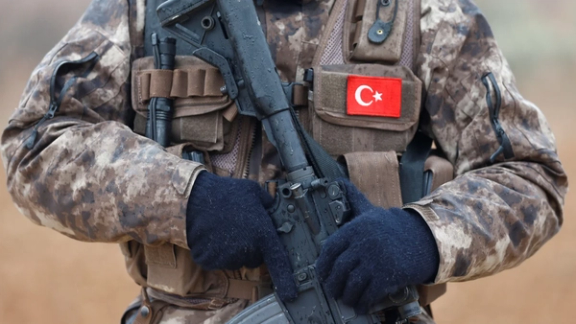
A member of the Turkish special forces stands guard in Azaz, Syria, on 24 January 24 2018

The sudden downfall of Syria's Bashar Al-Assad has put his main backer Iran on the backfoot while giving Turkey the upper hand in a transformed Middle East.

But propping up a friendly government in battered Syria where Tehran failed will be a serious challenge for Ankara, which must also navigate the competing agendas of other heavyweights in the region.

"Turkey is many ways is a real winner here, but time will tell, and if Erdogan overplays his hand, he could mess things up because Israel and the United States won't let it happen," said Henri J. Barkey, a scholar of the Middle East at the US Council on Foreign Relations.

Turkey's President Recep Tayyip Erdogan, a Sunni Islamist, had long supported the armed rebellion against ousted the Iran-backed Syrian dictator Assad, even as the United States and Israel had largely acquiesced to his presence.

Hardline Sunni Islamist rebels capitalized on Shi'ite Islamic Republic's vulnerability in the region after 14 months of withering combat with Israel to wrest Damascus from Assad, whose losing fight against them Iran and its armed allies supported.

"There are complicated days ahead ... for the Syrians in their relationship with Turkey," said Patrick Clawson, a researcher at The Washington Institute.

"The Turks don't have the money to pay for what Syria needs. The Iranians weren't paying a whole lot, just barely keeping outside the line. That's one of the reasons why its forces fell apart".

The reaction of Washington, de facto leader of the NATO alliance in which Turkey has often been a rogue member for its independent stances, will be crucial.

US President-elect Donald Trump said on Monday that Turkey is the ultimate decider of what happens next in Syria, but spoke in harsh terms about its sudden rise there.

"Turkey did an unfriendly takeover without a lot of lives being lost," Trump told a press conference at his Florida residence in Mar-a-Lago.

"Right now, Syria has a lot of, you know, there's a lot of indefinites ... I think Turkey is going to hold the key to Syria,” he added.

“I think this must have come as a big surprise to the Turks because they were expecting that relations with the United States would improve with Trump winning the election, especially because Trump was known to have great admiration for Erdogan," Barkey of the Council on Foreign Relations said.

The Islamic Republic too appears to be casting a skeptical eye on Turkey's role.

Iran’s Supreme Leader Ayatollah Ali Khamenei accused the United States, Israel, and another unnamed country of plotting to overthrow Assad in a speech to his followers last week.

Khamenei was clearly referring to Turkey but dared not criticize it by name because Iran is no position to respond, said Karman Matin, an associate Professor of International Relations at Sussex University in the UK.

“We see a sense of desperation and impotence. The Khamenei speech, I think, was very telling, especially if you put it next to the previous speeches and you see the sense of what he wanted to have but couldn’t,” Matin told Iran International.

After Iran lost its grip in the region after punishing blows by Israel eliminating the top leadership, fighters and weapons stores of Tehran's militant allies, the Islamic Republic must now focus on another grim development: the return of Trump.

Matin described the mood among Iranian hardliners as a growing sense of desperation and feeling of betrayal by its Muslim neighbour in Ankara.

Ahmad Khatami, a senior hardline Iranian cleric, blamed Turkey for Assad’s demise and warned Erdogan that he will face consequences.

“Erdogan will pay the price for this betrayal against Muslims—one day, they [Muslims] will come for him,” said Khatami, a member of Iran's Assembly of Experts and Tehran Friday prayers leader said Tuesday.

While these hardliners also want revenge against Israel for its continued campaign to destabilize the Islamic Republic and its proxies, the Jewish state is also on edge with what will come of Syria’s future governance.

The fall of Assad and the Iranian sphere of influence in Syria is good news for Israel, but Matin described it as bittersweet.

“Israel's concern is probably more about Turkish expansionism now through Sunni rulers of Syria,” said Matin, "Turkey is now an issue for Israel."

As the new leaders in Syria solidify their rule, Matin argues that they won't be in a position to challenge Israel yet.

The ousting of Assad has created an opening for Turkey to now assert itself as a primary external factor, replacing Russia and Iran.

Hakan Fidan, the Turkish foreign minister, told Saudi al-Hadath TV on Sunday that Iran must better understand its actions following Assad’s downfall

“We don’t want Iranian domination, Turkish domination or Arab domination. It’s time for us to come together and establish our own interests, our own order in the region, shoulder to shoulder,” said Fidan.

Turkish spy chief Ibrahim Kalin was reportedly in Damascus last week for a meeting with rebel leaders and prayed in the city’s Umayyad Mosque which dates back to the dawn of Islam, according to Turkish media.

During the height of the Syrian civil war a decade ago, Erdogan took aim at Assad’s attacks on civilians, vowing to one day pray in the courtyard of that mosque.

He may soon be able to honor that pledge.

Most Viewed

US blockade enters murky phase as tankers spoof signals and buyers hesitate
1
ANALYSIS

US blockade enters murky phase as tankers spoof signals and buyers hesitate

2

US tightens financial squeeze on Iran, warns banks over oil money flows

3
INSIGHT

Ideology may be fading in Iran, but not in Kashmir's ‘Mini Iran'

4
INSIGHT

Hardliners push Hormuz ‘red line’ as US blockade tests Iran’s leverage

5
VOICES FROM IRAN

Hope and anger in Iran as fragile ceasefire persists

Banner
Banner

Spotlight

  • Hardliners push Hormuz ‘red line’ as US blockade tests Iran’s leverage
    INSIGHT

    Hardliners push Hormuz ‘red line’ as US blockade tests Iran’s leverage

  • Ideology may be fading in Iran, but not in Kashmir's ‘Mini Iran'
    INSIGHT

    Ideology may be fading in Iran, but not in Kashmir's ‘Mini Iran'

  • War damage amounts to $3,000 per Iranian, with blockade set to add to losses
    INSIGHT

    War damage amounts to $3,000 per Iranian, with blockade set to add to losses

  • Why the $100 billion Hormuz toll revenue is a myth
    ANALYSIS

    Why the $100 billion Hormuz toll revenue is a myth

  • US blockade targets Iran oil boom amid regional disruption
    ANALYSIS

    US blockade targets Iran oil boom amid regional disruption

  • Iran's digital economy battered by prolonged blackout
    INSIGHT

    Iran's digital economy battered by prolonged blackout

•
•
•

More Stories

In rare retort, Iran's Revolutionary Guards rebut Putin on Syria evacuation

Dec 19, 2024, 17:41 GMT+0

A senior commander of Iran’s Revolutionary Guards swiftly denied Russian President Vladimir Putin’s claim earlier on Thursday that Russia had airlifted 4,000 Iranian troops from Syria to Tehran, marking a rare public disagreement between the two partners in arms.

"A large number of Iranians have been living in Syria for a long time, and Russia relocated most of them to Iran," said Mohammad Jafar Asadi, deputy commander of the Khatam-al Anbiya Central Headquarters.

"These were not Iran's advisory forces; we withdrew our advisory forces from Syria ourselves," he added. "We do not allow Russia to relocate our military forces."

The Islamic Revolutionary Guard Corps (IRGC), a transnational military organization that lies at the heart of Iran's ruling establishment, has been a key ally of Russia in Syria and Ukraine.

Moscow has launched hundreds of IRGC-provided drones at Kyiv's forces while Iranian and Russian troops together fought the Islamist rebels now running Syria after they seized Damascus from President Bashar al-Assad.

Putin had said Moscow evacuated 4,000 Iranian soldiers from Syria to Tehran by air after Assad's fall.

Putin said in remarks carried by state media that just as Iran had originally requested Russia transport its units to Syria to back Assad, Tehran again sought Moscow's aid to evacuate the soldiers.

"If earlier, for example, our Iranian friends asked us to help them transport their units to Syrian territory, now they asked us to withdraw them from there," Putin said.

"We took 4,000 Iranian fighters to Tehran from the Hmeimim base. Some of the so-called pro-Iranian units left without a fight for Lebanon, some for Iraq."

Netanyahu says Yemen's Houthis 'the final arm' of Iran's axis

Dec 19, 2024, 16:10 GMT+0

Israeli Prime Minister Benjamin Netanyahu said Thursday morning's airstrikes across Yemen targeting Iran-backed Houthi militias marked a decisive step in dismantling Tehran’s regional alliance.

"After Hamas, Hezbollah and the Assad regime in Syria, the Houthis are almost the last arm of Iran's axis of evil. They are finding out, and will find out, the hard way that whoever harms Israel – will pay a very heavy price," he said.

He made the remarks following dozens of strikes across Yemen early Thursday, about an hour after a Houthi missile struck a school in Ramat Gan.

"This morning, the Air Force attacked strategic targets of the Houthis in the port of Hodeidah and deep into Yemen," Netanyahu said. "We did this in response to repeated Houthi attacks against civilian targets in Israel," he added.

Last year, the Houthis launched a maritime blockade of the Red Sea region. Originally aimed at Israeli-linked vessels, it has since targeted global shipping.

"They are not attacking just us – they are attacking the entire world," Netanyahu said. "They are attacking the international shipping and commercial lanes. Thus, when Israel takes action against the Houthis, it is acting on behalf of the entire international community. The Americans understand this very well, as do many others."

In February, US and British forces launched a series of strikes on Houthi targets. They were supported by an international coalition, including Australia, Bahrain, Denmark, Canada and the Netherlands.

Iran’s Syria presence distracted it from Gaza's plight, Turkey says

Dec 19, 2024, 15:56 GMT+0

Turkey’s Foreign Minister Hakan Fidan leveled a diplomatic barb at Tehran, saying that Iran’s heavy involvement in Syria failed to protect the people of Gaza from a devastating Israeli incursion.

The criticism underscores the rift between the two Mideast heavyweights just as Ankara has gained more influence after Syrian rebels it supports ousted Iran's main Arab ally, President Bashar al-Assad.

"With all due respect to our Iranian friends, I mean, we’ve had this discussion maybe 1,000 times with them because their presence in Syria didn’t prevent a big genocide in Gaza," Fidan said in an interview with pan-Arab channel Al Jazeera published on Wednesday, referencing remarks made by Iran's Supreme Leader earlier in the week.

In his speech, Ali Khamenei emphasized that Tehran's armed groups, including Hamas and Hezbollah, remain strong despite external challenges. Addressing developments in Gaza, Lebanon, and Syria, Khamenei accused the United States and Israel of underestimating the strength of the Iran-backed resistance movement.

"They thought resistance was over. They are gravely mistaken. The spirit of Seyyed Hassan Nasrallah is alive; the spirit of Sinwar is alive," Khamenei said, referring to Hezbollah and Hamas leaders killed by Israel.

"Their martyrdom has not removed them from existence. Their path continues."

The plight of Gaza is a key issue animating political opinion in the Islamic world but neither Turkey nor Iran have been able to dent Israel's ongoing assault there.

Syria, under Assad, was a key component of Iran’s so-called 'Axis of Resistance,' serving as a vital land corridor for supplying weapons and materiel to Hezbollah in Lebanon. Over the years, Israel sought to disrupt this supply line through hundreds of airstrikes.

Fidan said Iran and Russia had realized their ally Assad was growing weaker.

“The Russians and Iranians have been in Syria a long time, and they know exactly how the Syrian regime has gone in a negative direction. They are very much familiar with the problem of the old Assad regime."

Fidan did not comment on whether any guarantees had been given to Iran or Russia, saying that it is for Syria’s people and government to decide.

In an interview earlier this week, Fidan said that Iran must better understand its actions following Assad’s downfall.

“I think Iran will also learn lessons in the new period; we need to help Iran in a constructive way,” Fidan said in an interview with Saudi-affiliated Al-Hadath on Sunday. He outlined Turkey’s vision for the Middle East as one based on cooperation and respect for sovereignty, adding, “We don’t want Iranian domination, Turkish domination, or Arab domination. It’s time for us to come together and establish our own interests, our own order in the region, shoulder to shoulder.”

Rouhani says nuclear arms quest would give US, Israel pretext for war

Dec 19, 2024, 15:39 GMT+0

Iran’s former president Hassan Rouhani criticized calls from top government officials for a shift toward pursuing nuclear weapons, saying they give Israel and the United States an excuse to attack.

In a meeting on Monday with his former top officials, Rouhani argued that any such moves would only empower Iran's adversaries.

“Given the sensitive regional and international conditions, we must avoid providing any excuses to our enemies. The remarks made by some individuals these days, suggesting that Iran's nuclear doctrine will change, are exactly what American and Israeli hardliners want to hear to pave the way for war,” the former president said, according to Etemad newspaper in Tehran.

Since May, top Iranian officials including Supreme Leader Ali Khamenei's adviser, Kamal Kharrazi, have warned that if Iran's nuclear installations are attacked, the Islamic Republic will shift its nuclear doctrine. So far, Tehran has been insisting that its nuclear program is entirely peaceful, in spite of having exceeded international limits on uranium enrichment and accelerating its nuclear program.

In October, 39 lawmakers called for changing the nuclear doctrine without mentioning an attack on nuclear facilities, but citing tensions with Israel.

Rouhani said that those advocating change of doctrine are merely helping the US and Israel to justify an attack on Iran.

“They [enemies] aim to convince global public opinion that if military action against Iran is not taken, Iran will be just days away from a nuclear bomb. Unfortunately, uninformed individuals in the media, and even on state television, are making statements that, at this critical juncture, work against us and provide ammunition to our enemies," he said.

Rouhani also highlighted the country’s political and economic difficulties as a serious energy shortage has closed all government offices and schools for the past week. Most industries have stopped work due to long power outages.

Iran accuses IAEA of blocking nuclear progress under US pressure

Dec 19, 2024, 14:03 GMT+0

The International Atomic Energy Agency (IAEA) creates obstacles to Iran's use of peaceful nuclear technology due to US pressure, Mohammad Eslami, head of Iran's Atomic Energy Organization, said Thursday.

“The IAEA is obligated to promote, facilitate, and support peaceful nuclear technology so that it is accessible to all nations,” Eslami said during a state TV interview. “They mediate whatever is necessary to enable other countries to provide the technology you need, but when it comes to us, they create obstacles because they are implementing US congressional laws.”

"The sanctions are not aimed at economic goals; rather, they are intended to instill this narrative: 'If you don’t have money, why spend it on nuclear energy?' This is their tactic and tool to pursue their objective of preventing us from obtaining nuclear knowledge," Eslami said regarding sanctions on Iran's nuclear program.

Eslami also criticized the director of the UN nuclear watchdog on Wednesday for making what he described as provocative statements regarding Tehran’s nuclear program. He said that despite Iran accepting limitations on its nuclear activities to build trust and in exchange for the lifting of sanctions, the agency continues to misrepresent Tehran’s efforts.

Rafael Grossi, head of IAEA, said Monday that the 2015 Iran nuclear deal, known as the Joint Comprehensive Plan of Action (JCPOA), is no longer sufficient to curb Tehran’s uranium enrichment, which has exceeded international limits.

"Iran is enriching uranium close to military levels and is rapidly moving towards becoming a nuclear state," Grossi told the ANSA news agency. "The philosophy of the original accord with Iran can be used, but that agreement is no longer useful," he added.

Kazem Gharibabadi, Iran’s deputy foreign minister for legal and international affairs, also responded to Grossi’s remarks, stating, "The Director General of a specialized organization is expected to speak based on facts and technical reports from the Agency's inspectors. Reading intentions based on hypothetical scenarios is not part of the Director General's duties and is contrary to the letter and spirit of the Agency's statute."

On December 6, the IAEA reported that Iran had significantly accelerated its production of 60% enriched uranium, which is now approximately five times higher than a month ago. Iran is believed to possess enough 60% enriched uranium to produce four to five atomic bombs, should it choose to pursue nuclear weapons.

Since the US withdrew from the JCPOA, Iran has breached its nuclear commitments, increasing uranium enrichment to 60%, near weapons-grade levels. Subsequent negotiations with the US and the E3 (France, Germany, and Great Britain) have failed to revive the deal or secure a new agreement. With ten months remaining until the “Termination Day” for UN Resolution 2231, which sealed the JCPOA, the impasse on restoring the nuclear deal continues.